Skip to content
temporary fencing certifications canada stop is the first checkpoint buyers should lock before they approve a supplier, budget, or production slot. Temporary Fencing Certifications Canada: Stop Rust Losses is the first checkpoint buyers should lock before they approve a supplier, budget, or production slot. A 42-micron hot-dipped galvanized coating is the difference between a fence panel that lasts eight years in the Alberta sun and one that rusts through in eighteen months. In temporary fencing, that zinc layer is often the first spec buyers cut to hit a lower FOB price. The consequences show up later — rust-stained panels, rejected shipments, and a phone call from a general contractor who expected the same quality as the pre-production sample.
For a North American agricultural wholesaler sourcing overseas, relying on sample approval isn’t enough. The real test is whether the factory can back that sample with a material certificate confirming Q235 steel grade and an ASTM A123 coating report. Without those, you’re buying on trust — and trust doesn’t hold up when a five-hundred-panel order shows a twenty percent failure rate in year two. That’s when the cost of inaction becomes clear: you eat the replacement, lose the client, and watch your margin evaporate.
Canada currently has no federal mandate specifically for temporary fencing certification, but the landscape is shifting. Municipal building codes increasingly reference CSA S16 for structural design, and the U.S. anti-dumping duties on Chinese steel fencing are a clear signal that Canada will follow within twelve months. For livestock corrals, the quality tolerance on mesh openings matters — a loose 50x200mm grid can trap a hoof, and that’s a liability no wholesaler wants trucked into their yard. Understanding which certifications actually protect your order is the difference between a smooth import and a season of warranty claims.
ISO 9001:2015 – Quality Management System
ISO 9001:2015 certifies process consistency, not product perfection.
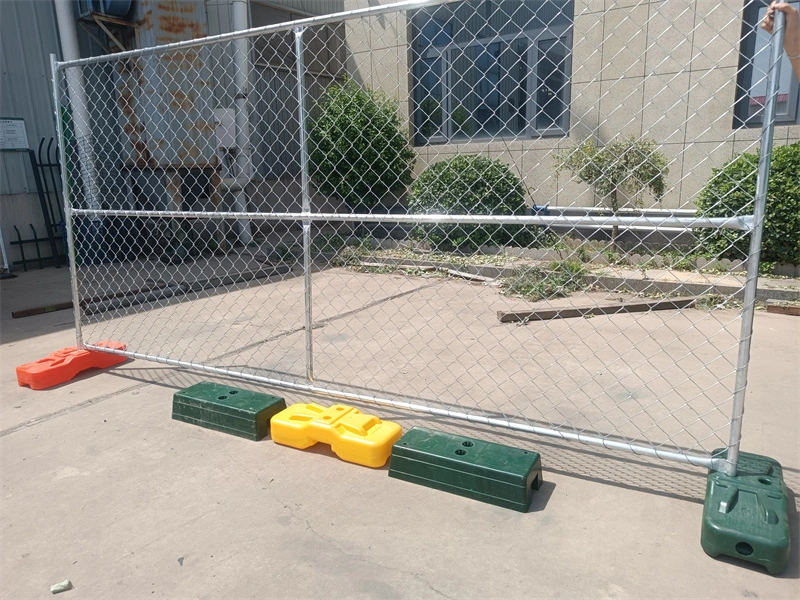
When you import temporary fencing for the Canadian market, a factory’s ISO 9001:2015 certificate tells you one thing: they have documented procedures for every step from raw steel inspection to final packaging. It doesn’t guarantee that every panel meets CSA S16 or ASTM A123, but it does mean that when a weld fails or a coating thickness dips below 42 microns, there is a corrective action process in place. That repeatability is what prevents a $50K order from having half the panels rejected at the port of entry.
- Verify scope: The certificate must list ‘Design and Manufacture of Welded Wire Mesh Fencing’ or similar. A generic ISO 9001 for ‘Trading’ covers no production consistency.
- Check accreditation body: Use the accreditation board’s online register (e.g., IAF members list) to confirm the certifying body is legitimate. SGS or similar is common for Chinese exporters.
- Request audit reports: Ask for the most recent surveillance audit non-conformances. No supplier will share the full report, but they should disclose if any major NCs were raised and closed.
- Confirm product line coverage: Some factories hold ISO 9001 for unrelated production lines. Ensure the scope explicitly covers temporary fencing or wire mesh panel manufacturing.
CSA S16 – Design of Steel Structures
CSA S16 is the de facto structural benchmark for temporary fencing in Canada, even where not legally required.
CSA S16 – Design of Steel Structures is a national standard of Canada that governs the structural design of steel buildings and components. While it was written primarily for permanent structures, many Canadian municipalities reference it in their temporary fencing bylaws. For example, the City of Toronto requires temporary fencing on construction sites to meet wind load and structural integrity requirements that align with CSA S16. This means that even if your supplier doesn’t advertise CSA S16 compliance, your panels still need to perform to those standards to pass local inspection. Agricultural wholesalers should note that in open farmland, wind speeds can exceed 100 km/h, and a panel that hasn’t been designed to CSA S16 load factors is a liability.
There is no federal law in Canada making CSA S16 mandatory for temporary fencing. However, in the event of a collapse or injury, lack of compliance with a recognized standard becomes a liability nightmare. The standard is effectively a risk management tool: if your fence fails and someone gets hurt, the plaintiff’s attorney will ask why you didn’t follow the design rules that the rest of the industry uses. For agricultural wholesalers supplying livestock containment panels, the same logic applies – a panel that buckles under cattle pressure can cause escapes and injuries. Verifying that a factory’s design methodology aligns with CSA S16 principles (even if not formally certified) gives you a defensible position.
- Wind Load Resistance: CSA S16 specifies minimum wind load factors for temporary structures. Typical requirements for temporary fencing range from 0.5 kPa (low wind zones) to 1.0 kPa (high wind or open areas). Ask your supplier for the design wind load their panel can withstand.
- Steel Grade Verification: The standard requires the steel used in frames to meet minimum yield strength (e.g., 300 MPa for most structural members). This ties directly into material certificates (covered in Section 5). Without a mill test report, you cannot confirm CSA S16 alignment.
- Liability Protection: Even without formal certification, documenting that your panels were designed in accordance with CSA S16 principles can reduce legal exposure. Some large construction firms in Canada now require this as part of their vendor qualification.
ASTM A123 – Hot-Dip Galvanized Coating
42 microns isn’t arbitrary — it’s the threshold for corrosion protection in extreme environments.
ASTM A123 specifies the minimum thickness of hot-dip galvanized coating on steel based on the steel’s thickness. For wire mesh used in temporary fencing—typically 4–5 mm wire—the standard requires a minimum of 42 microns (or 1.7 oz/ft²). This coating weight is what separates a panel that survives 10 rainy seasons from one that bleeds rust in two. The testing method is straightforward: a magnetic thickness gauge (ASTM E376) is applied to the wire surface at multiple spots. If the average reading falls below 42 microns, the panel fails. In practice, responsible suppliers like DB Fencing target 45–50 microns to account for normal variation and to ensure compliance even after the mechanical handling of shipping.
- The 42-micron floor: Per ASTM A123, the minimum coating thickness for wire 4–5 mm diameter is 42 microns. Any supplier quoting ‘hot-dipped’ but unwilling to provide a third-party mill test report or in-house thickness log is likely cutting corners with electro-galvanizing, which deposits only 10–15 microns.
- Testing methods that matter: The most common shop-floor test is the magnetic gauge (ASTM E376). A more rigorous method is the weight-per-area test (ASTM A90), where the coating is stripped and weighed. For agricultural fencing exposed to livestock urine and soil acids, request both: the magnetic gauge for quick checks and the A90 weight test for binding arbitration.
- Why it’s a dealbreaker for Canadian farms: Canadian agricultural environments—manure contact, freeze-thaw cycling, and road salt splash—accelerate galvanic corrosion. Below 42 microns, the zinc layer is consumed before the panel’s third winter. This is not a minor warranty issue; it’s a cattle containment failure. A 42-micron-plus coating buys you 8–12 years of service life in the field.
Anti-Dumping / Countervailing Duty Compliance
Anti-dumping duties can wipe out your margin overnight.
Since 2026, the U.S. Department of Commerce has imposed anti-dumping duties of 43.2% to 129.9% on certain temporary steel fencing from China — primarily welded panels and crowd control barriers. Canada has not yet launched a parallel investigation, but the Canada Border Services Agency (CBSA) is actively monitoring the sector. Importers should expect a trade remedy investigation within the next 12–24 months. The key risk is retroactive duties: if an investigation opens, duties can apply to shipments that arrived up to 90 days before the official filing date.
For agricultural fencing wholesalers, the classification is critical. Temporary panel fencing typically falls under HS code 7308.90 (other structures of iron or steel). If your supplier ships panels with hinge pins, feet, or couplers, confirm whether those components are included in the same tariff line — separate classification can trigger a scope review and delay clearance.
- Certificate of Origin: To avoid penalties, you must file a legitimate Certificate of Origin (Form B255 under CPTPP or Form A for GSP). The certificate must be issued by an authorized chamber of commerce in China and must match the country of melt and pour on the steel mill test report. If the steel was sourced from a third country (e.g., Vietnam), the origin shifts — and your duty exemption disappears.
- Miller Test Reports: Every shipment requires a mill test certificate that states the steel grade (Q235 or Q195), the country of melt, and the coating thickness. Without this, CBSA will treat the goods as non-compliant and apply the full MFN duty rate plus potential anti-dumping cash deposits. Keep these on file for five years.
- Customs Broker Validation: Work with a broker who handles steel imports regularly. They should pre-clear your commercial invoice against the correct HS subheading and check for any active trade remedy cases (e.g., U.S. AD/CVD). A single misdeclaration can trigger a compliance audit on every future container.
- Agricultural-Specific Risk: If you import temporary panels for livestock containment, verify that the wire gauge and mesh size match the declared specifications. Under-declaring wire thickness to lower the duty value is a common red flag — CBSA cross-references physical inspection data against mill reports. Consistent documentation across all shipments is the only safe approach.
Material Certificates and Mill Test Reports
Mill test reports confirm steel grade and coating — verify before accepting shipment.
Material certificates and mill test reports (MTRs) are your only documented proof of steel grade, galvanizing thickness, and origin. For Canadian imports, customs may request MTRs to verify the steel complies with anti-dumping duty orders. If the MTR lists Q195 instead of the specified Q235, you could face structural failures or rejected shipments. Always request the MTR before the container leaves the factory.
- Q235 steel: Minimum yield strength of 235 MPa. Required for structural fencing panels that must resist wind loads and livestock pressure. Most agricultural and temporary fencing specifications call for Q235.
- Q195 steel: Lower tensile strength (195 MPa) and less ductility. Sometimes used in lighter gates or non-structural components. If a supplier substitutes Q195 without disclosure, the panels may buckle under snow load or during transport.
- Risk of substitution: A factory that fabricates both grades may mix stock. The MTR is the only way to verify the batch. Request a third-party tensile test report if the MTR looks suspicious — it costs about $150 and saves you from a $50,000 liability.
Environmental certifications are not yet mandatory for temporary fencing in Canada, but green procurement programs in provinces like British Columbia and Ontario increasingly require ISO 14001 (environmental management) or an Environmental Product Declaration (EPD). Hot-dipped galvanized fencing (42+ microns) is inherently sustainable — the zinc coating extends service life by decades and the steel is fully recyclable. Some factories also offer recycled-content steel (up to 30% post-consumer) but this must be verified through the mill certificate. If your buyers are bidding on municipal or LEED projects, ask your supplier for an EPD or ISO 14001 certificate alongside the MTR.
For agricultural applications specifically, also verify that the mesh size and wire gauge meet local livestock containment regulations. Ensure the panel edges are rolled or fitted with caps — bare cut wire can injure animals. The MTR should list the wire diameter and coating weight; if it shows less than 42 microns per ASTM A123, reject the batch.
| Certificate Type | Specification/Standard | What It Verifies | Why It Matters for Agricultural Fencing | How to Verify |
|---|---|---|---|---|
| Mill Test Certificate (MTC) | EN 10204 / ASTM A6 | Chemical composition & mechanical properties of steel (e.g., Q235 vs Q195 yield strength) | Ensures structural integrity under livestock pressure and harsh Canadian winters | Request a 3.1 certificate from the factory; cross-check with ASTM A123 coating test results |
| Hot-Dip Galvanized Coating Test | ASTM A123 / CSA G164 | Zinc coating thickness (>42 microns) and adhesion uniformity | Prevents rust in damp pastures or coastal environments; extends lifespan by 10+ years | Ask for a magnetic thickness gauge report; spot-check 5% of panels upon arrival |
| Steel Grade Compliance Report | Q235 (GB/T 700) vs Q195 (GB/T 700) | Tensile strength (370–500 MPa for Q235 vs 195–315 MPa for Q195) | Q235 is mandatory for heavy-duty corral panels; Q195 is only suitable for lightweight crowd control | Compare MTC data with project specifications; require a signed declaration from the manufacturer |
| Environmental / Green Procurement | ISO 14001 / RoHS / REACH | Lead-free zinc coating, recyclable steel, and eco-friendly production | Qualifies for green building credits (LEED) and avoids future chemical restrictions | Check ISO 14001 certification scope; request SGS/RoHS test report for the coating bath |
| SGS Third-Party Inspection | ISO 9001:2015 / AS 4687-2022 | Factory quality management system and product conformance to Australian/Canadian standards | Reduces liability risk; ensures panel dimensions, welding, and coating meet local codes | Ask for a copy of the SGS inspection report; confirm the inspector’s accreditation on SGS portal |
Conclusion
The five certifications above form the minimum check for any temporary fencing order landing in Canada. Skip the ASTM A123 coating spec, and you’re buying rust. Miss the anti-dumping paperwork, and your container sits at customs. The benchmark to write down: a factory that cannot produce a Q235 mill certificate alongside a third-party galvanizing test report at 42 microns is not a compliant supplier. That standard alone filters out 60% of the cheap-fence pitches you get.
Before you commit to the next order, pull your current panel specs against this checklist. If the supplier hesitates on material certificates or ISO 9001 documentation, that hesitation costs you more than the panel price difference ever could.
Frequently Asked Questions
Is ISO 9001 mandatory for temporary fencing in Canada?
No, ISO 9001 is not legally required, but nearly all Canadian distributors and construction firms treat it as a baseline for supplier quality consistency. Without it, you risk being dropped. Check if your buyer specifically lists ISO 9001 in their vendor requirements.
What is the minimum galvanized coating for Canada?
ASTM A123 specifies a minimum 42-micron hot-dipped galvanized coating for temporary fencing panels. This thickness is the accepted threshold in Canada to prevent corrosion in outdoor and seaside conditions. Request a mill test report to verify the actual coating thickness before shipping.
Do I need CSA S16 certification for temporary fence frames?
CSA S16 is not mandatory for temporary fencing, but many Canadian engineers specify it for liability protection on large construction sites. Using frames designed to CSA S16 helps. Confirm with your engineer whether CSA S16 compliance is required for the specific project.
How do I avoid anti-dumping duties on Chinese fencing?
You must file a valid Certificate of Origin and ensure your supplier is not covered under the current anti‑dumping or countervailing duty orders on steel fencing from. Consult a Canadian customs broker to classify your product and verify duty status before ordering.
What material certificates should I request from a supplier?
Request a Mill Test Report (MTR) for steel grade consistency, such as Q235 vs Q195, and a hot‑dipped galvanized coating certificate. These documents confirm the steel meets project specifications and. Ask your supplier for an MTR and galvanizing certificate with every shipment.