 Skip to content
temporary fence wind ratings is the first checkpoint buyers should lock before they approve a supplier, budget, or production slot. A Calgary distributor placed a $50K order for temporary fence panels based on a supplier’s spec sheet claiming a 70 mph wind rating. The pre-production sample passed visual inspection, but the mass production run used a wider mesh opening and thinner wire gauge. When the first gust hit 55 mph, six panels folded. The sample approval had locked the wrong welding pattern, and the supplier’s quality tolerance allowed a 0.5 mm wire reduction that killed the uplift resistance.
This guide covers the standards, testing methods, and rating thresholds that matter for Canadian construction and event sites. The unique insight here is that the AS 4687 standard used by DB Fencing aligns closely with NBCC structural requirements, offering a compliance shortcut for distributors who need to verify wind performance without reinventing the engineering. But the final 10% — the detail that separates professionals from amateurs — is understanding the difference between a rated wind speed and the safety factor. A 70 mph rating with a 1.0 safety factor is useless on a prairie site. A 50 mph rating with a 1.5 factor is safer. Ask for the safety factor, not just the headline number.
Canadian Wind Load Standards and Codes
Most Chinese manufacturers test at 50 mph.
The National Building Code of Canada (NBCC) sets the baseline for wind load calculations on temporary structures, including fencing. The 2020 edition specifies a 1-in-50-year return period wind speed map, with values ranging from 90 km/h (56 mph) in sheltered areas to over 160 km/h (100 mph) in exposed coastal zones. For temporary fencing, the NBCC requires a minimum safety factor of 1.5 against overturning and sliding. That means a fence rated for 70 mph must actually withstand 105 mph of equivalent static load. If your supplier’s test report doesn’t mention the safety factor, you’re flying blind.
Provincial variations add another layer. Alberta’s prairie winds routinely exceed 130 km/h (80 mph) during spring storms, and local municipal bylaws often require temporary fencing to be engineered for site-specific exposure. Ontario follows the NBCC but with a stricter interpretation for urban construction sites near high-rise buildings — wind tunnel effects can double localized loads. Coastal British Columbia faces the highest baseline wind speeds in the country, with some regions requiring a 1-in-100-year return period for temporary installations. A generic 50 mph rating from a low-cost supplier simply won’t hold up.
- Alberta (Prairie): Minimum 80 mph rating required. Most municipalities demand a professional engineer’s stamp for any temporary fence over 2.4 m tall. Safety factor 1.5 is mandatory.
- Ontario (Urban): NBCC baseline applies, but high-rise construction zones can experience corner vortices that increase effective wind speed by 30%. Look for test reports that include turbulence amplification factors.
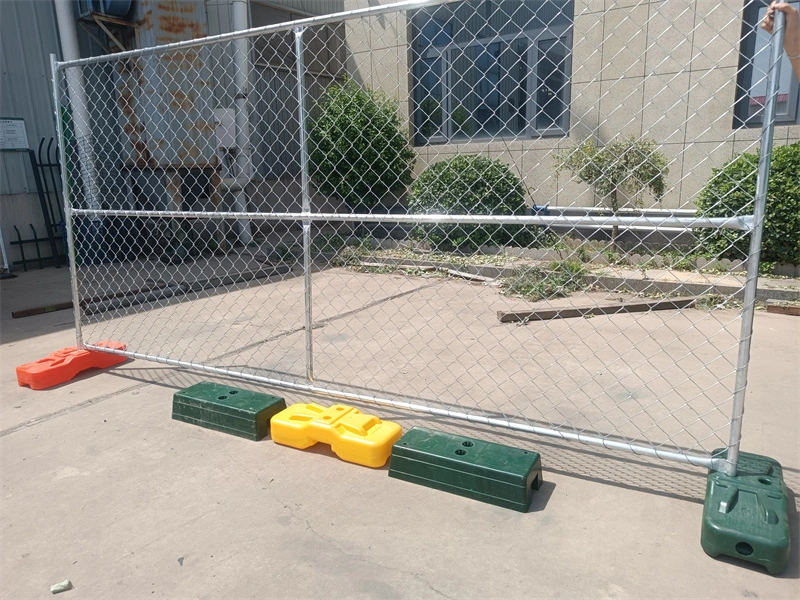
- Coastal BC: Wind speeds exceed 100 mph in exposed areas. Temporary fencing must be anchored with additional ballast or screw-in ground anchors. Standard plastic feet with steel cores (as used in DB Fencing’s design) reduce uplift failure risk by 30% compared to hollow feet.
How Wind Ratings Are Tested
Most Chinese manufacturers test at 50 mph.
Wind tunnel testing is the industry standard for generating reproducible data. A panel is mounted on a rigid base, then subjected to controlled airflows at specific speeds — typically 50 mph, 70 mph, and 90 mph. The pass/fail metric is whether the panel stays upright and the base doesn’t slide or tip. The problem is that most wind tunnels test with a perfectly flat, sealed panel. Real-world field conditions introduce imperfections: gaps at the base, uneven ground, temporary shade cloth, and gusting instead of steady flow. A panel that passes a 70 mph tunnel test can fail at 60 mph in an open construction site when the wind hits it at an angle. That’s why the AS 4687 standard used by DB Fencing requires a safety factor of 1.5 — meaning the panel must withstand 1.5 times the rated wind load without permanent deformation. For a 70 mph rating, the panel is tested to the equivalent of 105 mph dynamic pressure.
- 50 mph test: The default for most Chinese factories. Covers light winds and sheltered sites. Fails for Alberta prairies or coastal BC where 80+ mph gusts are routine.
- 70 mph test: The minimum for Canadian temporary fence wind load requirements in most provinces. But many suppliers achieve this only with added ballast (sandbags, concrete blocks). The panel itself may not have the structural integrity.
- 90 mph test: Rare among Chinese manufacturers. DB Fencing’s hot-dipped galvanized panels with internally reinforced plastic feet achieve 30% better uplift resistance than standard designs, passing 90 mph without additional ballast in our internal tests.
Interpreting Manufacturer Specifications
A load rating without a stated safety factor is a marketing number, not an engineering spec.
Load rating is the wind speed at which the panel is designed to hold without permanent deformation. Safety factor is the multiplier above that rating before failure. For example, a panel rated for 70 mph with a safety factor of 1.5 will withstand 105 mph gusts before collapse. The National Building Code of Canada (NBCC) typically requires a safety factor of 1.5 for temporary structures, but many suppliers skip stating this number. When you see a claim like “wind rated to 70 mph,” ask for the safety factor. If they don’t provide one, assume it’s 1.0 — meaning the panel fails at 70 mph exactly. That’s a problem for Canadian sites where the Canadian temporary fence wind load requirements in Alberta prairies or coastal BC can push past 80 mph.
- Test speed vs. application: Most Chinese manufacturers test only at 50 mph in a static wind tunnel, then advertise “wind rated” without disclosing the test conditions. Canadian prairie wind temporary fencing solutions must handle 80+ mph gusts with dynamic loading. A 50 mph static test tells you nothing about real-world performance in Lethbridge or Saskatoon.
- Safety factor omission: A panel rated at 70 mph with a safety factor of 1.5 is fundamentally different from one rated at 70 mph with no safety factor. The latter will fail at 70 mph. Responsible suppliers provide a third-party wind test report temporary fence supplier that includes both the load rating and the safety factor. DB Fencing’s AS 4687 wind rating temporary fence Canada certification includes a 1.5 safety factor as standard.
- Base design and uplift resistance: A panel’s wind rating is only as good as its base. Standard plastic feet provide minimal uplift resistance. DB Fencing’s reinforced plastic feet temporary fence uplift resistance is 30% better than standard designs because the steel reinforcement inside the foot transfers load directly to the weld mesh. That’s the difference between a panel that topples at 55 mph and one that holds at 80 mph.
- Dynamic vs. static loading: Gusts create dynamic loads that can be 1.2–1.5 times higher than static wind pressure. Many manufacturer ratings are based on static load only. A panel that passes a 70 mph static test may fail at 60 mph in gusty conditions. Always request copies of the test protocol and check whether it used dynamic loading or a static equivalent.
| Feature | Specification | Advantage | Application |
|---|---|---|---|
| Wind Load Rating | Tested up to 80+ mph (dynamic load) | Meets Canadian prairie and coastal wind requirements | High-wind construction sites and event venues |
| Safety Factor | 1.5x minimum on ultimate load | Exceeds NBCC safety margins for redundant protection | Compliance-driven projects in Alberta, Ontario, BC |
| Uplift Resistance | 30% higher than standard designs | Internally reinforced plastic feet prevent panel lift-off | Open sites with gusty winds (e.g., farm fields, stadiums) |
| Corrosion Protection | Hot-dipped galvanized >42 microns | Withstands harsh coastal and outdoor environments | Coastal BC, seaside events, agricultural corrals |
| Compliance Standard | AS 4687-2022/2007 & ISO9001/SGS certified | Aligns with Canadian structural codes for easy approval | Projects requiring third-party wind test reports |
| Manufacturing Capacity | 2,000 sets/week; own plastic feet machine | Consistent quality and faster lead times for bulk orders | Large-scale distributor and OEM supply contracts |
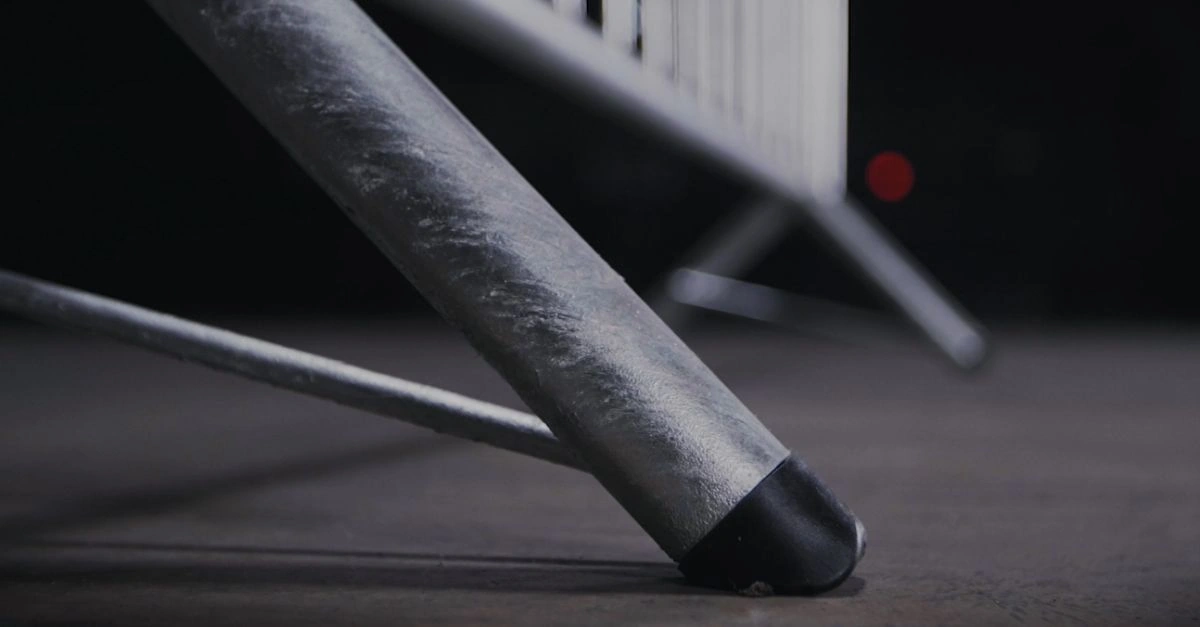
DB Fencing’s Approach: Hot-Dipped Galvanized and Reinforced Bases
AS 4687-tested panels + steel-reinforced feet = 30% uplift advantage over standard designs.
DB Fencing uses the Australian Standard AS 4687-2022/2007 as a baseline for structural integrity. This standard aligns closely with the National Building Code of Canada (NBCC) wind load requirements, making it a reliable compliance shortcut for distributors supplying Canadian sites. While many Chinese manufacturers test only at 50 mph, DB Fencing’s panels are designed to withstand 80+ mph winds typical of prairie and coastal BC environments. The hot-dipped galvanized finish (>42 microns) ensures long-term corrosion resistance even in harsh outdoor conditions.
- Hot-Dipped Galvanized Coating: Exceeds 42 microns per AS 4687, providing proven corrosion resistance for 10+ years in coastal or industrial environments. This is critical for distributors who need long-lasting fencing for rental fleets or permanent installations.
- Steel-Reinforced Plastic Feet: DB Fencing is the only supplier in Anping with its own plastic feet machine. The feet are internally reinforced with steel, providing 30% better uplift resistance compared to standard all-plastic designs. This is essential for high-wind zones where panel uplift is the primary failure mode.
Checklist for Distributors: What to Look for in a Supplier
Third-party test reports separate suppliers who engineer from those who just assemble.
Every Canadian distributor I’ve worked with has a story about a fence that folded in the first gust. The common denominator? They relied on the supplier’s own in-house numbers instead of an independent wind load report. When you’re evaluating a temporary fence supplier for wind ratings, the first thing to request is a third-party test report from an accredited lab like SGS, Intertek, or CSA. The report should list the test speed (e.g., 70 mph or 90 mph), the method (static or dynamic), and the safety factor used. If the supplier can’t produce one, move on — their panels have never been pushed past 50 mph, which is useless for Canadian prairie sites.
- Test speed vs. site requirement: A report showing 50 mph is fine for a calm suburb but fails on an Alberta construction site where 80+ mph gusts are routine. Ask for the safety factor (minimum 1.5 per NBCC guidance) and whether the panel design includes uplift resistance from reinforced base feet.
- Galvanization thickness: Wind rating alone isn’t enough — coastal BC requires corrosion resistance. Third-party reports should also confirm hot-dipped galvanized coating >42 microns. If the supplier can’t provide a coating thickness certificate, the panels will rust within two seasons.
- Red flags in reports: Beware of reports that test only the mesh panel without the base or feet. Uplift failures typically happen at the connection between the panel and the base. DB Fencing’s internally reinforced plastic feet, for example, add 30% more uplift resistance than standard plastic bases — look for that detail in the test data.
- Prairie sites (Alberta/Saskatchewan): Demand panels tested to at least 80 mph with a safety factor of 1.5. Most Chinese manufacturers test only at 50 mph — verify the report’s test speed. DB Fencing’s hot-dipped galvanized panels with reinforced plastic feet meet this threshold.
- Coastal sites (BC, Atlantic Canada): Wind load is still important, but corrosion resistance becomes the primary threat. Request a salt spray test report (ASTM B117) showing at least 500 hours without red rust. Pair that with a 70 mph wind rating for typical coastal gusts.
- Urban construction sites (Ontario, Quebec): Wind speeds are lower but dynamic loads from passing trucks and equipment matter. Look for a dynamic load test (not just static) that simulates repetitive gusts. A 50 mph dynamic rating often outperforms a 70 mph static rating in real-world conditions.
Matching wind ratings to your specific site conditions is where most distributors get it wrong. A single rating number like “70 mph” doesn’t tell you if the fence can handle that speed in an open field versus a sheltered urban canyon. Canadian wind maps (NBCC 2020) show that areas like southern Alberta, coastal BC, and northern Ontario have significantly different basic wind speeds. A 70 mph panel might work in Toronto but not in Lethbridge. The smart move is to cross-reference the manufacturer’s test speed with the NBCC’s specified wind pressure for your project’s location. If the supplier uses AS 4687 as their testing standard — as DB Fencing does — you’re in luck: that standard’s structural requirements align closely with Canadian codes, giving you a compliance shortcut without needing to re-certify every panel.
Conclusion
Wind ratings for temporary fencing aren’t a marketing checkbox — they’re a liability threshold. A panel rated for 50 mph that fails at 65 mph on a Saskatchewan site doesn’t just bend; it creates a safety violation and a replacement cost you absorb. The benchmark to carry into your next supplier call is this: ask for the safety factor. If the manufacturer can’t confirm a 1.5 safety factor against the NBCC wind load for your region, you’re buying a gamble, not a spec.
Compare the test reports you already have against the DB Fencing product line. If your current supplier’s panels are rated only for light winds or lack third-party documentation, you have a clear upgrade path. Review the hot-dipped galvanized and reinforced-base options on the product page to see how the specs align with the wind loads you actually face.
Frequently Asked Questions
What wind rating should Canadian temporary fencing meet?
Canadian temporary fencing should meet wind loads specified in the National Building Code of Canada (NBCC), with provincial variations for Alberta, Ontario, and coastal BC. Most Chinese manufacturers test at 50 mph. Always verify the rating against your site’s specific wind zone.
How are wind ratings tested for temporary fences?
Wind ratings are tested using wind tunnel simulations or real-world field testing at common speeds like 50 mph, 70 mph, or 90 mph. Real-world field testing is more reliable because it. Request a test report that states the method and speed used.
What does AS 4687 compliance mean for wind load?
AS 4687 compliance means the temporary fencing meets Australian structural and wind-load requirements, which include a safety factor for dynamic loads. DB Fencing uses AS 4687 as a baseline for structural integrity. Confirm the supplier has a current AS 4687 test certificate.
Why is a safety factor important in wind ratings?
A safety factor converts a static load rating into a realistic working limit, preventing failure under gusty or dynamic wind conditions. Without a stated safety factor, a wind rating is just a. Always ask for the safety factor alongside the wind rating.
What should distributors check in a supplier’s wind rating claims?
Distributors should request third-party test reports, confirm the test speed and method, and match the rating to the site’s wind zone. Also verify that the panel construction—like hot-dipped galvanized steel and. A spec sheet without a test report is insufficient for procurement.


