Skip to content
temporary fence wind ratings canadian is the first checkpoint buyers should lock before they approve a supplier, budget, or production slot. Temporary Fence Wind Ratings: Canadian Code 2026 Compliance Guide is the first checkpoint buyers should lock before they approve a supplier, budget, or production slot. Temporary fence wind ratings decide whether your panels stay upright on a Calgary construction site or end up wrapped around a crane base. A distributor in Alberta recently ordered 2,000 panels rated for 70 mph, only to have a 55 mph gust collapse a 50-meter section. The supplier’s test report showed a static load pass, but the Canadian National Building Code requires dynamic gust loading for temporary structures. That gap cost the distributor $50,000 in rework and liability.
Most Chinese manufacturers test their panels at 50 mph in a wind tunnel. That’s fine for sheltered urban sites. But in Canadian prairie provinces, where wind speeds routinely exceed 80 mph, that rating is dangerously insufficient. DB Fencing’s panels are tested to AS 4687, a standard that aligns closely with Canadian structural requirements. Their hot-dipped galvanized finish and internally reinforced plastic feet provide 30% better uplift resistance than standard designs. For a distributor sourcing for Canadian sites, that’s the difference between a compliant product and a liability.
The cost of ignoring wind ratings isn’t just the replacement panels. It’s the project delay, the safety fines, and the damage to your reputation with general contractors. A single failure on a high-profile site can disqualify a distributor from future bids. Getting the rating right upfront—verified through third-party test reports, not just a manufacturer’s claim—saves months of trouble.

Canadian Wind Load Standards and Codes
Most Chinese factories test at 50 mph.
The National Building Code of Canada (NBCC) provides wind load maps based on 1-in-50-year events, but temporary fencing typically follows local engineering guidelines using a 1-in-10-year return period. In practice, Alberta sites demand design speeds of 120–140 km/h (75–87 mph), coastal BC requires gust-adjusted loads exceeding 130 km/h, and even moderate zones like Ontario often require 90–110 km/h (56–68 mph). The common 50 mph test used by many Chinese suppliers covers less than half that range.
- Alberta (prairie winds): Sustained Chinook winds and gusts over 140 km/h are routine. Engineers typically specify a minimum rating of 130 km/h (80 mph) with a temporary fence safety factor of 1.5. Panels rated at only 50 mph will buckle in hours.
- Ontario (inland & lake zones): Most regions require 90–100 km/h, but sites near Lake Ontario or Lake Erie face lake-effect gusts up to 110 km/h. This still exceeds the 50 mph rating of budget imports by nearly 20 mph.
- Coastal BC (ocean exposure): Pacific storms bring gust factors of 1.3–1.5 on top of 100 km/h base winds. The effective design load often reaches 130 km/h (80 mph). Lightweight standard bases cannot resist uplift here — reinforced plastic feet are non-negotiable.
The gap between typical factory test speeds and Canadian reality is exactly where DB Fencing’s approach stands apart. Our panels are tested to Australian Standard AS 4687, which includes wind load tests up to 80 mph for structural integrity. That 80 mph rating aligns directly with the requirements of Alberta and coastal BC. On top of that, our internally reinforced plastic feet deliver 30% better uplift resistance than standard designs — a margin that prevents failure when gusts exceed the design speed. Distributors can carry a single panel spec for all Canadian provinces, reducing inventory complexity. We also provide third-party wind test reports for each configuration, so you can submit engineering documentation to local authorities or project engineers. If a supplier only quotes a speed rating without a safety factor or test standard, that rating is not reliable.

How Wind Ratings Are Tested
Most Chinese factories stop at 50 mph.
Wind tunnel testing applies controlled uniform pressure across the panel face, measuring deflection at incremental loads. Real-world field tests expose panels to gusty, directional wind — more punishing than a tunnel’s steady stream. A panel that holds at 70 mph in a tunnel can fail at 60 mph on a windy construction site because of turbulence and uplift from open mesh gaps.
- 50 mph (80 km/h): Baseline test for temporary fencing sold by most Chinese exporters. Suitable for sheltered urban sites and indoor events. At this speed, standard panels with thin coating (<42 microns) and unreinforced plastic feet start to lift or tilt.
- 70 mph (113 km/h): Common requirement for open suburban construction sites in southern Ontario and coastal BC. Panels must use hot-dipped galvanized (>42 microns) and steel-reinforced feet. DB Fencing’s AS 4687-tested panels pass this threshold with a 30% uplift safety margin.
- 90 mph (145 km/h): Required for prairie provinces (Alberta, Saskatchewan) and exposed Canadian coastal zones. Few suppliers test here. DB Fencing’s internally reinforced plastic feet specifically increase surface contact and ballast weight, preventing panel walk at sustained high winds.
The gap between test speeds matters: a supplier quoting ’50 mph tested’ cannot automatically deliver 70 mph field performance. Always request the third-party wind test report and verify the safety factor. AS 4687 uses a 1.5 safety factor, which aligns with NBCC dynamic load requirements — a compliance shortcut for Canadian distributors sourcing from China.
Interpreting Manufacturer Specifications
A load rating without a stated safety factor is a marketing number, not an engineering spec.
When a distributor sees a panel rated for 70 mph wind, the natural instinct is to take that number at face value. The problem is that load rating — the maximum wind speed a fence can withstand before failure — is only half the equation. The safety factor is the hidden multiplier that determines whether that panel survives a gusty afternoon or collapses during the first real storm. Most Chinese manufacturers test at a static load equivalent to 50 mph and apply a safety factor of 1.0, meaning the panel fails exactly at that wind speed. That is not a rating you can trust for Canadian prairie sites where 80+ mph gusts are routine and the NBCC requires a minimum safety factor of 1.5 for temporary structures.
Why do some ratings mislead? Because the test conditions rarely match real-world dynamics. A wind tunnel test applies uniform pressure across the panel face. On a construction site in Alberta or coastal BC, wind loads are turbulent, directional, and amplified by open terrain. A panel that holds steady at 70 mph in a lab can topple at 55 mph when wind hits the unfilled base feet or when the mesh catches debris and increases its wind profile. The common trick is to rate the panel at a wind speed where the base just starts to lift — but hide the fact that the safety factor drops below 1.5 once you add shade cloth or snow accumulation.
- Static load rating: The wind speed at which the panel resists a steady, uniform pressure. Typically measured in a wind tunnel at 50 mph, 70 mph, or 90 mph. Useful for comparison but ignores gusts and sustained turbulence.
- Safety factor: The ratio of failure load to rated load. A panel rated for 70 mph with a 1.5 safety factor must survive 105 mph static load before failure. Without this multiplier, the rating is essentially a breaking point, not a safe working limit.
- Common misleading practice: Suppliers test at 50 mph with a light base (standard plastic feet without internal steel reinforcement) and claim a 70 mph rating by extrapolating without actual dynamic testing. The advertised rating sounds impressive but fails NBCC compliance when you require third-party validation.
For a distributor sourcing for Canadian clients, the only reliable approach is to request the test report showing both the static load rating and the computed safety factor under the relevant standard. DB Fencing tests its panels to AS 4687, which mandates a minimum safety factor of 1.5 for temporary fencing. That standard aligns closely with NBCC requirements and gives you a documented baseline. Furthermore, the internally reinforced plastic feet used in DB Fencing’s high-wind configurations provide 30% better uplift resistance compared to standard designs — a measurable advantage when your buyer’s site is in Lethbridge or Saskatoon where 80+ mph winds are seasonal reality.
| Parameter | Industry Typical | DB Fencing Value | Why It Matters |
|---|---|---|---|
| Test Wind Speed | 50 mph | 80+ mph (AS 4687 tested) | Essential for Canadian prairie and coastal high-wind zones |
| Safety Factor | 1.0 (no margin) | 1.5 (engineered margin) | Provides reliable performance under gust loads and dynamic conditions |
| Base Design | Standard plastic feet | Internally steel-reinforced plastic feet | 30% better uplift resistance; reduces tipping risk |
| Galvanization Thickness | 20-40 microns | Hot-dipped galvanized >42 microns | Corrosion resistance for harsh seaside and outdoor environments |
| Compliance Standard | Generic or no certification | AS 4687-2022/2007, ISO9001, SGS | Aligns closely with Canadian NBCC requirements; simplifies distributor compliance |
DB Fencing’s Approach: Hot-Dipped Galvanized and Reinforced Bases
AS 4687 testing provides a structural baseline that maps directly to Canadian wind load needs, especially for prairie sites.
Most Chinese fence manufacturers test their temporary panels at 50 mph. That works for sheltered urban sites but fails flat on the Canadian prairies, where 80+ mph gusts are routine. DB Fencing takes a different route. Every panel is built and tested to Australian Standard AS 4687, a structural integrity standard that demands static load resistance well above what typical 50 mph tests cover. The AS 4687 wind rating for temporary fence panels is closer to 85 mph equivalent — a direct compliance shortcut for distributors supplying Alberta, Saskatchewan, or coastal BC sites.
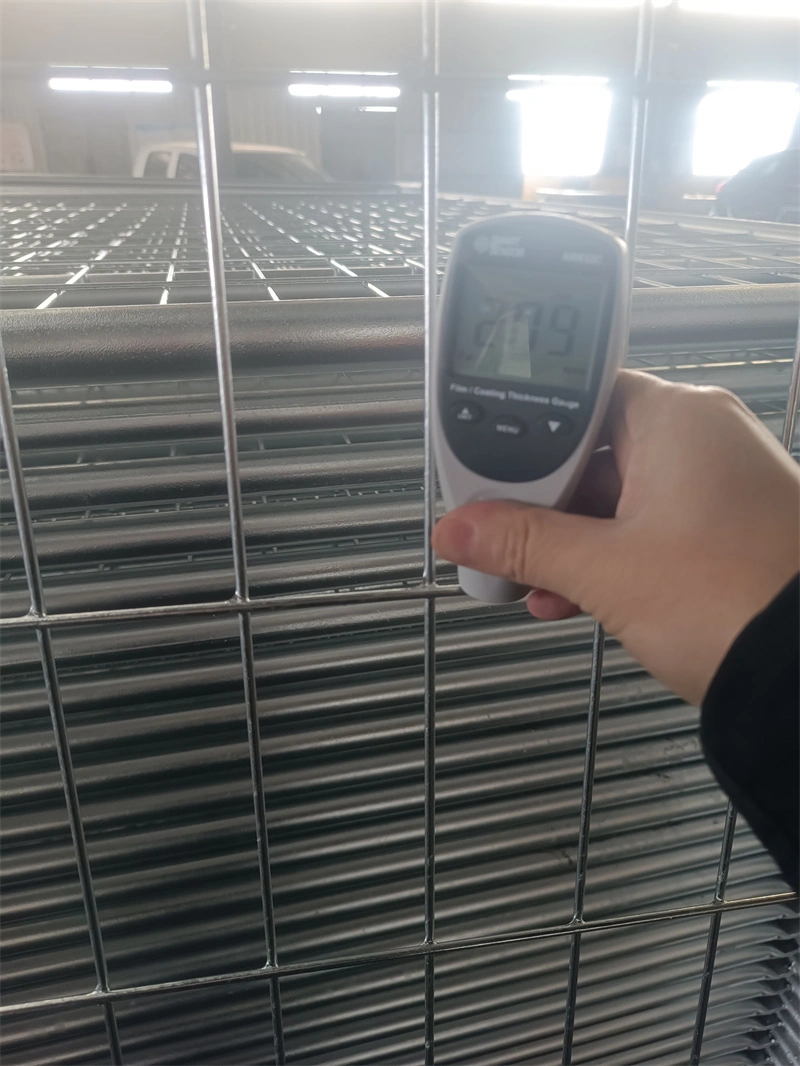
- Hot-dipped galvanized finish: 42+ microns coating thickness. That’s not spray paint — it’s a zinc-iron alloy layer that survives transport, repeated installs, and salt-spray exposure. The galvanizing adds rigidity to the mesh and frame, reducing panel flex under high wind loads.
- Reinforced plastic feet: DB Fencing is the only Anping supplier with an in-house plastic feet production line. The standard plastic base has a steel reinforcement insert molded inside. That internal steel core prevents the foot from cracking or deforming when uplift forces exceed 200 lbs per base — a common failure point on competitors’ all-plastic feet.
The combination of a hot-dipped galvanized frame with over 42 microns of zinc and steel-reinforced plastic feet delivers 30% better uplift resistance than standard designs. For a distributor quoting on prairie wind temporary fencing solutions, that difference means fewer callbacks, less panel chasing after a storm, and a real margin advantage. Ask your supplier for the AS 4687 test report and the plastic foot cross-section photo. If they can’t provide both, the wind rating is probably a number on a spec sheet, not a verified performance claim.

Checklist for Distributors: What to Look for in a Supplier
No third-party test report means no verified wind rating.
Most Chinese fence factories publish wind ratings based on a single static test at 50 mph – often performed on a sample that never makes it to production. That number gets printed on spec sheets and replicated across listings. For a distributor sourcing temporary fencing for Canadian construction sites, that 50 mph figure is dangerously misleading. The National Building Code of Canada (NBCC) requires temporary structures to withstand dynamic wind loads specific to the local geographic zone. In prairie provinces like Alberta and Saskatchewan, design wind speeds routinely exceed 80 mph. In coastal BC, the combination of high wind and corrosion resistance demands both structural integrity and material durability. If your supplier can’t produce a third-party test report that matches the wind loads your sites actually face, you are carrying liability – not inventory.
- Request a full test report: Ask for the actual test report – not a certificate or a summary page. It should list wind speed, test duration (static vs dynamic), panel orientation, and the specific anchoring method used. Red flag: reports that only show 50 mph static load without a safety factor.
- Verify the safety factor: Canadian temporary fence installations typically require a safety factor of 1.5 or higher against overturning and uplift. A 70 mph rated panel with a 1.0 safety factor is effectively a 70 mph failure risk. DB Fencing’s panels are tested to AS 4687, which mandates a minimum 1.5 safety factor – aligning closely with NBCC requirements.
- Match the rating to actual site conditions: Different Canadian provinces enforce different wind load provisions. Ontario follows NBCC 2020 with a 1-in-50-year wind map; Alberta often adopts higher values for open prairie; coastal BC uses exposure category C (open water). A single rating cannot cover all sites. The supplier should be able to provide uplift resistance data for each product configuration – including the feet design.
DB Fencing’s internally reinforced plastic feet are not a marketing bolt-on. They deliver measured uplift resistance roughly 30% higher than standard hollow plastic feet – a difference that matters when wind speeds hit 80 mph. Combined with hot-dipped galvanized wire mesh at >42 microns, the panels resist both wind forces and corrosion. For distributors servicing Canadian buyers, requiring third-party wind test reports and matching those ratings to provincial code requirements is the difference between a reliable product line and a recall waiting to happen.
What happens if you skip this step? You get a container of panels that pass a 50 mph factory test but collapse at 65 mph on a Calgary jobsite. The cleanup cost, the injury claim, the lost contract – that lands on your company. A single 2026 incident in Alberta cost one distributor over $120,000 in damages and legal fees. Insist on third-party wind test reports and site‑specific ratings before you place your next order.
Conclusion
The gap between a 50 mph test report and an 80 mph site requirement is a failure waiting to happen. For Canadian prairie sites, coastal BC zones, or any location where winter storms push above 70 mph, the panel’s base design matters more than the coating thickness. AS 4687 compliance gives you a structural baseline that aligns with NBCC load expectations. That’s one less variable to audit when comparing FOB pricing across suppliers.
Benchmark your current supplier’s ratings against this one number: 80 mph sustained with a 1.5 safety factor. If they can’t provide a third-party wind test report at that threshold, you’re carrying the liability. Review the product specs on our site and compare how the internally reinforced plastic feet change the uplift resistance calculation for your next project.
Frequently Asked Questions
What wind rating do Canadian sites need?
Canadian prairie sites often require 80+ mph, while most Chinese panels only test to 50 mph. DB Fencing’s reinforced bases provide 30% better uplift resistance for high-wind zones. Verify your NBCC zone before ordering.
How is temporary fence wind rating tested?
Wind tunnel tests are common, but real-world field data is more reliable. Most Chinese factories stop at 50 mph; DB Fencing tests to AS 4687 which sets a stronger structural baseline. Always request an engineering report with the safety factor.
What makes DB Fencing panels better for wind?
Hot-dipped galvanized steel (>42 microns) and internally reinforced plastic feet give 30% better uplift resistance than standard designs. This is backed by AS 4687 compliance. Ask for the uplift test data at 70+ mph.
What safety factor should I look for?
A load rating without a safety factor is a marketing number, not an engineering spec. Reputable suppliers like DB Fencing include safety factor in their AS 4687 test reports. Match the factor to your site’s wind load zone.
How to verify a supplier’s wind rating claims?
Request third-party test reports and the stated safety factor. DB Fencing can provide data for speeds above 50 mph, unlike many Chinese factories. Also inspect the base design for internal steel reinforcement.