Skip to content
custom temporary fence design is the first checkpoint buyers should lock before they approve a supplier, budget, or production slot. Every article on sourcing temporary fencing tells you the same thing: always get a pre-production sample first. That advice sounds solid until a $50K order lands and the mass production run doesn’t match the approved sample. The mesh pattern looks off. The color is a shade duller. The slip-fit bases don’t slide together the way they did on the sample. The problem isn’t the sample approval process — it’s that the sample was made in a controlled environment while the production run faced different conditions on the welding line or in the powder coating booth. A custom temporary fence design that works on paper can fail in the factory.
The real trick is understanding how the factory builds your design before you commit to tooling. Most Chinese factories run standard mesh patterns like 50x100mm or 50x200mm. Deviating to a unique mesh pattern requires a new stamp die, typically $500 to $2,000, amortized over 500 panels. Event managers ordering custom crowd control barriers with logos or non-standard heights for concert stages need to account for that upfront cost. They also need to verify that the factory can handle quality tolerances across a full production batch — not just on a single sample. So ignore the conventional wisdom. Skip the sample-first advice and start with a detailed spec sheet and a process audit. Here’s how to move from concept to container without getting burned.

Why Custom Designs Matter for Events and Branding
A logo panel turns safety gear into sponsor real estate.
Most event planners default to generic yellow barriers. That’s a missed revenue opportunity. Crowd control barriers with custom logos let you monetize sightlines — sponsors pay a premium for visible, high-traffic placements. The catch: not every factory can apply a durable logo without peeling. You need a supplier that uses UV-stabilized powder coating (RAL code specified) or hot-dip galvanized undercoat to survive Canadian snow and summer UV. Screen printing fades in 2–3 events; powder-coated logos last the life of the panel.
Non-standard heights are another trap. Standard temporary fence panels are 2.0m tall. But concert stage perimeters often require 2.4m to block rear-stage visibility and meet security sightline requirements. Specifying a custom height like 2.4m means the entire mesh pattern, tube gauge, and base design must be recalculated for wind load. Many Chinese factories will take your order but reuse a 2.0m weld pattern stretched to 2.4m — that creates a weak point at mid-span. Insist on a fresh CAD drawing with load rating (e.g., 1.5 kN/m) and verify the mesh pattern maintains its anti-climb properties at the new height.
- Custom mesh pattern die cost: Deviating from standard 50x100mm or 50x200mm patterns requires a new stamp die — USD 500–2,000, amortized over 500+ panels. Request mold ownership terms upfront.
- Slip-fit base compatibility: Event crews prefer slip-fit bases (no bolts) for 30-second assembly. Verify your custom-height panel uses a compatible base slot — not all factories offer this. DB Fencing manufactures its own plastic feet, ensuring alignment across custom runs.
- Logo placement and finish: Logos on crowd control barriers must resist abrasion from stacking and trucking. Specify a recessed logo pocket (0.5 mm deep) in the panel stamping, then fill with powder coat. Avoid stick-on decals — they peel in rain.
- Canadian UV and snow load: Standard polyester powder coating degrades after one winter. Require a UV-stabilized TGIC polyester or a hot-dip galvanized undercoat (>42 microns) with a top coat. Snow load capacity at 2.4m height: minimum 1.5 kN/m lateral force.
Step 1: Prepare a Detailed Specification Sheet
A vague spec sheet guarantees a mismatched container.
I’ve seen it happen more times than I can count: an event manager sends a supplier a PDF that says ‘2m x 3m fence panel, galvanized finish,’ and three months later the container lands with panels that are 1.95m tall, use a mesh pattern that doesn’t match the crowd control barriers from last year’s festival, and the coating starts flaking after two Canadian winters. The gap between what you think you ordered and what actually arrives is almost always traced back to an incomplete spec sheet.
When you’re working with an OEM temporary fence manufacturer in China, every millimeter matters. Here’s exactly what needs to be on your spec sheet before you send it to any factory.
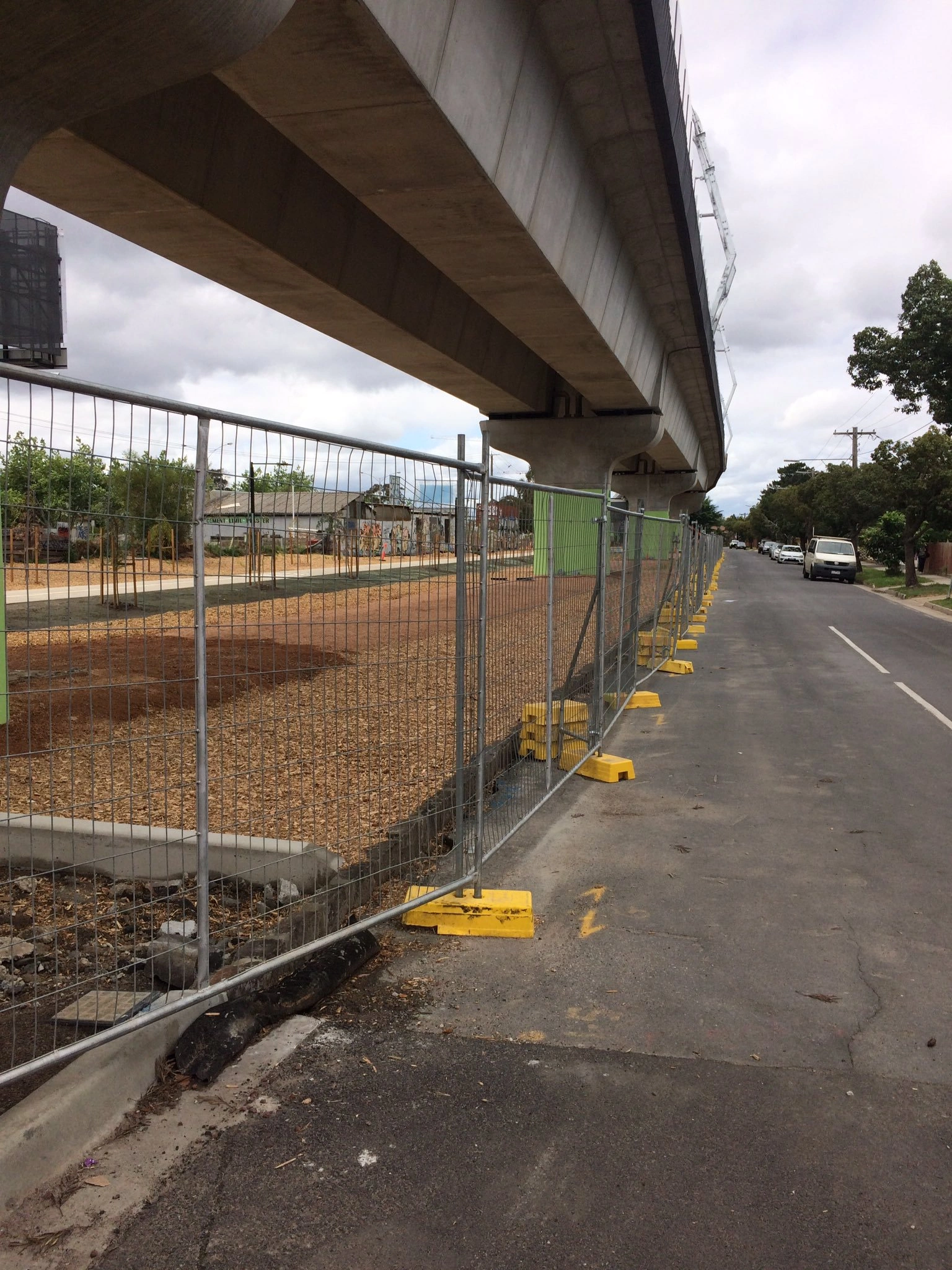
- Overall dimensions: State width (panel-to-panel connection face) and height in millimeters. For custom height temporary fence for events, standard heights are 2000mm or 2400mm, but concert stages often require 3000mm. Be precise — a 50mm difference changes shipping volume and base compatibility.
- Mesh pattern & wire diameter: Most Chinese factories stock dies for 50x100mm or 50x200mm apertures. If you need a custom mesh pattern — say, a tighter weave for anti-climb or a branded shape — that requires a new stamp die costing $500–$2,000. Specify aperture size in mm AND wire diameter in mm (e.g., 4.0mm wire). These two numbers determine both security level and panel weight.
- Frame tube size & wall thickness: Standard is 42mm OD round tube with 2.0mm wall thickness for temporary panels. Some suppliers cut corners to 1.5mm wall to save steel cost — your panels will bend under crowd load at a festival. Write ’42mm OD x 2.0mm wall’ explicitly. If you need heavier duty for construction sites, specify 48mm OD x 2.5mm wall.
- Finish specification: ‘Galvanized’ is not enough detail. You must specify hot-dipped galvanized (HDG) with minimum coating weight of >42 microns per ASTM A123 or Australian Standard AS/NZS 4680. For custom color powder coated temporary fence, list the RAL code (e.g., RAL 7016 Anthracite Grey) AND require an HDG undercoat beneath the powder coat — otherwise UV degradation will reach bare steel within one season in Canadian sun.
- Base / foot type: “Plastic feet” covers everything from flimsy blow-molded parts to reinforced injection-molded units that handle forklift impacts. If you want slip-fit bases for quick assembly (a common request from event managers), verify the socket ID matches your frame tube OD exactly — a loose fit means wobbly barriers on asphalt.
| Feature | Specification | Customization Options | Compliance Notes | Benefit for Event Managers |
|---|---|---|---|---|
| Panel Dimensions | Height: 1.0m–3.0m; Length: 2.0m–3.5m | Custom heights for stages; non-standard lengths for crowd control barriers | AS 4687-2022 tested for stability | Tailored fit for festival layouts and branded zones |
| Mesh Pattern & Aperture | Standard: 50×100mm or 50×200mm; Custom: any pattern with new stamp die | Custom logo mesh or anti-climb diamond pattern; die cost $500–$2,000 (amortized over 500+ panels) | Anti-climb tested per AS 4687 | Unique branding on barriers; easy crowd flow control |
| Tube Size & Wall Thickness | Frame: 30×30×1.5mm or 40×40×2.0mm; Horizontal rails: 25×25mm | Heavier gauge for high-traffic events; lighter weight for transport | Meets minimum structural requirements for 1.5 kN/m load | Durable yet portable – reduced shipping costs for rental fleets |
| Finish & Coating | Hot-dipped galvanized (>42 microns) or powder-coated (RAL color) | UV-stabilized powder coating for Canadian winter; hot-dip galvanized undercoat option | ISO9001, SGS certified; salt spray tested for coastal environments | Fade-resistant branding; no rust stains on event grounds |
| Base / Foot Type | Standard plastic foot (DB Fencing proprietary) or slip-fit base | Slip-fit bases for quick assembly (no bolts) – verify compatibility | 100% in-house production – consistent quality | Rapid deployment; reduces labor time on site by up to 30% |
| Load Rating | Standard: 1.5 kN/m tested; Higher ratings available on request | Engineered for wind loads or crowd surge (e.g., concert stages) | AS 4687-2022 structural certification | Safety assurance for large crowds; meets insurance requirements |
| Wire Diameter | 3.0mm–5.0mm (mesh wire) | Thicker wire for anti-climb or high-security areas | Consistent weld strength – tensile tested | Prevents climbing; withstands weather wear |
| Color (RAL) | Available in any RAL code; standard: RAL 9005 (black), RAL 3002 (red), RAL 5010 (blue) | Custom color matching for event branding or corporate identity | UV-stabilized powder – tested for 500+ hours QUV | Branded barriers enhance sponsor visibility |
| Minimum Order Quantity (MOQ) | 100 panels (standard); 50 panels for repeat orders | Low MOQ for trial runs or seasonal events; bulk discounts for 500+ panels | Factory-direct pricing with 24-hour quoting | Flexible procurement – no need to overstock for peak season |
| Certifications & Standards | AS 4687-2022/2007, ISO9001, SGS | OEM labeling with your brand and compliance marks | Full documentation provided for import clearance | Hassle-free import to Canada, Australia, and NZ |
Step 2: Share Technical Drawings (Scale: .dwg or .pdf)
A vague drawing is the fastest way to a rejected shipment.
When you send a technical drawing to a Chinese factory, you’re not just sharing a picture — you’re handing over the blueprint for every panel they’ll produce. What do factories expect? First, a scale drawing in .dwg or .pdf format showing exact overall dimensions, mesh pattern (e.g., 50x100mm or 50x200mm), tube size (wall thickness matters — 1.5mm vs 2.0mm changes structural integrity), and weld spacing. Most factories have stamp dies for standard patterns. If you want a custom mesh pattern, expect a tooling cost of $500 to $2,000 for a new die, amortized over 500+ panels. Also include the target finish: hot-dipped galvanized ≥42 microns (the internal standard here for coastal environments) or powder-coated with a specific RAL code. Don’t leave out the connection method — slip-fit bases vs bolted feet. Event managers often prefer slip-fit for quick assembly, but not every factory offers this; verify compatibility early.
- Tolerance specification: Explicitly state acceptable deviations: ±2mm on overall panel length and height, ±1mm on tube outer diameter, ±0.5mm on weld spacing. Without this, a factory’s default tolerance may be ±5mm, which can cause panels to not interlock or fit base plates.
- Critical dimensions: Mark dimensions that affect fitment with a note like ‘critical — no deviation beyond ±1mm’. For example, the distance between locking pins or the width of the panel frame that slides into couplers. A 3mm error on a 2.4m panel might sound small, but it adds up across 500 panels and creates gaps in crowd control lines.
- Finish tolerance: For galvanized finish, specify minimum coating thickness per AS 4687. For powder coating, require a cross-hatch adhesion test and UV-stabilized resin for Canadian winters. Many Asian suppliers don’t account for UV degradation — specify UV-stabilized or hot-dip galvanized undercoat to avoid fading and chalking within two seasons.
Step 3: Discuss Custom Tooling and Molds
Custom stamp dies cost $500–$2,000 but pay off after 500 panels.
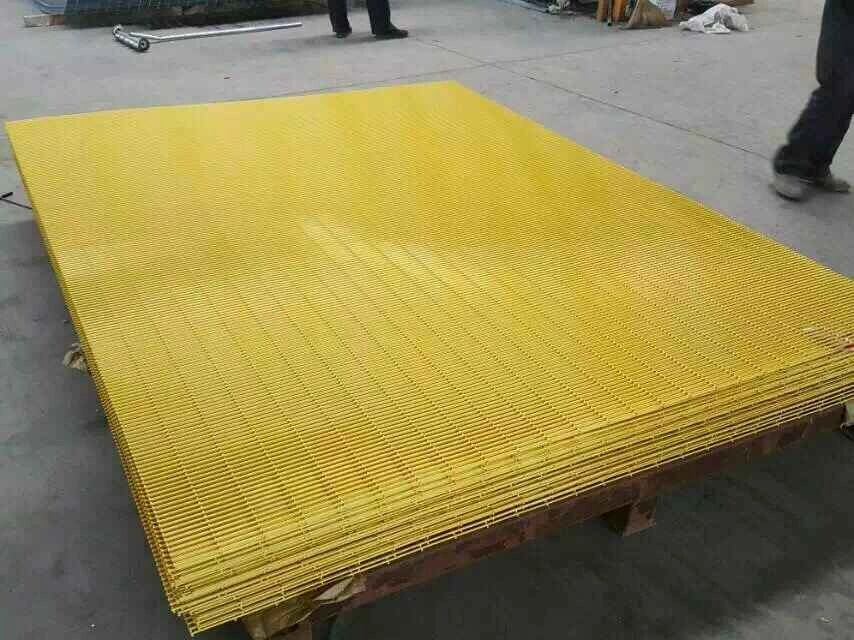
Most Chinese fence factories keep a narrow set of standard mesh patterns on the shelf — 50x100mm and 50x200mm are the defaults. The moment you request a custom mesh pattern for your event branding or anti-climb density, you’re asking for a new stamp die. That die is a custom tool, machined to your exact aperture and wire gauge, and it carries an upfront cost between $500 and $2,000, depending on complexity and size.
No reputable supplier expects you to eat that cost on a single order. The standard practice is to amortize the mold cost over the production volume — typically 500 panels or more. If your first order is only 200 panels, the factory will either charge a higher per-unit tooling fee or ask you to cover the full die cost upfront. Once you hit the agreed amortization threshold, the mold becomes part of the tooling library and subsequent reorders only pay for production.
- Mold ownership: Clarify in your contract who owns the die. Most factories will retain physical ownership of the tool stored on their floor, but you should secure a written agreement that the die is exclusive to your design and cannot be used for other customers. This prevents any ‘accidental’ production of your custom crowd control barriers for a competitor.
- Storage and maintenance: Storage is typically free for the first 12–18 months if you are an active client. After that, some suppliers charge a nominal annual storage fee (often $50–$150). If you plan to place repeat orders every season, confirm that the die will be maintained (cleaned, rust-proofed, and kept calibrated) at no extra charge. For event managers ordering custom height temporary fences seasonally, this is critical — a rusted or misaligned die will ruin your mesh tolerances.
One detail that separates professionals: ask to see a photo of the actual die with your order number stamped on it. I’ve seen cases where a factory claimed to hold a custom die but actually used a generic pattern and relied on the buyer not checking. A simple verification step saves you from getting standard mesh when you paid for a custom mesh pattern.
Step 4: Color Matching and Finishes
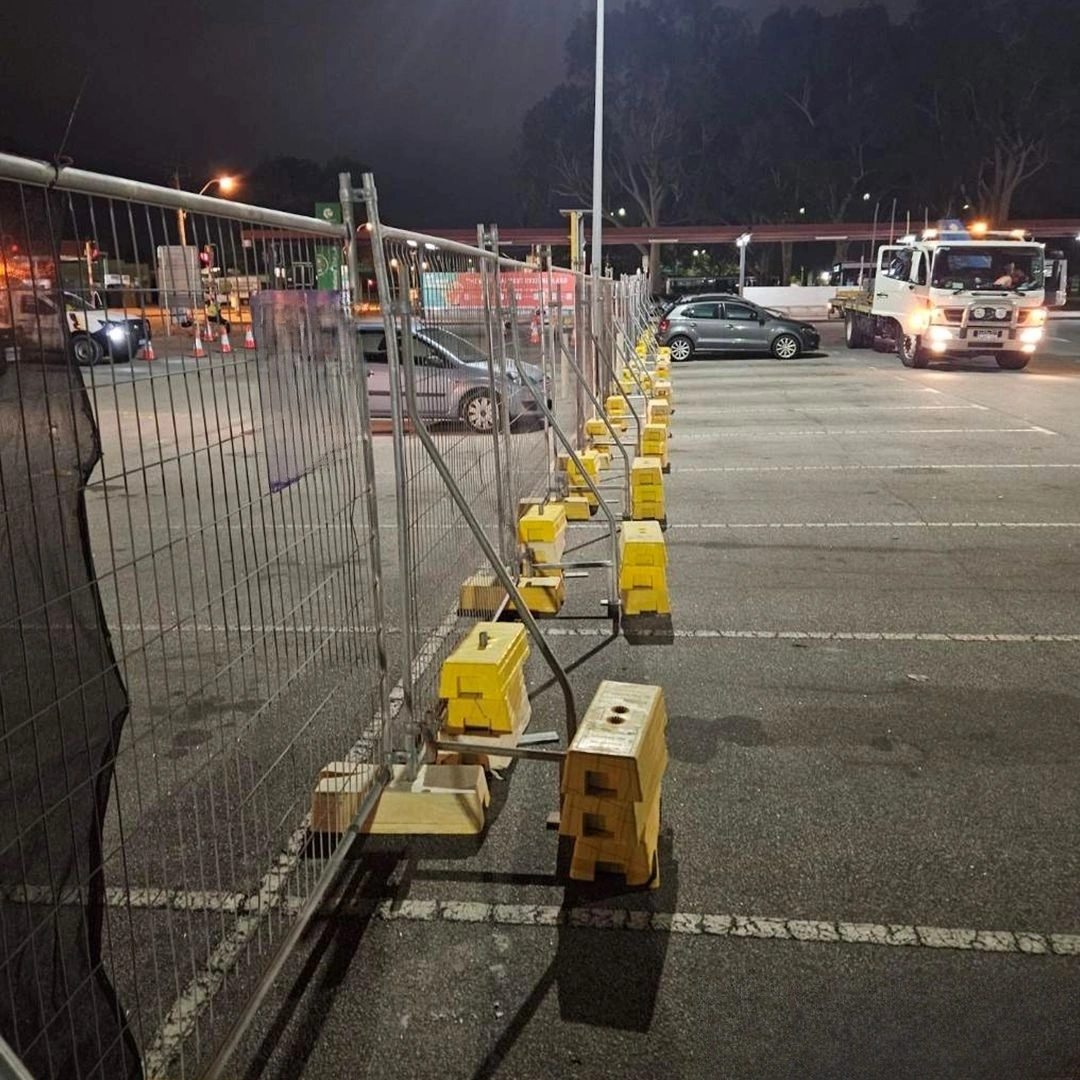
Standard powder coatings fail within one Canadian winter.
When you order custom color powder coated temporary fence, you hand the factory a RAL code. That five-digit number (e.g., RAL 7016 for anthracite grey) tells the powder supplier exactly which pigment blend to use. Most Chinese factories stock the top 30 RAL shades and can match any code within 48 hours.
The problem is not the color match. It is the UV stability of the powder coat. A standard polyester powder might look great on a sample panel under a factory roof, but put it outside in Calgary for six months and the top 20 microns of coating degrade. The gloss drops from 60% to 30%, and the base metal begins to rust through microscopic cracks.
- UV-stabilized powder: Specify outdoor-grade polyester with UV absorbers. These resist 1000 hours of QUV testing without significant color change or gloss reduction. Without this, expect visible fading within 18 months on a Canadian site.
- Hot-dip galvanized undercoat: For installations that endure freeze-thaw cycles and road salt, insist on a hot-dipped galvanized base (>42 microns per AS 4687) before powder coating. The zinc layer acts as sacrificial protection if the topcoat chips from snow plow impact or ice expansion.
- Snow load and moisture: Canadian winter means 6 months of constant wetting and freezing. Asked for a powder coat thickness of 80–100 microns (versus standard 60 microns) to reduce porosity. Pair with a UV-stabilized clear topcoat if the fence carries branded graphics.

Step 5: Sample Production and Approval
The sample that passes your desk is the only guarantee against a $50K mismatch.
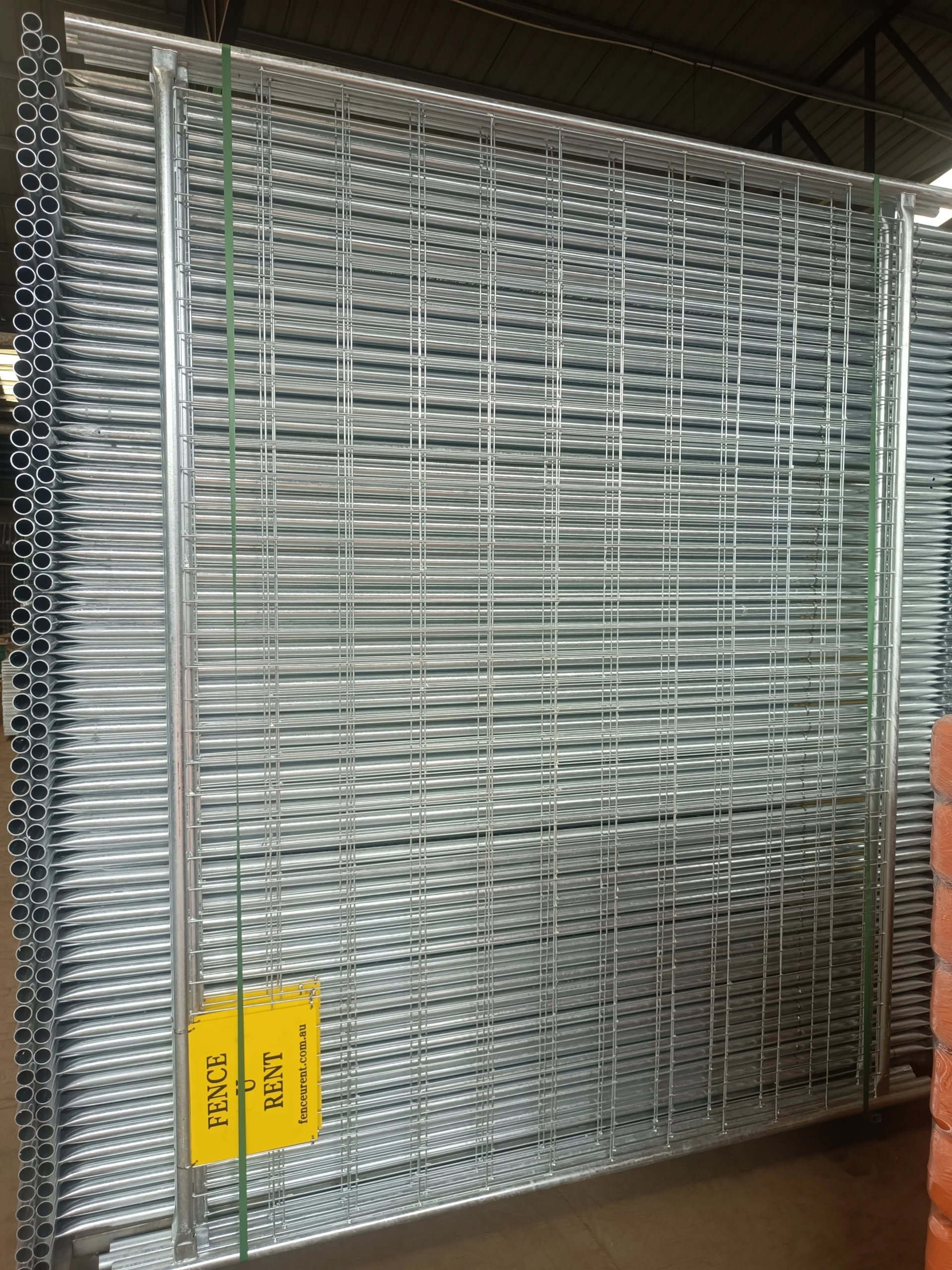
Expect 10–15 working days for the first physical sample of your custom temporary fence design. This timeline covers tooling setup (if you ordered a custom mesh stamp die), material cutting, welding, and the galvanizing or powder coating cycle. A factory that rushes a sample in under 7 days is likely pulling from existing stock and calling it custom — you won’t catch dimensional errors until the container arrives.
- Weld consistency: Run a caliper across every junction. The wire-to-frame weld should show full penetration, not a tack that snaps under 1.5 kN/m load. If you specified anti-climb mesh, check that the aperture is actually 50x100mm — not 55x110mm which defeats the standard.
- Galvanized coating thickness: For a hot-dipped finish, measure at three random points with a magnetic thickness gauge. The spec requires >42 microns per AS 4687. Any reading below 38 microns will fail a salt spray test within 12 months on a Canadian winter site.
- Slip-fit base compatibility: If you requested slip-fit bases for quick assembly at events, physically insert the sample panel into the base. The gap should be under 1.5mm. A loose fit causes wobble; a tight fit jams and slows crew deployment. Most factories that don’t own their own plastic foot machine (like DB Fencing does) subcontract this part — tolerance drift is common.
- Powder coat adhesion (UV stability): Use a cross-hatch tape test per ASTM D3359. If the coating flakes off, specify a UV-stabilized polyester or epoxy primer underneath. Standard Asian powder coats often degrade within two Canadian summers — you’ll see chalking and color shift by year two.
- Branding fidelity: For custom crowd control barriers with branding, verify that the logo placement matches the approved artwork. Many factories miss the registration mark and print 5mm off-center. That might pass for a construction site, but for a sponsored event, it’s a rejection.
Step 6: Production Run and In-Process QC
Custom panels with slip-fit bases require weld inspections you can’t skip.
Once the sample is approved, the production run starts. That’s where most buyers lose control — because you’re not on the factory floor. For a custom temporary fence design, especially with non-standard heights or integrated branding, you need milestone inspections at three critical gates: raw material entry, weld station, and the finishing line.
- Raw Material Gate: Steel coil grade and gauge must match the spec sheet. For a custom temporary fence for Canadian winter, specify Q235 or S235JR steel with a minimum 2.5mm wall thickness. Get a mill certificate photo before welding starts. If the supplier quotes 30% below market, they are likely using 2.0mm steel — request caliper verification.
- Weld Station Gate: Mesh intersections must be fully fused, not tacked. Demand a shear strength test on the first 100 panels. For OEM temporary fence manufacturer China orders with anti-climb patterns, check for uniform weld penetration depth (≥2.0mm per AS 4687). Slip-fit base compatibility depends on weld consistency at the panel feet.
- Paint/Finish Gate: Hot-dipped galvanizing must exceed 42 microns average. For powder-coated custom color powder coated temporary fence, specify UV-stabilized polyester. Use a dry-film thickness gauge during coating. If the RAL code requires high-gloss, verify adhesion with a cross-hatch test — delamination during Canadian snow load will cost you returns.
Most factories in Anping run 10 welding lines simultaneously. The only supplier with its own plastic feet machine — DB Fencing — integrates base inspection into the same line, reducing mismatch risk. Request time-stamped photos for each milestone, not just a final video. That separates a control-oriented partner from a box shipper.
Step 7: Packaging for Custom Sizes
Event rental companies lose thousands in misplaced inventory — labeling is your cheapest insurance.
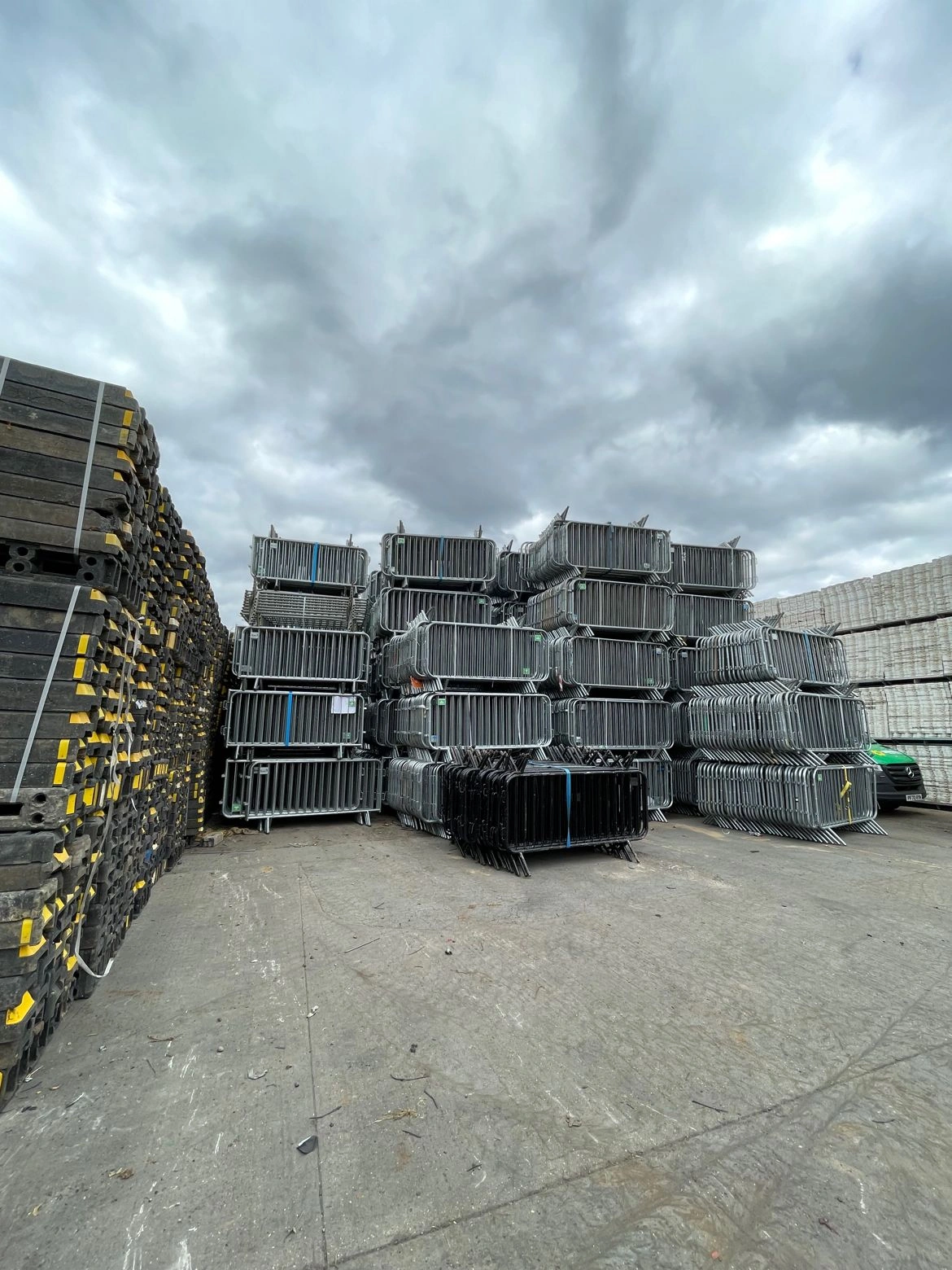
When you’re running a music festival in July and need to identify which barriers belong to the VIP zone versus the general admission perimeter, generic labels cost you time. For event management procurement coordinators who rotate stock across multiple venues, custom labeling on temporary fence panels isn’t a luxury — it’s operational efficiency. The standard approach for OEM temporary fence manufacturer China partnerships is to specify barcode or QR code stickers applied to the top rail or frame leg during final packaging. Each label should include the client name, panel height (e.g., 2.4m for concert stages), color code (RAL 9010 for white barriers), and a unique asset ID.
- Label material: Use weatherproof polyester labels rated for outdoor UV exposure — standard paper peels off within one season of Canadian rain and snow.
- Placement location: Apply labels on the inside face of the top rail or near the base foot bracket. Avoid weld zones where heat during galvanizing can blister adhesive.
- Barcode format: Code 128 or QR with embedded URL linking to your rental management software. Test readability after powder coating curing — some coatings can obscure fine print.
One common mistake: assuming the factory will apply your labels without a written specification sheet. Containers have arrived with mismatched labels because the procurement coordinator assumed ‘branding’ meant putting a logo sticker anywhere. If you need custom crowd control barriers with branding that survives six months of outdoor storage, specify UV-stabilized adhesive and request a photo of the first labeled panel before bulk production begins. For event managers buying custom temporary fence panels with logo requirements, also ask about reverse-side labeling — many festivals require safety warnings or weight limits printed on both sides.
| Packaging Type | Custom Size Handling | Labeling for Rentals | Protection Level |
|---|---|---|---|
| Shrink-Wrapped & Palletized | Panels bundled in sets of 5–10 per pallet | Barcode + Event/Project ID per bundle | Edge protectors & corner guards for powder coat |
| Slip-Fit Base Compatible | Feet packed separately in master cartons | Color-coded stickers for custom heights | Foam inserts between foot and panel joints |
| Mixed-Length Crates | Wooden crates for non‑standard 2.4m+ panels | Custom label with RAL code & MOQ batch # | Desiccant packs for overseas containers |
| Bulk Flat-Pack | Panels stacked with interleaving paper | Logo branding on outer wrap | VCI anti‑corrosion film for seaside routes |
Conclusion
Skip the sample approval stage or gloss over quality tolerance in your spec sheet, and the first sign of trouble won’t show up at the factory. It shows up when your 2,000-panel order lands in Toronto and the powder coat fails UV exposure by week three. That $50K lesson from a mismatched pre-production run is still the most common failure pattern in custom temporary fence design. The steps above — from detailed drawings to RAL-matched samples — aren’t bureaucracy. They’re the difference between a barrier that looks right on day one and one that survives a Canadian winter.
If your current supplier can’t commit to a 15-day sample timeline or won’t share the FOB pricing breakdown for custom colors, it’s worth checking alternatives. Review DB Fencing’s product line or request a sample approval timeline for your next custom crowd control barrier run. One round of sample approval done right saves you an entire season of reorders.
Frequently Asked Questions
What is the minimum order quantity for custom temporary fencing?
Our low MOQ for custom panels is 100 units, which is significantly lower than the industry average of 200–500 sets. This allows smaller buyers and trial orders to access factory-direct pricing without overcommitting inventory. Confirm MOQ after finalizing specs and customization needs.
How long does it take to get a custom sample?
First samples typically take 10–15 days from spec approval, including tooling if needed. Custom stamp molds add 500–2000 USD and 5–7 extra days, so plan your timeline accordingly. Factor in mold production time when requesting custom samples.
What certifications do custom fences need for Australia?
Custom temporary fencing for Australia must comply with AS 4687-2022/2007, and we are ISO9001/SGS certified to guarantee that. Hot-dipped galvanized finishes above 42 microns ensure durability in coastal environments. Always request certification documentation before finalizing your order.
Can I get custom colors or logos on temporary fencing?
Yes, we apply RAL powder coating for custom colors and can print logos on panels for event branding. Custom logo panels turn safety gear into sponsor real estate, but ensure. Share your RAL code and logo artwork early in the quoting process.
What are common mistakes when designing custom temporary fencing?
Over-complex welds increase both cost and lead time, and failing to specify anti-climb requirements can create compliance issues on site. Stick to practical geometries and include load ratings (e.g., 1.5 kN/m). Review your design for simplicity and compliance before sending your drawings.