Skip to content
The gap between a 42-micron hot-dipped galvanized coating and a 5-micron electro-galvanized coating on a sheep yard fencing panel is roughly eight years of field service. Most buyers never ask for the micron spec at sample approval, then wonder why the rust shows at month 14. That’s the kind of problem that starts with a shiny pre-production sample and ends with a $50,000 order that can’t be resold.
If you’re a veteran wholesaler considering a shift to factory-direct sourcing from China, the real math on sheep yard fencing vs cattle panels isn’t about FOB pricing per kilo. The critical differentiator is the quality tolerance built into the production line. Does the factory use dedicated adjustable jigs for sheep rail spacing, or do they simply narrow the cattle jig and hope the welds hold? The answer determines everything from animal safety to inventory turnover. The five differences that follow—covering wire spacing, gauge, coating, attachment methods, and supplier verification—give you a practical framework to separate a reliable partner from one shipping problems you’ll eat later.
Panel Design: Sheep vs Cattle Configurations
Cattle panels in sheep yards create welfare risks — head entrapment and handling delays.
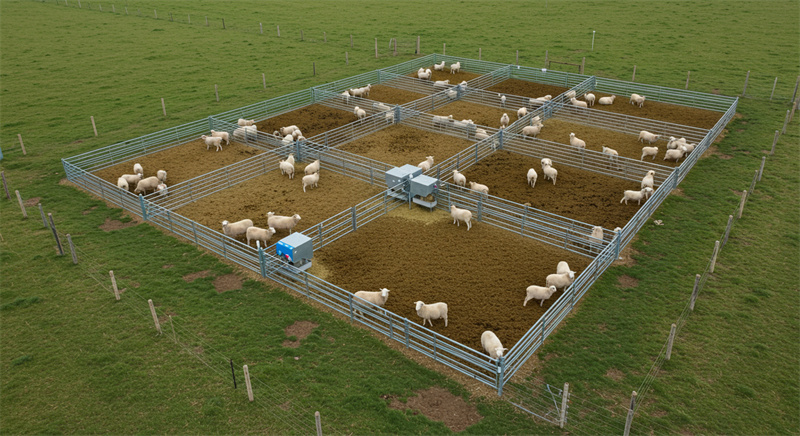
Sheep have different movement patterns than cattle. They flow toward light and shy away from shadows in handling yards, which means panel design must control both their line of sight and physical containment. The race width for sheep should be 350–400 mm — tight enough that a sheep cannot turn around but wide enough to let it walk forward without pressure. Cattle race widths run 680–720 mm. Slap a cattle panel into a sheep yard and you have a tunnel where sheep can spin, get stuck, and block the flow.
-
- Rail spacing: Vertical wire spacing must be closer at the bottom (38–50 mm to trap lambs) and wider at the top (150–230 mm). Many Chinese factories advertise sheep panels but run the same welding jigs used for cattle panels. The result: inconsistent spacing that lets a ewe wedge her head through the bottom rails. DB Fencing runs a dedicated sheep panel line with adjustable jigs — spacing is set per design, not by guesswork.
- Solid-sided forcing yard: Sheep refuse to walk past visual distractions. A forcing yard with solid sheeting on the lower half eliminates shadows and reflections. Without it, you waste time chasing individuals that baulk. Cattle panels with wide mesh gaps (8–10 inches) let in too much light and movement — SEQ Rural Steel explicitly warns these create welfare issues and operational delays.
- Weld joint integrity: When a factory uses the same jig for sheep and cattle panels, the cross-wire spacing gets forced into a compromise. That leads to weak weld intersections because the wire sits at a slight angle. Shear strength drops. A proper sheep panel has all wires perpendicular at the weld node, achieving 2000 N minimum shear. Always request weld shear test data from the supplier.
Coating and Galvanization: What Matters for Longevity
Electro-galvanizing looks shiny but fails fast—insist on real HDG.
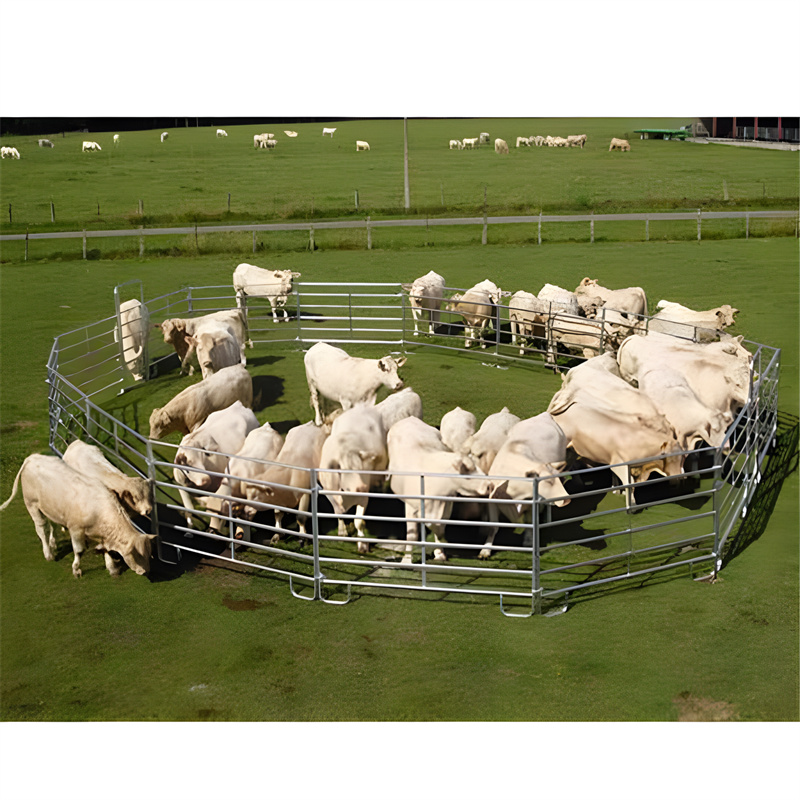
For sheep yard panels that sit outside in coastal humidity or livestock runoff, the coating thickness is the single most critical factor. The Australian standard AS/NZS 4680 mandates a minimum of 42 microns of hot-dipped galvanized (HDG) coating on structural steel. But many Chinese factories ship panels with only electro-galvanizing – a thin 5–15 micron layer that looks shiny on arrival but starts rusting within one season. If you’re sourcing for Australian farms, insist on HDG and ask for a mill test certificate showing thickness per panel.
-
- Hot-Dipped Galvanized (HDG): 42–100+ microns. Dull gray surface from zinc-iron alloy layers. Meets AS/NZS 4680. Delivers 10+ years even in salt spray zones.
- Electro-Galvanizing: 5–15 microns. Bright, shiny surface that buyers mistake for quality. Fails in 6–12 months. Not suitable for permanent sheep yards.
Here’s the insider truth: the rough, mottled surface of HDG is a sign of proper alloy formation. Inexperienced buyers often reject it as ‘poor quality’ and ask for shiny electro-galvanized panels instead – exactly the wrong move. DB Fencing’s internal testing shows that panels with coating below 42 microns fail 4× faster in controlled coastal environments. For maximum service life, specify minimum 85 microns at wire intersections (where corrosion starts first). That’s the standard for 10+ year sheep yards in coastal Australia or North American Pacific Northwest.
- What to verify with your supplier: Request a galvanization thickness report per AS/NZS 4680. Look for average >42 microns, with intersection measurements >85 microns. Reject any supplier who cannot provide third-party test data.
Wire Gauge and Strength: 14 vs 12 Gauge Trade-Offs
Sheep don’t need 12-gauge wire — but your ram yard does.
Sheep exert far less force on a fence than cattle or rams. For standard sheep yards, 14-gauge (2.0 mm) wire delivers enough strength at a lower material cost and noticeably easier handling during installation. The Reddit farming community regularly reinforces this: 14-gauge works fine for ewes and lambs, is cheaper per panel, and a crew can carry and place it without equipment. But that calculation changes the moment you add rams or run mixed livestock.
-
- Weld joint shear strength – 14 gauge: 2,000 N per joint. Adequate for quiet ewes and lambs in well-designed yards where pressure is distributed across multiple welds.
- Weld joint shear strength – 12 gauge: 3,500 N per joint. Required for ram pens or high-density holding areas where a single animal can hit a weld with 200+ kg of body weight.
- ISO 9001 weld consistency: Random destructive testing per production batch ensures every weld meets the rated shear value. Many Anping factories skip this step and rely on visual checks only.
- Handling penalty of 12 gauge: Each 1.8 m x 2.4 m panel weighs ~4 kg more in 12 gauge. Over a 200-panel container load that adds 800 kg of shipping weight and increases crew fatigue during installation.
The hidden failure mode is not wire breakage — it’s the weld popping under dynamic load. A ram hitting a panel during yarding creates a peak force that can exceed 1,000 N per contact point. If your supplier’s welds are inconsistent (common with generic jigs used for both cattle and sheep production), a single weak joint can cascade into a full panel failure. DB Fencing’s dedicated sheep panel line tests shear strength in-line and provides certs per lot. That’s the difference between trusting a spec sheet and trusting a process.
Fixing Methods: Attaching Panels to Posts
Stapling technique determines panel life more than wire gauge.
Drive each staple at a slight angle to follow the wood grain, not perpendicular to it. A staple driven straight into the grain boundary splits the post and gives you half the holding power. With hardwood posts (ironbark, cypress) common in Australian yards, angled staples let the fibers close around the wire rather than crack apart. One degree off can be the difference between a staple that pulls out after six months and one that lasts the life of the post.
Never drive staples tight against the wire. Leave 1–2 mm of slack. Why? Steel expands and contracts with temperature swings — a midday summer post can hit 60°C in direct sun, and a tight-stapled panel at that temperature will buckle or snap welds when it cools. The slack also gives you room to tension the panel after a few weeks of settlement. Avoid this and you’ll be replacing buckled sections inside the first year.
-
- Permanent yards (90 mm clouts + saddle clips): For fixed yards, 90 mm galvanized clouts (flat head nails) driven through saddle clips give the best lock. Saddle clips cradle the panel wire so it can’t shift sideways, unlike a single nail that loosens with stock pressure. Use two clouts per clip, offset vertically, and always hot-dipped galvanized — electro-galvanized clouts rust from day one in coastal humidity.
- Temporary yards (bracing + clamp systems): For seasonal or rotational yards, skip the nails. Use the same bracing and clamp systems found on construction temporary fence panels — over-centre clamps or wedge brackets. They let you relocate a 20-panel yard in under an hour without peeling coating off the wire. The clamps also allow for thermal expansion because they grip, not crush. If your supplier offers proprietary feet (DB Fencing is the only Anping factory with its own plastic feet machine), the base stability improves further.
Sourcing from China: What to Check Before Buying
80% of coating failures trace back to skipping pre-shipment inspection.
Veteran wholesalers know that the cheapest quote often hides the highest hidden costs. The quickest way to separate a real manufacturer from a trading desk is to ask about vertical integration. A factory that owns its wire drawing and welding lines controls two critical failure points: wire diameter consistency and weld joint shear strength. Anping has hundreds of trading companies, but less than a dozen hold the actual production equipment.
-
- In-house plastic feet machine: DB Fencing is the only Anping supplier with its own plastic feet injection line. This signals manufacturing depth and quality control over assembly components. Most suppliers buy feet from a third party, adding tolerance drift.
- Mill test certificate: Request the steel mill certificate for every batch of wire. A real factory can provide it within 48 hours. If you get pushback or a generic document, walk away — that means they bought spot steel from a scrap recycler.
- Galvanization report: Specify hot-dipped galvanized (HDG) per AS/NZS 4680 with minimum 42 microns. Electro-galvanizing (5–15 microns) looks shiny at first but rusts within one season. Ask for a coating thickness report from an independent lab like SGS. DB Fencing provides test data per shipment.
- Low MOQ for testing: A factory that can’t handle 100-panel MOQ for sampling likely lacks flexible production scheduling. DB Fencing’s MOQ of 100 panels lets you test SKUs before committing to a 40HQ container.
- Pre-shipment inspection checklist: Before loading, inspect weld shear strength (2,000 N for 14-gauge, 3,500 N for 12-gauge) and coating thickness at wire intersections — the first spot to fail. If the supplier won’t allow a third-party inspection, cancel the order.
Conclusion
Skipping the verification of coating thickness and weld quality on a sheep panel order might save a few cents per panel upfront. But when that container of electro-galvanized panels starts flaking in month 9, you’re looking at replacement costs that eat the entire first margin and a customer who won’t trust the next quote.
Pull the mill test certificates and galvanization reports before you commit to volume. DB Fencing offers a 100-panel MOQ for testing – use it to confirm the numbers match the promise.
Frequently Asked Questions
What is the best wire spacing for sheep panels?
Best spacing uses closer vertical wires at the bottom to prevent head entrapment—typically 150 mm or less. Horizontal rails should be spaced 350–400 mm apart to match sheep size and handling flow. Always match spacing to your flock’s breed and size.
Can I use cattle panels for sheep yards?
No—cattle panels have wider rail spacing that allows sheep to stick their heads through, causing welfare risks and handling delays. They also cost more per meter than purpose-built sheep panels. Stick with purpose-built sheep panels to avoid problems.
How much does sheep yard fencing cost per panel?
Cost depends on gauge, coating thickness, and panel size, but purpose-built sheep panels are generally cheaper than cattle panels. Factory-direct pricing from a manufacturer like DB Fencing usually offers. Request a quote with your exact specs and volume for an accurate price.
What is the difference between weldmesh and woven wire for sheep?
Weldmesh has welded intersections for rigid, shape-holding panels; woven wire has twisted crossings that can loosen over time. For permanent sheep yards, weldmesh is preferred for strength and longevity. Choose weldmesh if you need a durable, low-maintenance yard.
How do I ensure my sheep panels don’t rust in coastal areas?
Specify hot-dipped galvanized coating of at least 42 microns per AS/NZS 4680. Avoid electro-galvanized panels—they look shiny but rust within one season in salty air. Request a coating thickness test report from your supplier.