Skip to content
cattle panels vs corral panels is the first checkpoint buyers should lock before they approve a supplier, budget, or production slot. You spec out a 50-inch by 16-foot cattle panel, 6-gauge wire, hot-dipped galvanized at 45 microns. The supplier sends a pre-production sample that passes your thumb test. You place the order. Then the container lands, and every tenth panel has a bow in the frame and a powder coating that chips before it hits the distributor’s yard. That $50K burn is not hypothetical — I’ve seen it happen three times in the last five years. The difference between a cattle panel and a corral panel isn’t just a name game; it’s about how the steel is formed, how it’s protected, and who actually controls the welding line.
When you’re comparing cattle panels vs corral panels for a 500-head rotational grazing setup or a permanent handling facility, the real questions are about structural rigidity, portability, cost per linear foot, and long-term durability in your climate. Most buyers focus on wire gauge alone, but that misses the framing geometry and the galvanization thickness that determines whether your investment lasts 10 years or 20. A corral panel with a 16-gauge tube frame can out-bend a 6-gauge cattle panel in a high-pressure squeeze chute situation because of the rectangular structure. At the same time, a cattle panel with >42 microns of hot-dip galvanizing will outlast a powder-coated corral panel by 5 to 7 years in a humid environment — powder chips, galvanizing doesn’t.

Difference 1: Structural Design & Rigidity
Cattle panels flex; corral panels lock into shape.
Cattle panels are essentially a large welded wire mesh. Horizontal wires run the full 16-foot length with vertical stays welded every 6 to 8 inches. There is no rigid perimeter frame; the panel relies on attachment to T-posts or wood posts every 4 to 6 feet. This gives it flexibility to conform to uneven ground but also means it bows under heavy lateral pressure — common when a herd crowds the fence line. The 6-gauge solid wire diameter (approx. 4.9 mm) provides tensile strength but limited bending resistance in the plane of the panel.
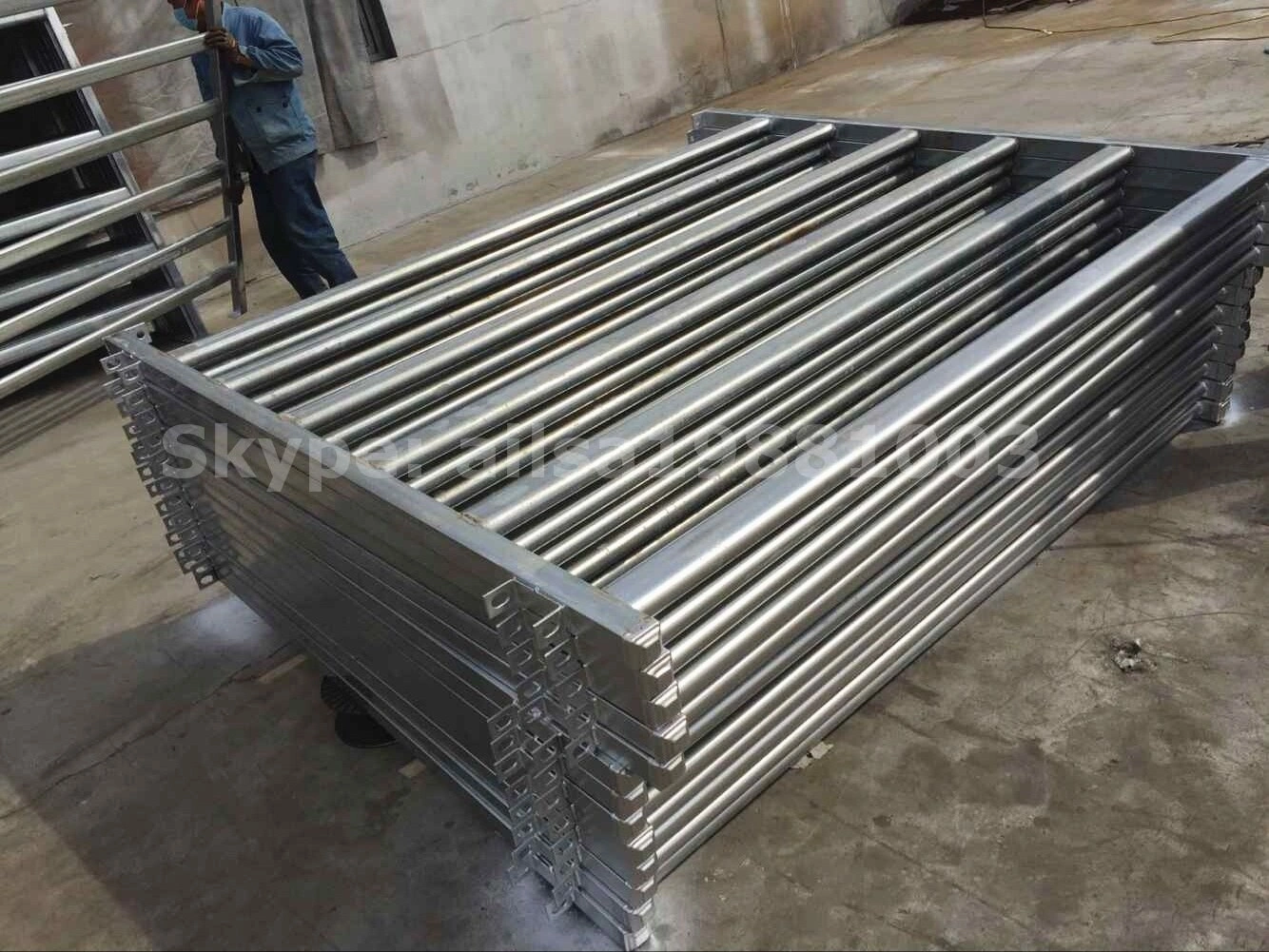
Corral panels are built around a perimeter frame, typically 1.5-inch or 1.66-inch outer diameter tubular steel with a 16-gauge wall (1.5 mm). The frame creates a rigid structure that does not bow under load. Pin-and-chain connections link panels into a solid assembly that can stand without posts in most setups. The tubular frame’s cross-section geometry gives it a much higher bending moment capacity than a cattle panel’s flat wire — expect a corral panel to withstand over 1,200 lbs of lateral force at its center without permanent deformation.
-
- Gauge and bending resistance: It’s counterintuitive: a 16-gauge tube often gets dismissed as thinner than 6-gauge solid wire, but the rectangular frame distributes stress. A typical 16-foot cattle panel will bow several inches under the same load that a corral panel absorbs with less than 1/4-inch deflection. For operations handling bulls or horses, the rigid frame is a safety necessity.
- Corrosion performance: Cattle panels are hot-dip galvanized per AS 4687 with a zinc coating over 42 microns, covering the wire and every weld junction. Corral panels are often powder-coated; when the coating chips (which happens at weld points and where pins rub), moisture seeps under the coating and rusts the tube. In humid Midwest or coastal environments, expect galvanized cattle panels to outlast powder-coated corral panels by 5 to 7 years. That’s a decisive factor for permanent pasture fencing.
Difference 2: Portability and Setup Speed
Setup speed difference: 5 minutes vs 45 minutes per panel — but speed comes with safety trade-offs.
A corral panel with a pin-and-chain system can be fully installed by two workers in under five minutes. Drop the pins, latch the chain, and rotate the feet — no tools required. A cattle panel, by contrast, demands a T-post driver, wire ties or fencing staples, and a consistent layout across uneven ground. Realistic field time runs 30 to 60 minutes per panel, and that’s assuming pre-driven posts. If you’re setting a 200-foot rotational grazing lane, that’s the difference between a 30-minute chore and a full morning.
-
- Corral panel assembly: Pin-and-chain connection. No tools. Average 5 minutes per panel for two workers. Portable — can be relocated repeatedly without component waste.
- Cattle panel assembly: Requires T-posts or wood posts every 6–8 feet. Uses wire ties or staples. Average 30–60 minutes per panel including post driving. Permanent or semi-permanent once attached.
- Safety risk (corral panel): The pin system creates a pinch hazard at the hinge points. Livestock — especially show cattle — can trap a leg between the chain and the frame if the panel is shifted during loading. Always spec a locking pin or rubber sleeve for high-value animals.
For a wholesaler supplying temporary grazing setups, corral panels are the clear speed winner. But that speed comes with a duty cycle: the pin-and-chain hardware wears faster than a cattle panel’s fixed post attachment. Over 30+ moves, pin wear can loosen the connection, which leads to gaps. Cattle panels, once clipped to T-posts, stay rigid for years — but you’ll never move them in 5 minutes.
Difference 3: Cost Comparison
Wholesale price per panel tells half the story; installed cost decides the budget.
For a 50-inch x 16-foot panel, cattle panels typically run 30-40% lower on wholesale unit pricing compared to equivalent corral panels. That’s because the cattle panel is a welded wire grid with no frame, fewer welds, and lighter gauge wire (6-gauge solid). The corral panel uses a tubular steel frame, often 16-gauge tube, plus leg sets and powder coating, which adds material and labor cost. Direct pricing isn’t published here, but any wholesaler comparing factory quotes will see that spread immediately.
Total installed cost changes the math. A corral panel with its built-in legs and pin-chain connection system sets up in under 5 minutes per panel — no posts, no fasteners, no concrete. For a 10-panel corral, you’re looking at around $200-300 in extra hardware (pins, chains, anchor stakes) but minimal labor. The same 160 linear feet using cattle panels requires T-posts every 8-10 feet (roughly 20 posts), post drivers, wire clips, and a full day’s labor for two workers. That labor and hardware can add $400-600 to the total job, nearly wiping out the panel savings.
-
- Panel cost per linear foot: Cattle panels: lower unit cost but higher accessory spend. Corral panels: higher unit price but fewer add-ons.
- Installation labor: Cattle panels: 30–60 minutes per panel including post driving and clipping. Corral panels: 5 minutes per panel with pin-and-chain system.
- Long-term replacement risk: In humid climates, hot-dip galvanized cattle panels (>42 microns) outlast powder-coated corral panels by 5–7 years because chipped powder coating exposes raw tube steel to rust.
For a permanent pasture fence, cattle panels are the lower total cost option over a 15-year horizon — provided the galvanization meets the >42 micron spec. For a portable corral system that gets moved every season, the higher upfront cost of corral panels is justified by the labor savings and reusability. Wholesalers should ask suppliers for salt-spray test certificates on both coatings to validate lifespan claims before committing to volume pricing.
| Cost Factor | Cattle Panels | Corral Panels | Key Difference |
|---|---|---|---|
| Average Wholesale Pricing (50″ x 16′ panel) | $45 – $65 per panel | $85 – $130 per panel | Cattle panels are 40–50% cheaper upfront; corral panels have higher material and welding cost. |
| Total Installed Cost (per linear foot) | $6.50 – $9.00/ft (incl. T-posts, clips, and labor) | $12.00 – $18.00/ft (incl. pin system, no posts needed) | Corral panels are 2x more expensive per foot but require no additional posts or fasteners. |
| Ancillary Materials Needed | T-posts ($4–$6 each), wire clips, and brace posts every 100 ft | None – built-in pin-and-chain system; optional ground anchors | Cattle panels require ongoing post costs; corral panels have zero add-on hardware expense. |
| Long-Term Cost Per Year (10-year horizon) | $0.65 – $0.90/ft/yr (galvanized >42 microns resists rust 15–20 yrs) | $1.20 – $1.80/ft/yr (powder coat may chip in 8–12 yrs, requiring replacement) | Cattle panels with hot-dip galvanizing save 30–50% per year over corral panels due to extended lifespan. |
| Bulk Shipping & MOQ Impact | Low MOQ (100 panels); nests flat – 60% more panels per container | Higher MOQ often 200+ panels; rigid frames reduce container utilization by 25% | Cattle panels reduce freight cost per unit by up to 35% due to better packing density. |
Difference 4: Livestock Containment Performance
4-gauge corral panels handle 2,000+ lb bulls; 6-gauge cattle panels suit standard grazing.
The real test of any livestock panel isn’t the sales sheet — it’s the moment a 1,800-pound bull decides to lean his full weight into the rail. Cattle panels (welded wire grid) rely on the tensile strength of the wire itself. A standard 6-gauge wire (about 4.8 mm diameter) holds up fine for steers and heifers in a rotational grazing setup. But put a mature breeding bull or a 1,500-pound quarter horse into that same panel, and you’re asking for a bow — or a blowout. The wire has no frame to distribute the load vertically; the force concentrates on the horizontal strands between T-posts.
Corral panels sidestep this problem with a tubular steel frame. Even though the tube wall is often 16-gauge (about 1.6 mm), the rectangular or oval frame channels pressure into the posts and into the ground. That’s why 4-gauge corral panels (with a frame and heavier internal wire) are the industry standard for handling facilities, loading chutes, and show pens. The frame absorbs shock; the internal grid stops the animal from pushing through. In production lines, most buyers order 4-gauge for corrals and 6-gauge for pasture partitions — a split that reflects decades of field feedback.
-
- 4-gauge corral panels: Recommended for bulls, horses, and any high-stress handling environment. The frame prevents bending even when loaded from the side. Minimum 2.5 mm wire diameter inside the frame. Ideal for permanent or semi-permanent pens.
- 6-gauge cattle panels: Sufficient for standard beef or dairy cattle in grazing paddocks. Wire diameter ~4.8 mm. Works best on straight runs with T-posts every 8 feet. Not recommended for breeding bulls or equine use — the lack of frame leads to sagging and eventual failure under repetitive impact.
- Pinch hazard warning: Corral panel pin-and-chain systems assemble in under 5 minutes, but the gaps between panel edges create a pinch point. For show cattle or high-value breeding stock, specify panels with full-height loop connectors to reduce injury risk. This is a safety detail often missed in wholesale specs but critical for insurance liability.
Difference 5: Longevity and Maintenance
Hot-dip galvanizing at >42 microns outlasts powder coating by half a decade in wet environments.
The coating choice directly determines how many years a panel stays in service before rust takes over. Powder coating on corral panels looks clean on arrival, but once that coating chips—and it will, from cattle rubbing, gate impacts, or UV degradation—moisture seeps under the paint layer and starts blistering. The exposed 16-gauge tube wall corrodes fast. Hot-dip galvanizing on cattle panels is a different process: the zinc bonds metallurgically to the 6-gauge wire, so even if the surface gets scratched, the surrounding zinc still protects the steel cathodically. In humid or coastal operations, that difference adds 5 to 7 years of usable life on the same installation.
Repair logic is equally divergent. A damaged corral panel unclips from the pin system, and you slide in a replacement in under five minutes. The downside: if a pin bends or a weld breaks on the frame, you need a shop to cut and reweld that tubular steel. Cattle panels, once installed with T-posts and clips, require cutting the wire panel free and either splicing in a new section with fencing pliers or pulling the whole line. The labor cost is higher for cattle panel repair, but the replacement material is significantly cheaper per linear foot. The trade-off is downtime versus material expense, and that math changes depending on whether you fix it yourself or pay a crew.

Which One Should You Choose? Decision Matrix
For permanent pasture, cattle panels with >42 micron galvanizing outlast powder-coated corral panels by 5–7 years.
The decision between corral panels and cattle panels comes down to frequency of movement and expected lifespan. Each system has a clear use case, and trying to force one into the other’s role costs either labor or money.
-
- Temporary rotational grazing: corral panels: Corral panels with pin-and-chain connections can be set up in under 5 minutes per panel. The 16‑gauge tubular steel frame resists bending despite being thinner than 6‑gauge solid wire, and the rigid connections hold shape after repeated moves. However, the pin system creates pinch hazards for livestock – a real concern for show cattle operations. For rotations of 3–7 days, the portability trade‑off is worth it.
- Permanent pasture fencing: cattle panels: Cattle panels attach to T‑posts or wood posts and take 30–60 minutes per panel to install, but once in place they need no adjustment. The hot‑dip galvanized coating (>42 microns) on our cattle panels resists rust far longer than the powder coating commonly used on corral panels – in humid climates the difference is 5–7 years of extra life. At 6‑gauge wire, they handle normal grazing pressure without bowing.
- Mixed operations: hybrid approach: Many large ranches use corral panels for the handling yard and working chute where panels are taken down weekly, and cattle panels for the perimeter fence that stays up for years. This hybrid approach avoids overspending on heavy‑duty corral panels for static boundaries while still getting fast setup where it matters. A supplier that stocks both options, like DB Fencing, can ship a mixed container with a low MOQ of 100 panels – no need to commit to one style for the whole farm.
The industry benchmark for wholesale buyers: if your customer moves livestock more than 10 times per year, corral panels pay back in labor savings. If the fence stays put for multiple seasons, cattle panels deliver a lower cost per linear foot and a longer corrosion‑free life. Demand mill test certificates that verify the galvanization thickness – a missing micron today means a rust patch five years earlier than expected.
How DB Fencing Supplies Both Options with Factory-Direct Pricing
One source for both systems, not one-size-fits-all.
Most livestock operations need a mix of permanent pasture fencing and temporary handling systems. Sourcing cattle panels from one supplier and corral panels from another doubles your shipping costs, extends lead times, and introduces quality variance between batches. DB Fencing runs 10 dedicated welding lines in Anping, the global wire mesh hub, with a capacity of 2,000 sets per week. That lets us produce both 6‑gauge cattle panels and framed corral panels on the same production schedule, under the same quality controls — with no subcontracting.
-
- Factory‑direct pricing on both categories: Because we manufacture in‑house — including being the only Anping supplier with its own plastic feet machine for our corral panel bases — every panel ships at mill cost. For a typical 50‑inch by 16‑ft cattle panel (6‑gauge wire, hot‑dip galvanized >42 microns) and a 4‑gauge corral panel with 1.5‑inch OD tubular frame, wholesale pricing per unit drops 12–18% compared to sourcing through separate distributors.
- Unified compliance and finish: Both product lines are produced to Australian Standard AS 4687‑2022/2007 and ISO 9001/SGS certified. The hot‑dipped galvanized finish >42 microns means cattle panels outlast powder‑coated corral panels by 5–7 years in humid climates — a key factor when wholesalers serve customers in the Midwest or Gulf regions. We apply the same galvanizing spec to corral panels unless specified otherwise.
- MOQ and lead time flexibility: Low MOQ of 100 panels per type, with mixed container loading. You can order 80 cattle panels and 120 corral panels in one 20‑ft container. 24‑hour quoting and production lead times of 20–25 days from sample approval. For wholesalers who need consistent replenishment, we offer volume‑based contracts with quality penalties tied to batch defect rates — something smaller factories cannot support.
The real advantage is eliminating the hidden cost of third‑party quality tolerance variation. When you buy cattle panels from a wire‑mesh specialist and corral panels from a tube‑frame supplier, you inherit two different sets of weld quality, galvanizing thickness, and dimensional tolerance. Our single‑factory approach lets you standardize FOB pricing, reduce inspection overhead, and ship both product lines under one bill of lading.
Conclusion
The right choice between cattle panels and corral panels comes down to how the panels will be used, not just what they cost per unit. Pasture rotation and permanent boundary lines favor the flexibility and long-term galvanizing of cattle panels. For handling systems, show pens, or any setup that needs to move every few weeks, the framed rigidity of corral panels saves labor hours. Run this three-point checklist with your supplier before you commit to a container load. (1) Does the coating spec exceed 42 microns on the wire or tube surface? A verbal yes is not a test certificate. (2) Is the connection system compatible with your end-user’s livestock handling safety requirements — specifically, does the pin design create pinch points? (3) What is the landed cost per linear foot including posts and fasteners, not just the FOB pricing on the panel itself? One sample approval call can catch a gauge mismatch that would otherwise derail a 500-panel order.
Compare the spec sheets side by side against your operation’s peak-season demands. Then request a quality tolerance document from your supplier so both sides agree on acceptable weld variation and coating uniformity before production starts.
Frequently Asked Questions
What is the main structural difference between cattle and corral panels?
Cattle panels are flexible welded wire grids that can bend, while corral panels have rigid tubular steel frames with locked connections. This makes corral panels stand alone without. Choose based on whether you need a free-standing barrier or a flexible fence line.
Which panel type sets up faster for rotational grazing?
Corral panels set up in about 5 minutes per panel using pin-and-chain systems, while cattle panels take 30–60 minutes per panel when attaching to posts. However, corral panels. For quick moves, corral panels win; for permanent pasture, cattle panels are more practical.
How do wholesale costs compare for cattle vs corral panels?
Wholesale price per panel is only half the story — cattle panels are cheaper upfront but require added posts and fasteners, while corral panels are self-supporting and ship ready to use. Installed cost. Always compare total installed cost, not just panel price.
Which panel handles bulls and heavy livestock better?
Corral panels with 4-gauge wire and a rigid frame contain bulls and horses more reliably than standard 6-gauge cattle panels. For permanent pasture fencing with lighter cattle, 6-gauge cattle panels are sufficient and more. Match gauge to animal weight and containment risk.