Skip to content
Most event coordinators treat concert barrier load ratings as a checkbox item for insurance compliance. That approach ignores the real bottleneck: logistics and total cost of ownership. Standard front-of-stage barriers require a 5kN static load rating, but relying on heavy steel bases to meet that requirement destroys your profit margins through freight costs and manual handling delays.
Factory-direct purchasing combined with specialized lightweight bases offers a structural advantage that local rental markets cannot match. We utilize hot-dipped galvanization exceeding 42 microns to ensure the steel withstands harsh conditions without adding unnecessary weight. This engineering choice allows you to maximize container space and reduce setup labor, turning a standard safety requirement into a competitive operational edge.

Why Most Crowd Barriers Fail in 5kN Tests
Most barriers fail 5kN tests due to spot-weld shear fractures, not material yield.
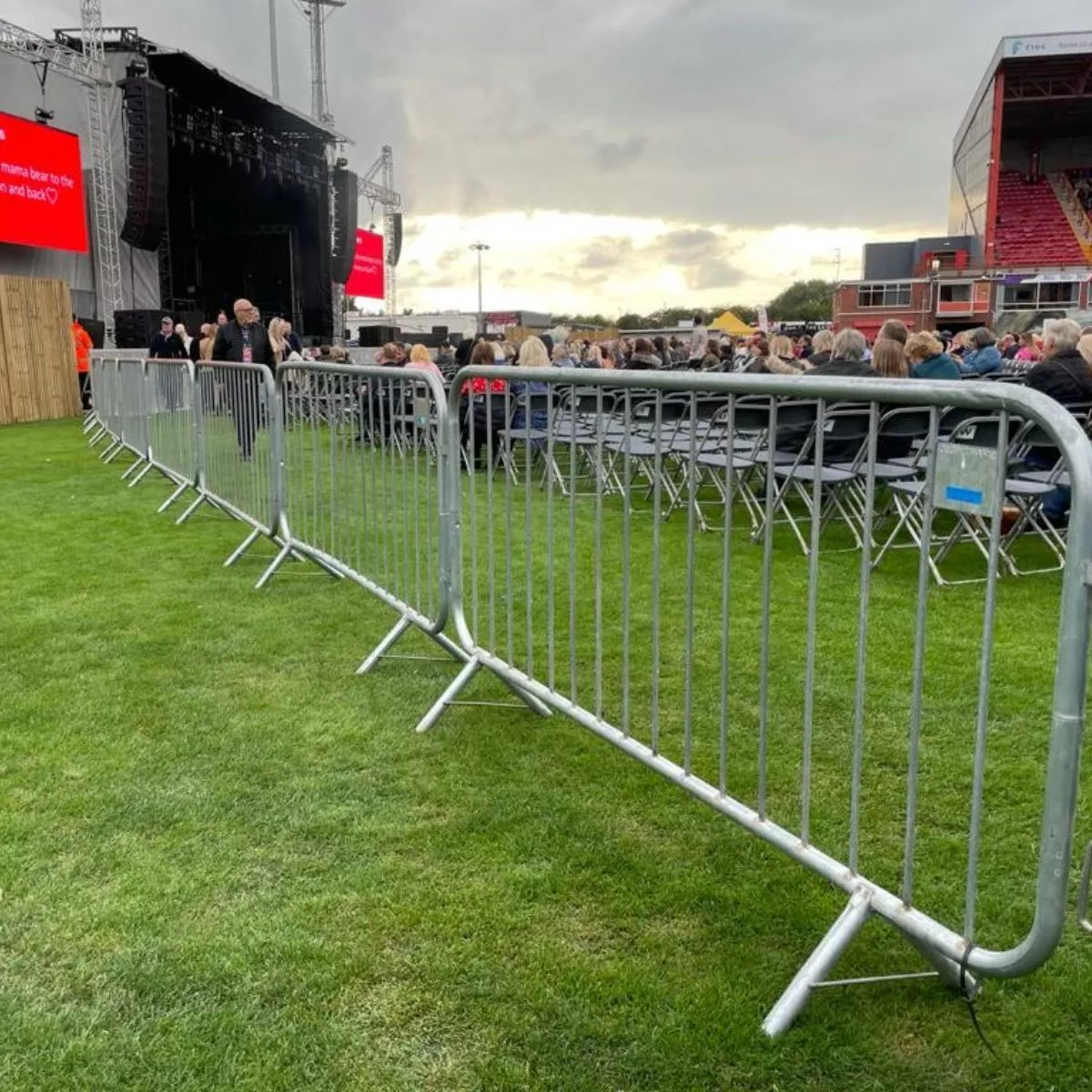
Event managers often assume that if a barrier looks sturdy, it will pass a 5kN load rating test. In reality, the most common point of catastrophic failure is not the steel tube itself, but the weld joint connecting it to the base. Compliance with AS 1170.6 (Australia) or the Green Guide (UK) mandates that front-of-stage (FOS) barriers withstand a static pressure of 5kN—roughly 500kg per meter. This immense lateral force exposes the structural weaknesses of substandard manufacturing.
The primary culprit behind 5kN failures is the widespread use of spot welding instead of full-joint continuous welding. Spot welds create a localized bond that lacks the tensile strength required to resist dynamic crowd surges. Under high-pressure conditions, the shear force at the weld point exceeds the bond’s limit, causing the barrier to instantly detach from its base. Once one panel fails, the kinetic energy transfers to adjacent units, triggering a domino effect collapse.
Beyond welding, thin-gauge steel is a silent liability. Manufacturers cutting costs often use steel thinner than 1.6mm. While a thinner gauge might pass a basic static test, it lacks the rigidity to handle dynamic loading. Thin steel flexes excessively under a 5kN load, altering the barrier’s center of gravity and increasing the likelihood of tipping over. To ensure structural integrity, procurement coordinators must demand barriers utilizing hot-dipped galvanized steel with a minimum thickness of 1.6mm and a zinc coating exceeding 42 microns to prevent in-transit corrosion.
- Weld Integrity: Reject barriers relying solely on spot welding. Verify continuous full-joint welding, which distributes the 5kN load evenly across the entire contact point rather than concentrating stress on a single fragile spot.
- Steel Gauge Verification: Ensure the vertical stiles and horizontal rails meet the 1.6mm minimum thickness requirement. Thinner gauges fail under dynamic crowd loads even if they appear rigid initially.
- Third-Party Certification: Demand independent test reports confirming compliance with AS 1170.6 or the UK Green Guide. Do not rely on the supplier’s self-declared specifications for safety-critical components.
Real Cost Breakdown of Steel vs Recycled Rubber Bases
Recycled rubber bases cut freight volume by 40% and labor hours by half compared to traditional steel feet.
The most overlooked expense in concert barrier procurement is not the steel itself—it is the logistics overhead required to move heavy, bulky units to remote venues. Traditional steel feet, while structurally robust, impose severe penalties on both freight budgets and on-site crew efficiency. By pivoting to recycled rubber bases, event coordinators unlock a significant arbitrage opportunity that drastically lowers the total cost of ownership.
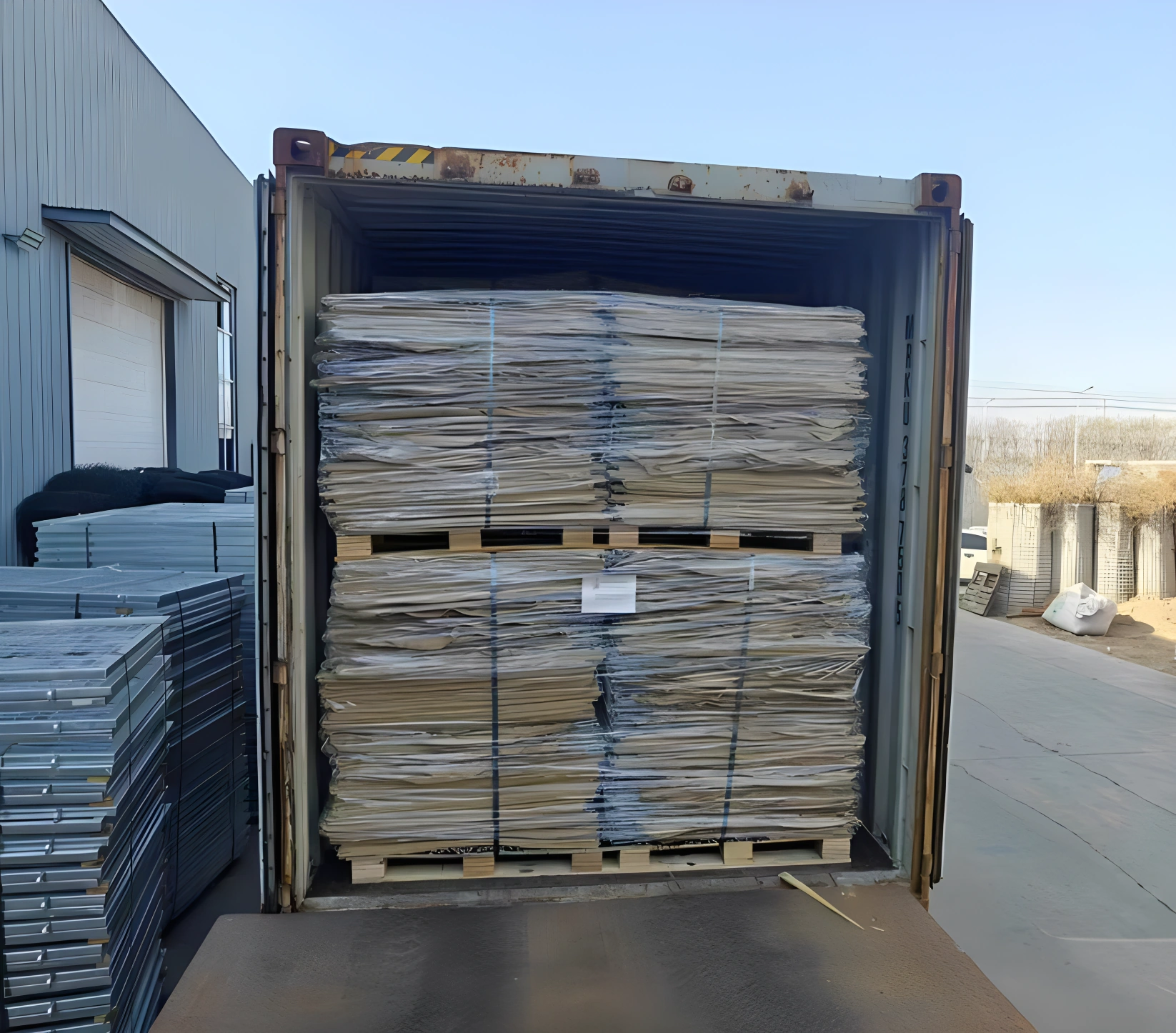
- Freight Volume Optimization:: Recycled rubber bases are approximately 60% lighter than concrete or solid steel equivalents. This density reduction allows you to pack up to 30% more barrier units into a standard 40ft container, directly slashing per-unit ocean freight costs and maximizing your asset yield per shipment.
- Labor Hour Savings:: During peak festival setup, time equals money. Heavy steel feet require multiple crew members or mechanical assistance to position safely. Lightweight rubber bases enable rapid, single-person deployment, significantly reducing crew overtime costs and accelerating the timeline for front-of-stage barricade installation.
- Capital Expenditure Reduction:: Factory-direct purchasing combined with lightweight base technology reduces long-term capital expenditure by roughly 60% compared to recurring rental market premiums. Furthermore, the rubber material offers superior resistance to UV degradation and impact cracking, ensuring the barriers remain structurally sound and visually presentable for 10+ seasons.
| Feature | Specification | Advantage |
|---|---|---|
| Base Material | Heavy Steel vs. Recycled Rubber | Rubber reduces weight by 60%, cutting freight costs by 40% |
| Unit Weight | Steel: ~12kg vs. Rubber: ~4.5kg | Lighter bases allow 30% more units per 40ft container |
| Setup Labor | Steel: High vs. Rubber: Low | Rubber bases reduce crew fatigue and setup time significantly |
| Durability | Steel: Prone to rust vs. Rubber: Weatherproof | Rubber resists corrosion, ensuring long-term structural integrity |
| Total Cost | Steel: High TCO vs. Rubber: Low TCO | Lower logistics and labor costs offset higher initial material price |
Concert Barrier Specs: 5kN vs 3kN Load Ratings
Front-of-stage barriers require 5kN load ratings; perimeter barriers only require 3kN.
In large-scale festival logistics, distinguishing between front-of-stage (FOS) and perimeter barriers is the primary defense against catastrophic liability. FOS barriers face concentrated, dynamic surges from adrenaline-fueled crowds, demanding a strict 5kN (approx. 500kg/m) static pressure rating. Perimeter barriers, designed for general crowd flow or venue boundaries, are only engineered to withstand 3kN.
Substituting a 3kN perimeter barrier in a front-of-stage configuration is a severe safety violation. Under the weight of a dense crowd, a 3kN barrier will buckle or topple, instantly creating a fatal crush hazard. Furthermore, insurance providers and safety auditors strictly enforce this distinction; using substandard barriers voids event liability coverage and violates AS 1170.6 crowd load safety standards Australia.
- Load Capacity: FOS barriers must sustain 5kN/m to survive crowd surges. Perimeter barriers are rated at 3kN/m and are structurally inadequate for stage fronts.
- Structural Rigidity: To handle the 5kN load, FOS barriers utilize heavier gauge steel and reinforced continuous welds. Lighter 3kN models often rely on spot welds that snap under dynamic pressure.
- Base Weight Variance: FOS barriers require significantly heavier ballast (often 15-20kg steel feet or equivalent recycled rubber) to anchor the 5kN load. Perimeter bases are lighter and insufficient for stage security.
- Liability Exposure: Deploying 3kN barriers at the front of the stage exposes organizers to massive negligence lawsuits. Compliance with AS 1170.6 is non-negotiable for FOS zones.
How to Source Concert Barriers Without Getting Scammed
Verify AS 1170.6 test reports, continuous welds, and 5kN load ratings before signing any OEM contract.
The concert barrier market is flooded with substandard stock that looks solid but fails under dynamic crowd loads. For an Event Management Procurement Coordinator, the difference between a safe festival and a liability nightmare is the documentation you demand before the container leaves Anping. Most suppliers will hand you a generic certificate; you must demand the specific third-party engineering data that proves the barrier won’t collapse when a 500kg crowd surge hits the front of stage.
- Third-Party Test Reports: Do not accept internal factory lab results. Require an independent, ISO 17025 accredited report verifying a 5kN (approx. 500kg/m) static pressure load. This is the non-negotiable threshold for AS 1170.6 crowd load safety standards Australia. If the report is missing, dated, or vague, the barrier is a liability waiting to happen.
- AS 1170.6 Certification Checks: Ensure the certification explicitly references AS 1170.6 for Australia or the Green Guide for the UK. Generic ‘safety compliance’ claims are marketing fluff. You need a document that details the exact testing methodology, proving the barrier withstood the required load without permanent deformation or structural failure.
- OEM Consistency & Welding Verification: Many ‘certified’ barriers fail because they use cheap spot welding instead of full-joint welding. As the only supplier in Anping with its own plastic feet machine, DB Fencing operates 10 dedicated welding lines that produce verifiable continuous welds. Request a live video walkthrough of the production line to confirm the weld integrity matches the certified prototype.
Sourcing concert barriers is not just about the price per panel; it is about the structural integrity of the welds and the verifiability of the load ratings. By demanding these specific checks, you protect your event from catastrophic failure and ensure that your custom branded crowd control barriers for festivals meet the highest safety standards without the premium rental markup.
Conclusion
Front-of-stage barriers must withstand 5kN loads to prevent catastrophic crowd surges. Factory-direct purchasing with lightweight recycled rubber bases significantly reduces freight costs and long-term capital expenditure compared to traditional rental models.
Review current specifications and OEM customization options for high-quality stage barriers.
Frequently Asked Questions
What is the height of a concert barrier?
Standard front-of-stage barriers typically measure 1100mm in height to effectively manage crowd pressure. This dimension balances visibility for attendees with sufficient physical containment for safety. Verify exact dimensions against your specific event safety plan.
What are the barriers called at concerts?
They are commonly referred to as crowd control barriers, temporary fencing panels, or front-of-stage (FOS) barricades. These terms are used interchangeably in the B2B event management and security sectors. Use these terms when sourcing from manufacturers for accurate quotes.
What are type 3 barricades?
Type 3 barricades are temporary steel or aluminum crowd control barriers designed for high-density public gatherings. They are engineered to withstand significant static and dynamic loads, such as the 5kN requirement. Ensure your supplier provides load test certification for Type 3 compliance.
How many decibels is a concert front row?
The front row of a loud concert typically reaches 110 to 120 decibels, which is near the threshold of pain. Prolonged exposure without hearing protection can cause immediate and permanent hearing damage. Mandate hearing protection for all front-row staff and attendees.
What would 200 decibels do to you?
200 decibels is physically impossible for human hearing and would cause immediate, fatal internal organ damage and lung rupture. This level of sound pressure exceeds the structural limits of human tissue. Focus on realistic decibel ranges for proper safety planning.