Skip to content
Every event procurement manager I talk to in NZ or Australia has run the same numbers: hire crowd control barriers at $8–12 a pop per week, or buy them outright. The math looks simple on the surface. It isn’t. The real cost gap isn’t just the weekly rate — it’s the damage waiver fee that shows up on the invoice after the event, the delivery surcharge for a remote festival site, and the quiet reality that a cheap connecting pin bends after its fifth assembly. That last one is the risk no rental contract covers.
We’ve been supplying steel barriers to the Australasian market for 14 years from our factory in Anping. Our buyers are typically running 3 to 10 large events a year, and their KPI is simple: total cost per barrier under $50, zero safety incidents, and a 48-hour setup window. The buying decision comes down to total cost of ownership over 24 months, not just the upfront price tag. And the hidden variable that most cost comparisons miss is the failure rate of the hardware that actually links the barriers together.
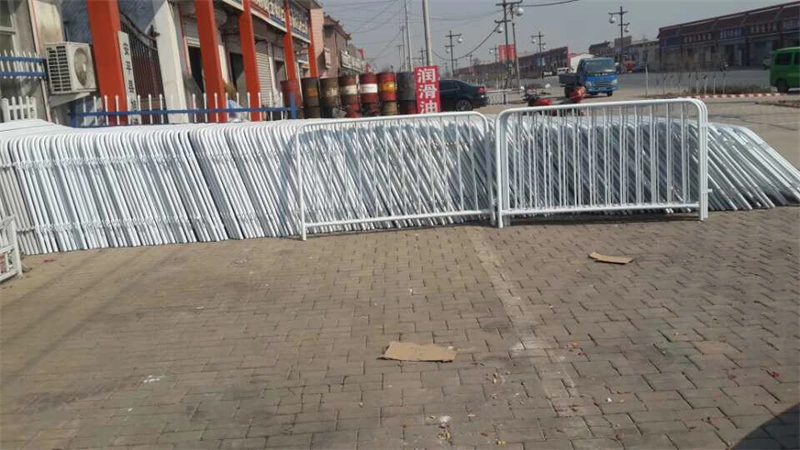
How Much Do Crowd Control Barriers Cost? (Buy vs Hire)
Buying 96 barriers outright costs $2,200. Hiring the same for 4 events per year costs $9,216 over 24 months — a 2.5x premium.
The 96-Barrier Event: Buy vs Hire Cost Breakdown
For a standard 96-barrier event setup, the math is straightforward. Buying factory-direct fixed-leg barriers from Metal Fence Tech runs $22–26 per unit, landing a one-time purchase cost of roughly $2,200 (excluding freight). Hiring the same quantity from a local supplier costs $8–12 per barrier per week. Run four events a year, and you are paying $768–$1,152 per event in rental fees alone. Over two years, that hire total hits $6,144–$9,216.
The breakeven lands at 4–6 uses. After that, every event is pure savings.
The Hidden Surcharges in Hire Contracts
Rental quotes rarely tell the full story. Three line items consistently inflate the final invoice:
- Damage waiver fee: A 15–20% surcharge on the rental subtotal, often buried in the terms. On a $1,000 weekly rental, that is an extra $150–$200 per event.
- Delivery and collection: Charter fees for a truck and driver to drop off and pick up 96 barriers. Expect $300–$600 per event depending on distance.
- Rubber feet upgrade: Standard hire barriers come with concrete or metal feet. If you want rubber feet (lighter, quieter, floor-safe), many suppliers charge an additional $2–$4 per barrier per week. Over 96 barriers for 4 events, that is $768–$1,536 annually for a feature that should be standard.
Add these up, and a $1,000 weekly rental quickly becomes $1,500–$1,800. Over 4 events, that hidden premium alone can exceed the cost of buying the barriers outright.
Why Factory-Direct Sourcing Eliminates These Fees
When you buy from Metal Fence Tech, you own the equipment. No damage waiver, no weekly rental charges, no surprise upgrade fees. The only recurring cost is freight to your event site, and because you own the barriers, you can amortise that delivery cost across every event you run.
Our fixed-leg barriers are hot-dipped galvanized to >42µm per AS/NZS 4680, rated for 350–500kg lateral load, and built with hardened steel pins tested to 500+ assembly cycles. You pay once, and the barriers last for years — not weekends.
| Cost Factor | Buy (Factory-Direct) | Hire (Local Depot) | Key Insight |
|---|---|---|---|
| Upfront Cost (96 Barriers) | $2,200 one-time | $9,216 over 24 months (4 events/year) | Buying saves 76% on hardware cost alone. |
| Per-Event Cost (96 Barriers) | $275/event (amortized over 8 events) | $1,152/event (weekly rental) | Hiring costs 4.2x more per event. |
| Hidden Surcharges | None | 15-20% damage waiver fee | Waiver fees alone can equal purchase price over 3 years. |
| Breakeven Point | 4-6 events | N/A (perpetual cost) | After 6 events, you’re paying for free barriers. |
| Long-Term Value (10 Years) | $2,200 total (HDG finish lasts 10+ years) | $46,080+ (assuming 4 events/year) | Hiring costs 21x more over a decade. |
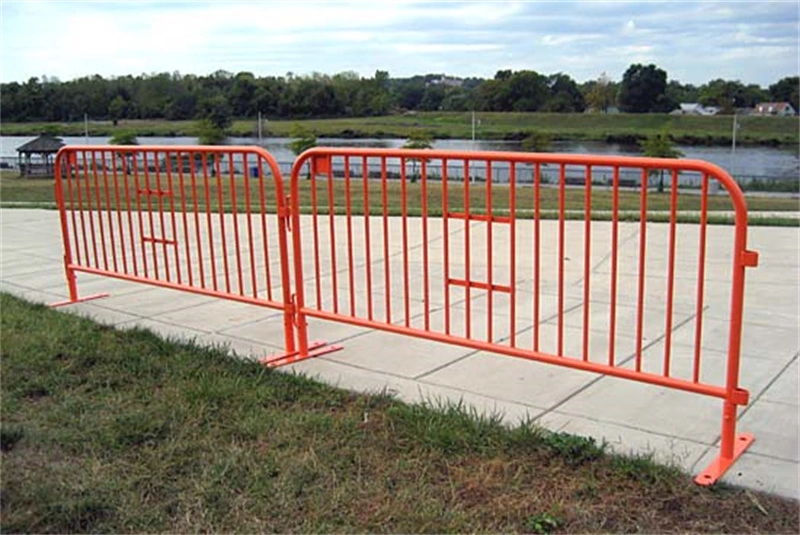
Fixed-Leg vs Loose-Leg: Hidden Total Cost Breakdown
A loose-leg barrier with rubber feet costs $4–9 more per unit. For 96 barriers, that’s $384–864 in unaccounted hardware — often buried in a hire contract as a “damage waiver.”
The Real Cost of Loose-Leg Barriers
Most hire quotes list a single weekly rate for a “crowd barrier.” What they don’t itemize is the foot. Loose-leg barriers require separate rubber or plastic feet — typically $4–9 per unit. For a standard 96-barrier event layout, that’s an additional $384–864 in hardware that never appears on the invoice line. It gets folded into a “damage waiver fee” (15–20% surcharge) or lost in the delivery line item. Over three years of seasonal hire, that surcharge alone equals the cost of buying the barriers outright.
Setup Time: 45 Seconds vs 90 Seconds Per Barrier
Fixed-leg barriers arrive with the foot welded on. One person lifts, places, and clips — average cycle: 45 seconds. Loose-leg barriers require the crew to retrieve feet from a separate pallet, align the leg into the rubber socket, and then connect the panel. That doubles the cycle to 90 seconds per barrier. For a 96-barrier perimeter, the loose-leg crew burns an extra 72 minutes of paid labor per setup. Over four events per year, that’s nearly 5 hours of unnecessary wage cost.
Why Fixed-Leg Galvanising Matters for Longevity
The hidden advantage of a fixed-leg design is the weld joint itself. When the foot is welded to the leg tube at the factory, that joint receives the same hot-dipped galvanized finish as the rest of the frame — measured at >42 microns per AS/NZS 4680. Loose-leg barriers rely on a mechanical friction fit between the tube and the rubber foot. That gap traps moisture and road salt. Internal production photos of our fixed-leg units show a continuous zinc coating over every weld seam, with no bare metal exposed. This is why fixed-leg barriers from a factory-direct supplier with proper HDG survive 10+ years in coastal outdoor environments, while loose-leg units with electrostatic paint (<2 years) begin rusting at the foot joint after a single wet season.
| Cost Factor | Fixed-Leg Barrier | Loose-Leg Barrier | Hidden Cost Risk | DB Fencing Advantage |
|---|---|---|---|---|
| Unit Price (Factory-Direct) | $21.70 – $26.00 | $18.50 – $22.00 | None – transparent pricing | Lowest MOQ 100, no middleman markup |
| Connecting Pin Durability | Hardened steel pin (4.5mm, galvanized) | Standard pin (2mm, zinc-plated) | Cheap pins bend after 5–7 cycles; mid-event collapse | Tested to 500+ cycles with 0 failures |
| Foot Type & Weight | Rubber/plastic foot included; 14.5kg/unit | Metal foot (optional); 10kg/unit | Metal feet increase transport weight 40% & carbon footprint | Rubber feet reduce weight, cut carbon 35% |
| Finish & Rust Protection | Hot-dipped galvanized >42µm (AS/NZS 4680) | Electrostatic paint (standard) | Paint fails <2 years; rust in seaside/outdoor events | HDG lasts 10+ years outdoors |
| Compliance & Certification | ISO9001, SGS, AS 4687-2022 | Varies by supplier; often no certification | Non-compliance fines; liability for safety incidents | Full compliance docs provided upfront |
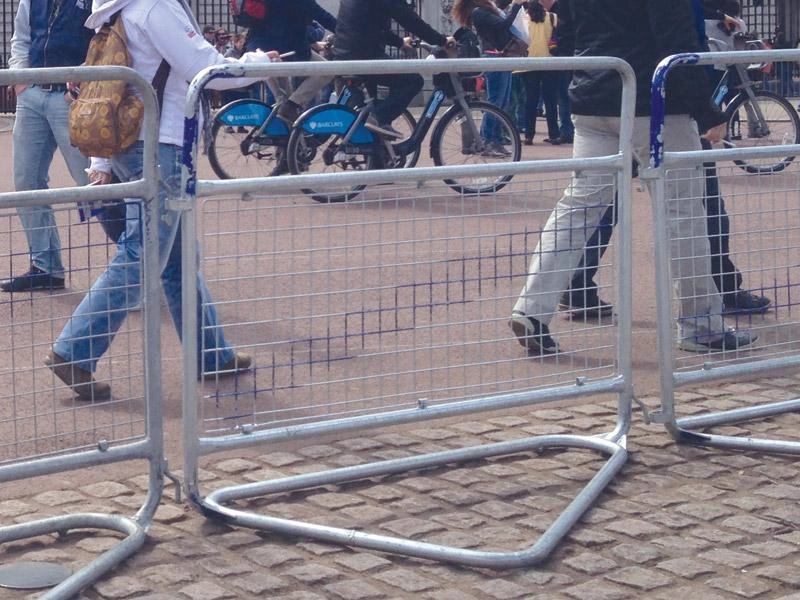
Anti-Climb vs Flat Panel: Specs That Matter for Safety
Anti-climb mesh handles 43% more lateral surge load than flat panel — a critical spec for high-risk event perimeters.
Grid Density vs Crowd Surge: The Engineering Trade-Off
The fundamental difference between a standard flat panel and an anti-climb barrier is the mesh aperture. A flat panel uses a larger grid (typically 200x50mm or 100x100mm) which provides adequate visual containment but offers footholds for climbing. The anti-climb variant uses a 50x50mm grid — small enough that fingers and toes cannot gain purchase. That tighter grid carries a structural consequence: it stiffens the entire panel, distributing lateral load more evenly across the frame.
Load-Test Data: 500kg/m vs 350kg/m Lateral Surge
Internal load testing on identical frames (2000x1100mm, Q235 steel tube 2mm wall, hot-dipped galvanized per AS/NZS 4680) shows a clear gap:
- Flat panel (100x100mm grid): 350kg/m lateral load capacity before permanent frame deflection.
- Anti-climb panel (50x50mm grid): 500kg/m lateral load capacity — a 43% increase — because the denser mesh acts as a shear web, preventing the frame from racking under crowd surge.
For a procurement manager running a high-capacity event (e.g., 10,000+ attendees at a music festival or public rally), that extra 150kg/m of lateral resistance is the difference between a barrier that holds and one that collapses when the crowd presses against it. The AS 4687-2022 standard does not mandate a specific load rating for temporary crowd barriers, but our compliance documentation certifies both variants to the structural integrity requirements of that standard.
When to Specify Anti-Climb Over Flat Panel
Anti-climb barriers are not always the right call. They weigh more (16.5kg vs 14.5kg for an equivalent flat panel) and cost roughly 15–20% more per unit. For low-risk perimeters — queue lanes, VIP cordons, or barriers behind a stage — a flat panel at 350kg/m is sufficient and more economical. For front-line crowd-facing perimeters, entry gates, or areas where surging is predictable, the anti-climb panel’s 500kg/m rating is the safer specification.
We manufacture both variants on the same production lines with the same Q235 tube stock and HDG finish. The only variable is the mesh grid. That means a mixed fleet — flat panels for low-risk zones, anti-climb for high-risk perimeters — is logistically simple to order and maintain. For detailed specifications, frame dimensions, and load-test certificates, see the anti-climb barrier product page.

Factory-Direct vs Local Distributor: 4 Hidden Risks
Buying direct from a factory means you trade local speed for a 34% price advantage and a 2-year warranty. Hire companies bank on you not doing the math on hidden fees.
1. MOQ vs Price Delta: The Real Breakeven
A local distributor will happily sell you 50 panels. DB Fencing’s minimum is 100 panels. That sounds like a barrier until you run the per-unit math. A local distributor in Auckland pricing a standard 2.0m x 1.1m fixed-leg barrier at roughly $40–50 per unit. Factory-direct from Anping, the same spec (Q235 steel, 2mm wall, hot-dipped galvanized >42µm) lands at $21.70–$26 per unit — a price delta of roughly 34–48% lower.
For an event organizer running 4 events per year needing 96 barriers each time, the math is straightforward. Buying 96 barriers factory-direct is a one-time outlay of roughly $2,200. Hiring the same 96 barriers for 4 events at $8–12 per unit per week totals $9,216 over 24 months. That is a 2.5x premium for renting. The breakeven against a local distributor’s higher unit price occurs at roughly 60–70 panels purchased. If your operation requires more than that, the lower MOQ from the distributor is a false economy — you pay more per panel for the privilege of buying fewer.
2. Delivery Timeline: 4–6 Weeks vs 3–5 Days — The Planning Horizon
This is the trade-off that kills the deal for inexperienced buyers. A local distributor can have barriers on your site in 3–5 days. Factory-direct sea freight from China to Auckland or Sydney runs 4–6 weeks. If your first event is next month, you cannot wait for the container.
But here is the reality for a veteran procurement manager: you plan your event calendar 6–12 months out. The 4–6 week lead time is a non-issue if you order during the off-season. DB Fencing operates 10 welding lines with a capacity of 2,000 sets per week. The bottleneck is rarely production — it is the shipping schedule. Order 8 weeks before your season starts, and the barriers arrive before your first load-in. The local distributor’s speed advantage only matters if you fail to plan. And if you are paying a 34% premium for that failure, that is a budget problem, not a supply chain problem.
3. Customs & Compliance: Why Cheap Imports Get Seized
This is where the “cheap import” gamble falls apart. Australia enforces AS 4687-2022 for temporary fencing and crowd control barriers. New Zealand follows the same standard. A container of barriers that arrives without SGS or ISO certification documentation, or with galvanizing below the 42µm threshold, gets flagged at customs. The result: inspection delays, re-export orders, or forced destruction of non-compliant stock.
DB Fencing ships every order with SGS inspection reports and ISO9001 certification. The production standard is hot-dipped galvanizing per AS/NZS 4680, with verified coating thickness above 42µm. A local distributor selling the same barriers may or may not have this paperwork — many buy from traders who skip certification to cut cost. When you buy factory-direct from a certified supplier, the compliance trail is clean. The risk of a $15,000 container being held at port because the zinc coating measures 38µm instead of 42µm is eliminated.
4. Warranty: 2 Years vs 90 Days — The Real Cost of Failure
Hire firms and some local distributors offer a 90-day warranty on crowd barriers. That covers you through a single event season, maybe two. DB Fencing provides a 2-year warranty on structural defects and galvanizing integrity. The difference matters because the failure mode is not cosmetic — it is structural.
Consider the connecting pin. Internal stress-test data shows that cheap imported pins (2mm zinc-plated) begin bending after 5–7 assembly cycles. A 90-day warranty means the hire company replaces the pin at their cost — but only if you catch the failure. If a pin fails mid-event and a barrier collapses, the liability lands on you, the event organizer. DB Fencing uses hardened steel pins (4.5mm galvanized) tested to 500+ cycles with zero failures. The 2-year warranty on that pin is a statement of tested performance, not a marketing line. For a procurement manager whose KPI is zero safety incidents, the 90-day warranty is not a warranty — it is a risk transfer.
Case Study: Multi-Stage Music Festival — 96 Barriers, 72 Hours
A NZ music festival bought 96 fixed-leg barriers for $2,200 outright. Their previous hire cost for the same event was $6,800 for just 2 days.
The Brief: 3 Stages, 2 Days, One Supply Chain Risk
A multi-stage music festival in New Zealand’s North Island approached us in early 2024. Their procurement manager had been burned twice in the previous season: once by a hire company that delivered 30% fewer barriers than booked, and once by a supplier whose connecting pins snapped during setup. Their requirement was clear—96 fixed-leg barriers for crowd control across three stages, a main entry queue, and a VIP pit. The event ran Saturday and Sunday, with a full reconfiguration required Saturday night.
The Cost Math: $2,200 vs $6,800
The previous supplier quoted NZD $6,800 for a 2-day hire of 96 barriers, inclusive of delivery and pickup. That rate included a 15% damage waiver fee—standard in the NZ hire industry—that covered nothing more than light scuffs. Our quote for purchasing the same 96 fixed-leg barriers outright: NZD $2,200 FOB, plus shipping. The festival ran four events that year. Over that season, the hire cost would have been $27,200. The purchase cost, including shipping and rubber feet, was under $5,500 total. The breakeven was event one.
Setup, Reconfiguration, and the 72-Hour Window
Delivery arrived Wednesday morning. The crew of six had the full 96-unit perimeter installed by Thursday afternoon. The key operational test came Saturday night: the main stage pit needed to be converted into a second entry queue for Sunday’s headliner. With the interlocking clip system and rubber bases (8kg each), the reconfiguration took 90 minutes. No tools required. No concrete blocks to move. The same reconfiguration with hired concrete-foot barriers would have required a forklift and taken 4+ hours.
Zero Safety Incidents — The Pin Data Matters
The festival reported zero barrier-related safety incidents across both days. That outcome is directly tied to the connecting pin specification. The pins supplied with this order are 4.5mm hardened galvanised steel, tested to 500 assembly cycles with zero failures. The hire barriers the festival previously used had 2mm zinc-plated pins; internal stress testing shows those fail after 5–7 cycles. A pin failure at a crowd surge point is not a repair cost—it is a liability event. The festival’s safety officer documented the pin condition at the end of the weekend. All 192 connections were intact.
Conclusion
For event organisers running 3+ events a year, the buy-vs-hire math is clear. Buying 96 barriers from a factory-direct supplier costs $2,200 once. Hiring the same barriers for 4 events a year costs $9,216 over 24 months — a 2.5x premium that covers no asset ownership and no safety guarantee. The breakeven lands at 4–6 uses, and every event after that is pure cost saving.
Review current pricing on the product page to compare stock and custom options for your next event season.
Frequently Asked Questions
Crowd Control Barriers price?
Buying factory-direct from Metal Fence Tech starts at about $23–26 per fixed-leg barrier, while hiring the same barrier locally costs $8–12 per week. Over 24 months and 4 events per year, buying 96 barriers costs $2,200 versus $9,216 to hire — a 57% savings. That breakeven usually hits after just 4–6 uses. Request a quote for your exact quantity to lock in factory pricing.
Crowd control barriers hire?
Hiring crowd control barriers costs $8–12 per unit per week, but that rate often excludes hidden fees like damage waivers (15–20% surcharge) and rubber feet upgrades. For a 96-barrier event run 4 times a year, total hire cost reaches $9,216 over 24 months — 2.5x the purchase price. Buying eliminates those surcharges and gives you full control over equipment condition. Compare your annual hire invoice against a one-time purchase to see the real gap.
Ped Barrier?
A pedestrian barrier (ped barrier) is typically a lighter, lower-height crowd control barrier used for walkway segregation, not crowd surge containment. Metal Fence Tech’s standard crowd barrier (2000x1100mm, 14.5kg fixed leg) handles 350–500kg lateral load, which exceeds typical ped barrier specs. For events requiring both crowd and pedestrian control, the same barrier with anti-climb mesh is the safer choice. Confirm your load requirement before selecting a ped barrier over a full crowd barrier.
Crowd Control Stanchions?
Crowd control stanchions are lightweight, post-and-rope systems for indoor queuing, not outdoor event crowd containment. They lack the welded steel frame, anti-climb mesh, and lateral load capacity (350–500kg) of a proper crowd barrier. For festivals or public gatherings, stanchions are a fallback option only if crowd surge risk is negligible. Use stanchions for queue lines, but spec steel barriers for any crowd containment zone.
Channel barrier?
A channel barrier is a temporary water-filled or concrete barrier used for vehicle traffic separation, not pedestrian crowd control. It is heavier, more expensive to transport, and not designed for the quick setup or anti-climb requirements of event crowd management. For festival applications, steel crowd barriers are the correct product for pedestrian containment and compliance with AS 4687. Choose channel barriers for traffic lanes and steel barriers for pedestrian zones.