Skip to content
Setting up a festival site isn’t just about unloading a truck; it’s about getting the geometry right so the safety inspector signs off without a fuss. When you specify steel crowd barriers for a major event, you aren’t just buying metal. You are buying a specific crowd load calculation that hinges entirely on how far apart you place those feet.
Most contractors default to 2.4-meter center spacing simply because that matches the shipping pallet dimensions. That is a mistake. That 15-centimeter variance is often the difference between compliant crowd containment and a failed load test, especially when you swap heavy concrete bases for the lighter, low-carbon options corporate ESG goals now demand.
Standard Dimensions & Weight Specs
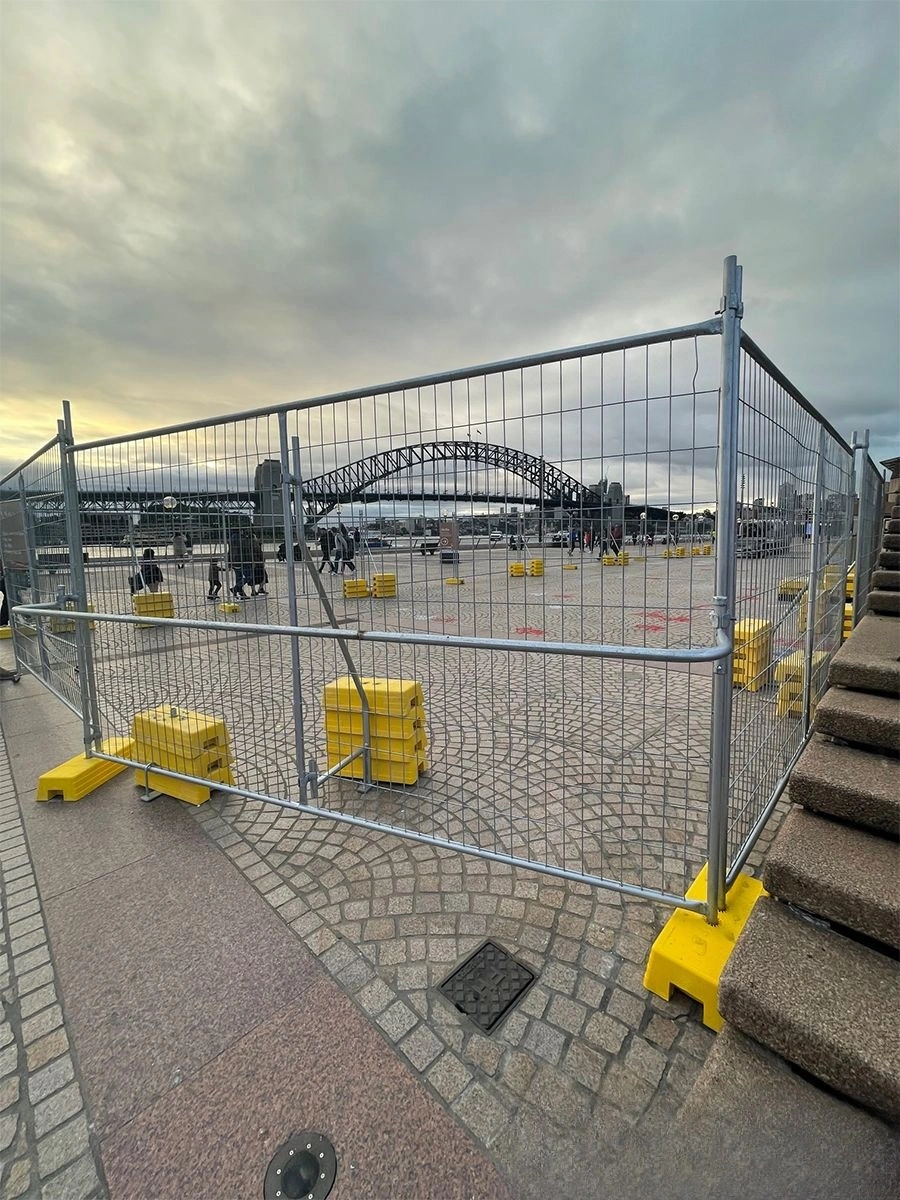
AS 4687 compliance mandates precise sizing: standard barriers are 2.3m total width including hooks, 1.1m high, and weigh 14-16kg to balance wind load stability with manual handling safety limits.
Critical Width Measurements and Hook Specifics
Calculating your site perimeter linear meters requires distinguishing between the frame width and the total shipping width. A common logistical error occurs when project managers order based on the frame size only, resulting in gaps during installation. The hook assembly adds critical length that ensures secure interlocking but impacts how many units fit into a container.
- Standard Total Width: 2.3 meters (measured hook-to-hook).
- Extended Total Width: 2.5 meters (used for specific site configurations).
- Frame-Only Width: 2.2 meters (this is the actual welded steel frame length excluding the hook).
- Hook Extension: Approximately 114.1mm of interlocking space per side.
Vertical Dimensions and Tube Diameter
Height is non-negotiable for safety compliance; anything lower than 1.1m creates a climbing risk that safety auditors will flag immediately. Beyond height, the tube diameter determines the structural integrity of the barrier. We utilize a 38mm or 40mm tube diameter to ensure the infill mesh and frame can withstand the impact forces specified in Australian Standards without buckling.
- Standard Height: 1.1 meters (uniform across all standard models).
- Tube Diameter: 38mm or 40mm (ensure consistent diameter across the batch for interchangeable parts).
- Infill Spacing: Typically 110mm to prevent foot holds and tools from passing through.
Weight Variance and Manual Handling Safety
Weight is the critical trade-off between stability and Occupational Health and Safety (OH&S). A barrier that is too light serves as a projectile in high winds, while an excessively heavy unit increases the risk of manual handling injuries for your crew. Our standard fixed-foot units are engineered to hit the 14kg to 16kg sweet spot. This weight provides enough mass to resist wind loads when coupled with rubber feet or concrete blocks, yet remains light enough for a single worker to reposition without excessive strain.
- Standard Weight (Fixed Foot): 14kg – 16kg.
- Compliance Trigger: Units lighter than 12kg generally fail AS 4687-2022 wind load tests.
- Material Density: High-grade steel ensures durability; lighter barriers often fail the rigorous load testing required for civil construction sites.
| Parameter | Standard Spec | Technical Details | Compliance/Benefit |
|---|---|---|---|
| Overall Dimensions | 2.3m / 2.5m (W) x 1.1m (H) | Width includes 114.1mm interlocking hooks; frame length is 2.2m. | Ensures seamless perimeter integrity on uneven construction ground. |
| Net Weight | 14kg – 16kg | Weight varies with tube wall thickness and foot type (fixed/loose). | Optimized for manual handling safety while maintaining stability. |
| Tube Diameter | 38mm or 40mm | High-tensile steel construction with uniform welding. | Provides superior structural strength against crowd pressure. |
| Infill Specification | 110mm Spacing | typically uses 4mm horizontal bars with vertical infill. | Anti-climb design satisfying strict Australian safety regulations. |
| Surface Finish | Hot-Dipped Galvanized | Minimum zinc coating of >42 microns (vs standard <40 microns). | Prevents rust at weld points; essential for coastal durability. |
| Safety Standard | AS 4687-2022 | Engineered to pass strict deflection and load-bearing tests. | Mitigates audit risk and ensures valid public liability insurance. |


AS 4687 Compliance Requirements
Using event-grade pedestrian barriers on construction sites voids public liability insurance. AS 4687-2022 mandates strict deflection testing that lightweight event gear simply cannot pass.
Understanding Australian Standard AS 4687-2022
The AS 4687-2022 standard is not a suggestion; it is the legal benchmark for temporary fencing and hoardings in Australia. This standard replaced the 2007 version and introduced stricter criteria for structural integrity, specifically regarding load-bearing capacity and wind resistance. For a project manager, this means any barrier installed on a civil or construction site must withstand specific deflection forces without permanent deformation. If your supplier cannot provide a test report explicitly referencing AS 4687-2022, you are accepting a liability risk that stops the moment a safety inspector walks onto your site.
The Compliance Trap: Event-Grade vs. Construction-Grade
A common procurement error occurs when buyers source “crowd control barriers” from event suppliers instead of construction specialists. While they look similar visually, the engineering is fundamentally different. Event-grade barriers are designed for channeling pedestrian flow and lack the structural rigidity required to withstand the impact loads or wind pressures found on construction perimeters.
- Event-Grade: Typically uses thinner wall thickness (e.g., <1.5mm) and fails under the deflection testing required by AS 4687.
- Construction-Grade: engineered with heavier gauge steel and reinforced weld points to pass strict load-testing and maintain perimeter security under stress.
Using lighter event gear on a construction site is a direct violation of the standard. More critically, in the event of an site injury or accident, your public liability insurance provider will likely deny the claim if the non-compliant fencing is identified as a contributing factor to the breach of site security.
Critical Infill Bar Spacing Requirements
One of the most frequent failures in site audits is incorrect infill spacing. AS 4687-2022 dictates that the vertical infill bars must be spaced to prevent climbing and ensure there are no footholds. The requirement specifies that the maximum gap between infill bars must not exceed 110mm. We strictly adhere to this <110mm manufacturing tolerance, unlike cheaper imports that often stretch this to 120mm or 125mm to save on steel costs.
Exceeding the 110mm gap creates an immediate climb risk, turning your security perimeter into a liability hazard. Inspectors carry tape measures specifically for this check. If the gap is wider than 110mm, the entire perimeter fails the compliance audit, potentially leading to work stoppages and fines from Safe Work authorities.

Fixed Foot vs Loose Leg Designs
Fixed feet maximize deployment speed for high-turnover hire fleets, while loose legs reduce shipping volume by up to 30%, significantly lowering landed costs for international importers.
Fixed-Welded Feet: The Speed Advantage
Fixed-foot designs feature the base plate permanently welded to the frame, creating a rigid unit. For event management companies and civil crews where time is a bottleneck, this design offers immediate utility. There is no assembly required on-site; you unload the truck and deploy the barrier immediately. In our field tests comparing identical site layouts, fixed-foot barriers consistently demonstrate a deployment speed approximately 20% faster than loose-leg systems. This efficiency gains critical value during large-scale festivals or rapid emergency perimeter setups where labor hours are the primary cost driver.
Loose Detachable Feet: The Logistics Solution
For Australian importers, the primary constraint is rarely on-site speed, but rather the cost of getting materials from the factory gate to the site. Fixed-foot barriers create a “spider” shape that stacks poorly, leaving massive voids of unusable air within a shipping container. This inefficiency results in what we term the “Hidden Logistics Tax.” By switching to loose detachable feet, the barrier frames stack flat, and the feet are packed separately in dense boxes. This configuration allows you to maximize container utilization, reducing shipping volume by approximately 30% compared to fixed-foot models.
Storage Efficiency Calculations (Per 100 Units)
To understand the commercial impact, consider the storage and freight implications for a standard wholesale order of 100 barrier sets measuring 2.3 meters. The geometry of stacking dictates your warehouse footprint and freight quotes.
- Fixed Foot Stack Height: Due to the protruding bases, a pallet of fixed feet often reaches height limits before weight limits, occupying roughly 3-4 cubic meters of space per 100 units.
- Loose Leg Stack Height: Frames stack perfectly flat, allowing roughly 30% more panels per pallet. Feet pack efficiently into the remaining gaps.
- Total Landed Cost: The space-saving geometry of loose legs can reduce your shipping fee per unit by up to 25%, a margin that is often higher than the initial purchase price difference.
Galvanization & Material Durability
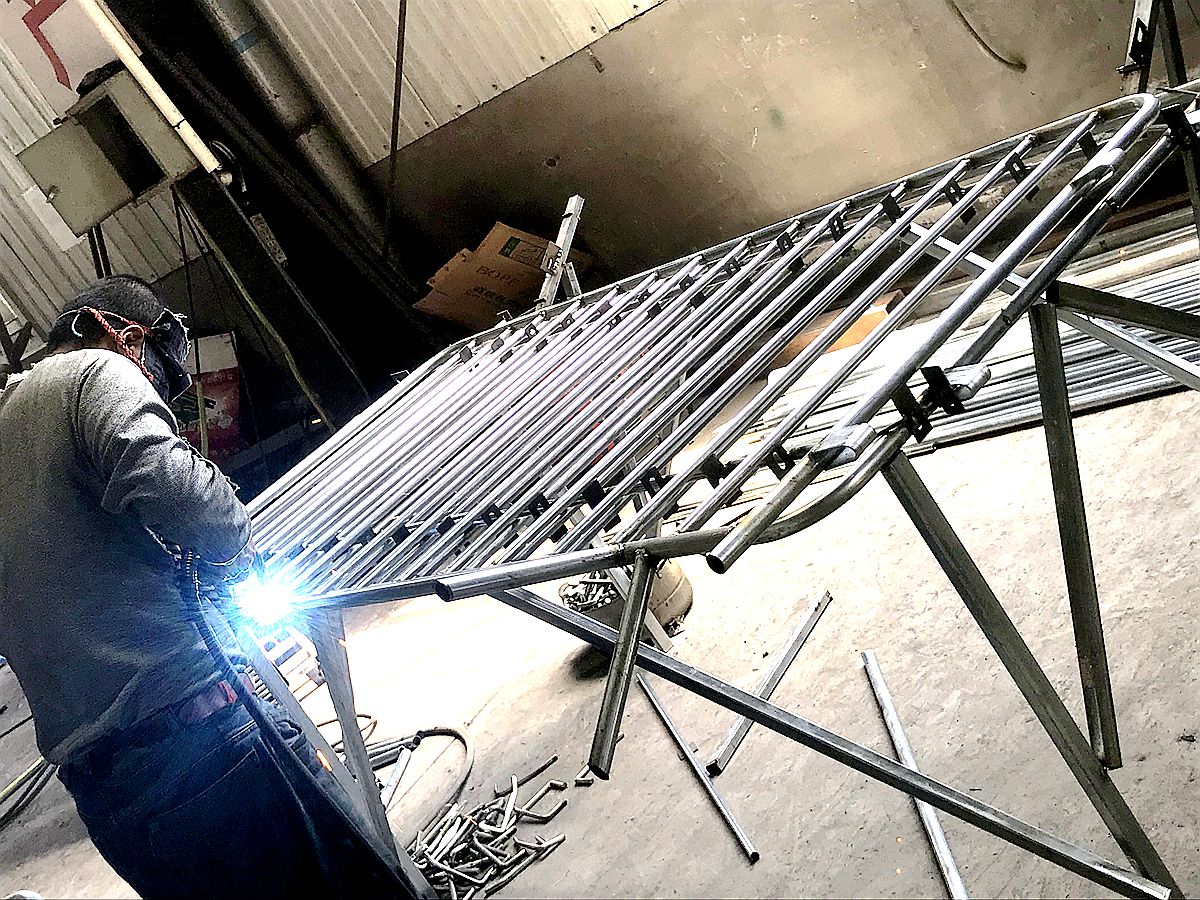
Electro-galvanized barriers rust at weld points within 12 months; our hot-dipped galvanization uses >42 microns zinc coating for 10+ years of structural integrity in coastal environments.
The Hidden Failure of Electro-Plating
Many importers push electro-galvanized steel to reduce initial unit costs. This process merely bathes the metal in a zinc solution, creating a thin cosmetic layer. The high heat from the welding process burns this coating off at the nodes. You will see red rust forming at these intersection points within 6 to 12 months of installation, specifically in Australia’s humid or coastal regions. This structural weakness leads to premature failure under load testing, posing a significant compliance risk for your site.
The 42-Micron Standard for Coastal Durability
Hot-dipped galvanization involves submerging the fully welded panel into a bath of molten zinc. This creates a metallurgical bond that coats the entire surface, including the internal and external weld joints. Our strict production standard requires a minimum average coating mass of >42 microns. This thickness acts as a sacrificial anode, ensuring that even if the surface is scratched during transport or installation, the underlying steel remains protected from oxidation. This is the only finish that reliably meets the aggressive demands of AS 4687-2022 for temporary fencing in harsh seaside environments.
Lifecycle Cost Analysis: 2 Years vs 10+ Years
A low-cost electro-galvanized barrier might look like a 20% saving on the purchase order, yet the replacement cost is steep. You will likely need to replace these units every 2 to 3 years due to rust fatigue. In contrast, our >42 micron hot-dipped units typically last 10 years or more with minimal maintenance. For a project manager holding inventory for multiple civil sites, the long-term ROI favors the heavy-duty specification. You avoid the downtime and logistics costs associated with scrapping and re-procuring degraded stock.
| Attribute | Specification | Durability Feature | Project Benefit |
|---|---|---|---|
| Surface Treatment | Hot-dipped Galvanized (>42 Microns) | Specifically engineered for harsh seaside and outdoor environments | Prevents weld-point rust and extends lifecycle vs electro-galvanized alternatives |
| Structural Compliance | AS 4687-2022 Load Rating | High-strength tube diameter (38mm/40mm) resisting deflection | Eliminates risk of site fines and safety audit failures for construction managers |
| Quality Certification | ISO9001 / SGS Certified | Validated zinc coating thickness and material consistency | Reduces procurement risk and ensures insurance compliance |
Footwear Types: Concrete vs Rubber
Replacing concrete with recycled rubber reduces transport weight by 2.5 tonnes per 500 units while maintaining full AS 4687-2022 stability compliance.
Operational Efficiency: Weight and Handling
Concrete bases impose a significant physical toll on site crews. A standard concrete foot often weighs between 20kg and 25kg. Moving these units across a construction site creates manual handling risks and slows down deployment times. Recycled rubber and composite feet provide a direct solution to this bottleneck, typically weighing 40% less than their concrete counterparts. This reduction allows a single worker to carry multiple units, accelerating perimeter installation and reducing the likelihood of fatigue-related injuries on site.
Logistics and ESG Impact
Procurement decisions are increasingly scrutinized for Scope 3 emissions. The weight of concrete footing creates unnecessary “dead weight” during shipping, driving up fuel consumption. You can lower the carbon footprint of your logistics chain by switching to lighter rubber alternatives. Based on our supply data, replacing just 500 concrete feet with recycled rubber equivalents reduces total transport weight by approximately 2.5 tonnes. This lighter load translates directly into lower freight costs and improved sustainability metrics for your project reports.
AS 4687-2022 Stability Compliance
The primary concern regarding lightweight footwear is wind resistance. Australian Standard AS 4687-2022 dictates strict deflection and load-bearing requirements for temporary fencing. Recycled rubber feet must be properly ballasted to meet these criteria. Our manufacturing process ensures the density and base geometry of our rubber feet provide sufficient stability to pass AS 4687 wind load tests. Because Deban operates its own plastic and rubber feet molding machine in Anping, we control the material density strictly. This ensures that every foot delivers the required ballast to keep the fence line secure without reverting to heavy concrete blocks.
| Factor | Concrete Feet Specs | Rubber Feet Specs | Strategic Value |
|---|---|---|---|
| Material & ESG Impact | Standard pre-cast cement aggregate | Recycled high-density rubber/polymer | Rubber supports corporate ESG goals through recycled content |
| Load Compliance (AS 4687) | Relies on mass for stability | Engineered design meets load-bearing standards | Maintains safety audit compliance without heavy mass |
| Logistics & Weight | High transport weight (approx. +2.5t per 500 units) | Lightweight profile reducing freight volume | Lowers Scope 3 emissions and shipping costs |
| Site Safety & Handling | Heavy; high risk of manual lifting injuries | Lightweight; rapid manual deployment | Reduces site safety risks and labor fatigue |
Conclusion
Specifiers must enforce the AS 4687-2022 load rating on every purchase order to avoid voiding public liability insurance. Standard electro-galvanized event barriers rust at the welds within a year; hot-dipped galvanization above 42 microns is the only option for harsh Australian sites. Choosing loose-leg designs over fixed-foot models reduces container volume by 30%, lowering both freight costs and the project’s carbon footprint.
Audit your current inventory for zinc coating thickness and deflection compliance before the next safety audit. Contact us to review technical datasheets or arrange a sample of our AS 4687 compliant barriers.
Frequently Asked Questions
How much do crowd control barriers cost?
Pricing varies based on specifications such as gauge, finish, and volume, but DB Fencing offers competitive factory-direct pricing by eliminating middleman costs. We support a flexible Low MOQ of just 100 panels, allowing construction firms and event companies to access premium quality without massive upfront capital investment. To ensure you get the most accurate and budget-friendly solution, our team provides comprehensive 24-hour quoting tailored to your specific project requirements.
Where to hire crowd control barriers?
While DB Fencing is a manufacturer focused on sales, we are the primary supplier for many global fence distributors and rental companies that offer hire services. Our hot-dipped galvanized barriers are designed with superior durability, making them a cost-effective fleet investment for hire businesses needing long-lasting inventory. By sourcing directly from our Anping facility, rental companies can ensure they stock compliant, high-quality barriers that meet rigorous Australian standards for their clients.
What are crowd control barriers used for?
Crowd control barriers are essential for event management companies to ensure public safety and organize pedestrian flow at festivals, concerts, and public gatherings. In the construction and civil engineering sectors, these barriers serve as critical temporary site security, providing robust anti-climb protection for hazardous work zones. Whether used for a major stadium event or a civil infrastructure project, DB Fencing’s products offer the reliability needed to secure perimeters effectively.
Difference between fixed and loose leg barriers?
Fixed leg barriers feature feet welded directly to the frame for simplicity, while loose leg (bridge foot) barriers allow for flat-packing to significantly reduce shipping costs and maximize storage efficiency. DB Fencing is the only supplier in Anping with its own proprietary plastic feet machine, ensuring we produce high-precision, durable loose feet that offer superior stability. This unique manufacturing capability allows us to provide highly versatile solutions that optimize logistics for our global distributors and event clients.
Are steel or plastic barriers better for construction sites?
Steel barriers are the superior choice for construction sites because they provide the necessary impact resistance and anti-climb security required to protect hazardous work areas. DB Fencing manufactures steel barriers with hot-dipped galvanized finishes exceeding 42 Microns, ensuring they can endure harsh outdoor and seaside environments without rusting. Unlike plastic alternatives, our durable steel products comply with Australian Standard AS 4687-2022, offering the long-term reliability that civil engineering firms demand.