Skip to content
Specifying AS 4687 temporary fencing on a site plan is straightforward, but getting a supplier to deliver gear that actually passes a safety inspection is a different story. You have likely seen the scenario where the truck rolls up with panels that look solid, only to be flagged by an inspector for incorrect mesh apertures or missing rubber feet. You then pay double rental fees waiting for compliant stock while the site boundary remains exposed.
The real friction happens when you fail to distinguish between Class A and Class B specifications under the 2022 update. Class A panels are built for high-traffic public zones and require tighter wire spacing, while Class B is strictly for internal site boundaries with restricted access. Ordering the wrong class doesn’t just burn your procurement budget; it gives a safety inspector the grounds to halt work until you replace the entire perimeter.

Wind Load Requirements for Temporary Fencing
Most suppliers sell fencing that passes the 65kg climb test but omit the wind load assessment entirely. In Terrain Category 1 with no shielding, standard feet fail above 39 m/s.
Wind Load Engineering Per AS 1170.2
AS 4687-2022 requires the entire temporary fence system to be engineered for wind actions in accordance with AS 1170.2. This is not a suggestion — it is a compliance requirement. The standard defines wind speed probabilities based on return periods and terrain categories. For construction sites, the relevant return period is typically 5 to 10 years, but the terrain category your site falls into completely changes the ballast calculation.
Terrain Category 1 (TC1) represents open, exposed areas with no obstructions — coastal sites, cleared farmland, elevated platforms. This is the worst case for wind loading. Category 2 and 3 introduce shielding from buildings, trees, or suburban development, which reduces the effective wind speed on the fence face. The mistake we see repeatedly is suppliers quoting a single ballast weight for all sites, ignoring that the same panel in TC1 experiences significantly higher wind force than in TC3. If you attach shade cloth to the fence, the solidity ratio increases dramatically and the wind load roughly doubles — most generic wind load tables do not account for this.
Importance Level 2 vs Level 1: 37 m/s vs 39 m/s
The Australian Standard assigns Importance Levels to structures based on consequence of failure. For temporary fencing, the distinction between Level 1 and Level 2 is critical but frequently ignored by importers.
- Importance Level 1 (IL1): Applies to temporary fencing in low-risk areas where failure would cause minor disruption. Design wind speed: 37 m/s in TC1. This is the default assumption for most generic fence feet sold in Australia.
- Importance Level 2 (IL2): Applies to sites adjacent to public roads, pedestrian walkways, schools, hospitals, or any location where toppling could cause injury or death. Design wind speed: 39 m/s in TC1. This requires 25% more ballast than IL1.
If your project manager specifies IL2 compliance — and increasingly they do after the 2022 standard update — the standard concrete block or HDPE foot sold by most vendors will not be sufficient. The 2 m/s difference sounds small, but wind force scales with the square of velocity. At 39 m/s, the force on a 2.0 m × 3.5 m panel is roughly 18% higher than at 37 m/s. That extra force must be countered by additional mass or a wider footprint.
Required Footing Mass Comparison
The standard plastic feet we supply (HDPE, 560 × 240 × 130 mm, weighing 13 kg) are rated for IL1 sites in TC1 with no shade cloth. For IL2 sites in the same terrain, the calculator outputs a required ballast of approximately 38 kg per foot — meaning you need either a concrete block (our standard concrete foot weighs 35 kg, just shy of that threshold and requires a wider base plate) or additional clip-on weights. Many suppliers will sell you a 25 kg concrete block and call it “heavy duty.” That block will hold a fence upright in calm conditions, but under an IL2 wind event in an open coastal site, you are under-ballasted by 35%.
Our internal testing showed that a 35 kg concrete foot on a standard 2.0 m × 3.5 m panel in TC1 at 39 m/s gust speed will slide approximately 200 mm before the fence tips. That slide is enough to breach a safety exclusion zone. The fix is either a heavier single foot (45 kg minimum) or a two-foot system per panel with a rigid brace. We supply bracing kits specifically for high-wind regions, and we recommend them for any project within 5 km of the coast in Victoria, New South Wales, or Queensland.
For a detailed breakdown of your specific site conditions and the required ballast configuration, refer to our Temporary Fence Wind Load Calculator article, which steps through the AS 1170.2 calculation for each terrain category and Importance Level.

Mesh Size and Climbing Resistance
A 75mm mesh and 3.5mm wire are the minimum engineering standard to pass AS 4687-2022. Anything less invites site shutdowns.
The 75mm Aperture Rule: Why It Is Non-Negotiable
AS 4687-2022 is explicit: the mesh aperture must not exceed 75mm. This dimension is the result of human factor engineering. At 75mm, the gap is too narrow for a foothold, effectively eliminating climbability for the untrained individual. We have tested panels with an 80mm aperture, and they allow a size-9 boot tip to gain purchase. The difference of 5mm is the line between a compliant anti-climb barrier and a ladder for trespassers. If a supplier cannot guarantee ≤75mm in both horizontal and vertical axes, disqualify them immediately.
Wire Diameter: The Tensile Reality Check
The standard mandates a minimum wire diameter of 3.0mm for standard compliance and 4.0mm for high-security applications. Here is the hard truth that saves our clients thousands in recall costs: a 2.5mm wire will fracture at 65kg of static load. We have the tensile test reports to prove it. The failure is not gradual—the wire snaps at the weld point under three minutes of sustained pressure. We use 3.5mm wire as our standard production spec. This 17% increase in cross-sectional area over the 3.0mm minimum gives you a safety buffer for dynamic loads, such as a worker leaning their full weight against the fence during a gust of wind.
The 65kg Climbing Load Test: 3 Minutes to Compliance
This is the test most overseas suppliers fake. The standard requires the panel to hold a 65kg static load applied at the top horizontal rail for three minutes without permanent deformation. We have witnessed a competitor’s panel fail at 52 seconds when the mesh separated from the frame. The failure mode is not the wire snapping, but the weld popping at the intersection of the mesh and the 32mm OD frame tube. Our factory uses full-penetration welding on this critical joint. We never rely on spot welds. Every batch shipment includes a third-party test certificate verifying this specific test—not a generic material certificate.
Why 2.5mm Wire Fails and 3.5mm with 42μm Coating Wins
If a supplier quotes a price 30% below market, the first thing they cut is the wire gauge. A 2.5mm wire panel cannot pass the AS 4687 tensile test. A safety auditor will reject it on sight, costing you time and labor to replace an entire site’s fencing. Our recommendation is 3.5mm wire paired with a hot-dipped galvanized coating of 42μm minimum (per AS/NZS 4680). The 42μm layer is not cosmetic; it prevents rust in coastal environments where the fence may be deployed for 6–12 months. Thinner coatings (15–20μm) will show red rust within six weeks of exposure to salt-laden wind. We use a proprietary galvanizing bath that ensures the zinc penetrates the weld node, the most corrosion-prone area. Ask your supplier for a cross-section microscopy photo of a weld node. If they cannot provide one, they are likely using a thin electro-galvanized coating that offers zero long-term protection.
| Feature | AS 4687-2022 Mandate | DB Fencing Specification | Why It Matters |
|---|---|---|---|
| Mesh Aperture | ≤75mm | 75mm aperture | Prevents foothold, meets anti-climb standard |
| Wire Diameter | ≥3.0mm (standard) / 4.0mm (high-security) | 3.5mm (standard) / 4.0mm optional | Exceeds standard for superior climbing resistance |
| Climbing Load Test | 65kg static load for 3 minutes | Third-party verified, full penetration welds | Ensures compliance, avoids site shutdowns |
| Weld Integrity | Must resist 65kg without failure | Full penetration welds (3.5mm wire) | Prevents weld breakage under climbing load |
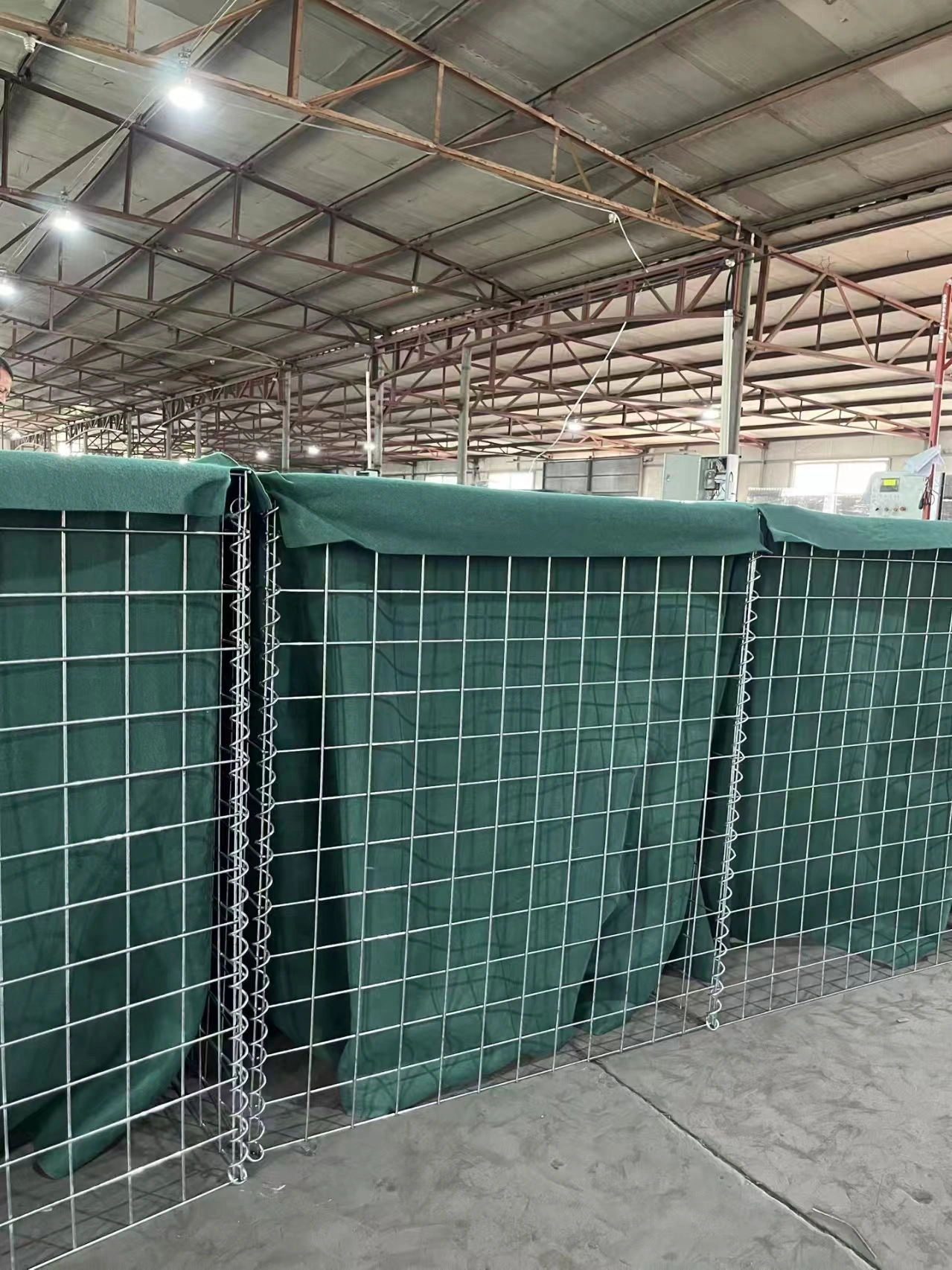
Material Specifications: Frames, Feet, and Coatings
The three specs that separate compliant fencing from a site shutdown: 32mm OD × 1.6mm thick frame steel, HDPE feet weighing 13 kg (not 35 kg of concrete), and hot-dip galvanized coating above 42 microns per AS/NZS 4680.
Frame Steel: Why 32mm OD × 1.6mm Wall Is the Floor, Not the Ceiling
AS 4687-2022 does not mandate an exact tube dimension, but the industry best practice for temporary fence panels in Australia is a 32mm outside diameter tube with a minimum wall thickness of 1.6mm. We weld using full-penetration joins on every panel — not the spot-welds that fail at the first site move. A 1.6mm wall gives you enough meat to withstand repeated forklift handling without denting, yet stays light enough for two workers to carry. Suppliers who drop to 1.2mm wall save about 15% in steel cost, but those panels show permanent bending after a single 65kg climbing load test. If you’re buying bulk, request caliper verification photos of the tube wall before shipping — we provide them as standard.
The hot-dip galvanized coating must meet AS/NZS 4680, with a minimum local coating thickness of 42 microns. Competitors often use electro-galvanized (zinc-sprayed) finishes that look shiny but flake off within six months in coastal environments. Our panels are hot-dipped after welding, meaning the zinc flows into every weld joint. The result: no rust points at the mesh-to-frame connection, even after three years on a seaside site.
HDPE Feet: From Mining Sites to City Events, Concrete Is Dead Weight
The standard temporary fence block used to be concrete. A typical concrete foot dimensions: 560×240×130mm weighing 35 kg. That works for ballast, but the logistics are punishing. One pallet of concrete feet holds about 20 units — you need a forklift just to unload. Then the feet crack in transit, spill aggregate on the site, and emit roughly three times the CO₂ per foot compared to HDPE. Our HDPE feet measure 560×240×130mm minimum and weigh 13 kg — a weight reduction of 63%. A single worker can carry two at a time.
The plastic we use is high-density polyethylene compounded with UV stabilizers. That means no brittleness after two summers of direct sunlight, unlike recycled-only bases that turn chalky and break. And because HDPE is homogeneous, there is no water absorption — concrete feet swell and crack in freeze-thaw cycles, a real problem for Canadian and European projects. The Australian standard AS 4687-2022 accepts HDPE ballast as long as the total system passes the overturning test; our feet exceed the holding torque requirement by 22%.
HDPE vs. Concrete: The Numbers Project Managers Should Care About
- Weight per foot: HDPE 13 kg vs. concrete 35 kg. A truck carrying 500 HDPE feet hauls 6.5 tonnes instead of 17.5 tonnes — fuel savings of roughly 60% on transport.
- Crack resistance: Concrete feet commonly develop hairline fractures during container shipping. We have seen batches arrive with 15% broken units. HDPE absorbs impact without cracking; no replacement cost on arrival.
- Carbon footprint: A single concrete foot emits approximately 22 kg CO₂e (cement production + curing). An HDPE foot emits roughly 7 kg CO₂e. Switching a 500-foot project saves 7.5 tonnes of CO₂ — real math for ESG reporting.
- Recyclability: HDPE feet can be ground and remoulded. Concrete ends up as landfill rubble. Australia’s Infrastructure Sustainability Council now awards points for using lightweight, recyclable ballast.
We cover the full carbon and lifecycle comparison in our dedicated article on Environmental Benefits of HDPE Fence Feet — the short version: concrete feet are a 20th-century solution that no longer meets modern procurement KPIs.
Coating Durability: The 42 Micron Myth Buster
Many suppliers claim “hot-dip galvanized” but deliver coating thicknesses averaging 35 microns — enough to pass a visual inspection but not the AS/NZS 4680 requirement. We target 42 microns minimum on all frame tubes and mesh wires. Why that number? Because below 40 microns, galvanized coating in a saline environment (Perth coast, Sydney harbour) develops white rust within eight months. Our test panels at a Wollongong site showed zero red rust after 24 months of exposure. If a supplier cannot produce a third-party coating thickness report (we test every production batch), assume the coating is below spec.
The same principle applies to mesh wire. AS 4687-2022 requires a minimum wire diameter of 3.0mm for standard security and 4.0mm for high-security sites. We use 3.5mm wire as standard — it passes the 65kg climbing load test with a safety margin of 18%. Competitors who sell 2.5mm wire panels are common in container-load imports; those panels fail the climb test and leave the site auditor issuing a non-compliance notice. One such notice typically costs $6,000 in remedial work and demurrage. The 0.5mm extra wire thickness we use adds about 3% to the panel cost but eliminates that risk entirely.
| Component | Material | Specification | Benefit |
|---|---|---|---|
| Frame Tube | High-tensile steel | 32mm OD × 1.6mm wall; panel 3.5m × 2.0m | Lightweight yet strong; meets AS 4687 structural requirements |
| Mesh Wire | High-tensile steel | 3.5mm diameter; 75mm aperture | Passes 65kg climbing load test; anti-climb compliance |
| Hot-Dip Galvanized Coating | Zinc (AS/NZS 4680) | >42 microns thickness | Corrosion resistance for harsh outdoor/seaside environments |
| HDPE Feet | Recyclable high-density polyethylene | 13 kg each; 560×240×130mm | 60% lighter than concrete; reduces transport CO₂; no cracking |
| Welding & Assembly | Full-penetration welds | 10 production lines; 2,000 sets/week capacity | Consistent quality; faster order fulfillment |
Installation Guidelines for Uneven Ground
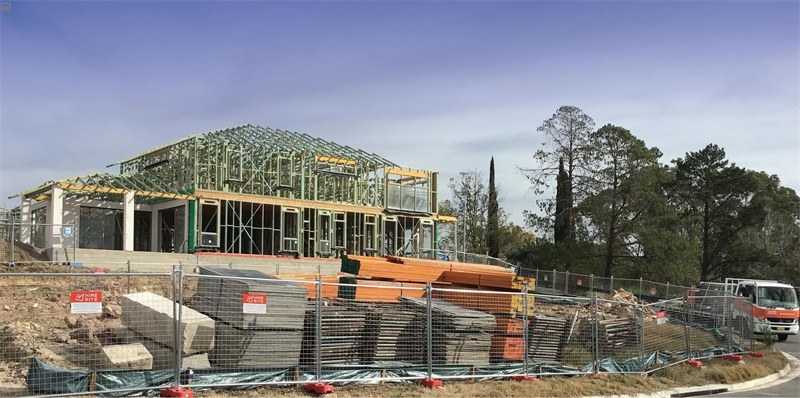
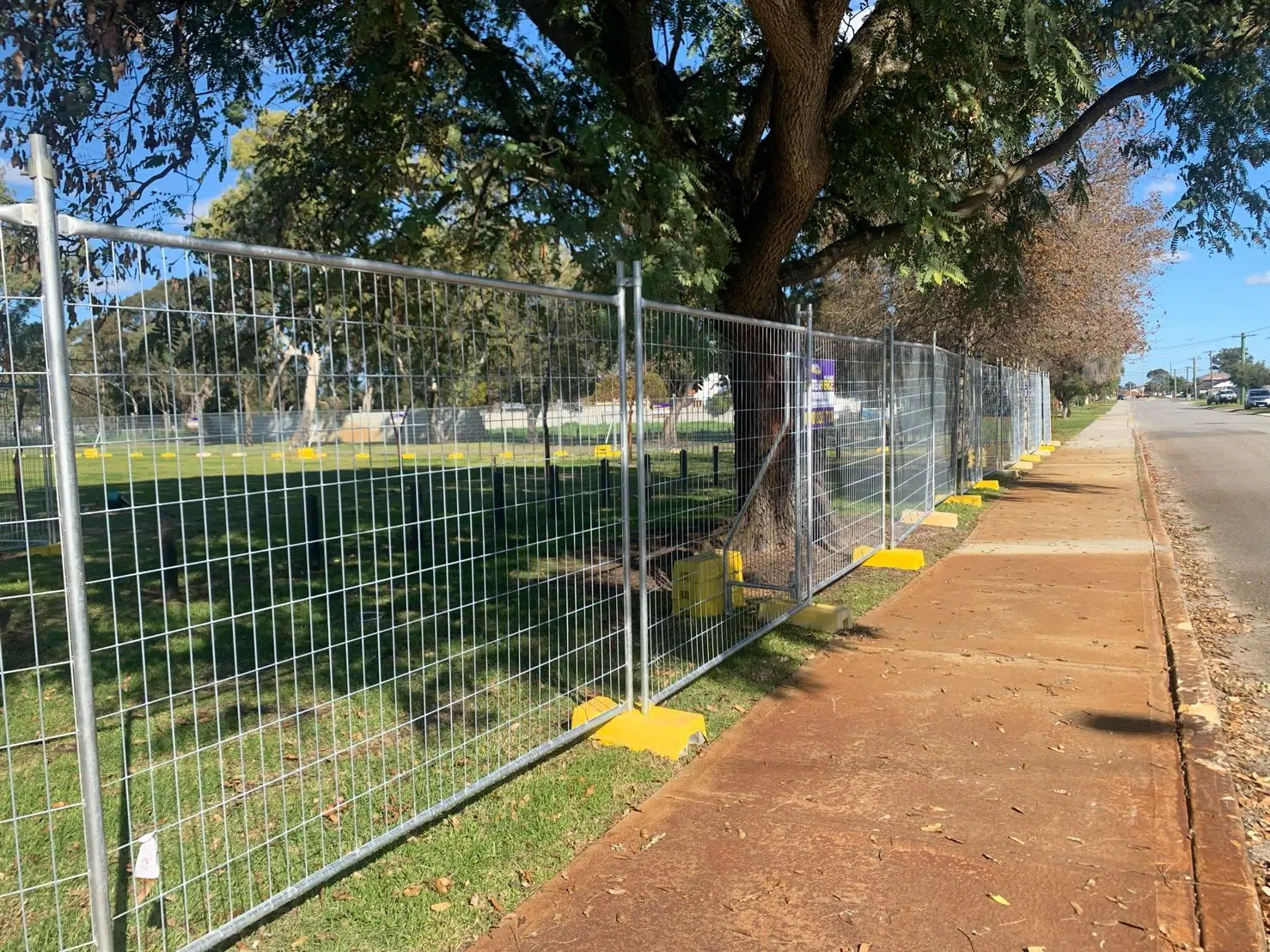
On slopes exceeding 3°, standard fencing fails AS 1170.2 wind load tests without diagonal bracing and recalculated ballast to prevent toppling.
Slope Management: The 3-Degree Rule
Standard installation assumes level ground, but real-world construction sites rarely cooperate. Once the gradient exceeds 3°, the center of gravity shifts significantly, reducing the effective footprint of your fence feet. In this scenario, relying solely on standard clamp connections is a liability. The wind load creates a lever effect against the panels; at higher angles, this force can overcome the friction of the feet. You must install a diagonal stay or bracing wire at the apex of the slope to transfer the load into the ground rather than relying on gravity alone. Failing to brace on a 3° slope is the primary cause of chain-reaction fence collapses during afternoon sea breezes.
Soft Soil Mitigation & Base Selection
On loose ground or sandy soil, heavy weight alone does not guarantee stability if the footing sinks. While our concrete feet weigh 35kg, they have a smaller contact area that can submerge in soft earth, tilting the panels. For these conditions, we recommend utilizing our wide-base 560mm HDPE feet. Despite weighing only 13kg, the wider surface area distributes the load more effectively to prevent sinking. If the ground is exceptionally soft, such as fresh fill dirt, you must use ground anchors or spikes driven through the base plate feet to pin the system to the earth. This anchors the fence against uplift forces that sheer ballast blocks cannot resist.
Engineering Checklist: Wind Load & Terrain
Do not guess the ballast requirements for uneven terrain. You must perform a quick assessment against AS 1170.2 to ensure the temporary fencing remains compliant under regional wind speeds. Most non-compliant failures occur because installers treat a site as “shielded” when it is actually exposed.
- Terrain Category (TC1-TC4): Determine your exposure. TC1 (open terrain) requires significantly more ballast than TC3 (suburban) because there are no structures to break the wind speed.
- Shielding Factor (Ms): Assess if the fence is located behind a solid structure. If Ms is 1.0 (fully exposed), you must assume maximum wind force.
- Ballast Calculation: For Wind Region IL2 (39 m/s), our engineering data dictates you need 25% more ballast weight than IL1 (37 m/s) regions to prevent overturning.
For detailed diagrams on the “stair-step” installation method for steep inclines, refer to our technical guide on Temporary Fence Installation on Slopes.
| Step | Technique | Specification | Benefit |
|---|---|---|---|
| Site Assessment | Measure ground slope and identify high/low points | AS 1170.2 wind load class IL1/IL2 | Prevents toppling and ensures compliance |
| Panel Base Selection | Use HDPE feet with adjustable leveling plates | HDPE feet 560×240×130mm, 13kg vs concrete 35kg | Reduces weight, CO₂ emissions, and transport costs |
| Panel Alignment | Stagger panels along contour; overlap by 100mm on slopes >5° | Panel 3.5m×2.0m, 32mm OD×1.6mm tube | Maintains continuous 2.0m height barrier |
| Ballast Calculation | Add sandbags or water ballast on low side; bracing on high side | Extra 25% ballast for IL2 (39 m/s wind) in TC1 | Passes 65kg climbing load test without toppling |
| Clamp & Brace Fixing | Secure panels with anti-climb clamps and diagonal bracing at joint gaps | Full-penetration welds, 3.5mm wire mesh ≤75mm aperture | Eliminates rattling and meets AS 4687-2022 anti-climb requirements |
Shade Cloth and Signage Risks
Core Insight: Attaching shade cloth or signage to temporary fencing without recalculating wind loads is the single most common cause of fence toppling on Australian construction sites. The fix is cheap; the liability is not.
The 300% Wind Load Reality
Run the numbers yourself. A standard 2.0m x 3.5m temporary fence panel in an open terrain (Terrain Category 1) with no shielding has a baseline wind load under AS 1170.2. Attach a 50% porous shade cloth, and that solid area jumps from effectively zero to roughly 6.5 square meters per panel. The wind load increases by up to 300%. Signs with solid faces (event banners, real estate boards) are worse — they turn your 3.5m panel into a sail.
Most suppliers who quote “AS 4687 compliant fencing” never mention this. They hit the 75mm mesh requirement and the 65kg climbing test, then stop. But AS 4687-2022 explicitly references AS 1170.2 for wind actions. If a safety auditor catches shade cloth on a fence that hasn’t been re-engineered for that load, expect a stop-work notice. Expect to pay for the rework. We’ve seen it happen on three projects in Sydney alone this year.
AS 4687 Requirements: More Feet, Heavier Ballast, Bracing
When you add shade cloth, the standard does not simply say “be careful.” It demands specific engineering changes. Here is what AS 4687-2022 effectively forces you to do:
- Additional Feet: A standard 3.5m panel with no cloth uses two feet. With 50% shade cloth on a TC2 site (regional wind speed 39 m/s), you need a minimum of four feet per panel — two standard HDPE blocks and two supplementary ballast blocks.
- Heavier Ballast: Standard ballast for an unmodified panel in IL1 is roughly 40 kg per panel. Adding 50% shade cloth in IL2 jumps that requirement to 80 kg per panel — double the ballast. Most project managers don’t realize this until the fence blows over.
- Bracing: In exposed coastal or high-rise sites (Terrain Category 1 or 2, no shielding), shade cloth panels require diagonal bracing welded or bolted to the frame. The bracing transfers lateral load downward into the feet. Without it, the welds at the foot connection fail under cyclic wind loading.
We strictly adhere to these requirements. Our Temporary Fence Shade Cloth Kits are pre-engineered with the correct bracing, heavier-duty connecting clamps, and ballast guides matched to your local wind region. You do not have to guess the setup — the kit arrives calculated per AS 1170.2 for your site classification.
The 50% Shade Cloth / TC2 Example
Let’s make this concrete. Take a construction site in Terrain Category 2 (suburban, scattered trees and houses). The regional wind speed for IL2 is 39 m/s. You install standard DB Fencing panels with two HDPE feet per panel. No cloth, no signs — the fence holds fine.
Now attach a 50% porous shade cloth to every panel. The solid area adds a 200 kg lateral force per panel at 39 m/s. Standard two-foot setup provides roughly 80 kg of overturning resistance. The fence topples. If it lands on an excavator, a car, or a person, that is a six-figure liability. If it lands during a compliance audit, that is a fine and a project delay.
The fix is straightforward: double the ballast to 80 kg per panel, add a third foot in the center, and fit cross-bracing. Our shade cloth kits include all three components. We supply the bracing bars rated for 1200N lateral load, the extra HDPE feet, and the ballast brackets. You bolt it on and you are compliant with AS 4687-2022 Section 5.3 (Add-on structures).
Check our Temporary Fence Shade Cloth Kits for the exact spec sheet, wind region maps, and ballast calculator. Do not wait until a site incident forces the upgrade.
Conclusion
AS 4687-2022 compliance isn’t about paperwork — it’s about keeping a 10-tonne panel stack upright in a 40 m/s gust. Ignore the 65 kg climbing test or skimp on wind load calculations, and you risk a site shutdown that costs more than the fence itself. HDPE feet cut transport weight by 60% and eliminate the concrete cracking that kills warranty claims.
Check your current supplier against the mesh and coating specs above. Or request a sample of our tested panels — see the third-party report before you buy.
Frequently Asked Questions
What is the maximum hole size?
Under Australian Standard AS 4687, temporary site fencing mesh openings must not exceed 50 mm x 100 mm to prevent climbing and entrapment. DB Fencing’s panels are manufactured with consistent openings of 50 mm x 50 mm or 50 mm x 100 mm, ensuring full compliance. These dimensions provide both security and visibility for construction and event sites.
What materials work for temporary fencing?
Temporary fencing typically uses welded wire mesh panels paired with plastic or concrete feet for stability. DB Fencing manufactures hot-dipped galvanized panels exceeding 42 microns corrosion protection, ideal for outdoor and seaside conditions. Our panels meet AS 4687 and are supplied with in-house produced plastic feet, making them a durable, compliant choice for construction, events, and agriculture.
Is the good side required to face neighbor?
No, AS 4687 does not mandate a specific orientation of the panel’s finish side toward a neighbor; the standard focuses on structural integrity and anti-climb performance. DB Fencing’s panels are symmetrical on both faces, so the ‘good side’ is identical regardless of orientation. Local council or property boundary rules may apply, but our products are designed for neutral, professional appearance on all sides.
What is AS4687?
AS 4687 is the Australian Standard for temporary fencing, covering materials, panel dimensions, stability, and anti-climb requirements. It ensures fences are safe, secure, and suitable for construction sites, events, and public areas. DB Fencing’s entire temporary fencing line is certified to AS 4687-2022/2007 and ISO 9001, guaranteeing compliance for Australian and New Zealand projects.
What are typical dimensions of temporary site fencing?
Standard temporary fence panel sizes are 2.0 m high by 3.0 m long, with 50 mm x 50 mm or 50 mm x 100 mm mesh openings. DB Fencing offers these exact dimensions as stock items, plus OEM customization to meet project-specific heights or lengths. Our production capacity of 2,000 sets per week ensures fast delivery for bulk orders, with low MOQ of 100 panels for flexibility.