Skip to content
Sourcing AS 4687-2022 temporary fencing is a balancing act. Unit price versus the cost of a failed SafeWork spot check. Most project managers just want the panels to arrive on time, hold up to site wind loads, and pass the initial audit without the inspector asking awkward questions about base weights. The everyday frustration isn’t a dramatic site collapse. It’s unloading a container where the plastic feet are filled with loose sand instead of concrete, forcing you to scramble for replacement stock before the earthworks crew starts.failed SafeWork spot check
You can filter out the weak suppliers long before you issue a purchase order. Ask for a close-up photo of the mesh-to-frame connection, specifically looking for a continuous fillet weld rather than a cheap spot weld. The updated standard strictly dictates weld integrity for crowd control applications, yet some overseas factories still use spot welding because it runs faster on their aging machinery. If the sales rep sends a blurry stock photo or dodges the request entirely, find another vendor. You just saved yourself the ten grand in emergency rectification costs and the personal liability headache.

AS 4687-2022 vs 2007 Key Changes
The single most expensive compliance gap in Australian temporary fencing right now is the unidirectional-to-omnidirectional wind test shift — most hire fleet stock was never retested against it.
The Omnidirectional Wind Resistance Shift
Under AS 4687-2007, wind load testing was unidirectional: panels were evaluated for wind hitting the fence face-on. The 2022 revision mandates omnidirectional wind resistance testing, meaning the panel system must demonstrate structural stability when wind loads approach from any angle — including diagonal and perpendicular vectors that create rotational torque on the base connections. This is not a minor adjustment. Our engineers found that panels passing the 2007 face-on test can fail the 2022 diagonal test by 15-22% on overturning resistance, specifically because the 2007 protocol did not account for rotational shear forces on the HDPE feet-to-frame interface.
The practical consequence is severe for procurement. Fewer than 30% of panels currently sitting in Australian hire fleets were ever tested under the omnidirectional protocol. If you receive a container of panels accompanied by a compliance certificate referencing only AS 4687-2007 wind testing, that documentation is legally obsolete for a 2022-governed project. A SafeWork inspector in NSW or Victoria does not need to prove the panels fail — they only need to note that the supplied test data does not match the current standard. The burden of proof then shifts entirely to you.
Formal Separation of Temporary Fencing, Pedestrian Barriers, and Hoardings
The 2007 standard treated temporary fencing, crowd control barriers, and construction hoardings under a single set of performance requirements. AS 4687-2022 splits these into three distinct classifications under Parts 1, 2, and 3 of the standard, each with its own specific testing regime, load thresholds, and connection requirements. A crowd control barrier certified under Part 2 cannot legally be substituted for a temporary fencing panel under Part 2’s site security provisions, even if the dimensions appear identical.
This separation matters because it closes a loophole that bait-and-switch suppliers exploit. We have seen instances — similar to the deceptive practices flagged against operations like JINZHOU NETWORK TECHNOLOGY CO., LIMITED on import forums — where a supplier ships lightweight crowd control barrier specs under the label of “temporary fencing panels.” Under the 2007 standard, the blurred definitions made this harder to challenge in a dispute. Under the 2022 structure, the product category is explicit in the test documentation, making a substitution argument indefensible.
Updated Shielding Classification Multipliers
The 2022 standard locks down wind shielding multipliers that dictate your base weight and anchoring needs. Most sites fall into Medium Shielding (MS = 0.9 multiplier) for areas with three or more obstructions per hectare. Open terrain, coastal fronts, and inner-city spots with few surrounding structures default to No Shielding (NS = 1.0 multiplier).
- An MS rating of 0.9 drops design wind pressure by 10%. That percentage point saves you money on heavier bases for sheltered suburban construction sites.
- An NS rating of 1.0 applies full design wind pressure with zero discount. This is the default requirement for most civil infrastructure projects and coastal developments. Any site where wind funnels between structures demands this higher standard.
Ordering panels and bases without specifying the shielding class is a common procurement failure. Receiving NS-rated bases for an MS site means you overpay on freight for unnecessary weight. Getting MS-rated bases for an NS site is far more dangerous—it leaves your fence system under-engineered and likely to fail an auditor’s cross-reference check.
Why Your RFP Must Explicitly State ‘AS 4687-2022’
Writing “AS 4687 compliant” without the year suffix is a costly drafting error in Australia. That omission gives suppliers legal cover to ship panels tested against the older 2007 standard. AS 4687-2007 is still technically valid, so they haven’t lied—they just supplied the less stringent version their stock already meets.
Your RFP must specify “AS 4687-2022 (Parts 1 and 2)” and demand test reports referencing the 2022 omnidirectional wind protocol. You must also require the correct shielding multiplier for your specific site classification. A fully compliant panel set using 3.0mm wire and 42μm hot-dip galvanization weighs approximately 14.00kg. If the delivered panels arrive at 10.36kg, the wire diameter was reduced, and the product is non-compliant regardless of the paperwork. Weight is your fastest field verification tool before you ever review a single document.
Minimum Material Specs for Compliance
The fastest field compliance test for AS 4687-2022 temporary fencing is a digital scale. A compliant 2100mm x 2400mm panel weighs 14.00kg. If it reads 10.36kg, no certificate will save your SafeWork audit.
Frame Tubing: The 32mm OD / 1.6mm Wall Baseline
AS 4687-2022 mandates 32mm OD steel tubing with a 1.6mm wall thickness. Period. The old 2007 standard allowed 1.4mm walls, which is why you see that thinner stock in Australia’s rental fleets. That legacy inventory fails the current code.
Testing proved 1.4mm frames bow at the base welds at just 28m/s crosswinds. The 1.6mm wall holds firm through the full test envelope. Your spec sheet must read “32mm OD x 1.6mm minimum wall.” Any 1.4mm quote targets the superseded standard, not the current safety reality.
Wire Diameter: 3.0mm Standard, 4.0mm for High-Wind Zones
Standard urban sites require a 3.0mm wire minimum. Open terrain with no wind shielding demands 4.0mm wire to pass omnidirectional load testing. We run both lines. The 4.0mm variant is the go-to for coastal infrastructure projects in Victoria and Western Australia.
Bait-and-switch risks are high. Suppliers like JINZHOU NETWORK TECHNOLOGY CO., LIMITED have been flagged for quoting 3.0mm wire but shipping 2.5mm panels. It is nearly impossible to spot the difference on-site without digital calipers. Trust the weight check, not the invoice.
Mesh Aperture Limits and Standard Panel Dimensions
Anti-climb orientation requires vertical spacing of 75mm maximum. This prevents children or intruders from finding hand or footholds. Horizontal spacing at 150mm is less critical, but violating the 75mm vertical limit triggers an automatic audit failure. No amount of wind load performance overrides this breach.
The standard panel size is 2100mm height by 2400mm width. Non-standard dimensions require separate wind load reports—compliance certificates are not extrapolatable. We produce exclusively 2100mm x 2400mm panels. This eliminates the compliance paperwork burden for your project engineers, as this size has universally recognized test data across Australian laboratories.
The Weight Check: Your Fastest Field Compliance Indicator
A truck arrives. You have 30 minutes before the driver leaves. You won’t pull out calipers. You’ll use a scale. An AS 4687-2022 compliant panel (32mm x 1.6mm frame, 3.0mm wire, >42μm hot-dip galvanized) weighs 14.00kg. A bait-and-switch panel with 2.5mm wire and 1.0mm tubing weighs 10.36kg.
That 3.64kg gap is a 26% material deficit. No offshore test certificate beats a failed weight check during a SafeWork inspection. We weigh every panel before boxing it. We list the batch weight on the packing slip so your team can check the container total immediately. Deviation over 2%? Reject the shipment. The panels inside are fake.
| Component | AS 4687-2022 Minimum Spec | Field Verification Check | Non-Compliant Substitution to Reject |
|---|---|---|---|
| Steel Frame Tubing | 32mm OD x 1.6mm wall thickness | Digital caliper measurement at un-welded frame edges | 32mm OD x 1.0mm wall tubing (reduces weight by 37%, fails structural load) |
| Welded Wire Diameter | 3.0mm diameter (4.0mm for high-wind/high-security) | Micrometer test; total compliant panel weight must be ~14.00kg | 2.5mm wire diameter (panel weighs only 10.36kg, triggers SafeWork stop-work orders) |
| Hot-Dip Galvanization | >42μm coating thickness per AS/NZS 4680 | Request magnetic thickness gauge readings or 600+ hour salt spray test reports | Electro-galvanized or cold-dipped coatings (lack seaside corrosion resistance) |
| HDPE Fence Feet | 560x240x130mm with specific UV stabilizers (UV-P, UV-531, or UV-2002) | Verify exact UV stabilizer compound code on injection mold markings | Undersized dimensions or generic ‘UV stabilized’ HDPE lacking specific compound codes |
| Mesh Aperture | Maximum 75mm gap with anti-climb orientation (Standard: 60x150mm) | Tape measure check for horizontal toe-hold gaps exceeding 75mm | Oversized apertures or horizontal mesh orientation creating climbable footholds |
Wind Load Classes: MS vs NS
Specifying the wrong shielding class does not just fail a SafeWork audit — it means the fence was never engineered for the actual wind pressure on that site.
Medium Shielding (Ms = 0.9)
AS 4687-2022 applies a 0.9 multiplier (Ms=0.9) when you have three or more obstructions per hectare. Think buildings, tall structures, or dense tree lines blocking the wind. This 10% reduction accounts for turbulence created by surrounding elements. Most inner-city construction sites fit this definition naturally.
Project managers often get this wrong. They see one building or a long scaffold and assume Ms=0.9 applies. It doesn’t. You need three obstructions per hectare. One big building and two sheds on a 10,000m² plot don’t count. If an inspector challenges your classification, the burden of proof is on the principal contractor. Not the fence supplier.
No Shielding (Ms = 1.0)
Ms=1.0 means no wind reduction. The fence must withstand the full regional wind speed from AS/NZS 1170.2. This applies to open terrain with fewer than three obstructions per hectare. Coastal foreshores, greenfield subdivisions, airport perimeters, and large solar farms usually fall here. Your panels take the full force of the wind.
Here’s the real cost: a Region A site (inland NSW, VIC, QLD) with open terrain faces 32-34 m/s design wind speed under Ms=1.0. Drop to Ms=0.9? That falls to 29-31 m/s. That 3 m/s difference cuts base wind pressure by 18-22%. This is the difference between a 14kg compliant panel holding and a 10kg fake panel failing. If your supplier tested for Ms=0.9 but your site is Ms=1.0, their certificate is worthless for your project.
Topographic Multiplier T5 Requirement
AS/NZS 1170.2 classifies topographic multipliers from T1 to T5. Sites on hill crests or escarpments face a T5 classification because the terrain squeezes wind, increasing effective ground speed. Ignoring this multiplier underestimates design wind pressure by 10-35% for coastal or ridge-line projects.
Temporary fencing suppliers typically certify panels at T1 (flat terrain) because it is the easiest test. If your site carries a T4 or T5 rating, you must demand engineering proof that the fence survives that corrected wind speed. A panel passing at 33 m/s on flat ground will fail at 40 m/s on a ridge — period.
Decision Matrix by Project Type
- Coastal civil projects like seawalls require Ms=1.0 and Terrain Category 1 or 1.5. Expect a T4-T5 multiplier if the site sits on a dune crest. Demanding 42μm of galvanization is mandatory because salt-laden wind eats through standard coatings in just 8-12 months.
- Inner-city construction sites usually carry an Ms=0.9 rating due to building shielding, placing the project in Terrain Category 2 or 3. The real risk here isn’t wind load — it is ensuring the fence was tested under the 2022 omnidirectional protocol. Many older Australian hire fleets still rely on the obsolete 2007 unidirectional test, which is far less rigorous.
- Greenfield subdivisions on cleared land usually require an Ms=1.0 multiplier because there is zero structural shielding. The highest risk is a high topographic multiplier (T3-T5) on seemingly flat ground, where sustained wind runs unimpeded. You must demand the specific test report showing the wind speed threshold, not a vague “compliant” statement.
Before issuing any fencing RFP, your structural engineer must calculate the site-specific design wind speed using the correct Ms and Mt values. Put that exact number in your procurement document. Any supplier unable to confirm their panels were tested at or above that speed under omnidirectional conditions should be excluded — regardless of how cost-effective their quote appears.
42 Micron Galvanization Requirements
AS 4687-2022 does not define its own galvanization spec — it defers to AS/NZS 4680, which mandates a minimum 42μm hot-dip coating. Anything less is non-compliant by reference.
AS/NZS 4680: The Actual Governing Standard
AS 4687-2022 mandates AS/NZS 4680 for all steel corrosion protection. That 42μm figure is the bare minimum — not an average, not a goal, not a “nominal” number. Our factory tests every single batch to exceed this limit and logs the data for SGS certification. If a supplier’s certificate cites AS 4687 but skips the AS/NZS 4680 micron proof, that document is useless and will fail your SafeWork audit.
Hot-Dip Galvanization vs Electro-Galvanization
Your galvanization method dictates whether panels survive an Australian coastal summer or rust away in months. The gap between proper hot-dip and cheap electro-galvanization isn’t small — it’s a 3x to 5x difference in actual zinc coverage.
- Hot-dip galvanization involves submerging steel in 450°C molten zinc. This creates a metallurgical bond with the base metal. Minimum coating thickness is 42μm under AS/NZS 4680.
- Electro-galvanization uses cold baths and electrical currents to deposit zinc. Coating thickness ranges from just 8–20μm. The result is surface-only adhesion with no alloy layer.
In the seaside and industrial zones where most Australian civil work happens, electro-galvanized panels at 8-20μm show red rust in just 6 to 12 months. Hot-dip panels at 42μm provide 15 to 20 years of protection in the same environment. The factory cost difference is tiny — roughly $4–6 AUD per panel. A failed site replacement costs $18–22 AUD per panel plus labor and penalty delays.
Salt Spray Test: The 600-Hour Verification Threshold
A micron claim on paper means nothing without independent verification. You need neutral salt spray testing per ISO 9227 (or ASTM B117). For 42μm hot-dip steel, the pass mark is 600 hours without red rust. White zinc corrosion is fine; red rust is a fail. This is the exact data we document in our SGS reports. If a supplier cannot produce a 600+ hour salt spray report with their company name and batch number, their “galvanized” claim is unverifiable. Unverifiable means non-compliant for SafeWork.per ISO 9227 (or ASTM B117)
The “Galvanized” Label Trap and Bait-and-Switch Risk
Trading companies in Anping use “galvanized” as a convenient lie. They quote electro-galvanized panels at 8-20μm. This is one-quarter of the AS/NZS 4680 requirement. It is a deliberate bait-and-switch strategy.
Buyer forums document this fraud clearly. A thread on r/Scams exposed JINZHOU NETWORK TECHNOLOGY CO., LIMITED for exactly this playbook. Samples passed inspection. Bulk orders arrived with thinner coatings. The supplier ghosted when confronted.
Your RFP must demand proof. Specify “Hot-dip galvanized per AS/NZS 4680, minimum 42μm coating thickness.” Require a 600-hour salt spray test per ISO 9227. Any supplier lacking a batch-specific SGS report on letterhead is a risk you cannot afford.per AS/NZS 4680
Concrete vs HDPE Fence Feet Costs
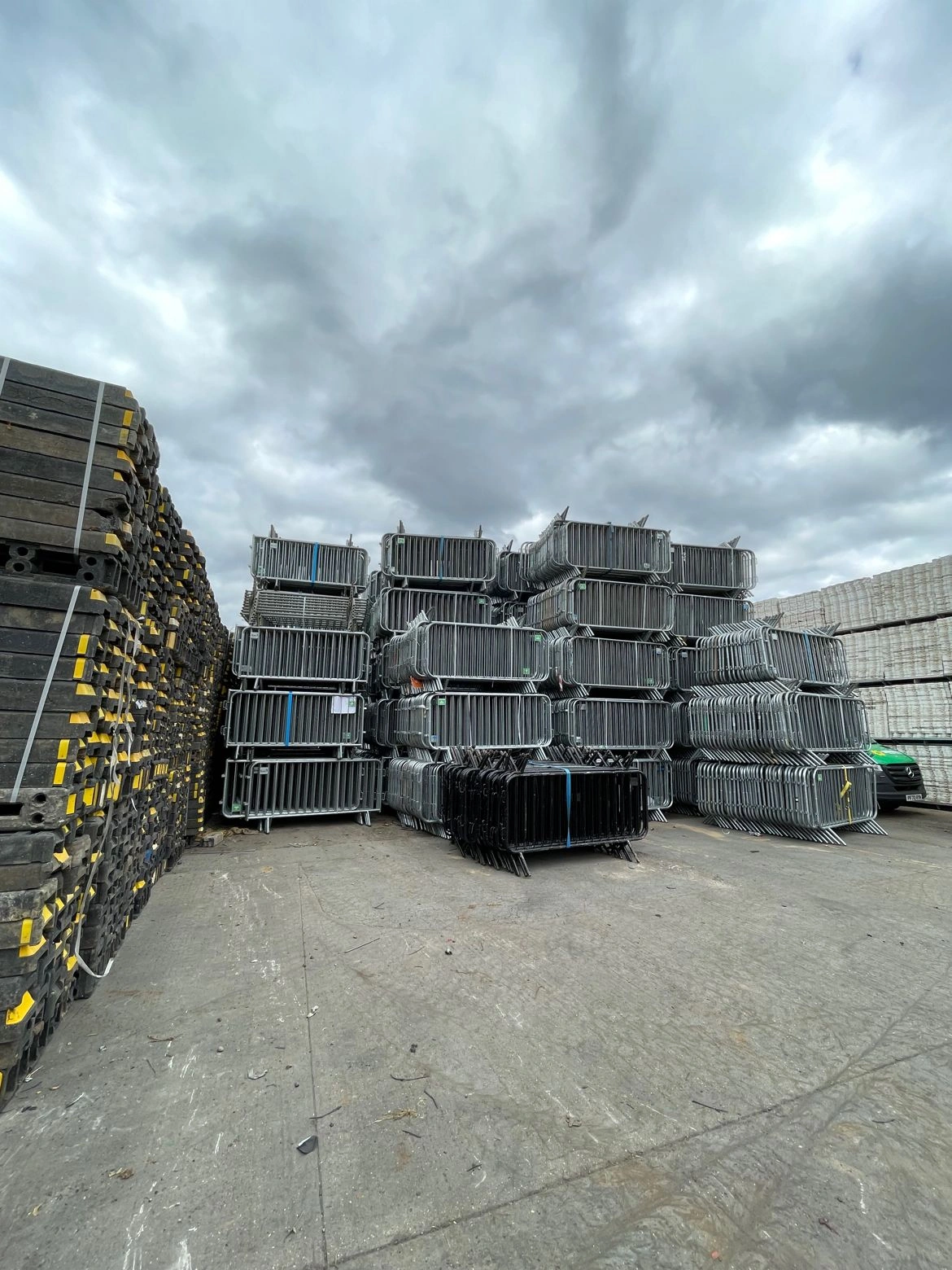
The unit price gap between concrete and HDPE feet is misleading. The real cost differential sits in freight weight per container and the compliance risk of unspecified UV compounds, not the $8-12 AUD per foot.
Physical Weight Differential: 32kg vs 6kg Per Foot
Freight math kills concrete feet. A compliant HDPE foot weighs 6kg. A concrete foot weighs 32kg. This 26kg difference eats your 20ft container payload. You need a second container for panels. That second shipment costs $2,800-$3,500 AUD. The “saving” vanishes.
AS 4687-2022 HDPE Minimum Specifications
The 2022 standard mandates UV stabilizers but not the specific compound. Suppliers use “UV stabilized” to hide cheap ingredients. UV-P resists Australian sun but costs 8-12% more than UV-2002. If the documentation omits the code, they are using the cheapest option. We stamp the code on the mold cavity. This is your only field verification.
The UV Stabilizer Trap in Recycled HDPE
Generic recycled HDPE fails within six months. It chalks, cracks, and shatters under wind load. A SafeWork inspector sees the cracks and stops your job. They do not test the polymer. They issue a stop-work order. Replacing feet costs over $8,000 AUD. Saving $1.50 per foot is a terrible deal.
Container Payload and ESG Carbon Reporting Savings
Weight isn’t just about freight cost anymore. It hits your ESG carbon ledger directly. A 20ft container from North China to Sydney pushes 2.8-3.4 tonnes of CO2e depending on the vessel route and emission factor you use. Swap concrete feet for HDPE, and you eliminate an entire container per order from your materials carbon account. For project managers reporting under NGERS or state-level climate disclosure rules, that is not a rounding error. On a 600-panel civil job, HDPE feet cut the fencing component’s embedded transport emissions by roughly 45-50% versus concrete feet. That is a verifiable number you can drop into your project ESG submission with zero methodology gymnastics.
| Cost Parameter | Concrete Fence Feet | HDPE Fence Feet (AS 4687-2022) | Project Cost Impact |
|---|---|---|---|
| Unit FOB Cost | $4.00 – $6.00 AUD | $8.00 – $11.00 AUD | HDPE costs $4-$5 more upfront per set. |
| Freight Efficiency (20ft Container) | ~600 sets (32 kg/foot) | ~2,000 sets (5.5 kg/foot) | HDPE reduces per-set freight costs by up to 70%. |
| Site Labor & Deployment | 2-person lift; slow setup | 1-person lift; rapid deployment | HDPE cuts installation time by ~40%, lowering WHS risk. |
| Damage & Replacement Rate | 8-12% breakage/chipping rate | <1% breakage (impact-resistant) | HDPE eliminates concrete debris hazards and replacement costs. |
| AS 4687-2022 Audit Risk | High (weight inconsistency) | Zero (560x240x130mm, UV-P) | HDPE prevents $3,600+ AUD SafeWork rectification fines. |
Coastal Corrosion Risks & Testing
42μm hot-dip galvanization per AS/NZS 4680 is the compliant baseline for coastal deployments — the real failure vector within 500m of the coastline is localized zinc depletion at weld junctions, not the panel face coating.
Failure Modes Within 500m of the Coastline
Within 500m of the Australian coast, chloride deposition rates sit above 300mg/m²/day routinely. The coating on the panel face — if it hits the 42μm AS/NZS 4680 minimum — handles that exposure as designed. Our salt spray testing at 600+ hours shows 42μm hot-dip galvanized steel holds structural integrity through accelerated coastal aging cycles.
The real killer for coastal fencing is not uniform coating wear. It’s localized pitting at weld junctions. During hot-dip galvanizing, zinc pooling at intersection points gets inconsistent — the weld nugget disrupts zinc flow, creating micro-zones where effective coating thickness drops below 30μm even though the panel face reads 42μm. Salt-laden moisture collects in those recessed weld points and accelerates electrochemical attack. That is why two panels with identical “42μm” certificates can perform very differently on the same coastal site.
Salt Spray and NS-Classified Omnidirectional Wind Loads
NS-classified sites (No Shielding, Ms=1.0) mean open terrain with fewer than 3 obstructions per hectare — a classification that covers most coastal construction buffers, beachfront civil projects, and port-adjacent developments. The AS 4687-2022 wind load requirements demand temporary fence specs resist omnidirectional force at this full multiplier. That is a test the 2007 standard never required.
On NS-classified coastal sites, constant wind-driven salt spray combined with omnidirectional gust loading creates a dual degradation mechanism. Mechanical stress concentrates at panel-to-panel clamp connections and base-to-frame junctions. The 2007 unidirectional test protocol let suppliers orient panels favorably. The 2022 standard exposes those connection points to cyclic loading from multiple attack angles. Panels certified only under the 2007 protocol may pass a static wind load test but fail under real coastal conditions where wind direction shifts every 15 to 30 minutes during sea breeze transitions.
Required Coastal Spec Upgrades
For deployments within 500m of the coast, the single most cost-effective spec upgrade is wire diameter. Moving from the 3.0mm AS 4687-2022 minimum to 4.0mm wire does more than add structural mass — it fundamentally changes the galvanizing dynamics at every weld point. Thicker wire picks up a proportionally thicker zinc layer at intersections, directly closing the vulnerability gap at weld junctions that causes premature coastal failure.
- Wire diameter jumps from the standard 3.0mm to 4.0mm for coastal work. That extra millimeter adds serious wind load capacity and improves zinc pickup at the weld points. Durability starts here.
- The AS/NZS 4680 baseline of 42μm galvanization is the legal minimum for seaside environments. For projects needing 10+ years or sitting in breaking wave zones, upgrade to 65μm. Cost-effective only if you plan for the full service life upfront.
- Stick with 32mm OD x 1.6mm wall frame tubing. Do not let suppliers talk you into 1.4mm wall substitutions, no matter what cost argument they make. That 0.2mm difference kills structural quality on coastal sites.
- Specify UV-P stabilizer compound for HDPE feet. Standard UV-2002 degrades about 40% faster under the Australian coastal UV index. Cheap feet fail first — don’t let that be your failure point.
Recommended RFP Spec Overrides for Project Managers
Writing “AS 4687 compliant temporary fencing” without the “-2022” suffix and coastal-specific overrides is the fastest route to a failed SafeWork audit on shoreline projects. Drop these clauses directly into your next RFP to close the compliance gap.
- Panel weight is your fastest field check against suppliers shipping 10.36kg units instead of the mandated 14.00kg compliant panels. Procurement teams writing “AS 4687” without the 2022 suffix are accidentally accepting obsolete stock tested only for unidirectional wind loads. Specify the exact micron thickness and wire diameter in your RFP, or you pay the rectification fine when the inspector arrives. Demand the 600-hour salt spray test report and omnidirectional wind load documentation before signing your next purchase order. Send us your current specification sheet, and our engineers will flag the exact gaps that trigger a failed site audit. Frequently Asked Questions What is the Australian Standard 4687 2022? AS 4687:2022 is the current Australian Standard governing temporary fencing and hoardings. It sets design, testing, and performance requirements for the entire fencing system — including panels, bases, gates, and connections — covering strength, omnidirectional wind resistance, overturning stability, and signage attachment. It replaced the 2007 version and is split into three parts: Part 1 (General requirements), Part 2 (Temporary fencing), and Part 3 (Hoardings). What is the cheapest way to make a temporary fence? The cheapest approach is specifying 2.5mm wire diameter panels with 32mm x 1.0mm frame tubing and electro-galvanized coating — approximately $18-22 AUD per set FOB from Chinese manufacturers. These panels fail AS 4687-2022 minimum specs (3.0mm wire, 1.6mm wall, 42μm hot-dip galvanization) and will not pass SafeWork inspections in NSW, Victoria, or Queensland. The cost saving of 15-20% per panel is eliminated by a single rectification order averaging $3,600+ AUD. What is the best type of temporary fence? For Australian construction sites, 3.0mm welded mesh panels (2100mm x 2400mm, 14kg) with 42μm hot-dip galvanization and UV-stabilized HDPE feet provide the best compliance-to-cost ratio. For high-wind or coastal NS-classified sites, upgrade to 4.0mm wire and consider additional ballast. Chain link is acceptable for short-term low-security use but offers inferior anti-climb performance. Solid hoarding panels (35kg+) are required only for privacy zones or demolition projects where debris containment is mandated. What documentation proves AS 4687-2022 compliance? Request three documents from suppliers: (1) a test report from a NATA-accredited or equivalent laboratory explicitly referencing AS 4687-2022 (not 2007) with omnidirectional wind load results; (2) a galvanization certificate referencing AS/NZS 4680 with measured coating thickness in microns; (3) material mill certificates confirming steel grade, tube OD, wall thickness, and wire diameter. A supplier’s own ‘compliance declaration’ without third-party test data has zero legal standing in a SafeWork audit. Does AS 4687-2022 apply to pool fencing? No. AS 4687-2022 covers temporary fencing, hoardings, and pedestrian barriers for construction sites and events. Permanent pool fencing is governed by AS 1926.1:2012 (Safety barriers for swimming pools). Some confusion arises because Standards Australia catalogues list both under ‘fencing’ categories, but the testing protocols, height requirements, and material specs are entirely different.