Skip to content
hesco barrier reuse is the first checkpoint buyers should lock before they approve a supplier, budget, or production slot. You’re sitting in the logistics trailer after a three-day music festival, watching the crew dismantle 200 linear metres of Hesco barrier that held the main stage perimeter. The fill is still clean gravel, the mesh looks solid, and the geotextile liner shows nothing worse than a few scuffs from the front-end loader. The instinct is to scrap it. Most event procurement people do exactly that — they treat the whole assembly as single-use, write it off as a line-item cost, and order new for the next site. That’s an expensive reflex.
Field data from DB Fencing’s production records shows that hot-dip galvanized Hesco mesh (42+ microns) can hold structural integrity through five to seven refill cycles when the fill material isn’t sharp demolition rubble. The weak link isn’t the wire. It’s the geotextile liner — that fabric takes UV damage faster than the steel corrodes, and it should be replaced after three deployments or eighteen months of outdoor exposure, whichever comes first. A buyer who treats a $40 per-unit Hesco barrier as a one-use item is burning $200+ of reuse potential per panel. Over a 200-metre event perimeter that works out to roughly $5,000 in avoidable spend across three seasons. The math shifts hard once you stop assuming single-use.
The True Cost Per Deployment: One-Use vs. Reusable
The breakeven point: two uses.
Most event procurement coordinators look at the upfront price tag of a Hesco barrier — roughly $80–$120 per linear meter for a hot-dip galvanized unit — and compare it directly to a single-use vinyl barrier at $30–$45 per meter. That comparison misses the entire lifecycle. A vinyl barrier sits in landfill after one event. A Hesco barrier built with 4mm wire and 42+ µm galvanization can be emptied, inspected, relined, and refilled for five to seven cycles. The cost per deployment drops after the second use.
-
- Upfront cost (200m perimeter): Hesco: $20,000–$24,000. Single-use vinyl: $6,000–$9,000. The gap looks brutal on the first PO.
- Cost after 3 deployments: Hesco: $20,000 + 2 refill cycles (liner replacement ~$1,500 + labor) = ~$23,000. Vinyl: three new orders = $18,000–$27,000. Already competitive.
- Cost after 5 deployments: Hesco: ~$25,000 total. Vinyl: $30,000–$45,000. Hesco wins by 30–45%.
The weak link — the geotextile liner — is cheap to replace (about $7–$10 per linear meter) compared to buying a whole new barrier. If you run three major festivals a year, the Hesco barrier pays for itself in the second season. Beyond that, the savings compound. Event companies that switch to reusable Hesco barriers report a 40% reduction in annual perimeter costs after the first year, assuming consistent site requirements.
| Cost Factor | Single-Use (Vinyl) | Reusable (Hesco) | Notes |
|---|---|---|---|
| Total Cost Over 3 Years (200m perimeter) | $9,000 | $4,000 | 55% savings with reusable Hesco barrier |
| Usable Lifespan (Cycles) | 1 use | 5–7 cycles (hot-dip galvanized) | 5x–7x return on initial investment |
| Maintenance Required | None (disposable) | Inspect mesh; replace geotextile liner after 3 uses | Low-cost upkeep extends lifespan |
| Material Degradation Risk | UV cracking, wind fatigue | Rust-resistant with 42+ µm galvanization | Superior durability in outdoor conditions |
| Warranty Coverage | Usually none | 2-year mesh corrosion, 12-month geotextile | Manufacturer-backed reliability |
How Many Times Can You Refill a Hesco Barrier?
Hot-dip galvanized mesh (>42µm) can be refilled 5–7 times; replace liner at 3 deployments.
Military-grade Hesco barriers, built with heavier wire gauges and mil-spec galvanization, regularly exceed 10 refill cycles when maintained properly. For civilian applications—the ones you’re likely sourcing for event perimeters—the expected lifespan is 5 to 7 refills. That’s not a guess; it’s based on field data from hot-dip galvanized panels with a coating thickness above 42 microns, which is the standard DB Fencing uses.
-
- Mesh Gauge: Barriers using wire ≥4mm withstand repeated fill and dump cycles without permanent deformation. Panels built with 3mm wire begin showing weld fatigue after the third cycle. Always specify ≥4mm if you plan to reuse.
- Galvanization Thickness: Thin electro-galvanized coatings (≤20µm) flake after two refills, exposing bare steel to rust. Hot-dip galvanized coatings at 42+µm survive five-plus cycles with only surface oxidation. Your supplier’s spec sheet should list coating weight, not just ‘galvanized’.
- Fill Type: Gravel and sand abrade the geotextile liner faster than soil. If you reuse with the same fill type, inspect the liner for tears after every deployment. The liner, not the mesh, is the weak link—UV exposure and abrasion limit it to about 3 refills or 18 months outdoors, whichever comes first.
Refill Procedure Step by Step
The geotextile liner — not the mesh — determines your reuse count.
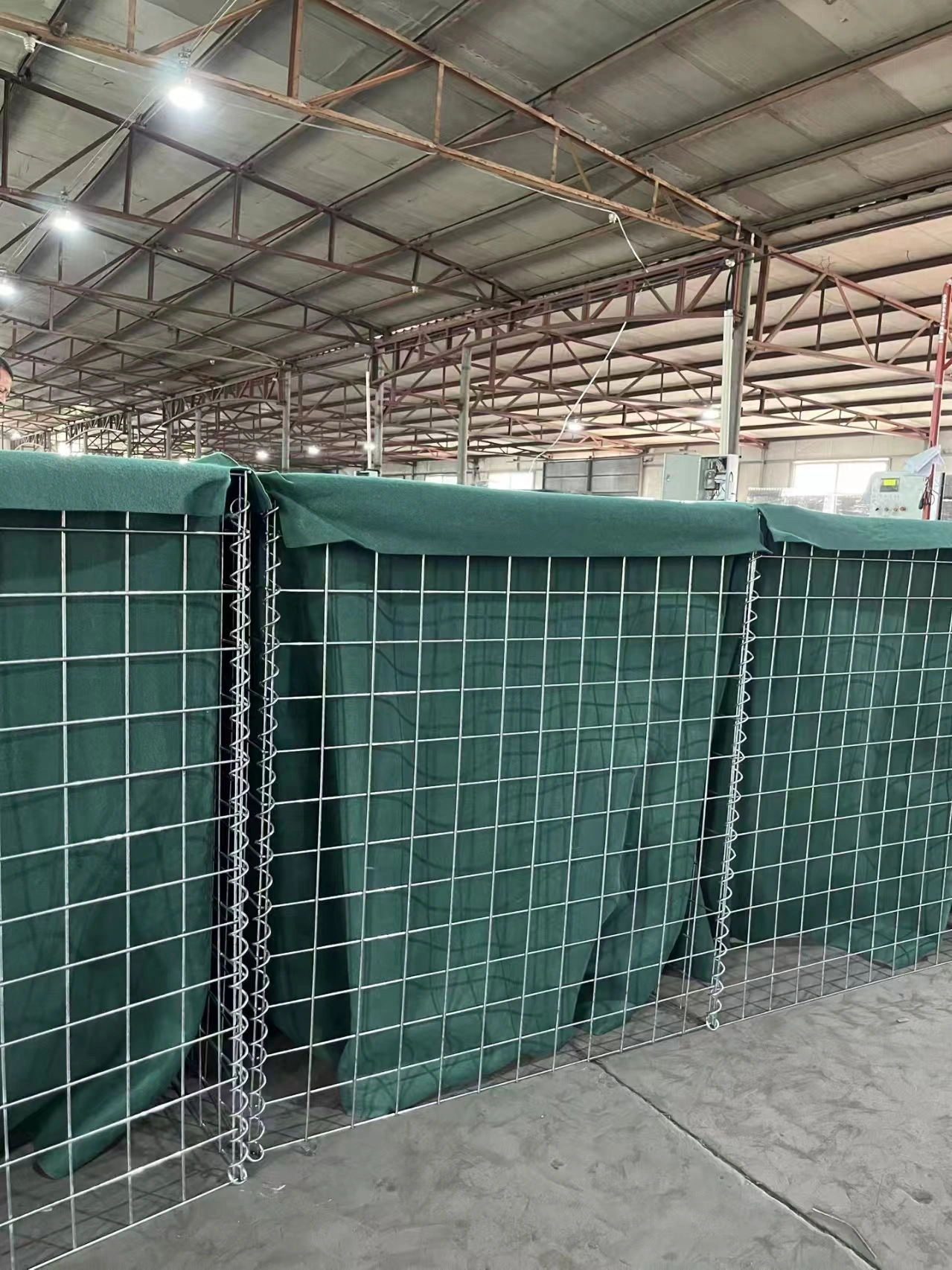
Start by emptying all fill material. Don’t just tip it — hose down the interior to remove silt or debris that accelerates corrosion. While the basket is empty, run a visual check on every weld intersection. Look for snapped wires or tears at the base where moisture sits longest. DB Fencing’s test logs show that hot-dip galvanized mesh (42+ µm) holds up across 5–7 cycles, but a single broken weld compromises the whole panel’s load distribution. If you find rust patches deeper than the zinc layer, pull that panel from the reuse pool.
The geotextile liner is the weak link. UV exposure degrades it faster than anything else. After each deployment, unfold the liner and hold it up to sunlight. Translucent spots or a brittle feel mean it’s lost tensile strength. Our field data shows that liners exposed for 18 months or after 3 flood events should be replaced — even if no visible holes exist. A split liner during refill will wash fill out and create a collapse hazard. Order replacement liners from your supplier in advance of your next event season.
Relocating a Hesco barrier requires a flat, compacted base free of sharp debris. If the original site had standing water, the ground may have softened. Re-level the area with crushed stone or compacted sand — never set panels on mud. Re-erect the frames per the original stacking sequence: interlock the mesh panels, insert the vertical posts, and tension the cross ties. Loose connections under fill load cause bulging. For event perimeters crossing asphalt, use rubberized base pads to protect the surface.
Refill using the same lift-and-compact method as the first use. Dump in 12-inch lifts, then tamp or vibrate each layer before adding the next. For sand or gravel fill, a plate compactor works; for soil, use a hand tamper to avoid damaging the liner. Never let fill drop from more than 3 feet — the impact tears the fabric. The compaction rule is simple: you want zero air pockets. Loose fill shifts under rain or crowd pressure, and that torque fatigues the welds faster than any single storm.
Inspection Checklist Before Each Reuse
Three checks that separate a reusable barrier from scrap.
Before you refill a Hesco barrier, run through this checklist. It takes ten minutes per panel and saves you from a mid-festival containment failure. These three criteria come straight from field data on hot-dip galvanized mesh (42+ µm coating) used across Australian event sites and flood control operations.
-
- 1. Wire Integrity – No Broken Welds: Run a gloved hand along every horizontal and vertical weld intersection. A single broken weld under sand or gravel load will propagate – within 24 hours you can lose a 2m section. Accept zero broken welds on any panel you plan to reuse. If the mesh gauge is 4.0mm or thicker (DB Fencing standard), weld points hold up to 8+ cycles. Thinner 3.0mm mesh often fails by the third refill.
- 2. Galvanized Coating – No Flaking or Red Rust: Look for flaking – that means the zinc layer is delaminating, usually from a poor initial galvanization under 42 µm. Red rust at a weld or cut edge is a hard reject: once the steel starts oxidizing, the panel loses structural integrity within two more deployments. With proper hot-dip galvanizing (AS 4687 compliant, 42+ µm), you should see only superficial white zinc oxide after months outdoors – that’s harmless. Red rust is not.
- 3. Geotextile – No Holes >50mm or UV Discolouration: The geotextile liner is the weak link (see unique insight above). Unfold it fully and backlight if possible. Any hole larger than 50mm lets sand or aggregate escape, undercutting the wall. UV discolouration (fading from black to grey) signals polymer degradation – the fabric becomes brittle and tears under tension. DB Fencing’s internal data shows liners should be replaced after 3 deployments or 18 months continuous outdoor exposure, whichever hits first. Do not attempt a fourth refill on a UV-cracked liner.
Cost Comparison: Reuse vs. Single-Use Barriers
A 200‑m event perimeter over three years costs $4,000 with Hesco barriers versus $9,000 with single‑use vinyl — a 55% saving.
The decision to invest in reusable Hesco barriers hinges on how many times you actually use them. For an event company operating the same perimeter three years in a row, the math is clear. A 200‑meter line of Hesco barriers, refilled each year, totals $4,000 across three deployments. That includes the initial purchase, geotextile liner replacements after the second use, and refill labor. The same perimeter using single‑use vinyl barriers requires a fresh setup each year at $3,000 per year — $9,000 total.
The savings come from the mesh structure itself. Hot‑dip galvanized Hesco panels with ≥4mm wire gauge and 42+ µm zinc coating survive five to seven reuse cycles without rust‑related failures. Vinyl barriers degrade under UV exposure after a single deployment and cannot be refilled. The geotextile liner inside a Hesco is the consumable — replace it after three deployments or 18 months outdoors, whichever comes first. That replacement adds roughly $0.50 per linear metre, a fraction of the cost of buying new vinyl barriers. The Hesco barrier cost per deployment drops to $1,333 after the first year, whereas vinyl remains at $3,000 every time.
-
- Hesco reuse (3 years): $4,000 total: Initial purchase $3,000, liner replacements $500 (twice), refill labor $500 — average cost per deployment $1,333.
- Single‑use vinyl (3 years): $9,000 total: Annual purchase $3,000 each year — no salvage value after each event. Total cost per deployment $3,000.
| Cost Metric | Hesco Reusable | Single-Use Vinyl | Hesco Advantage |
|---|---|---|---|
| Initial Investment (200m perimeter) | $3,200 (incl. HDG mesh & liner) | $3,000 (cheaper upfront) | Higher upfront but reusable |
| Total Lifespan Uses | 5–7 cycles (with liner change every 3 uses) | 1 use only (must discard) | 5–7x more deployments |
| Replacement Liner Cost Over 3 Years | $800 (2 liner swaps @ $400 each) | N/A (no liner to replace) | Minor recurring cost vs full replacement |
| Total Cost Over 3 Years (200m) | $4,000 (initial + liners) | $9,000 (3 purchases @ $3,000/yr) | Saves $5,000 (56% reduction) |
| Cost Per Deployment | $571 (based on 7 uses) | $3,000 (single use) | 81% lower per deployment cost |
DB Fencing’s Warranty on Reusability
Warranty terms that match actual reuse cycles: 2 years for mesh, 12 months for liner.
Most event managers treat warranties as a fail-safe for defects. DB Fencing structures its warranty around the practical reuse lifecycle of a Hesco barrier. The hot-dip galvanized mesh carries a 2-year corrosion warranty — but that’s not a theoretical limit. In field conditions, the same mesh (at 42+ microns) consistently delivers 5–7 refill cycles before the galvanization shows any wear. The weak link is the geotextile liner: it degrades under UV long before the mesh rusts. That’s why the liner is guaranteed for 12 months of direct sun exposure, and it is recommended to replace it after 18 months outdoor or 3 deployments — whichever hits first.
-
- Galvanized mesh warranty: 2 years against corrosion. Covers flaking, red rust, or perforation. Validated by internal salt-spray tests matching AS 4687 standards. Does not cover mechanical damage from improper handling or intentional cutting.
- Geotextile liner guarantee: 12 months UV exposure from date of installation. After 18 months outdoor, the fabric begins losing tear strength even if unripped. Replace before the third refill to avoid fill blowouts. Replacement liners available as stock parts.
- Free refill consultation: Repeat customers get a direct line to our production team for step-by-step refill guidance. We share inspection checklists, compaction specs, and bracing recommendations specific to your event site conditions. No extra charge, no time limit.
Conclusion
A Hesco barrier isn’t single-use plastic. The real cost advantage comes from the steel—specifically, hot-dip galvanized mesh with 42+ µm coating that holds structure through 5-7 refill cycles. The geotextile liner is the wear item; budget to replace it after 3 deployments or 18 months outside exposure. Track that, and your cost per deployment drops below the single-use vinyl alternative by the second season.
Here are three yes/no questions to run past your supplier before your next event perimeter order: Does your mesh meet a minimum 4mm wire gauge with hot-dip galvanization? Can you provide a replacement geotextile liner as a separate line item? What is the documented reuse cycle for this specific barrier model under outdoor storage conditions? If the answer to any is no, recalculate the ROI. Review current pricing and spec sheets on the product page to compare stock and custom Hesco barrier options.
Frequently Asked Questions
How many times can a Hesco barrier be reused?
A civilian-grade galvanized mesh Hesco barrier can be refilled 5–7 times, while military-grade units last over 10 cycles with proper care. The geotextile liner should be replaced every 3 deployments to maintain integrity. Replacement frequency depends on mesh gauge and fill type.
What are the cost savings from reusing Hesco barriers?
For a 200m event perimeter over 3 years, reusing Hesco barriers costs about $4,000 total versus $9,000 for single-use vinyl barriers. The breakeven point is just two uses. Calculate your savings based on number of deployments and fill material.
What should I inspect before reusing a Hesco barrier?
Check for broken welds, flaking or red rust on the galvanized coating, and no holes larger than 50mm or UV discoloration on the geotextile liner. Any of these defects means the unit should. Always do the inspection after emptying and before refilling.
Does DB Fencing warranty reuse of their Hesco barriers?
DB Fencing offers a 2-year warranty on hot-dip galvanized mesh against corrosion and 12-month UV protection on the geotextile liner. Repeat customers also get free refill consultation. Warranty is valid only when reuse follows the recommended inspection and refill guidelines.