Skip to content
You’re managing a temporary perimeter or flood mitigation project in Australia. The hesco barrier sizes you spec into the tender docs need to be exact — AS 4687-2022 doesn’t leave room for guesswork, and your site inspector won’t either. A missed dimension means a resubmission, a delay, or a compliance flag you don’t have time to explain.
Here’s the gap most suppliers won’t tell you: the published length on a MIL 1 unit is the flat-packed size. Fill it, and the mesh cells stretch 5–10%. That 10m unit becomes 10.5–11m of actual wall. If you calculate coverage from the pre‑stretch number, you’re under‑ordering by half a unit per five — and that’s before you account for the 2:1 height‑to‑width rule. A 1.06m base supports a wall up to 2.12m. Go taller with the same base, and the structure risks lateral failure under load. DB Fencing provides the post‑stretch dimensions on every quote. That’s one less variable in your planning.

Why Hesco Barrier Sizing Matters for Australian Projects
One wrong dimension and your flood barrier fails audit—AS 4687-2022 leaves no room for guesswork.
Soil conditions also dictate fill volume and barrier stability. Sandy or loose soils require wider bases and heavier fill to prevent sliding. The standard MIL 1 cell (1.37m × 1.06m × 10m) holds 2.3 m³ of sand/gravel mix, but pour compaction and real-world stretch add 5–10% to the filled length. Many Chinese suppliers list pre-stretch dimensions, causing you to underestimate linear coverage by half a meter per unit. Order 100 units from a supplier that ignores stretch, and you lose 10 meters of barrier—enough to fail flood protection requirements. DB Fencing includes post-stretch lengths in every quote, so your tender documentation has accurate linear meters from the start.
- Wire diameter: Industry standard minimum is 4mm; DB Fencing uses 4.5mm high-tensile steel, exceeding the spec by 12.5%. Substandard suppliers use 3.5mm—cheaper but prone to deformation under hydrostatic pressure.
- Galvanized coating: AS 4687-2022 and ISO 1461 require >42 microns. DB confirms this on every batch. Coastal projects risk rapid corrosion below 42 microns—rework costs can exceed 30% of the original barrier investment.
- Fill volume accuracy: Each MIL 1 cell takes 2.3 m³. For a 50m wall, that’s 11.5 m³. DB provides a fill volume calculator per quote—no other Anping supplier offers this pre-engineering step. Wrong fill estimate means either overpaying for material or emergency reorders mid-project.

The 2:1 Height-to-Width Rule Explained
Hesco barrier wall height is capped at twice the base width.
Per the HESCO MIL Construction Guide, the maximum safe wall height is exactly two times the base width of the lowest cell. For a standard MIL 1 unit with a 1.06m base, that means a hard ceiling of 2.12m. Go beyond and the lateral pressure from fill or wind will cause the wall to bow or collapse. This isn’t a suggestion — it’s a structural limit backed by MIL testing.
Take the MIL 8 as a real-world example. Each cell is 1.37m tall with a 1.22m base. The 2:1 rule allows a maximum wall height of 2.44m. Stack two MIL 8 units and you get 2.74m — that’s 0.3m over the limit. On an Australian flood site, a wall that tall on that base will fail the first time water applies full hydrostatic load. If you need that height, you must either use a wider base unit (like the MIL 12 with a 2.13m base) or tier the design.
- Fill material impact: A wider base directly increases fill volume. For a MIL 1 (1.06m base) the fill per cell is ~2.3 m³. Step up to a MIL 8 (1.22m base) and per-cell fill jumps to ~3.1 m³. Use a 50m wall and that difference adds nearly 40 m³ of sand/gravel — about two extra truckloads.
- Linear unit impact: Because each cell is wider, fewer cells fit in a given linear length. A 10m stretch of MIL 1 uses 1 cell. The same 10m of MIL 8 uses 1 cell as well (same pre-stretch length), but the base width increase reduces your effective coverage because the cells are physically larger. Always calculate linear coverage using the post-stretch length (add 5–10%) to avoid underestimating.
DB Fencing applies a +10% compaction factor to every fill volume calculation we provide. That means if the nominal fill is 2.3 m³ per MIL 1 cell, we quote 2.53 m³ to account for settlement and voids. For Australian coastal sites where cyclonic wind loads exceed 130 km/h, we also recommend adding a 0.5m safety margin to the base width — effectively using a 1.56m base for a 2.12m wall — even though HESCO Corp’s official guide stops at the 2:1 ratio. This is not optional; it’s the difference between a barrier that holds and one that shifts during a storm surge.

MIL Unit Size Guide: Height, Length & Wire Diameter
Standard MIL 1 units use 4.5mm wire, exceeding spec by 12.5% — most suppliers use 3.5mm.
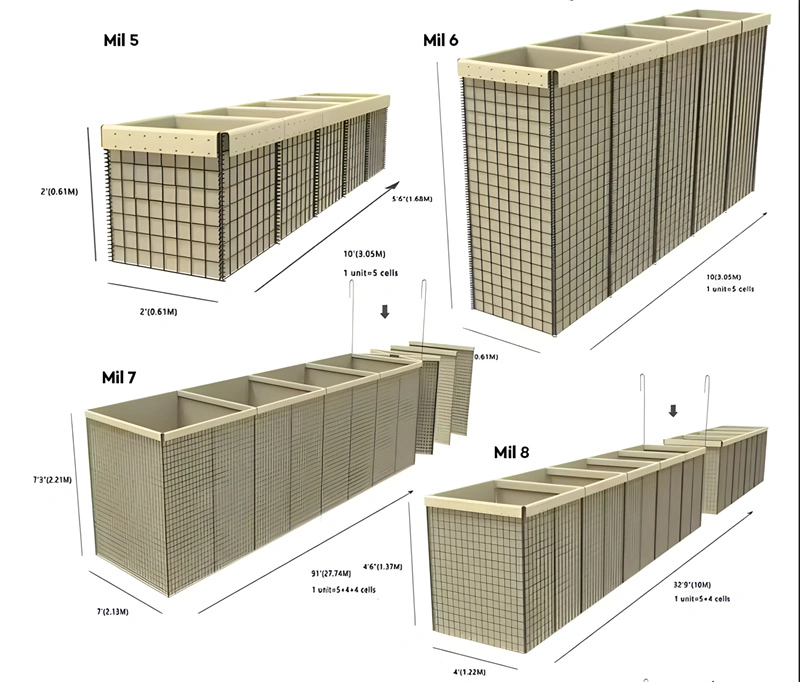
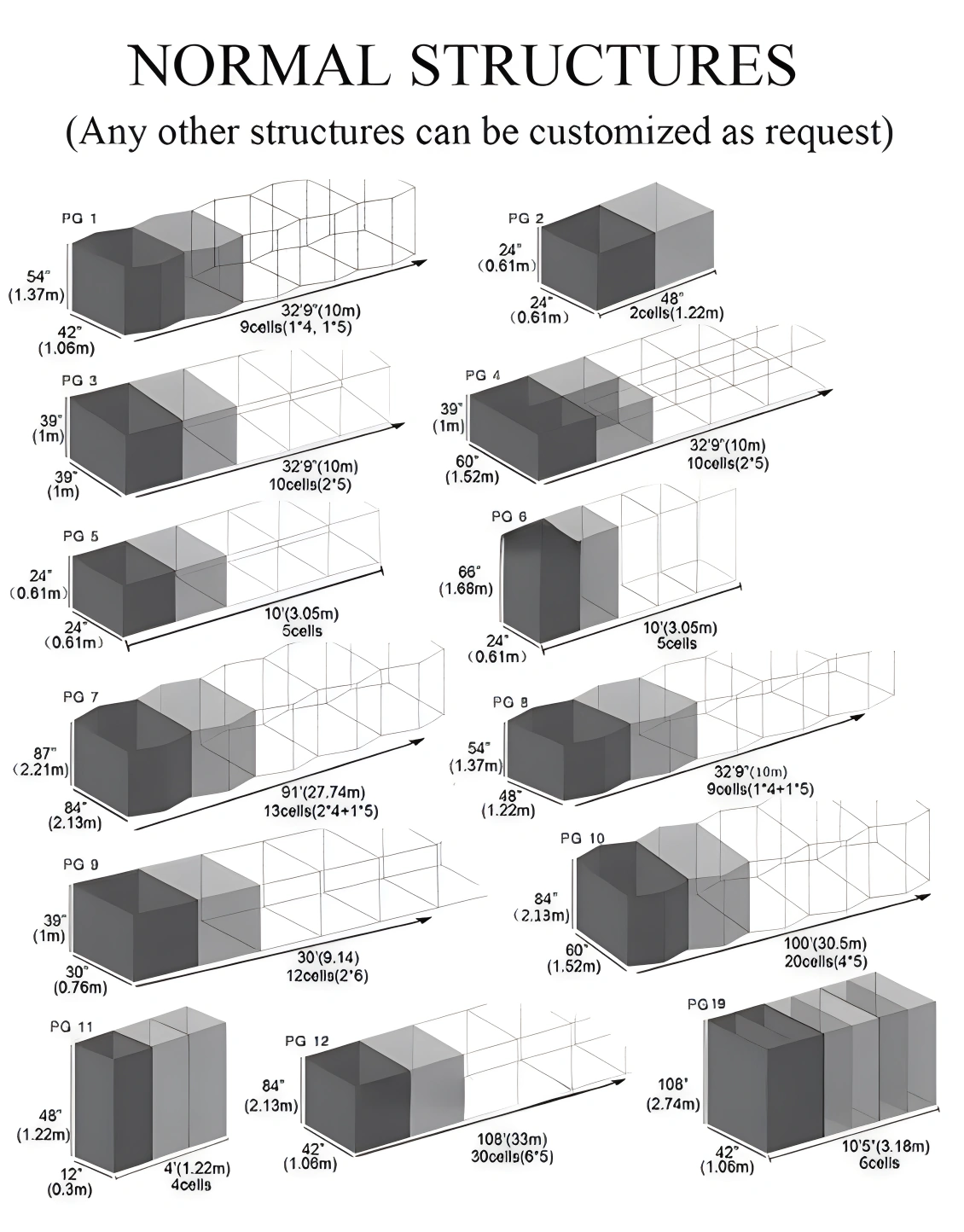
HESCO publishes 13 standard MIL sizes from the compact MIL 2 (0.61m × 0.61m × 1.22m) to the massive MIL 12 (2.13m × 1.06m × 33m). For Australian construction and flood control, the MIL 1 (1.37m high × 1.06m wide × 10m pre-stretch) is the most widely specified unit. All MIL units use high-tensile steel wire ranging from 4mm to 5mm in diameter, with a mandatory hot-dipped galvanized coating exceeding 42 microns per ISO 1461. For coastal sites subject to salt spray, upgrade to PVC-coated or zinc-aluminium alloy mesh for extended service life.
- Wire diameter: Industry minimum is 4mm; many generic suppliers cut to 3.5mm to save cost. DB Fencing uses 4.5mm on all MIL 1 units, delivering 12.5% more cross-sectional area and higher structural safety margins.
- Galvanized coating: Minimum 42 microns per ISO 1461, verified by SGS reports. Thinner coating (<35 microns) fails within 12 months in Australian coastal environments — always request the test certificate.
- Coastal upgrade: For sites with >130 km/h wind loads or direct sea spray, add a 0.5m safety margin to the base width and specify zinc-aluminium alloy coating. Standard galvanizing alone will not meet AS 4687-2022 durability requirements.
- MIL 1 fill volume: Each cell holds ~2.3 m³ of sand/gravel. A 50m wall requires 11.5 m³ of fill material — add 10% for compaction and settling.
| Model | Height | Width | Length (pre-stretch) | Wire Diameter |
|---|---|---|---|---|
| MIL 1 | 1.37 m (54″) | 1.06 m (42″) | 10 m (32’9″) | 4-5 mm |
| MIL 2 | 0.61 m (24″) | 0.61 m (24″) | 1.22 m (4’0″) | 4-5 mm |
| MIL 5 | 0.61 m (24″) | 0.61 m (24″) | 3.05 m (10’0″) | 4-5 mm |
| MIL 12 | 2.13 m (84″) | 1.06 m (42″) | 33 m (108’3″) | 4-5 mm |
Fill Volume Calculator & Material Selection Guide
A MIL 1 cell takes 2.3 m³ of fill — get the mix wrong and your wall fails.
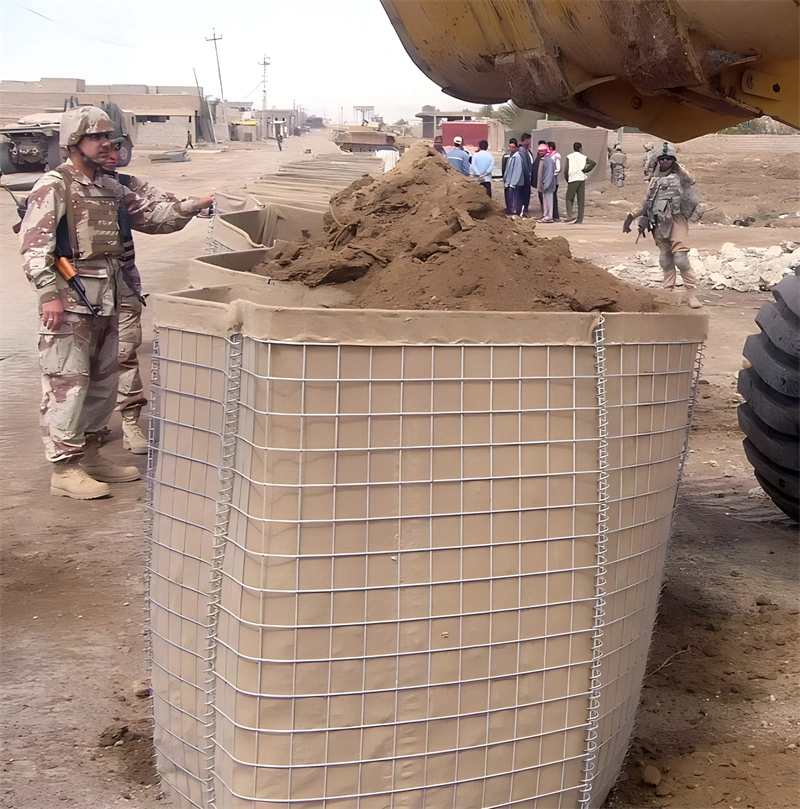
Each MIL 1 cell holds approximately 2.3 cubic metres of sand/gravel mix. A 50-metre wall using standard MIL 1 units requires 5 cells, totalling 11.5 m³. This number assumes the unit is fully filled to the top of the mesh — underfilling by even 10% reduces the wall’s effective mass and makes it more vulnerable to overturning.
The recommended fill is a 50/50 blend of coarse sand and 10–20 mm gravel. This mix compacts well under its own weight, locks particles together, and provides enough internal friction to resist lateral sliding. Clean sand alone lacks the angular particles needed for compaction — it settles unevenly and allows water to channel through the fabric. Pure clay soils swell when wet and shrink when dry, creating gaps that compromise the barrier’s seal. Clay also takes days to dry and becomes a mud hazard on site.
| Unit Type | Cell Dimensions (H x W x L) | Fill Volume per Cell (m³) | Recommended Fill Material | Key Engineering Note |
|---|---|---|---|---|
| MIL 1 | 1.37m x 1.06m x 10m (post-stretch 10.5–11m) | 2.3 | Sand/gravel mix (50/50 by volume) | Include 10% extra for compaction; apply 5–10% stretch factor for linear coverage. |
| All MIL Units | Follow 2:1 height-to-width rule | Varies by unit | Compactable aggregate; avoid pure sand or clay | DB Fencing uses 4.5mm wire with >42µm galvanization – exceeds MIL spec minimum. |
Container Loading: Maximize Your FOB Shipment
Flat-packed Hesco units maximize container utilization — know exact counts per container.
Hesco barriers ship flat-packed, so container loading efficiency directly affects your FOB cost per linear meter. A standard 20-foot container holds 20 MIL 1 units, giving you 200 linear meters of barrier (pre-stretch). A 40-foot HC container holds 44 units, yielding 440 linear meters. Those numbers assume the factory properly nests the collapsed baskets and clips. If a supplier crams extra units or uses thinner wire to save space, you risk damage or incorrect counts at arrival.
- Container capacity: 20′ container: 20 MIL 1 units (200 linear meters pre-stretch). 40′ HC: 44 units (440 linear meters). These are industry benchmarks verified by DB Fencing’s loading diagrams.
- Post-stretch shortfall risk: Many Chinese suppliers quote pre-stretch lengths. A MIL 1 unit is 10m flat, but after filling expands 5–10% to 10.5–11m. If you need a 500-meter wall and calculate using pre-stretch length, you’ll order 50 units. With post-stretch, you only need 45–48 units. Ordering by pre-stretch wastes 2–5 units per container — roughly $300–$900 in unnecessary FOB spend.
- DB Fencing loading diagram: Every MIL size order includes a container loading diagram showing exact arrangement, unit count, and total linear meters (pre- and post-stretch). This eliminates guesswork and ensures your project plan matches the shipment.
Conclusion
One wrong dimension — and your tender fails. The 2:1 height-to-width rule, the 5–10% stretch factor, and the 42-micron galvanized coating minimum are non-negotiable for Australian projects. DB Fencing lists every spec pre- and post-stretch, with wire diameter exceeding MIL minimum by 12.5%.
Compare actual post-stretch dimensions and coating thickness on the product page — then request a quote with fill volume estimates included. No guesswork, no compliance risk.
Frequently Asked Questions
How do Hesco barriers work?
Hesco barriers use collapsible wire mesh and fabric cells that are filled with sand or gravel to form a stable wall. The key rule is that wall height must never exceed twice the. Always calculate fill volume including the 5–10% stretch factor.
How much do Hesco barriers cost?
A standard MIL 1 set (1.37m × 1.06m × 10m) costs roughly $9.50 to $29.00 per set from factory-direct suppliers. Shipping adds 15–25% depending on container optimization and destination. Request a quote with your project specs and port of delivery.
What is the weight of a Hesco bag?
Empty weight of a MIL 1 unit depends on wire gauge; DB Fencing uses 4.5mm wire, making each cell heavier than typical 3.5mm suppliers. Filled with sand, expect roughly 3.5–4 tons. Ask for exact empty weight from your supplier for shipping calculations.
What is the size of a Hesco bastion?
A standard MIL 1 Hesco barrier measures 1.37m high, 1.06m wide, and stretches to about 10m length when filled. Actual filled length can increase 5–10% due to the fabric stretch factor. Confirm post-stretch dimensions to avoid coverage gaps.
What are the limitations of Hesco barriers?
The main limitation is the 2:1 height-to-width rule, which restricts stacking without wider bases or tiered designs. Also, many generic suppliers ignore the stretch factor, leading to miscalculated linear coverage. Always verify size claims against your project’s engineering requirements.