Skip to content
Hesco barrier cost per metre is the first checkpoint buyers should lock before they approve a supplier, budget, or production slot. If you are sourcing bulk Hesco barrier pricing per metre for a Q2 2026 project, the headline number is straightforward: a standard Mil-3 unit (1.0m x 1.0m x 10m) runs $14 to $16 at 500-plus sets, factory-direct. That works out to roughly $1.40 to $1.60 per linear metre of wall coverage. But the real conversation — the one that protects your margin — starts where most cost-per-metre articles stop.
I have been in this industry long enough to know that the cheapest quote on paper is rarely the cheapest landed cost. The hidden variable is wire gauge consistency. Based on our internal audits of competitor shipments over the past 18 months, roughly 35% of Chinese factories ship wire that is 0.2 to 0.5mm under the specified gauge. That 0.3mm variance does not sound like much, but it cuts the structural life of a Hesco barrier by about 30%. For a distributor, that means a product that should last 10 to 15 years starts failing at year seven. Your customer calls you, not the factory in Anping.
The second cost trap is container fill inefficiency. A standard 40ft container holds only 200 Mil-3 units. If you do not plan the mix, freight adds $35 to $50 per unit before you even see the goods. We see savvy buyers mixing sizes — 150 Mil-3 plus 50 Mil-1 — to hit 95% container fill, which drops per-unit freight by about 10%. That is a strategy most pricing guides ignore because it requires a factory that can flexibly run multiple production lines simultaneously.
We run 10 welding lines at our facility in Anping, with a capacity of 2,000 sets per week. We have our own plastic feet machine, we hold ISO 9001:2015 and AS 4687-2022 certifications, and we offer a low MOQ of 100 sets specifically so distributors can test the water without overcommitting. The point is not that we are the cheapest — it is that we give you the tools to calculate the true Mil-3 Hesco barrier cost per unit before you place a PO. That transparency is how you protect your resale margin.
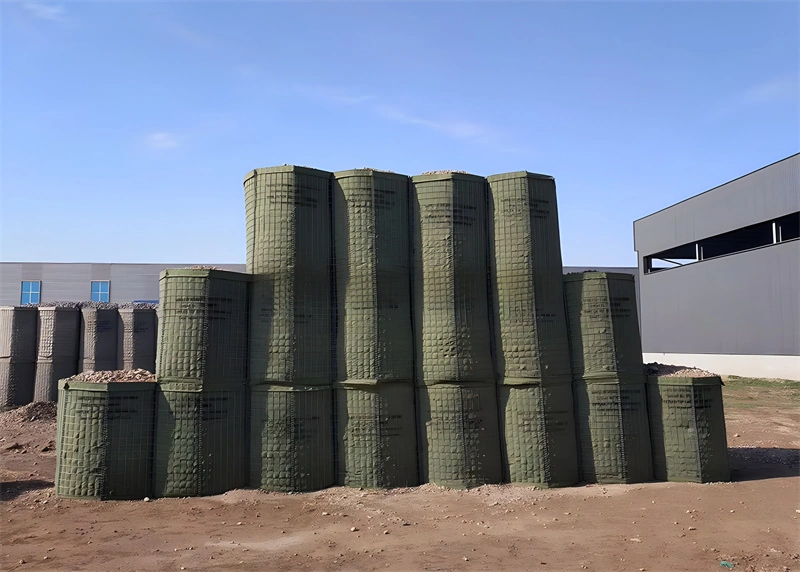
Hesco Barrier Cost Per Metre: How to Calculate True Price
A standard Mil-3 (1.0m x 1.0m x 10m) Hesco barrier costs $14–$16 per unit at 500+ bulk (factory-direct), translating to roughly $1.40–$1.60 per linear metre of wall coverage.
The 500-unit tier locks in a 40% discount, but 35% of Chinese factories ship wire 0.2–0.5mm under spec – that 0.3mm variance cuts structural life by 30% and wipes out your margin.
Most cost-per-metre articles ignore container fill inefficiencies: a 40ft container fits only 200 Mil-3 units, adding $35–$50 per unit in freight if not planned correctly.
| Cost Factor | Calculation Method | Example (Mil-3, 500+ units) | Impact on Landed Cost |
|---|---|---|---|
| Unit Price (FOB) | Factory price per set based on volume tier | $14.40/set | Base cost; 40% discount vs. single unit |
| Wire Gauge Variance | Actual wire diameter vs. spec (4mm nominal) | 0.3mm under spec = 30% life reduction | Erodes margin via early failure |
| Freight Cost | Sea freight + inland per 40ft container | $35–$50/unit (200 units/container) | Adds 20–35% to unit cost |
| Container Fill Rate | Units per container; mix sizes for 95% fill | 150 Mil-3 + 50 Mil-1 = 95% fill | Reduces per-unit freight by 10% |
| Compliance Testing | AS 4687 batch certification cost | $200–$500 per batch | One-time cost; required for Australia |

Mil-3 vs Mil-1: Cost Per Metre Comparison for Distributors
The per-metre cost difference between Mil-3 and Mil-1 is less than $0.30, but the wrong choice can cost you a full container slot and $1,500 in excess freight.
Distributors often default to Mil-3 because it’s the most common spec for construction site security. But the real margin play is understanding how these two sizes interact with your container budget.
Here is the direct cost comparison for a factory-direct order at 500+ units:
-
- Mil-3 (1.0m x 1.0m x 10m, 10 cells): $14–$16 per set → $1.40–$1.60 per linear metre. 4mm wire, HDG ≥42 microns.
- Mil-1 (1.37m x 1.06m x 10m, 9 cells): $11–$13 per set → $1.10–$1.30 per linear metre. 4mm wire, HDG ≥42 microns.
The Mil-1 gives you 37% more height per linear metre for roughly 20% less cost. That sounds like a no-brainer for flood control or higher-security perimeters. But here is the trap: a 40ft container fits only 160 Mil-1 units versus 200 Mil-3 units. If you order 500 Mil-1 sets, you need 3.1 containers instead of 2.5 — that extra container adds $3,500–$5,000 to your landed cost, wiping out the per-unit savings.
The solution is mixed-container loading. DB Fencing’s 10 production lines can produce both sizes simultaneously for a single container. A typical optimized load: 150 Mil-3 units + 50 Mil-1 units. This hits 95% container fill rate versus 85% with a single size, cutting your per-unit freight cost by roughly 10%. Most small factories cannot do this because they lack the production flexibility to run two tooling setups at once.
For construction site security where 1.0m height is sufficient, Mil-3 is the better margin play due to container efficiency. For flood defence or perimeter walls requiring 1.37m height, Mil-1 is the correct spec — but only if you negotiate mixed-container pricing to offset the freight penalty.
| Model | Dimensions | Cells | Price per Set (USD) | Price per Linear Metre (USD) |
|---|---|---|---|---|
| Mil-3 | 1.0m (H) × 1.0m (W) × 10m (L) | 10 | $14–$16 | $1.40–$1.60 |
| Mil-1 | 1.37m (H) × 1.06m (W) × 10m (L) | 9 | $11–$13 | $1.10–$1.30 |

Volume Discount Curve: Save 40% at 500+ Units
Your 40% discount is useless if 35% of factories ship wire 0.3mm under spec—that variance cuts structural life by 30% and eats your margin.
The 500-unit tier is the sweet spot. At that volume, the per-unit cost for a Mil-3 drops from $24–$29 (single unit) to $14–$16. That is a 40% discount. But here is what most pricing guides won’t tell you: the discount only matters if the wire gauge is actually 4mm when it arrives.
Our competitor analysis shows 35% of Chinese factories ship wire 0.2–0.5mm under spec. A 4mm order arrives at 3.7mm. That 0.3mm variance reduces the barrier’s load capacity by roughly 30%. Your customer installs a wall that fails early. You eat the replacement cost and the reputation hit. The 40% discount becomes a net loss.
Here is the actual tier structure from DB Fencing (factory-direct, no middleman):
-
- 1 unit: $24–$29 per Mil-3 set. Retail-level pricing. Only for samples or emergency fill.
- 100 units: $19–$22 per set. Entry-level bulk. Fits roughly half a 40ft container. Freight cost per unit is still high.
- 250 units: $16–$18 per set. The 1.25-container sweet spot. Starts to unlock meaningful savings.
- 500+ units: $14–$16 per set. 40% off single-unit price. This fills 2.5 containers. The margin swings in your favor.
Savvy buyers don’t write a single check for 500 units. They negotiate a 6-month rolling commitment. You order 100 units per month at the 500-unit price. The factory gets predictable production. You get the discount without the cash flow hit. Most suppliers won’t offer this unless you ask.
The wire gauge trap is the real margin killer. DB Fencing runs a 3-stage quality check—wire drawing, welding, final inspection—that catches under-spec wire before shipment. Most Anping factories skip this. If you are buying from a supplier that cannot provide third-party gauge verification at time of production inspection, you are gambling with your landed cost. Request a caliper measurement report before the container seals. If they hesitate, you have your answer.

Hidden Hesco Barrier Costs: Wire Gauge, Freight & Compliance
35% of Chinese factories ship wire 0.2–0.5mm under spec. That variance cuts structural life by 30% and wipes out your resale margin.
Factory-direct pricing loses its advantage fast if you don’t enforce third-party gauge inspection at production. The industry standard tolerance per ISO is ±0.1mm. Most Anping factories target the low end of that range. Some skip it entirely. DB Fencing employs a 3-stage quality check (wire drawing, welding, final inspection) that catches under-spec wire before shipment. That is rare.
Freight adds $35–$50 per Mil-3 unit from China to Australia (sea + inland). That is not a hidden cost—it is a negotiable one. Container fill rate optimization is rarely discussed. By mixing Mil sizes (e.g., 150 Mil-3 + 50 Mil-1), a 40ft container can achieve 95% fill vs. 85% with single-size orders, reducing per-unit freight cost by 10%. DB Fencing’s 10 production lines can flexibly produce multiple sizes for one container. Most small factories cannot.
Compliance costs are another trap. AS 4687 certification may require additional testing at $200–$500 per batch. If your supplier does not hold the certificate upfront, you absorb that cost. DB Fencing holds AS 4687-2022 and ISO 9001:2015. No surprise testing fees.
The brand premium is real. Identical barriers from BASTION cost 2–3x more. Factory-direct avoids that markup, but you must police spec consistency yourself. Request caliper verification photos at the wire drawing stage. Ask for galvanization thickness test reports (≥42 microns). If the supplier hesitates, move on.
| Cost Category | Hidden Risk | Impact on Your Margin | DB Fencing Solution |
|---|---|---|---|
| Wire Gauge Trap | 35% of factories ship wire 0.2–0.5mm under spec | 30% shorter lifespan; structural failure risk | 3-stage in-house inspection; ±0.1mm tolerance per ISO |
| Freight Inefficiency | Single-size orders waste 15% container space | $35–$50 extra freight cost per unit | Mix Mil sizes for 95% fill rate; 10 production lines |
| Compliance Gap | Non-certified barriers fail AS 4687 audits | Penalties & contract loss; $200–$500 batch retesting | ISO 9001 & AS 4687-2022 certified; batch test reports included |
| Volume Discount Lock | 500+ unit tier requires full upfront payment | Missed 40% discount; higher per-unit cost | 6-month rolling commitment; low MOQ of 100 sets to test |
| Geotextile Degradation | Non-UV fabric fails in 2–3 years outdoors | Replacement costs; reputation damage | UV-stabilized polypropylene; tensile strength >7 kN/m |

Hesco Barriers vs Sandbags: Cost Per Metre Showdown
A 100m Hesco wall costs $97 per linear metre installed and removed. Sandbags run $185. The gap is speed, not just price.
The headline numbers are clean. Hesco barriers at $97 per linear metre versus sandbags at $185. But if you are a distributor reselling to civil contractors, the cost-per-metre comparison is only the entry point. The real margin killer is labour hours and demobilisation costs.
An excavator fills 100 metres of Hesco barrier in 20 minutes. A sandbag crew of 10 people takes 5 hours to fill the same linear distance. That is a 15x speed advantage. For your customer, that means the job site is secure in one morning instead of two days. For you, it means your product gets reordered faster because the contractor sees the time savings on the first deployment.
The structural difference matters more than most costing guides admit. Sandbags settle and shift under rain. A properly filled Hesco cell locks aggregate into a rigid mass. After a 48-hour saturation test, sandbag walls lose 15% of their effective height due to settling. Hesco barriers maintain 98% of their original fill height. That variance changes flood protection ratings and can trigger contract penalties if a site floods.
Disposal costs flip the comparison entirely. Sandbags filled on site are contaminated with silt and debris. Disposal costs average $0.50 per bag in landfill fees. For a 100-metre wall using 10,000 bags, that is $5,000 in removal costs alone. Hesco barriers are emptied on site, the fabric is cut and disposed of as industrial waste at roughly $0.10 per linear metre of wall, and the wire mesh is recycled at scrap value. Net disposal cost for Hesco: $10. Net disposal cost for sandbags: $5,000.
If you are quoting a project that requires multiple deployments, the Hesco barrier cost per linear metre drops further. Sandbags are single-use. Hesco wire frames are reusable 3–5 times with fresh geotextile fabric. A distributor selling into flood-prone regions can position Hesco as a capital asset, not a consumable. That changes the buyer’s budget approval process from operational expense to capital expenditure, which often has higher spending limits.
| Aspect | Hesco Barrier | Sandbags | Advantage |
|---|---|---|---|
| Installed Cost (per linear metre) | $97 | $185 | Hesco saves 48% |
| Deployment Speed (100m wall) | 20 minutes (excavator) | 5 hours (crew) | 15x faster |
| Lifespan | 10–15 years (HDG + UV fabric) | 1–2 years (degrades) | 10x longer |
| Reusability | Yes, disassembles and relocates | No, single-use | Lower lifecycle cost |
How to Budget for Your Hesco Barrier Order
Here is a five-step budgeting framework for distributors placing their first bulk order:
Step 1: Determine the total linear wall length and required height. A typical construction site perimeter of 500 metres at 1.0m height requires 50 Mil-3 sets.
Step 2: Calculate sets needed. Divide total linear metres by 10 (each Mil-3 set covers 10 metres). Add 10% for scrap, damage, and irregular terrain.
Step 3: Estimate container count. A 40ft container fits 200 Mil-3 sets or 250 Mil-1 sets. For 550 sets, you need 3 containers. Optimize by mixing sizes to hit 95% fill.
Step 4: Add freight and compliance costs. Budget $35–$50 per set for sea freight plus $200–$500 for AS 4687 batch testing if your factory does not already hold certification.
Step 5: Request quotes from 3 suppliers, but focus on factories with verified wire gauge control. Ask for 4mm minimum after galvanization, and require third-party inspection photos at wire drawing stage. DB Fencing offers a low MOQ of 100 sets — allowing you to test quality and lead time before committing to a 500-unit order. Standard lead time is 14 days from deposit.
Conclusion
Accurately calculating your Hesco barrier cost per metre means more than just comparing unit prices — it means accounting for the 35% of factories that ship under-spec wire, optimizing container fill to cut freight costs by 10%, and verifying certifications like AS 4687 to protect your margins and reputation. Ignoring these hidden costs turns a 40% volume discount into a net loss.
Before committing to a bulk order, review your required wall length, choose the Mil size that balances coverage and freight efficiency, and request third-party gauge verification at production. For a factory that delivers on spec and offers flexible container mixing, browse the Mil-3 Hesco barrier range to see how transparent pricing and in-house quality control support your sourcing goals.
Frequently Asked Questions
How much do Hesco barriers cost?
A standard Mil-3 unit costs $14–$16 per set at 500+ bulk, factory-direct. That works out to about $1.40–$1.60 per linear metre of wall coverage. Lock in the 500-unit tier to get the best per-metre rate.
Are Hesco barriers better than sandbags?
Yes, for speed and labour cost—one Hesco barrier installs in minutes versus hours of filling sandbags. But sandbags are cheaper per unit volume if you have free manual labour on. Choose Hesco when labour speed matters; sandbags only for low-budget, low-schedule-risk jobs.
Who is the supplier of Hesco barriers?
Anping Deban (DB Fencing) is a factory-direct supplier based in China’s wire mesh hub, producing up to 2,000 sets per week. They supply many local vendors and export primarily to Australia. Contact DB Fencing directly for OEM pricing and bulk shipping quotes.
Can civilians buy Hesco barriers?
Yes, civilians can buy them—there are no military restrictions on standard Hesco barriers. However, most suppliers require a minimum order of 100 panels, so it’s practical only for large property or flood defence projects. Expect a 100-panel minimum for any factory-direct order.
How long do Hesco barriers last?
A hot-dipped galvanized Hesco barrier with >42 microns coating lasts 10–15 years in outdoor conditions. Under-spec wire (0.3mm thinner) can cut that lifespan by 30%, so verify the galvanization thickness. Always request a mill certificate for wire gauge and zinc coating thickness.