Skip to content
hesco barrier fill material sand is the first checkpoint buyers should lock before they approve a supplier, budget, or production slot. Hesco Barrier Fill Material: Sand, Soil or Gravel? is the first checkpoint buyers should lock before they approve a supplier, budget, or production slot. A $50,000 order of Hesco barriers arrived on site, passed sample approval, and looked right in the yard — then the mass production fill spec changed without notice, and the barriers settled 18% below the approved height within six weeks. The fill material decision had been treated as an afterthought. It rarely is. Any serious Hesco barrier fill material comparison starts with one uncomfortable truth: the barrier itself is just the container. What goes inside determines whether it holds a flood line, anchors a perimeter at a festival, or deflects a blast load. Get the fill wrong and the structure underperforms regardless of the wire gauge or geotextile quality.
For event coordinators working under tight site schedules, the fill choice also drives deployment speed. Sand is the cheapest option on paper, but it takes roughly 30% longer to place with a front-end loader because of how it flows and bridges inside the cell — a real problem when you have a 6-hour site window before a venue opens. Gravel in the 10–20mm range loads faster, drains freely, and prevents hydrostatic pressure from building behind the barrier face during rain, which is a failure point most procurement specs never mention. Soil with more than 15% organic content introduces a different risk entirely: decomposition-driven settling that can reduce effective barrier height by up to 20% over six months. That matters less for a three-day event and a great deal more for a flood-control installation expected to hold a seasonal peak.
The FOB pricing on the barrier unit itself is only part of the cost equation. Fill material sourcing, on-site compaction equipment, and long-term stability all feed into the real cost per linear metre of protected perimeter. This guide breaks down the three main fill options across the variables that actually matter at the procurement stage: density, compaction behaviour, drainage, cost, and equipment requirements — so the decision is made before the barriers ship, not after they’re in the ground.
Why Fill Material Choice Affects Barrier Performance
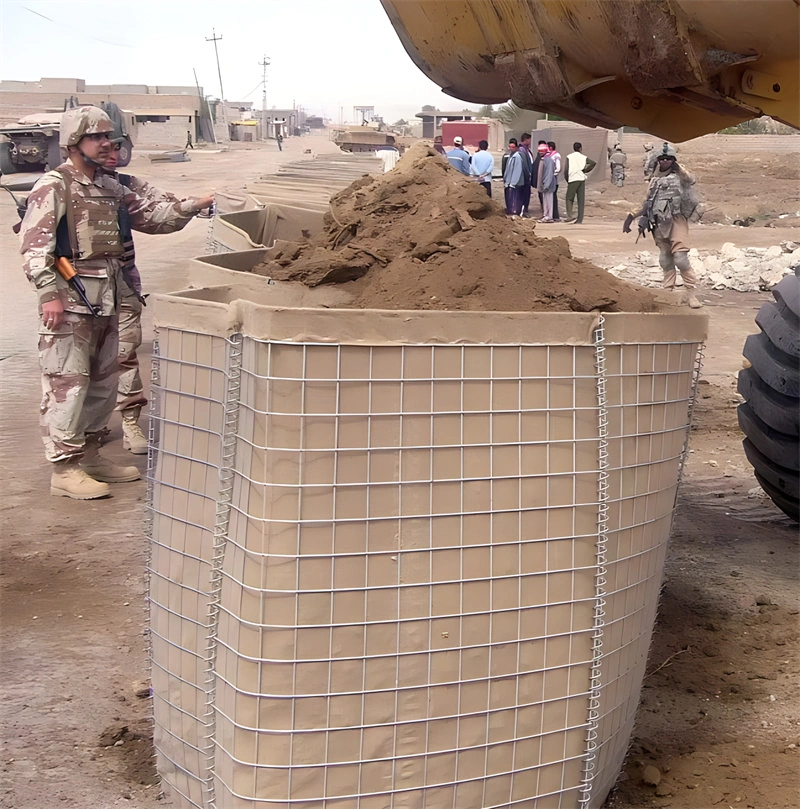
The wire mesh container is only half the system — fill material determines whether barriers hold or shift.
Every article on Hesco barriers tells you to ‘choose the right fill material.’ That advice is useless without understanding the actual physics behind why fill choice matters. The real issue is this: a barrier’s resistance to lateral force — crowd pressure, floodwater, or blast overpressure — depends on the fill’s bulk density and its ability to resist internal shear. The wire mesh cage provides containment. The fill provides mass and friction. Get the fill wrong and the cage becomes a liability.
Weight vs. Stability: They Are Not the Same Thing
Heavier fill increases the barrier’s resistance to sliding and overturning. That much is obvious. What most buyers miss is that weight and stability are not interchangeable. Saturated sand, for example, can reach 1,900–2,000 kg/m³ — among the densest common fill options. But under sustained lateral load, saturated fine sand behaves plastically. It flows toward the low-pressure side, which means a barrier filled with wet sand can bulge and deform even when it hasn’t been overloaded by total weight.
Gravel (10–20mm angular aggregate) sits at a lower bulk density — typically 1,500–1,600 kg/m³ dry — but its angular particle geometry creates internal friction angles that resist shear far more effectively than rounded sand grains. For event security applications where barriers face intermittent crowd pressure rather than continuous hydrostatic load, that shear resistance matters more than raw mass.
Settling and Slumping: The Failure Nobody Watches For
Settling is the slow failure. A barrier that passes its initial setup inspection can lose 15–20% of effective height over weeks if the fill material compacts unevenly or undergoes volume change. Soil with organic content above 15% is the worst offender — organic matter decomposes under load and moisture cycling, and that decomposition translates directly into void formation inside the geotextile liner. The barrier looks intact from the outside while the fill has quietly lost structural continuity inside.
- Sand (fine, dry): Low initial settling risk, but fines migration through liner seams accelerates over time — particularly in barriers exposed to vibration from heavy vehicle traffic nearby.
- Soil with >15% organics: Can settle up to 20% over 6 months as organic content decomposes. Effective barrier height drops without any visible external damage to the mesh cage.
- Angular gravel (10–20mm): Minimal settling under normal load conditions. Particle interlocking resists compaction-induced slump, making it the most dimensionally stable option for deployments longer than 30 days.
For event coordinators managing multi-day festivals or temporary crowd control installations, the settling risk is compounded by the fact that barriers are rarely re-inspected after initial setup. Specifying angular gravel where site conditions allow — and avoiding unscreened topsoil entirely — is the most reliable way to ensure the barrier height you set on day one is still the height you have on day five.
| Fill Material | Bulk Density (kg/m³) | Settling Risk | Deployment Speed | Best Application |
|---|---|---|---|---|
| Sand | 1,600 – 1,900 | Low – Medium (fines migration) | Slow (30% longer fill time) | Flood control, blast protection |
| Soil (Low Organic) | 1,400 – 1,700 | Medium (variable compaction) | Fast (on-site availability) | Flood control with clay content |
| Soil (High Organic >15%) | 1,100 – 1,400 | High (up to 20% height loss over 6 months) | Fast (on-site availability) | Not recommended for long-term use |
| Gravel (10–20mm) | 1,400 – 1,600 | Very Low (self-draining, stable) | Very Fast (free-flowing) | Event security, crowd control, quick-deploy |
| Engineered Sand Mix | 1,800 – 2,000 | Very Low (controlled gradation) | Moderate (requires sourcing) | Military, blast protection, critical infrastructure |
Fill Material Comparison Table
Gravel (10–20mm) drains hydrostatic pressure during rain events — the failure point most event specs never address.
Each fill material has a specific failure mode that only surfaces after deployment. Sand migrates through liner seams under vibration. Soil with high organic content decomposes and drops barrier height by up to 20% over six months. Gravel drains fast but delivers less mass per cubic metre than either alternative. The right choice depends on your application, not your nearest stockpile.
Side-by-Side: Sand, Soil, and Gravel Performance Factors
- Sand – Bulk Density: Typically 1,600–1,800 kg/m³ when compacted. High mass-per-unit-volume makes it the preferred fill for flood control and blast protection where stopping power matters most.
- Sand – Fill Speed Risk: Takes approximately 30% longer to load via front-end loader compared to gravel. Fine particles flow unpredictably, causing loader bucket spillage and slower cycle times on tight event schedules.
- Sand – Fines Migration: Under repeated vibration (foot traffic, vehicle movement near event perimeters), fine particles migrate through geotextile liner stitching over time, reducing effective fill volume without any visible external sign.
- Soil – Cost Advantage: On-site excavated soil costs near zero in material terms. For large-scale flood response or construction perimeter barriers, this is the primary reason it gets specified — no procurement lead time, no haulage cost.
- Soil – Organic Content Risk: Soil with more than 15% organic content (topsoil, loam, peat-heavy ground) decomposes inside the barrier cell. Field data shows this can reduce effective barrier height by up to 20% over six months — a compliance failure on any rated installation.
- Soil – Compaction Variability: Clay-heavy soil compacts well and retains shape. Sandy loam or silty soil compacts inconsistently, creating soft spots across a barrier run. Without a Proctor compaction test on the source material, you are guessing at final density.
- Gravel – Drainage Performance: 10–20mm clean gravel allows water to pass through freely, preventing hydrostatic pressure buildup behind barriers during sustained rainfall. This is the failure mode that takes down soil-filled barriers at outdoor events — water saturates the fill, adds unplanned mass, and destabilises the wall face.
- Gravel – Deployment Speed: Gravel loads and places faster than sand. Consistent particle size means predictable loader bucket fill rates and minimal spillage. For event coordinators working against a site-open deadline, this matters more than the cost premium.
- Gravel – Weight Trade-off: Clean gravel typically delivers 1,400–1,600 kg/m³ — measurably lower than compacted sand. For blast-rated or flood-control applications where mass is the primary design requirement, gravel alone does not meet the specification threshold.
- Maximum mass required: Specify sand. Accept the slower fill time and plan loader cycles accordingly.
- Zero procurement cost required: Specify on-site soil — but only after confirming organic content is below 15% and running a basic compaction check.
- Fast deployment and rain exposure expected: Specify 10–20mm clean gravel. The drainage advantage eliminates the hydrostatic failure risk that catches most event coordinators off guard.
Quick Decision Reference by Priority
| Fill Material | Density (kg/m³) | Settling Risk | Relative Cost | Best Application |
|---|---|---|---|---|
| Sand | 1,600 – 1,900 | Low (5–8% over 12 months) | $ Low | Flood control, blast protection |
| Native Soil | 1,200 – 1,600 | High (up to 20% if >15% organic content) | $ Lowest (on-site) | Flood control with clay content |
| Gravel (10–20mm) | 1,400 – 1,700 | Very Low (2–4% over 12 months) | $$ Moderate–High | Event security, crowd control |
| Engineered Sand Mix | 1,800 – 2,000 | Minimal (<3% over 12 months) | $$$ High | Military, blast protection |
| Clay-Soil Blend | 1,500 – 1,750 | Medium (8–12% over 12 months) | $ Low | Flood control, semi-permanent barriers |

Recommended Fill for Each Application
Fill material determines whether your barrier holds position or quietly fails under load.
Flood Control: Sand or Clay-Bearing Soil
For flood control, the goal is mass and impermeability. Sand compacts to roughly 1,600–1,800 kg/m³ when properly settled, giving each barrier cell enough dead weight to resist hydrostatic pressure from rising water. The catch: sand takes approximately 30% longer to fill using front-end loaders because of its flowability — it slides off the bucket edge rather than dropping cleanly into the cell.
Clay-bearing soil is the practical alternative when sand isn’t on-site. Soil with 20–35% clay content self-seals around the geotextile liner, reducing water infiltration through the barrier wall. Avoid anything with organic content above 15%. Soil at that threshold decomposes over time and can settle up to 20% over six months — which on a 1.5m barrier translates to a 300mm drop in effective height. That’s the difference between a barrier that holds and one that overtops.
- Best fill: Clean sand (particle size 0.1–2mm) or clay-bearing soil with less than 15% organic content.
- Target density: 1,600–1,800 kg/m³ compacted — verify with a field density test before declaring the line complete.
- Key risk: Organic-rich topsoil settles up to 20% over six months, reducing barrier height and flood protection margin.
- Best fill: Clean crushed gravel, 10–20mm particle size — angular gravel locks better than rounded river stone.
- Drainage advantage: Prevents hydrostatic pressure buildup during rain events, a common cause of barrier lean and base failure.
- Deployment speed: No compaction passes required — gravel reaches working stability on first fill, cutting setup time.
- Key trade-off: Lower mass per m³ than sand; not suitable for vehicle-rated perimeter applications.
- Best fill: Angular engineered sand mix, compacted above 1,800 kg/m³ — avoid rounded beach or river sand.
- Compaction protocol: Fill in 150–200mm lifts with mechanical compaction between each layer to eliminate void channels.
- Critical failure mode: Skipping lift compaction creates differential settlement zones that fracture the liner under blast pressure cycles.
Crowd Control and Event Security: Gravel for Fast In and Fast Out
Event coordinators consistently underestimate one failure point: rain. When barriers are filled with sand or fine soil on an outdoor site, water accumulates behind the wall and builds hydrostatic pressure against the liner. Gravel at 10–20mm particle size drains freely, preventing that pressure buildup entirely. On a wet festival weekend, that drainage property is what keeps a perimeter barrier standing upright rather than leaning outward at the base.
The second advantage is speed. Gravel loads and dumps faster than sand, and it doesn’t require compaction passes to reach working stability. For a multi-day event where the perimeter needs to go up in hours and come down the morning after, that time saving is real. The trade-off is weight — gravel runs 1,400–1,600 kg/m³, lighter than compacted sand. For crowd control applications where the barrier is managing pedestrian flow rather than stopping vehicles, that density is sufficient.
Military and Blast Protection: Engineered Sand Mix
Blast protection barriers operate under a different physics constraint. The fill needs to absorb and dissipate energy, not just resist static load. Engineered sand mixes — typically clean angular sand blended with a small percentage of fine aggregate — achieve compacted densities above 1,800 kg/m³ and minimize void space where blast pressure can channel through. Rounded beach sand is explicitly avoided in these applications because the particle shape reduces interlocking and lowers effective density under dynamic load.
Compaction protocol matters here more than in any other application. Military specifications typically require fill in 150–200mm lifts with mechanical compaction between each layer before adding the next. Skipping lift compaction in a blast-rated installation doesn’t just reduce density — it creates differential settlement zones that fracture the liner under repeated pressure cycles. For procurement teams specifying barriers into conflict or high-security environments, the fill spec and compaction procedure should be documented and verified on-site, not assumed.
How to Calculate Fill Volume for Your Barrier Dimensions
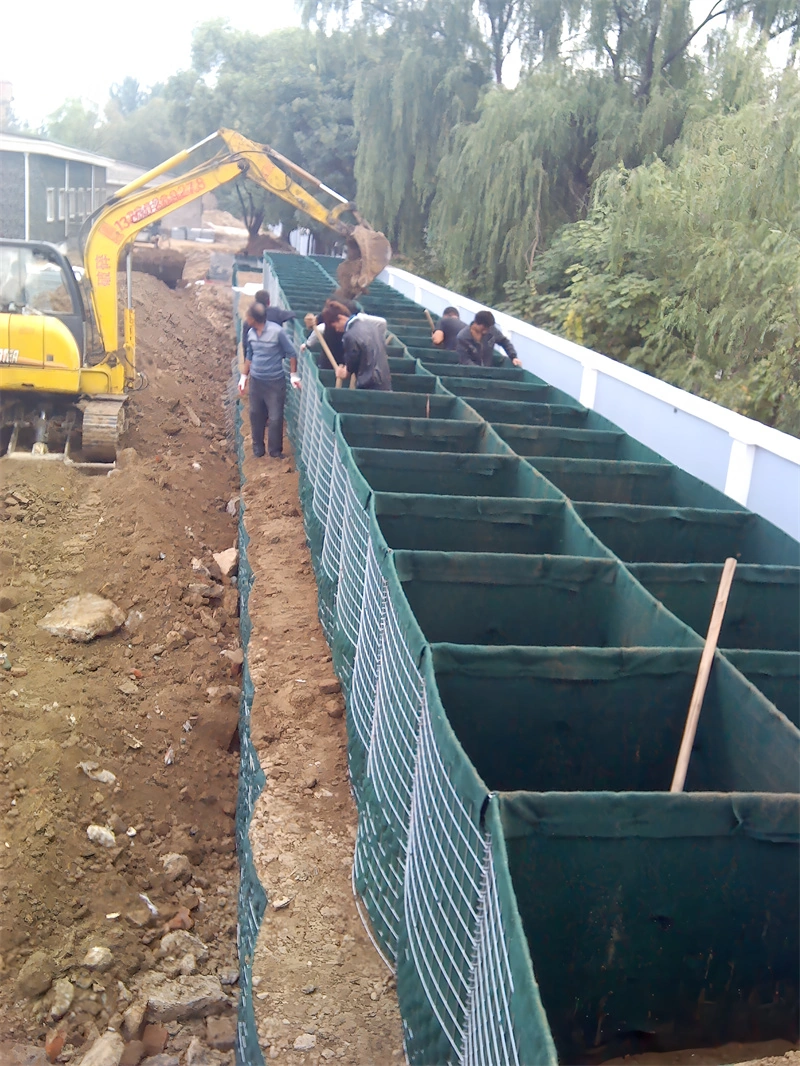
Overfilling by 10% upfront costs less than remobilizing equipment to top off settled barriers.
The base formula is straightforward: multiply the internal length × width × height of the barrier cell to get gross cubic volume. For a standard 1m × 1m × 1m unit, that gives 1.0 m³ gross. But gross volume is not what you order. Every fill material compacts differently, and ignoring that gap is how procurement teams end up short on site.
The Core Volume Formula
Net fill volume = (L × W × H) ÷ compaction factor. The compaction factor accounts for air voids collapsing as material settles under its own weight and equipment pressure. A barrier that measures 1.0 m³ internally will never hold 1.0 m³ of loose-tipped material at final compacted density — the loose-to-compacted ratio always leaves a deficit if you order to exact volume.
Compaction Rate Adjustments by Material
- Sand (dry, washed): Apply a 1.10–1.15 overfill factor. Dry sand flows freely during loading but compacts 10–15% once vibrated or loaded. Order 1.12 m³ of loose sand per 1.0 m³ of barrier cell volume as a working rule.
- Cohesive soil (clay-rich): Apply a 1.20–1.25 overfill factor. Soil with clay content compacts well but starts with significant air void content when loaded by excavator bucket. Soil containing more than 15% organic matter settles further over time — up to 20% reduction in effective barrier height over six months — so add an additional 5% buffer on long-duration deployments.
- Gravel (10–20mm clean): Apply a 1.05–1.08 overfill factor. Angular gravel self-interlocks quickly and has the lowest compaction variance of the three materials. It is the most predictable to calculate, which is one reason it suits event deployments where fill volume accuracy directly affects setup schedules.
Worked Example: 20-Unit Event Perimeter
One practical note on barrier geometry: the internal dimensions of welded mesh Hesco-type units are slightly smaller than the external frame dimensions. Deduct approximately 50–80mm from each external dimension to get true internal cell volume, depending on the liner and mesh gauge used. Confirm internal cell dimensions with the barrier supplier before running final material calculations — not after the trucks are booked.
| Barrier Dimension | Fill Volume (m³) | Sand Required | Soil Required | Gravel Required |
|---|---|---|---|---|
| Standard Small Unit (1m × 1m × 1m) | 0.80 m³ (net, 80% fill factor) | ~1,440 kg | ~1,200 kg | ~1,040 kg |
| Medium Unit (1.5m × 1.5m × 1m) | 1.80 m³ (net, 80% fill factor) | ~3,240 kg | ~2,700 kg | ~2,340 kg |
| Large Unit (2m × 2m × 1m) | 3.20 m³ (net, 80% fill factor) | ~5,760 kg | ~4,800 kg | ~4,160 kg |
| Tall Flood Unit (1m × 1m × 1.5m) | 1.20 m³ (net, 80% fill factor) | ~2,160 kg | ~1,800 kg | ~1,560 kg |
| Event Security Unit (1m × 1m × 0.6m) | 0.48 m³ (net, 80% fill factor) | ~864 kg | ~720 kg | ~624 kg |
| Bulk Perimeter Run (10 × 1m × 1m × 1m) | 8.00 m³ (net, 80% fill factor) | ~14,400 kg | ~12,000 kg | ~10,400 kg |
| Reference Density Used | Bulk density baseline | 1,800 kg/m³ | 1,500 kg/m³ | 1,300 kg/m³ |
On-Site Equipment Needed for Each Material Type
Sand takes 30% longer to fill than gravel — the equipment choice amplifies or cancels that gap.
Sand and Soil: Where the Loader Becomes the Bottleneck
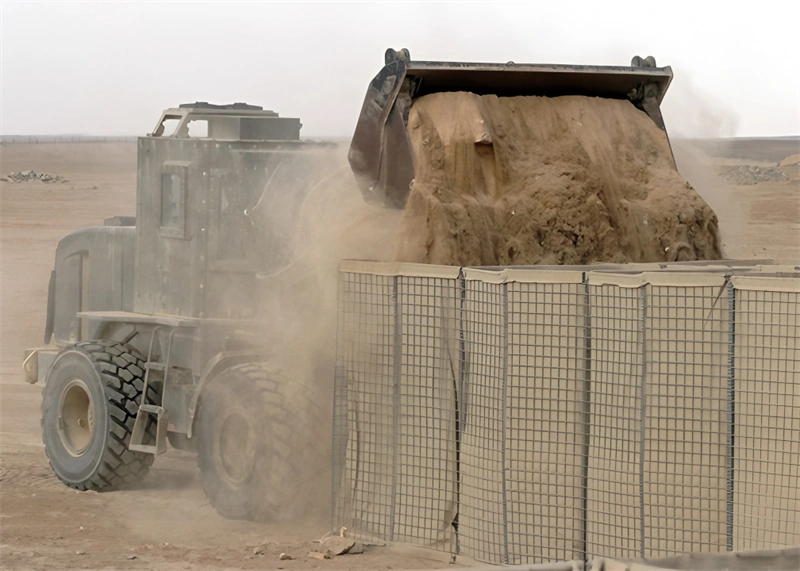
Sand flows. That sounds like an advantage until a front-end loader operator tries to scoop a clean bucket of it — the material shifts and slumps before the bucket closes, reducing effective fill volume per pass. On a standard 1m × 1m × 1m Hesco cell, sand filling typically requires a front-end loader with a bucket capacity of at least 0.5 m³, combined with a second operator on the ground using a tamping rod or plate compactor to consolidate each lift.
- Front-end loader (0.5–1.0 m³ bucket): Primary fill machine for sand and loose soil. Smaller buckets increase cycle count and slow the job. For a 20-cell deployment, budget for at least 40–50 loader passes with sand versus 30–35 with compacted soil.
- Plate compactor or jumping jack: Required after every 300mm lift of sand or fine soil. Skipping compaction on sand allows 8–12% post-fill settlement, which directly reduces effective barrier height — a real problem on flood-control deployments where every centimeter matters.
- Water bowser (optional but effective): Wetting sand by 10–15% moisture content before compaction significantly reduces air voids and speeds consolidation. Sites with access to a water truck can cut plate compactor passes in half.
- Ground crew: minimum 2 personnel: One to guide the loader, one to manage compaction and liner positioning. Sand filling without a dedicated liner handler risks geotextile displacement, which compromises the cell’s structural integrity.
- Excavator or wheeled loader (1.0 m³+ bucket): Gravel’s bulk density runs approximately 1,500–1,700 kg/m³, heavier per bucket than loose sand. A loader rated for sand loads may be operating near its hydraulic limit on gravel — check the machine’s rated payload before deployment.
- No plate compactor required: Angular 10–20mm gravel self-locks under its own weight. Running a plate compactor over it risks cracking the geotextile liner. Skip the compaction step entirely and rely on the natural interlock.
- Reduced crew requirement: Gravel filling typically runs with a single loader operator and one ground supervisor. The absence of a compaction step removes one full labor position versus sand, which matters on fast-turnaround event security deployments.
Gravel: Faster to Fill, but Compaction Changes the Equation
Gravel in the 10–20mm range loads cleanly — buckets fill without slumping, and material drops into the cell with minimal void redistribution. The equipment list is shorter. But gravel’s angular particle geometry means it self-interlocks rather than compacting under vibration, so plate compactors are largely redundant here. What gravel does need is a heavier loader or excavator bucket to handle the higher per-bucket weight without straining the hydraulic arm.
One practical note for event coordinators: gravel also makes demobilization faster. Sand-filled cells often require mechanical loosening before the material can be extracted and the liner reused. Gravel pours out cleanly, which is why it is the preferred fill on temporary deployments where the barrier will be repositioned or stored after the event.
| Material Type | Primary Equipment | Secondary Equipment | Operator Skill Level | Key Operational Note |
|---|---|---|---|---|
| Sand | Front-end loader / excavator bucket | Plate compactor | Low – standard machinery | Takes ~30% longer to fill than gravel due to flowability; avoid overfilling in single passes |
| Soil (Clay-Mix) | Excavator or skid-steer loader | Vibratory roller or hand tamper | Low-Medium – site-sourced | Test organic content before use; >15% organic content risks 20% settling over 6 months |
| Gravel (10–20mm) | Dump truck with chute or telehandler | Minimal – self-compacting | Low – fastest deployment | Best for event sites; allows drainage to prevent hydrostatic pressure buildup during rain |
| Engineered Sand Mix | Concrete mixer truck or batching plant | Pneumatic compactor | High – specialist required | Used for military/blast protection; requires controlled particle size and moisture content |
| Recycled Crushed Aggregate | Skid-steer loader or conveyor belt | Plate compactor | Medium – sourcing verification needed | Cost-effective alternative to gravel; verify no contaminated material per site safety regulations |
Tips to Avoid Settling and Maintain Barrier Height
A barrier that settles 15% in height has lost its structural credibility — often before anyone notices.
Settling is not a slow-motion failure you can catch at the end of a project. With soil containing more than 15% organic content, decomposition alone can reduce effective barrier height by up to 20% over six months. That’s not a maintenance issue — it’s a specification failure that starts at the material selection stage.
Pre-Filling Preparation: What Actually Prevents Settling
The single most overlooked step in hesco barrier fill compaction tips is ground preparation before the first scoop goes in. Filling directly onto soft, uneven, or waterlogged ground creates a base that shifts under load. Clear and level the footprint, and where possible, compact the sub-base with a plate compactor before positioning the barriers.
For sand fills, avoid dumping the full load in one pass. Sand’s flowability — the same property that makes it dense — causes it to bridge across the geotextile liner rather than pack from the bottom up. Fill in 300mm lifts and tamp between each layer. This adds time, but it’s the only way to achieve consistent compaction density across the full cell height.
- Lift depth limit: Fill in maximum 300mm increments for sand and soil. Dumping full-depth in one pass leaves voids at the base that compress under load later.
- Organic soil risk: Soil with more than 15% organic content decomposes over time. This is not visible at installation — it shows up as a 15–20% height loss at the 3–6 month mark.
- Gravel advantage: 10–20mm gravel self-compacts under its own weight with minimal voids. It reaches stable density faster than sand or soil, making it the preferred choice for quick-deploy event security barriers where topping up is not practical.
- Liner integrity check: Inspect the geotextile liner for punctures before filling. A torn liner allows fine material to migrate out from the base — a common cause of gradual height loss that looks like settling but is actually material loss.
- 30-day inspection cycle: Mark the original fill height on the exterior of the barrier at installation. Any drop greater than 50mm over 30 days signals active fines migration or organic decomposition — investigate before topping up blindly.
- Post-rain check: Heavy rain saturates fill material and accelerates settlement. Inspect within 48 hours of significant rainfall events, particularly for soil fills with variable compaction.
- Material consistency rule: Never mix fill materials when topping up. Gravel over sand creates a drainage layer that pulls moisture from the sand below, increasing long-term shrinkage.
- Does your fill material contain more than 15% organic content?: If yes, reject it. Organic soil decomposes and will reduce barrier height over the deployment period — no amount of topping up fixes the underlying decomposition rate.
- Can your site crew compact in 300mm lifts with tamping between layers?: If no, switch to 10–20mm gravel. It self-compacts without lift management and reaches stable density without mechanical intervention.
- Is your deployment longer than 30 days?: If yes, build a monthly height inspection into the site schedule and confirm your top-up material matches the original fill exactly. Mismatched materials create layered compaction failures that are harder to diagnose than the original settling problem.
Monitoring and Topping Up Over Time
Sand and soil fills require scheduled inspection, especially after rain events. Water infiltration accelerates fines migration in sandy fills — material works its way through the geotextile over weeks, and the visible drop in fill level is the last sign, not the first. Check fill height against the original installation mark at 30-day intervals for any deployment lasting longer than one month.
Topping up is straightforward but must match the original fill material. Mixing gravel into a sand-filled barrier to save time creates uneven compaction layers that perform worse than either material alone. For flood control applications where the best fill for hesco barrier flood control is a clay-rich soil or sand, top up with the same material and re-tamp the surface layer.
For event coordinators running multi-day or seasonal deployments, the practical answer is to specify gravel from the start and eliminate the topping-up problem entirely. The higher unit cost per cubic metre is offset by zero maintenance overhead and faster pack-down at event close.
3-Point Decision Checklist Before Confirming Your Fill Specification
Conclusion
Fill material is not a secondary decision you sort out on-site the morning of deployment. It determines whether your barriers hold their rated height through a rainstorm, whether you can demobilize in four hours or four days, and whether the structure you built on day one still performs on day 180. Getting the material right — matched to your application, your equipment, and your timeline — is what separates a barrier system that works from one that quietly fails.
- Soil with more than 15% organic content can settle up to 20% over six months, reducing effective barrier height.
- Gravel at 10–20mm allows water to drain freely, preventing hydrostatic pressure buildup during rain events.
- Sand fills at roughly 30% slower rates using front-end loaders due to flowability — factor that into your deployment schedule.
- For flood control, prioritize sand or clay-bearing soil; for event security requiring quick removal, gravel is the practical choice.
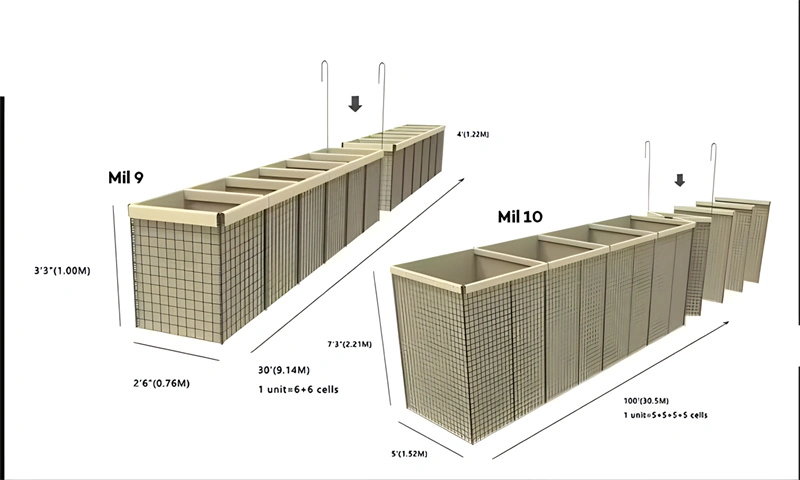
If you are specifying barriers for an upcoming event or flood-control project, the next step is confirming that the barrier unit itself is rated for the fill weight and compaction pressure your chosen material will generate. Review the product specifications for DB Fencing’s Hesco-style barriers to match cell dimensions, geotextile liner ratings, and FOB pricing to your order volume before committing to a fill strategy — the barrier spec and the fill spec need to be decided together, not in sequence. Browse the current product range at metalfencetech.com/products/ to compare available configurations.
Frequently Asked Questions
Which fill material is best for flood control barriers?
Sand with a clay content of 10–20% is the standard choice for flood control because it compacts tightly and limits water infiltration through the barrier mass. Pure clean. Specify clay-bearing sand in your fill contract before deployment, not after settling is observed.
Does gravel or sand fill faster on site?
Gravel (10–20mm) fills faster in practice because it flows freely from a loader bucket without bridging or clumping, cutting fill cycle time per cell. Sand. Use gravel only when rapid deployment and easy removal matter more than maximum mass per cubic metre.
What fill material causes the most settling problems?
Native soil with high organic content causes the most settling because organic matter compresses and decomposes under load, dropping barrier height well below the approved. If using on-site soil, test compaction density and organic content before committing to a full barrier run.
Can I use on-site soil to cut fill costs?
On-site soil is cost-effective only when it is subsoil with low organic content and consistent compaction characteristics. Variable or mixed-origin fill introduces unpredictable settling that. Run a compaction test on a sample cell before approving on-site soil as the project fill standard.
How much fill volume does one Hesco barrier cell need?
Fill volume depends directly on the cell’s internal dimensions after the geotextile liner is seated, and you should calculate to 95% of nominal volume. Calculate fill volume per cell from confirmed internal dimensions, not nominal product dimensions listed on the spec sheet.