Skip to content
Why do some AS 4687 compliance Hesco barriers fail within six months of installation? A Sydney council project manager found out the hard way after a $50,000 order—the pre-production sample passed all checks, yet the mass production run had a 35-micron galvanization coating instead of the required 42. The geotextile liner failed UV stability testing within three months, and the project was hit with an AUD 80,000 fine.
That gap between sample approval and actual delivery is where most compliance failures hide. The difference often comes down to how a supplier manages quality tolerance on wire mesh gauge, weld shear strength, and hot-dipped galvanization thickness. When you compare FOB pricing across manufacturers, the real question isn’t just the unit cost—it’s whether the mass production barriers will match the certified sample. The seven-point checklist below covers exactly what to verify before placing that next order.
Why AS 4687 Matters for Hesco Barriers on Australian Sites
Flood control Hesco barriers fall under AS 4687 – ignore it at your cost.
AS 4687 was originally drafted for temporary site fencing, but flood control barriers share the same risk profile: they hold back dynamic loads, must resist corrosion, and are often deployed in public spaces. The standard applies to any temporary barrier system – permanent flood walls use different engineering standards. If you’re specifying Hesco barriers for a flood protection project in Australia, you need AS 4687-2022 compliance to cover wire mesh gauge, weld shear strength, and hot-dipped galvanization coating above 42 microns. Many project managers assume ‘temporary fencing’ is separate from ‘flood barriers’ – that assumption has already cost some suppliers their contracts.
-
- Fines for non-compliance: The penalty for supplying non-compliant barriers can reach AUD 80,000 per incident. In one Sydney council project, the geotextile liner failed UV exposure testing – the supplier was fined, the project delayed, and the barriers had to be replaced at their cost.
- Project shutdowns: If an inspector flags missing engineer certification for flood barrier designs or incorrect galvanization micron thickness, the site may be shut down until corrected. That means idle crews, rescheduling costs, and reputational damage with the client.
- Replacement liability: Barriers that show rust within 6 months due to sub-42 micron coating must be pulled from service. The cost of replacement, logistics, and disposal falls on the importer or contractor – not the end user.
The 7-Point AS 4687 Compliance Checklist
The 42-micron galvanization test is the #1 failure point on imported Hesco barriers — skipping it costs AUD 80k.
-
- 1. Wire mesh gauge and weld shear strength: AS 4687-2022 mandates a minimum wire diameter (typically 4.0 mm) and a certified weld shear test from an accredited lab. If your supplier cannot show a test report for the exact batch, assume the welds will snap during filling. Imported Hesco barrier compliance failures often trace back to undersized wire.
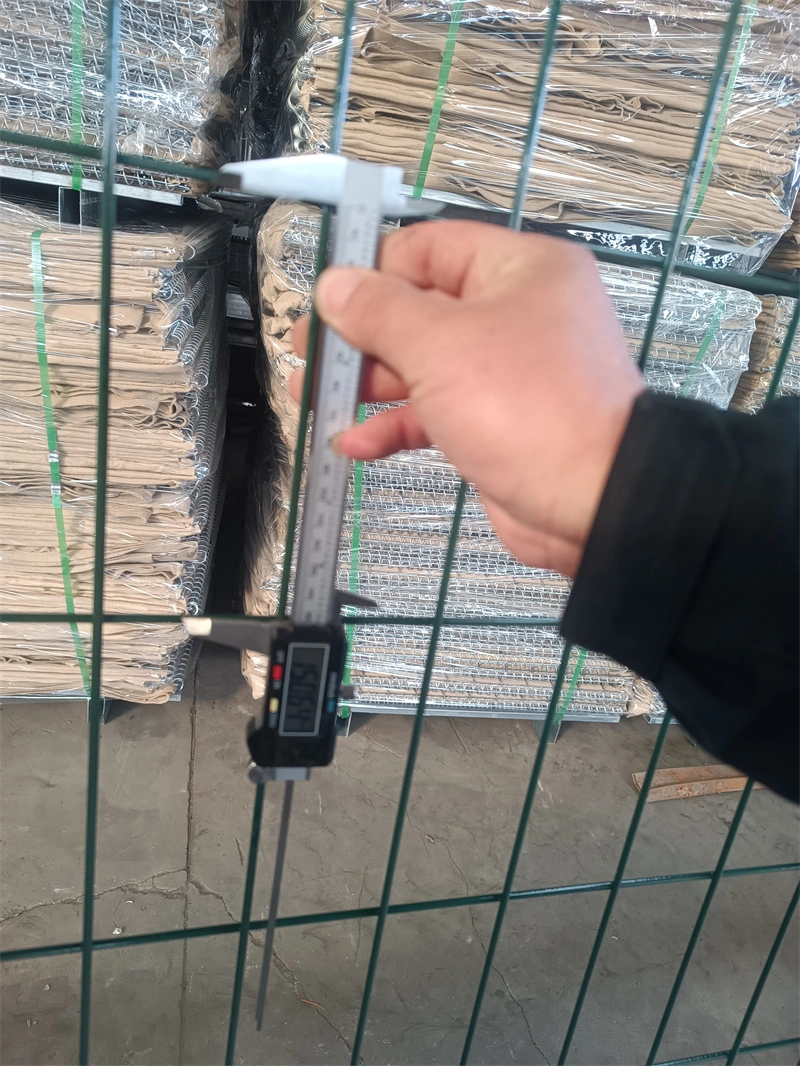
- 2. Hot-dipped galvanization coating >42 microns: Electro-galvanized coatings peel within 6 months in Australian coastal or flood environments. Only hot-dipped galvanized (HDG) provides the >42 micron layer required by AS 4687. Verify with a magnetic thickness gauge on random panels. DB Fencing supplies HDG barriers confirmed at 45–50 microns across 10 production lines.
- 3. Geotextile liner UV stability and tear resistance: The liner must retain at least 80% of its tensile strength after 500 hours of UV exposure (ASTM D4355). A Sydney council project was fined AUD 80,000 when its geotextile liner disintegrated during a routine flood drill. Always request the UV stability test report and tear resistance data (AS 3706.3) before the container ships.
- 4. Structural stability: fill weight and stacking limits: Each barrier’s maximum fill weight (e.g., 1.8–2.0 tons per cubic meter of sand/gravel) and stacking height must be backed by a structural engineering analysis. Without it, a two-high barrier can buckle under hydrostatic pressure. The engineer certification for flood barrier designs should include these calculations.
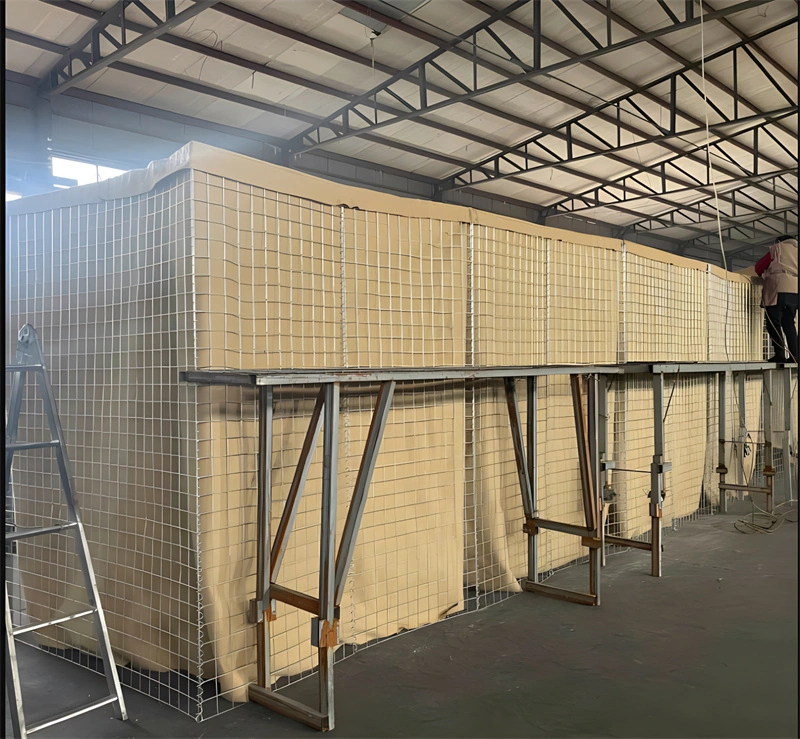
- 5. Labeling and traceability requirements: AS 4687 requires every panel to carry a permanent label with the supplier’s unique identifier, batch number, production date, and the standard mark. Without traceability, your site safety inspector can reject the entire shipment on arrival. Insist on photos of the labels before loading.
- 6. Engineer certification for flood barrier designs: For flood control applications, a Registered Professional Engineer (RPE) in Australia must certify that the barrier design meets AS 4687 and the site’s hydraulic conditions. This certification is non-negotiable for council and state projects. Some suppliers provide a generic stamp — verify it covers your specific barrier configuration.
- 7. Supplier documentation: ISO 9001 and test reports: A compliant supplier produces ISO 9001 certification (audited by SGS or equivalent) and third-party test reports for each production batch: wire gauge, coating thickness, weld shear, geotextile properties. Without these, you cannot prove compliance during a workplace safety audit. DB Fencing provides full documentation, including AS 4687-2022 test reports and ISO 9001 certification.
How DB Fencing Meets Each Compliance Point
DB Fencing’s compliance isn’t a claim—it’s baked into our production process.
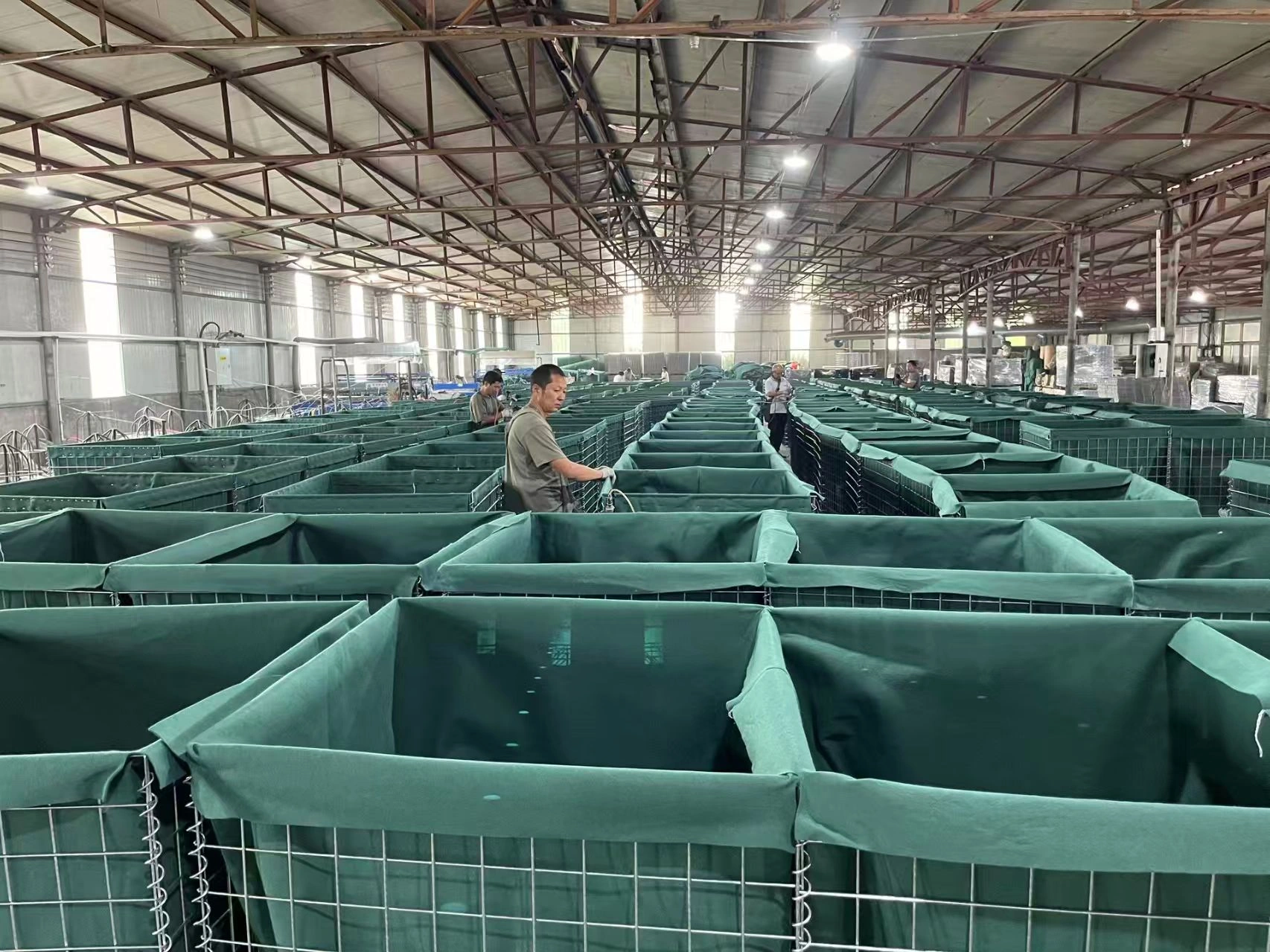
Most suppliers talk about compliance. We built our entire production line around AS 4687 because 75% of our business goes to Australia and New Zealand. That means every Hesco barrier we ship must pass the same checklist your site auditor will run. Here’s how we match each of the seven points.
-
- Wire Mesh Gauge & Weld Shear: We run 10 welding lines with automated shear testing. Our standard mesh uses 4.0mm wire for the barrier frame—exceeding the AS 4687 minimum for temporary flood barriers. Weld shear strength is verified at the factory before any panel leaves the line.
- Hot-Dipped Galvanization >42 Microns: No electro-galvanized shortcuts. We hot-dip galvanize every mesh panel to a minimum 42 microns coating thickness. This is the spec that low-cost manufacturers skip—we’ve seen their panels rust within six months on coastal Australian sites.
- Geotextile Liner UV Stability & Tear Resistance: We source liners that pass UV exposure testing per AS 4687 requirements. A Sydney council project was fined AUD 80,000 because a competitor’s liner degraded after two months. Our liners carry batch traceability tags for full chain of custody.
- Structural Stability – Fill Weight & Stacking: Every barrier unit is designed for stable fill ratios. We provide stamped load calculations for single and double-stacked configurations, so your engineer can sign off without guesswork.
- Labeling & Traceability: Each panel is laser-marked with production date, wire gauge, galvanization batch, and AS 4687 reference. No paper tags that fall off in transit.
- Engineer Certification & Documentation: We supply third-party SGS inspection reports and ISO 9001 certificates alongside each shipment. For custom barrier designs, we coordinate directly with your structural engineer to provide the required design certification.
Common Compliance Failures Found in Imported Barrier Shipments
A Sydney council was fined AUD 80,000 for geotextile liner UV failure.
Most imported Hesco barrier shipments fail AS 4687 compliance not on wire gauge but on the coatings and liners. Low-cost manufacturers routinely skip the 42-micron hot-dipped galvanization requirement, substituting electro-galvanized wire that rusts within six months in Australian coastal or flood-prone environments. The geotextile liner is another common shortcut—suppliers use non-UV-stabilized fabric that disintegrates after 12 months of exposure, exactly what triggered the AUD 80,000 fine on a Sydney council project.
-
- Galvanization thickness: AS 4687 requires >42 microns hot-dipped. Electro-galvanized coatings (typically 5–12 microns) fail within months. Check using a magnetic thickness gauge on arrival.
- Geotextile liner UV stability: Must meet AS/NZS 4399 or equivalent UV resistance rating. Uncertified liners degrade rapidly under Australian sun, leading to barrier collapse and site safety violations.
- Weld shear strength: Imported panels often have welds that shear below the 10 kN minimum per AS 4687. A batch of 2,000 panels from one supplier had a 23% weld failure rate in third-party testing.
- Engineer certification: Many shipments arrive without a signed structural design certificate from a NERB-registered engineer. Without it, the site inspector can reject the entire barrier system—and has.
- Missing traceability labels: AS 4687 requires each panel to carry a manufacturer’s ID, batch number, and date code. Unlabeled panels are automatically non-compliant and cannot be used on a licensed site.
What to Request from Your Supplier Before Ordering
Five documents that separate compliant suppliers from costly risks.
A Sydney council project was fined AUD 80,000 when the geotextile liner on their Hesco barriers failed UV exposure testing three months after installation. The supplier had skipped the 42-micron galvanization requirement and used an unrated liner. One missing document can delay your project or trigger a compliance audit. Here are the five specific requests you need to make before issuing a purchase order.
-
- AS 4687-2022 Test Report: Request the full test report – not just a certificate of conformity. It must include measured values for wire mesh gauge, weld shear strength (minimum 1500N per weld for temporary fencing under AS 4687), and galvanization coating thickness. A certificate only states compliance; a test report proves it.
- Hot-Dipped Galvanization Coating Thickness Certificate: The standard requires >42 microns average coating thickness. Ask for a certified mill test report showing the actual micrometer readings. If the supplier cannot provide this, assume the coating is below spec. Barriers with inadequate zinc often show rust within 6 months in coastal or wet environments.
- Geotextile Liner UV Stability & Tear Resistance Data: The liner must meet UV stability requirements for Australian exposure (AS/NZS 4399 or ASTM D5034). Request the test report showing UV degradation after 500 hours. The Sydney fine was directly caused by a liner that lost 60% of its tear strength after three months in the sun.
- Engineer Certification for Flood Barrier Design: For flood control applications, a structural engineer must certify the barrier design – including fill weight limits, stacking height, and overturning resistance. Request the stamped certification specific to your project site. Without it, your installation may violate state or council regulations.
- Third-Party Inspection Reports (SGS/ISO 9001): A supplier with ISO 9001 certification should have routine SGS inspections. Request the latest inspection report that documents product conformity and factory quality control. This verifies that the manufacturing process – welding, galvanization, assembly – is consistent across bulk orders.
Without these documents, you are ordering blind. The cost of inaction – a failed audit, a project shutdown, or a fine – far outweighs the effort of verifying compliance upfront. Request them in writing before you commit to a supplier.
Conclusion
Before finalizing your order, run through this three-point decision checklist with your supplier. Does the wire mesh gauge test report confirm compliance with AS 4687-2022 weld shear strength? Is the hot-dipped galvanized coating measured at >42 microns, verified by a third-party test? Has the geotextile liner passed UV stability testing for Australian flood control conditions?
If the answer to any question is no, request documented evidence or reconsider the supplier. Compare FOB pricing and sample approval timelines alongside compliance documentation to avoid costly surprises.
Frequently Asked Questions
What zinc coating thickness does AS 4687 require?
AS 4687 mandates hot-dipped galvanization with a minimum average coating of 42 microns. This is the most common failure point on imported Hesco barriers, so always request a mill test certificate. Verify the test report before production starts.
What documents prove AS 4687 compliance?
You need ISO 9001 certification, an SGS or equivalent third-party test report, and an engineer certification for the flood barrier design. The supplier must also provide traceability labeling on each unit. Request these three documents before placing the order.
How do I check an imported Hesco barrier for compliance?
Inspect the galvanization coating thickness with a magnetic gauge and verify weld shear strength on random samples. Also confirm the geotextile liner has a UV stability certificate from the supplier. Arrange a pre-shipment inspection for these three checks.
What are common compliance failures in Hesco barriers?
The top failures are sub-42 micron coating, weak weld shear strength, and unrated geotextile liner that degrades within months. These issues often surface when a supplier skips engineering certification or proper traceability. Avoid these by auditing the supplier’s test reports upfront.