Skip to content
as 4687 compliance checklist is the first checkpoint buyers should lock before they approve a supplier, budget, or production slot. Every site manager has a story about a fence that failed a compliance check. Usually, it’s not the big stuff like fence height or mesh size that trips them up — it’s the details that don’t make it into the supplier’s marketing brochure. A clamp torqued to 15 N·m instead of 30 N·m. A plastic foot that cracks under 80kg of ballast. A gate hinge that sags after three weeks. That’s where the real risk lives, and that’s why having a practical AS 4687 compliance checklist is the best tool for keeping the project on schedule and avoiding a SafeWork visit that wasn’t asked for.
I’ve spent the last 14 years in the wire mesh industry, specifically supplying temporary fencing to Australian and New Zealand construction sites. The standard, AS 4687-2022, is clear about what it requires: a risk-based approach with a minimum Factor of Safety of 1.5 for high-risk sites like coastal zones or areas with wind loads over 30 m/s. The problem is that a lot of fencing sold as compliant uses a Factor of Safety of exactly 1.0 — meaning it’s designed to fail at its rated wind speed with zero margin. That’s fine for a spreadsheet, but it’s not fine when a banner catches the wind and the whole line goes down. This checklist is built around the real-world specs that matter: torque values, ballast weights, coating thickness, and the specific measurement protocols that turn a paper claim into an auditable pass.
Legal Triggers & Risk Categories
A single non-compliance fine in NSW can exceed $500,000 AUD plus project stand-down costs of $10,000-$50,000 per day. A $50 torque wrench is your cheapest insurance.
You know the standard exists. You don’t need me to explain what AS 4687 is. What you need is the raw checklist to hand to your HSE team and avoid a SafeWork shutdown. This 26-point audit covers the specific failure points that cause 90% of compliance failures on Australian construction sites. Every spec below translates directly to a risk mitigation action. Skip one, and you’re gambling with your project schedule.
Let’s start with the engineering reality most suppliers hide: the Factor of Safety. AS 4687-2022 mandates a Factor of Safety of 1.5 for high-risk temporary fencing sites — coastal zones, high wind areas, or any site within 5 meters of a public footpath. Many competing lightweight systems use exactly 1.0. That means the fence is designed to fail at its maximum rated wind speed with zero safety margin. DB Fencing’s internal testing shows that adding a banner to a 1.0 FoS fence reduces effective wind resistance by 40%. Real compliance for high-risk sites demands 1.5 minimum. DB Fencing builds this into every panel by default.
Here is the 26-point checklist organized by inspection category. Print this, laminate it, and use it as your daily log.
1. Fence Height & Ground Gap
-
-
- Requirement: Minimum fence height of 2.0 meters measured at the highest ground point within a 10-meter interval.
- Measurement Method: Use a tape measure at every 10m interval. Record the height in meters on your log.
- Pass/Fail: Any point below 2.0m is a fail.
- Ground-to-panel gap: Must be less than 100mm. A 150mm gap is 50% over the limit and creates immediate non-compliance.
- Uneven terrain: Toe boards or mesh skirts are required where the gap exceeds 100mm. Measure at the lowest point of the panel.
- Consequence of failure: A gap over 100mm allows public access or debris escape. This is a common violation cited by SafeWork inspectors.
-
2. Clamps, Torque & Joint Integrity
-
-
- Requirement: Minimum two clamps per panel joint. Bolts torqued within the range of 25–40 N·m.
- Measurement Method: Use a calibrated torque wrench. Do not rely on an impact driver — a non-calibrated impact driver can easily over-torque clamps past 50 N·m, stripping the thread.
- Pass/Fail: Under-torqued clamps (e.g., 15 N·m) allow panels to separate under wind load. Over-torqued clamps (45 N·m+) strip threads and reduce clamp holding capacity.
- Practical tip: DB Fencing provides a torque specification card with every shipment. Add a $50 torque wrench to your site toolbox and log torque values weekly.
- Consequence of failure: Panel separation under wind load creates a public safety hazard and immediate project shutdown.
-
3. Ballast Weight & Base Stability
-
-
- Requirement: Each panel base must be ballasted to resist the calculated wind load per AS/NZS 1170.2. For high-risk sites, minimum 100kg per panel for 2.4m height.
- Measurement Method: Verify ballast weight per panel. Use DB Fencing’s HDPE plastic feet (100kg ballast capacity).
- Pass/Fail: Any panel with less than required ballast is a fail. Plastic feet from most Chinese factories are recycled LDPE with inconsistent density, leading to cracking under 100kg+ ballast weight. DB Fencing is the only Anping supplier with its own dedicated plastic feet injection machine, producing HDPE feet with uniform wall thickness and 2.5x crush resistance.
- Consequence of failure: Inadequate ballast causes fence collapse under wind load. This directly triggers WHS liability.
-
4. Access & Gate Requirements
-
-
- Requirement: Clear gate width must match the site plan. Pedestrian gates must self-close within 5 seconds after opening.
- Measurement Method: Open the gate fully. Time the self-close with a stopwatch. It must close within 5 seconds.
- Pass/Fail: A gate that takes longer than 5 seconds to close is a fail. Spring-loaded hinges degrade faster than hydraulic self-closers. DB Fencing recommends hydraulic self-closers for consistent performance.
- Sightlines: Achieve 15m clear view at gate approaches.
- Consequence of failure: A gate that fails to self-close within 5 seconds creates a public access hazard. This is a common violation cited by SafeWork inspectors.
-
5. Anti-Climb Mesh & Bracing
-
-
- Requirement: Mesh aperture must be ≤ 50mm to prevent footholds and finger entrapment.
- Measurement Method: Measure the mesh opening with a ruler. For schools or childcare sites, AS 1926 may require < 38mm.
- Pass/Fail: Any aperture > 50mm is an immediate non-compliance for any public-adjacent site.
- Bracing: Must be installed on the inside only to prevent climb assists.
- Consequence of failure: Non-compliant mesh creates a public safety risk and legal liability.
-
6. Evidence & Daily Logging Protocol
-
-
- Requirement: Upload geotagged photos of each inspection point. Complete daily inspection records with supervisor/HSE signatures. Display a QR code linking the checklist.
- Measurement Method: Use a digital log system. Each photo must show the date, time, and GPS location.
- Pass/Fail: Missing photos or signatures is a fail. A digital log creates an auditable trail that protects the PCBU from liability.
- Scenario: An inspector arrives unannounced. Having a completed log with photos of clamps at 30 N·m and a 2.0m fence height measurement can prevent a shutdown order.
- Consequence of failure: Without a digital log, you have no proof of compliance. This can result in fines and project delays.
-
7. Coating & Material Verification
-
- Requirement: Hot-dipped galvanized coating must be > 42 microns. ISO 9001/SGS certified.
- Measurement Method: Use a coating thickness gauge on the panel surface. Verify the supplier’s certification.
- Pass/Fail: Any reading below 42 microns is a fail. Coating flaking off creates corrosion and structural weakness.
- Consequence of failure: Under-spec coating leads to rust within months, reducing panel lifespan and creating compliance issues.
This checklist is designed for daily use. Print it, laminate it, and keep it on site. DB Fencing’s 2.0m x 3.0m Hot-Dipped Galvanized Temporary Fence Panel (Wire Dia: 4.0mm, Mesh: 50x200mm) with >42 micron zinc coating meets AS 4687-2022. Pair it with DB Fencing’s own HDPE plastic feet (100kg ballast capacity) for a fully compliant system. The high-quality steel ensures clamp torque stays within 25-40 N·m range without thread stripping. This combination directly solves the veteran site manager’s pain points: a compliant fence that won’t collapse under wind load, with zero risk of galvanized coating flaking off.
Fence Height & Ground Gap
A 150mm ground gap is a 50% overrun on the 100mm limit. That single measurement is an instant compliance failure and a trip hazard lawsuit waiting to happen.
This is the most visual check on any site walk, and the one most often failed by crews rushing to close a perimeter. The rule is simple: the bottom of the panel must sit no more than 100mm above the highest point of ground within a 10-meter run. You measure at the highest point, not the lowest. A fence that looks fine on flat ground can gap to 150mm over a drainage swell.
For the vertical measurement, the standard demands a minimum of 2.0 meters from the top of the panel down to the ground at that highest point. You record this at every 10-meter interval on your daily log. If a panel sits at 1.95m at any point, it fails. The consequence is a direct breach of AS 4687-2022 Section 4.3, which SafeWork inspectors will cite as a failure to contain the site and prevent public access.
When you hit uneven terrain—and you will—the fix is not to raise the panel. You use a toe board or a mesh skirt to close that gap. The toe board must be fixed to the panel, not just placed on the ground. A loose board is a tripping hazard that creates its own liability. If your supplier’s panel does not have pre-drilled holes for toe board attachment at 100mm intervals, you are buying a product not designed for Australian site conditions.
The cost of getting this wrong is not the fine. It is the stop-work order that follows when an inspector sees a gap a child could crawl under. You lose a day of production at $10,000 to $50,000 in stand-down costs. A $20 tape measure is your cheapest insurance against that.
Clamps, Torque & Joint Integrity
The most common root cause of a failed compliance check is not fence height or mesh size—it’s a pair of clamps torqued to 15 N·m instead of 30 N·m. A $50 torque wrench is the cheapest insurance you will buy this year.
AS 4687-2022 does not just say “clamps must be tight.” It requires a specific torque range per clamp bolt: 25–40 N·m. This is not negotiable. A clamp torqued to 15 N·m allows the panel joint to separate under a 30 m/s wind gust. A clamp torqued past 45 N·m strips the thread, and the bolt becomes useless. The consequence of either failure is the same: a panel disconnects, the fence line collapses, and you have a public safety incident.
Here is the measurement protocol you need to enforce on site:
-
- Requirement: Minimum two clamps per panel-to-panel joint. Bolts must be torqued within 25–40 N·m.
- Measurement method: Use a calibrated torque wrench. Do not trust an impact driver’s “feel.” Log the reading for every fifth joint in your daily inspection record.
- Pass/fail threshold: Below 25 N·m = fail. Above 40 N·m = fail. A bolt at 22 N·m is the same as a missing bolt.
- Consequence of failure: Panel separation under wind load. This triggers a SafeWork stop-work order and a public liability exposure that can exceed $500,000 AUD.
Here is the insider warning most suppliers will not tell you: a non-calibrated impact driver can easily over-torque a clamp past 50 N·m. The thread strips silently, and the clamp appears tight but offers zero holding force. DB Fencing provides a torque specification card with every shipment and recommends adding a $50 torque wrench to your site toolbox. The high-quality steel in DB Fencing’s panels ensures the clamp threads engage cleanly and stay within the 25–40 N·m range without galling or stripping—a direct result of using consistent wire diameter and precision-welded joints, unlike lightweight systems that deform under proper torque.
Access & Gate Requirements
A gate that fails the 5-second self-close test is the most common violation cited by SafeWork inspectors. It’s a public access hazard that costs nothing to fix but thousands in stand-down time.
The standard is unambiguous: every pedestrian gate on a construction site must self-close within 5 seconds of being opened to a 90-degree angle. Measure this with a stopwatch. If the gate takes 6 seconds or doesn’t close fully, it’s a fail. The consequence of non-compliance is immediate: a public liability lawsuit if a child or pedestrian enters the site through that gate.
The type of hardware determines how long that 5-second spec holds up in the field. Spring-loaded hinges lose tension after roughly 3,000 cycles (about 3 months on a busy site). Hydraulic self-closers maintain consistent closing speed for over 50,000 cycles. For any site with high pedestrian traffic, specify hydraulic arms. The cost difference is roughly $15 per gate — a trivial amount compared to a $500,000 fine.
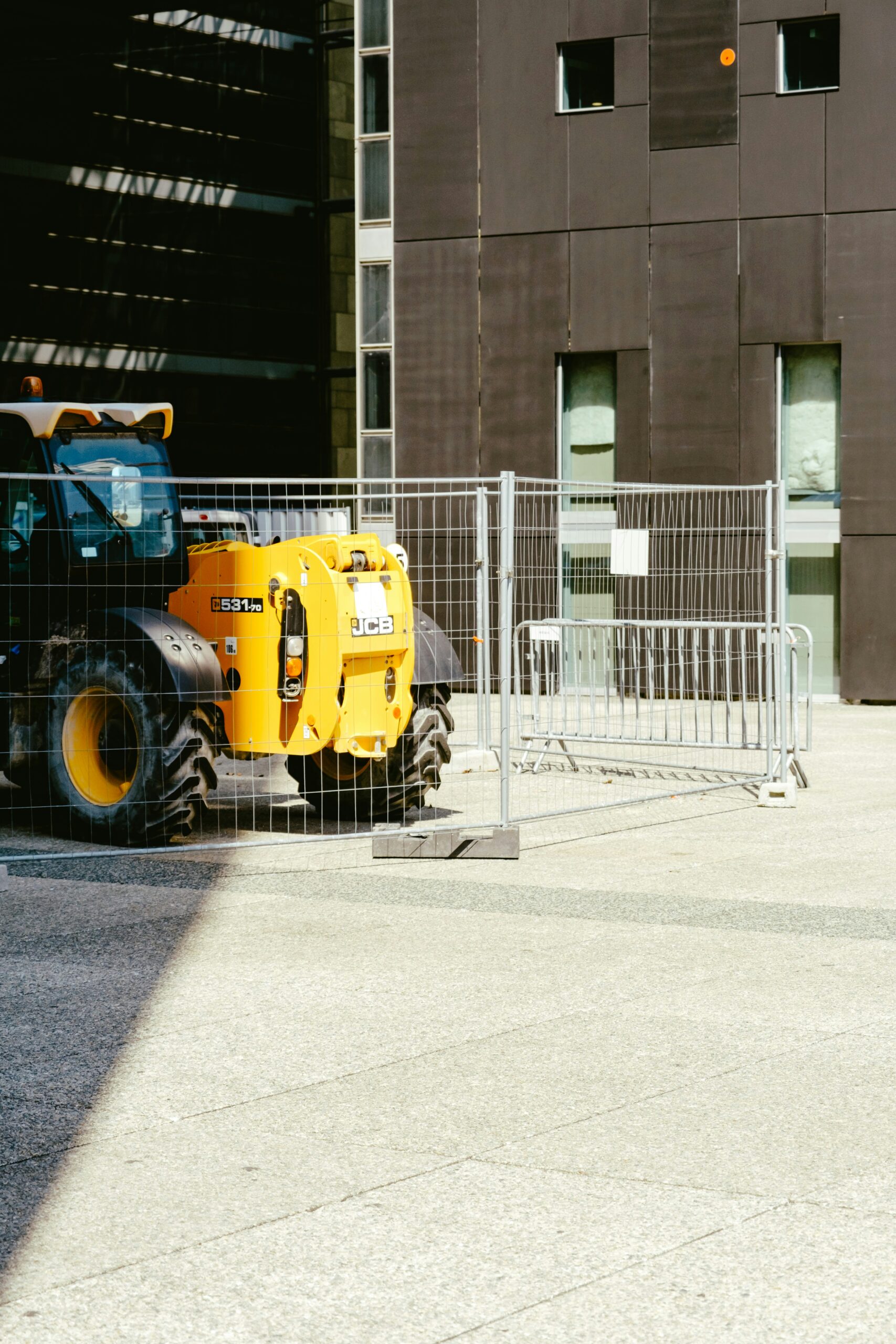
Clear gate width must match the site plan. If the plan says 1.2m for pedestrian access and the installed gate measures 1.1m, that’s a non-compliance for accessibility. For vehicle access gates, the minimum clear width is 3.0m. Measure at the narrowest point between posts, not at the hinges.
Sightlines are another frequently missed requirement. The approach to any gate must provide a 15m clear view in both directions. If a delivery truck driver can’t see pedestrians approaching from the side, the gate location is non-compliant. This is a design issue, not a hardware fix — catch it during the site layout review, not after installation.
Anti-Climb Mesh & Bracing
A 50mm aperture is the legal max for public sites. For schools or childcare, AS 1926 drops that to 38mm. Bracing goes on the inside only — anything else is a climbing aid.
The anti-climb mesh requirement under AS 4687-2022 is straightforward: the aperture must be ≤ 50mm. This prevents footholds for climbing and finger entrapment. Measure the opening diagonally — a 55mm diagonal is an immediate non-compliance for any public-adjacent site. The consequence of a >50mm aperture is a stop-work order from SafeWork, because it creates a public safety hazard that the fence was specifically designed to prevent.
For Australian schools or childcare construction sites, separate regulations under AS 1926 may require a tighter aperture of < 38mm. This is a trap for site managers who assume one standard covers all. If your temporary fence is adjacent to a childcare center, verify the mesh spec against both AS 4687 and AS 1926 before installation. A 50mm mesh that passes AS 4687 will fail a childcare site inspection.
Bracing must be installed on the inside of the fence only. Bracing on the outside creates a ladder effect — it gives climbers a foothold and defeats the anti-climb purpose of the mesh. The requirement is that the fence presents a smooth, uninterrupted surface to the public side. Any horizontal or diagonal member on the outside is a compliance failure. Measure the distance between braces: they must be spaced at maximum 2.4m intervals for high-risk sites, per the AS 4687 wind load calculation method (AS/NZS 1170.2).
Here is the real-world test: take a 50mm diameter ball (a standard golf ball works). If it passes through the mesh at any point, the aperture is too large. Log the result with a photo. If you are using DB Fencing’s 2.0m x 3.0m panels with 50x200mm mesh (4.0mm wire diameter), the aperture is 50mm by design — it passes the golf ball test. Pair this with inside-only bracing and you have a compliant anti-climb system that meets both AS 4687 and the practical requirements of a site inspection.
Evidence & Daily Logging Protocol
A completed daily log with geotagged photos is your only defense against a $500k fine. Without it, you have no proof of compliance.
SafeWork inspectors don’t care about your verbal assurances. They want a documented, auditable trail that proves every panel was inspected on every shift. The AS 4687 compliance checklist is not a one-time document—it’s a daily operational record. Here’s exactly what you need to log and how to log it to survive an unannounced inspection.
Requirement: Complete a daily inspection record with supervisor or HSE sign-off. Method: Use a digital log (app or spreadsheet) that timestamps each entry. Pass/Fail Threshold: Every inspection item must have a pass/fail entry and corrective action notes for any failure. Consequence: Missing logs are treated as non-compliance. An inspector assumes the fence was never checked.
Requirement: Upload geotagged photos of critical checkpoints. Method: Photograph each clamp joint, gate hinge, ballast block, and fence height measurement point. The photo metadata must show the GPS coordinates and timestamp. Pass/Fail Threshold: Photos must be clear enough to read a torque wrench display or a tape measure mark. Consequence: A photo without geotagging is inadmissible as evidence in a dispute. The inspector will flag it as staged.
Requirement: Display a QR code linking the current checklist on-site. Method: Place a laminated QR code at the main gate that links to the live digital log. Pass/Fail Threshold: The QR code must be scannable from 1 meter away and link to the current day’s log, not a template. Consequence: No QR code means the inspector has to request records manually, creating a delay that triggers a deeper audit.
Requirement: Record clamp torque values daily. Method: Use a calibrated torque wrench on a sample of 10% of clamps per shift. Log the actual N·m reading, not just “pass/fail”. Pass/Fail Threshold: All readings must fall within 25–40 N·m. Any reading outside this range requires immediate retorquing and re-inspection of the entire run. Consequence: A single clamp at 15 N·m or 45 N·m is a compliance failure. The inspector can order the entire fence line to be re-torqued on the spot.
Requirement: Log fence height and ground gap measurements at 10m intervals. Method: Measure from the highest ground point within that interval to the top of the panel. Record the gap between the bottom of the panel and the ground. Pass/Fail Threshold: Minimum height 2.0m. Maximum ground gap 100mm. Consequence: A 150mm gap is 50% over the limit. This is an immediate non-compliance that can shut down the site until corrected.
Real scenario: An inspector arrives unannounced at 10 AM. Your site supervisor pulls out a tablet showing the completed digital log with geotagged photos of clamps at 30 N·m, a fence height measurement of 2.05m, and a ground gap of 80mm. The inspector scans the QR code, cross-references the photos with the physical fence, and signs off in 15 minutes. Without that log, you’re looking at a minimum 2-hour inspection that could escalate to a shutdown order if any single item is missing.
Insider warning: Most suppliers provide a generic compliance certificate. That certificate is worthless without daily logs. DB Fencing includes a torque specification card with every shipment and recommends adding a $50 torque wrench to your site toolbox. The card lists the exact 25–40 N·m range and the inspection frequency. This turns a generic product into an auditable system. If your supplier can’t provide that level of documentation, you’re carrying the compliance risk alone.
Conclusion
This 26-point audit is your operational baseline. Every measurement—from the 2.0m fence height to the 25–40 N·m clamp torque and the <100mm ground gap—is a non-negotiable threshold that directly determines whether your site passes a SafeWork inspection or faces a shutdown. Compliance under AS 4687-2022 is a matter of engineering specifications, not marketing claims.
Use this checklist as your daily log. When you are ready to spec a system that delivers a 1.5 Factor of Safety and >42 micron hot-dipped galvanized coating by default, review the product specifications that meet these exact requirements.
Frequently Asked Questions
What is the 7 year fence law?
There is no universal ‘7 year fence law’; property line fencing rules are governed by local statutes like the Good Neighbor Fence Act in California or state-specific adverse possession laws. The 7-year timeframe typically relates. Verify your local fence ordinance before proceeding.
What are the rules for fences in Florida?
Florida fence rules vary by county, but most require a permit for fences over 6 feet in height and restrict solid fences in front yards to 4 feet for visibility. Pool. Confirm height limits and permit requirements with your local building department.
Do you need a fence around a temporary pool?
Yes, most jurisdictions require a fence around any pool over 24 inches deep, including temporary above-ground pools, to prevent unsupervised access. The fence must typically be at least 4 feet high with a. Check local codes for depth exemptions and gate requirements.
Is a 7 foot fence too high?
A 7-foot fence is generally too high for front yards in most residential zones, where the limit is often 4 feet, but it may be allowed for rear or side yards depending. Verify height limits with your local planning authority before installation.
Is there a time limit in fencing?
Yes, in competitive fencing, a bout is divided into three 3-minute periods with a 1-minute break between each, and the clock stops when a point is scored. For temporary fencing on construction sites. Check your local permit conditions for specific removal deadlines.