Skip to content
hesco barrier factory quality check is the first checkpoint buyers should lock before they approve a supplier, budget, or production slot. Every distributor has a story about the container that didn’t match the spec sheet. A $50K order of Hesco barriers lands, the pre-production sample looked right, but the mass production run arrives and the weld points are already spotting rust. The spec said hot-dip galvanized, 42 micron minimum. What arrived was bare steel at every joint. That gap between sample approval and actual production happens more often than most buyers realize, and it starts with how a factory handles the galvanizing step.
The common shortcut: factories galvanize the wire mesh before welding, then assemble the panels. At each weld point the zinc burns off and never gets replaced. The only way to catch this before shipping is to request a cross-section micrograph of a weld joint. A factory that can produce that third-party test report — and show consistent coating thickness above 42 microns — is one you can trust. That single data point tells you more about their quality control than a stack of certificates.
So when you’re running a quality check on a Hesco barrier supplier, you need to look past the sales pitch. The real indicators include how they manage galvanization thickness after welding, the UV stabilisation of the geotextile liner, and whether the collapsible cells stay square under load. These aren’t check-box items — they determine if your barriers survive one project or a decade of coastal conditions. A factory like DB Fencing in Anping, for example, runs its own plastic feet machine and supplies feet to other local vendors, a sign of internal consistency that shows up in the final product.
For a distributor comparing suppliers, keep a benchmark in mind: a factory should be able to share a cross-section micrograph of a weld joint with coating thickness exceeding 42 microns across multiple samples. If they hesitate or can’t produce it, that’s a red flag worth acting on. Write that number into your next supplier call script — it cuts through the noise faster than any brochure.
Why Factory Verification Matters for Hesco Barriers
One skipped galvanizing step can turn your Hesco barrier into a costly liability within 18 months.
Containers of Hesco barriers arrive in Darwin with geotextile liners that disintegrated under 90 days of UV exposure. The wire mesh looked fine from 10 meters, but the welds were already bleeding rust because the factory had hot-dip galvanized the wire before welding, not after. That exposed steel at every joint cut the product’s service life by more than half.
-
- AS 4687-2022 Requirement: The Australian standard for temporary fencing mandates a minimum hot-dipped galvanized coating of 42 microns on all exposed steel surfaces. For Hesco barriers, this means the coating must survive the welding process. A cross-section micrograph of a weld joint will reveal if the zinc layer is continuous or if it burned off during assembly.
- Geotextile Failure Mode:Substandard liners lack UV stabilisation additives. Without a third-party burst strength test (minimum 8 kN/m for most civil applications), a liner can tear under hydrostatic pressure during a flood event. A 200-meter barrier row failed because the liner shredded at the seam where it met the mesh.
- Factory Audit Shortcut: AS 4687 compliance is not just a paper certificate. The factory must demonstrate traceability from coil to finished panel. Request their in-house coating thickness gauge readings for your batch. If they can’t produce them on the spot, the galvanizing is likely outsourced and inconsistent.
Verification isn’t about being difficult—it’s about avoiding a situation where a $50,000 order sits unreleased because the geotextile doesn’t meet your end-client’s specification. A proper China Hesco barrier factory audit checklist should start with weld integrity inspection and end with a geotextile UV stabilisation test report. Anything less is a gamble with your reputation.
Key Quality Indicators to Check
A 42‑micron galvanized coating means nothing if the weld points are exposed steel.
Distributors sourcing Hesco barriers from China need a sharp eye on four critical quality indicators. The failures that cost buyers most—corrosion blow‑out, geotextile shredding, weld fracture, and cell collapse—trace back to shortcuts in these areas. Here is what to demand in your factory vetting.
-
- Hot‑dipped galvanization (≥42 µm): The Australian standard AS 4687‑2022 mandates a minimum coating thickness of 42 microns on finished wire. Many Chinese factories electro‑galvanize the wire before welding, leaving bare steel at every weld junction. You need a magnetic thickness gauge reading taken directly on the weld zone. The factory should provide a third‑party test report (salt spray per ASTM B117) showing no red rust before 500 hours.
- Geotextile liner UV stabilisation and burst strength: The fabric inside a Hesco barrier must survive months in direct sunlight. Demand a UV stability test report (ASTM D4355) showing <20% strength loss after 500 hours. Burst strength should exceed 800 N (CBR puncture per ASTM D6241). If the supplier cannot quote the UV additive percentage, assume it is absent.
- Weld integrity – spot checking panel joints: Weld failure is the most common field defect. Request a cross‑section micrograph of a weld joint to verify full fusion—no cold welds. Also do a hand‑sledge test: place a panel on concrete and strike a weld point with a 2‑kg hammer. A quality weld deforms the wire without breaking. A cold weld snaps clean. DB Fencing’s production lines set weld current and pressure digitally; ask if the factory logs those parameters.
- Straightness and squareness of collapsible cells: A Hesco barrier that does not sit square on site creates gaps and instability. Lay a fully assembled unit on a flat floor and measure diagonals: they should differ by no more than 5 mm over a 1.2 m width. Check cell alignment along the length. Suppliers that skip final assembly inspection will ship crooked units that cause stacking problems and reduce effective containment volume.
A factory that owns its moulding equipment—like DB Fencing’s in‑house plastic feet machine—usually demonstrates the same care in metalwork. When a supplier also makes the feet that other vendors buy, the quality floor is higher. Always ask for a line‑walk video of the galvanizing bath and the geotextile sewing area. If they hesitate, that is a red flag.
How to Conduct a Virtual or On-Site Factory Audit
Certificates alone don’t guarantee quality — verify the data behind them.
When requesting ISO 9001 and SGS certificates, don’t just accept a PDF. Verify the scope of certification: does it specifically cover welded wire mesh and barrier fabrication? Many factories hold certificates for unrelated product lines. Ask for the certificate number and look it up on the issuing body’s directory. For Australian buyers, also request documentation showing AS 4687 compliance, as that standard governs temporary fencing and barriers. A supplier that can provide ISO 9001:2015 with SGS batch test reports for your specific order demonstrates a genuine quality management system.
Third-party test reports are your best hedge against claim vs. reality. For Hesco barriers, you need at least two reports: a galvanizing thickness test showing ≥42 microns per AS 4687, and a weld integrity test — ideally a cross-section micrograph of a weld joint to confirm that zinc fully penetrated the welded area. Many Chinese factories skip hot-dip galvanizing after welding, leaving raw steel exposed at joints. Request a tensile strength report for the wire mesh (target minimum 450 MPa for standard mesh) and a geotextile burst strength report if your application requires liner durability. Insist that reports come from an accredited lab like SGS, TÜV, or Bureau Veritas.
-
- Welding line: Ask to see the welding machine in operation. Check if the mesh is welded before or after galvanizing. Ideally, you want welded then hot-dip galvanized.
- Galvanizing bath: Verify the hot-dip galvanizing bath is active and properly heated. Ask for the temperature log. A cold bath means they’re not doing it in-house.
- Plastic feet production: If the supplier claims to make plastic feet, ask to see the injection molding machine. Many purchase feet from DB Fencing in Anping — that’s not a problem, but it affects lead time and consistency.
- Warehouse and stock: Look for organized raw material storage, especially zinc ingots and geotextile rolls. Check that geotextile rolls have UV stabilisation labels.
- Quality control station: See the thickness gauge and tensile tester. Ask for a live measurement of a random panel. If they hesitate, that’s a red flag.
Red Flags in Factory Communication
A factory that hides its weld galvanization is hiding a rust problem.
If a supplier refuses to share ISO 9001 or SGS certificates during initial discussions, that’s a hard stop. For AS 4687 compliance in Australia, third-party certification is non-negotiable. The standard requires documented traceability on galvanization thickness and geotextile UV stabilization. A refusal to share means they either haven’t passed or haven’t tested. Legitimate factories, like DB Fencing, provide certificates on request and can walk you through their test reports for corrosion resistance and tensile strength.
Unrealistic lead times for custom Hesco barrier sizes are another red flag. Standard production for a custom run—different cell dimensions, specific mesh gauge, or specialized geotextile—takes 3 to 4 weeks, including hot-dip galvanizing after welding and quality checks. If a factory quotes 7 to 10 days, they are likely skipping the post-weld galvanizing dip. That leaves the weld joints exposed to corrosion. Always request a cross-section micrograph of a weld joint to verify the zinc coating continuity. Any hesitation to provide that image is a signal to walk away.
-
- No certification documents: No ISO 9001 or SGS = no audited process. For Australian projects, AS 4687 requires certified galvanization >42µm. Without proof, expect coating failures within 18 months in coastal conditions.
- Unrealistic lead time: Custom sizes under 2 weeks typically omit the final hot-dip galvanizing step. Check weld cross-sections; exposed steel at joints will rust and cause panel collapse under load.
- Missing capacity proof: A factory claiming it can fill a full container load but unable to show 10+ welding lines or a dedicated plastic feet machine likely lacks throughput. Many Anping vendors outsource feet to DB Fencing—if they can’t control base quality, they can’t control panel consistency.
For large container orders, ask for a production line video walkthrough and current order load. DB Fencing operates 10 welding lines with a capacity of 2,000 sets per week and owns the only in-house plastic feet machine in Anping—supplying even local competitors. If a supplier cannot show similar vertical integration or documented capacity, your 40-foot container may face delays, partial shipments, or inconsistent quality across batches.
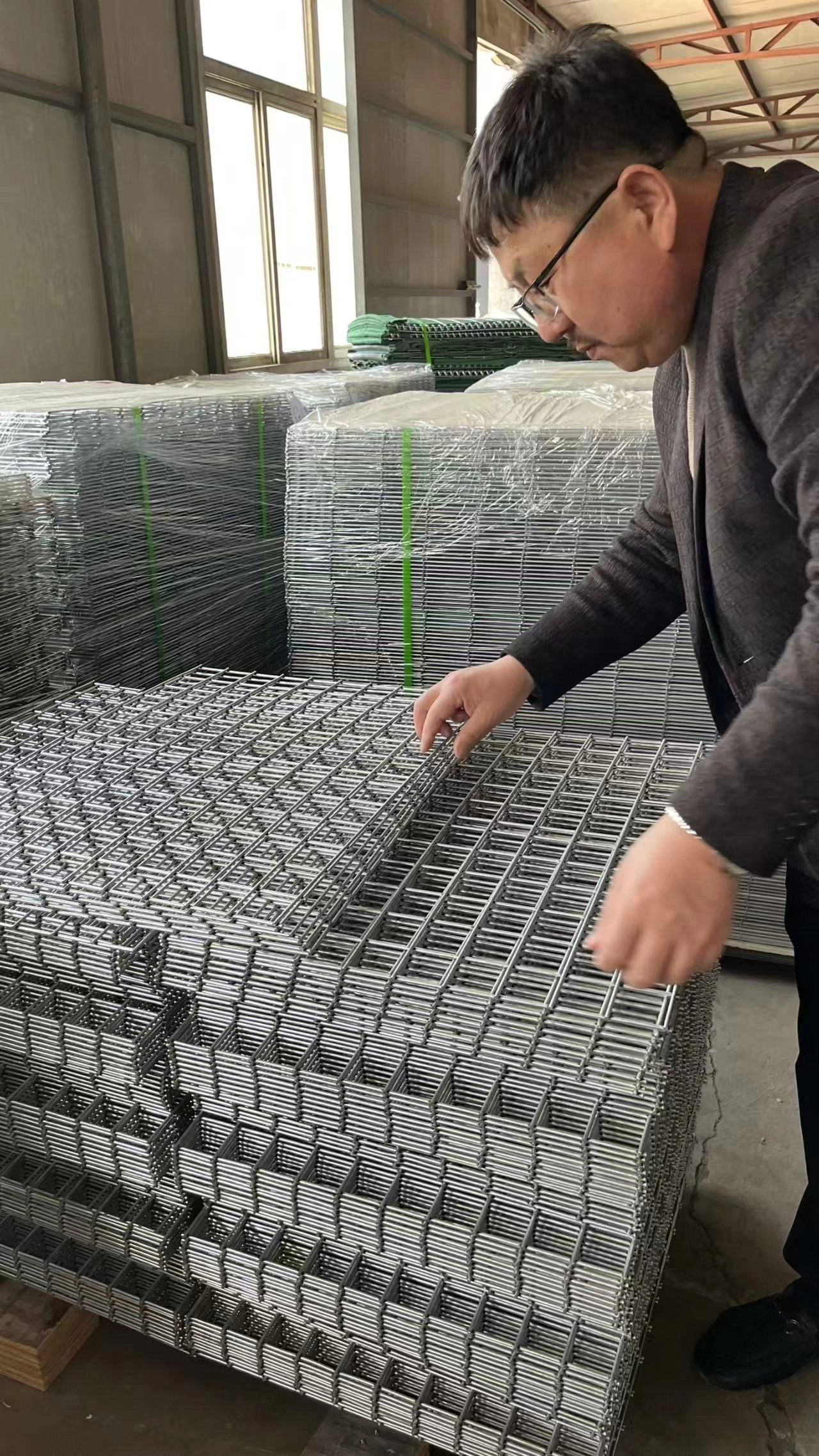
DB Fencing Factory Case Study
DB Fencing is the only Anping factory with an in-house plastic feet injection machine — many local competitors buy their feet from.
Instead of splitting orders across multiple vendors who each have gaps, you can consolidate with a single factory that controls the entire production chain. DB Fencing runs 10 dedicated welding production lines with a combined output of 2,000 sets per week — enough to fill a container without splitting your order.
-
- Production capacity: 10 lines running 6 days/week yield 2,000 Hesco barrier sets per week. This volume supports container-load orders with consistent quality across batches.
- Plastic feet machine (unique): DB Fencing owns its own plastic feet injection machine — the only supplier in Anping County with this in-house capability. They supply plastic feet to other local fencing vendors, meaning you get a direct quality check on a component that usually causes field failures.
- AS 4687 compliance: All temporary fencing products are tested to Australian Standard AS 4687-2022/2007. The hot-dipped galvanized coating exceeds 42 microns, verified by SGS reports. For Australian projects, this certificate is non-negotiable — and DB has it on file for every production run.
Checklist for Your Supplier Vetting Process
Three yes/no questions that separate real factories from traders.
You can cut through the noise with three verification questions. If a supplier hesitates on any of them, move on. These are not nice-to-haves — they are the minimum bar for a factory that can deliver Hesco barriers that actually hold up in the field.
-
- 1. Can you show me a cross-section micrograph of a weld joint after hot-dip galvanizing?: Many Chinese Hesco barrier factories skip the hot-dip galvanizing after welding. That leaves bare steel at every weld point — corrosion starts there within months. Ask for a cross-section micrograph. If they can’t produce one, they likely don’t have the process. Compare that with a factory like DB Fencing, which has 10 welding lines and runs continuous hot-dip galvanizing that meets AS 4687-2022 with >42 micron coating.
- 2. Do you have a third-party test report for geotextile UV stabilisation and burst strength?: The geotextile liner is what makes a Hesco barrier actually hold soil and water. Without UV stabilisation, the liner degrades in sunlight within six months. Request a test report showing UV resistance (ASTM D4355) and burst strength (ASTM D3786). A factory that exports to Australia will have these on file because AS 4687 compliance requires it. If they send you a generic material certificate without test data, that is a red flag.
- 3. Can you schedule a live video walkthrough of your production line — including the plastic feet assembly area?: A virtual factory tour reveals more than any PDF. Watch how panels are welded: are the joints clean and uniform? Check the straightness of collapsible cells — they should stack flat without gaps. DB Fencing is the only supplier in Anping with its own plastic feet machine; many local vendors actually buy feet from DB Fencing. If a factory outsources its feet, ask why. Consistent base quality matters for stability in high-wind events. Also verify they have ISO 9001 and SGS certificates, and ask for a third-party test report for tensile strength and corrosion resistance.
Run these three checks before you send an RFQ. They will filter out 80% of the traders posing as manufacturers. For the remaining suppliers, you can negotiate MOQ, lead times, and FOB pricing with confidence.
Conclusion
A Hesco barrier that fails at the weld or delaminates after six months in coastal air isn’t a cost-saving — it’s a liability. Verifying galvanization thickness, weld integrity, and geotextile UV stabilisation before placing the order is the only way to avoid that 50K write-off.
Now run the three questions above against your shortlist. If the supplier hesitates on any of them, you have your answer. To see how a factory that owns its plastic‑feet line and tests every weld joint structures its quality system, take a look at DB Fencing’s production setup.
Frequently Asked Questions
What galvanization thickness is required for Hesco barriers?
The minimum requirement is hot-dipped galvanization with a coating thickness of 42 microns or more. This level is essential for withstanding harsh seaside or outdoor environments common in Australian and North American sites. Always request a third-party test report for coating thickness.
Which certifications should a Hesco barrier factory have?
A qualified factory should hold ISO 9001 and SGS certification, and ideally meet Australian Standard AS 4687-2022 or 2007. These ensure consistent quality control and compliance with export requirements for construction and event. Ask for digital copies before placing a trial order.
How to perform a virtual factory audit for Hesco barriers?
Schedule a video call walkthrough and ask to see the welding lines, galvanization bath, and the geotextile liner storage area. Focus on spotting rust on raw materials, uneven welds, and whether. Request a live test of a sample panel during the call.
What are red flags when vetting a Hesco barrier supplier?
Refusal to share certificates, unrealistic lead times for custom sizes, or lack of capacity for full container orders are major red flags. A factory that cannot show you third-party test reports for corrosion or tensile. Cross-check any supplier that hesitates on documentation.
How does in-house plastic feet production affect Hesco barrier quality?
In-house plastic feet production, like DB Fencing’s dedicated machine, means tighter control over base stability and UV resistance. Most factories outsource this part, so a supplier with its own machine can ensure consistent fit. Verify that feet are UV-stabilized for outdoor use.