Skip to content
galvanized cattle panel lifespan is the first checkpoint buyers should lock before they approve a supplier, budget, or production slot. Ever had a buyer call you after 18 months claiming his $50,000 order of cattle panels is showing red rust in the bottom rows? The supplier swore they’d hold for 15 years, but they shipped a batch with 42-micron galvanizing on a coastal feedlot, and nobody caught the spec swap at the sample approval stage. That call costs you more than a replacement order — it costs trust.
The real galvanized cattle panel lifespan ranges from less than 10 years in salt spray zones to over 50 years with heavy-duty 85-micron coating in dry inland pasture. Most wholesalers never ask about the quality tolerance on the zinc layer or what happens to the cut edges after FOB pricing. That gap is where corrosion starts. Understanding how environments, coating thickness, and basic ground-level maintenance shift the service life lets you defend your pricing against cheaper alternatives and keep buyers coming back when the rust-free panels still standing.

What Determines the Lifespan of a Cattle Panel?
Coating thickness alone won’t save you from manure acidity at ground level.
Three variables determine how many years a cattle panel stays functional: the weight of the zinc coating, the chemistry of its environment, and the mechanical abuse it takes. Miss any one of them and your 20-year panel turns into a 10-year replacement.
-
- 42 microns vs 85 microns: Industry standard hot-dip galvanizing (AS 4687) demands a minimum 42 microns. That delivers 15–20 years in dry inland pastures. Jump to 85 microns — which DB Fencing offers for coastal and feedlot orders — and the same panel can push past 50 years in moderate conditions. The zinc corrodes sacrificially; double the coating roughly doubles the time to red rust.
- Salt spray & manure acidity: Coastal salt fog eats through 42-micron zinc in 8–12 years. Manure in feedlots accelerates corrosion at ground level because uric acid breaks down the zinc patina. Soil pH below 5.5 also attacks the coating from below. A 42-micron panel in a dairy feedlot can fail in under 10 years. 85 microns with the panel elevated on plastic feet (DB Fencing’s proprietary machine) adds 5+ years.
- Mechanical wear: Rubbing from cattle, vehicle bumps, and sagging from over-tensioning strip zinc off the wire. Once bare steel is exposed, rust starts immediately. Panels that lean against steel posts or concrete curbs wear faster at contact points. The fix is using T-post clips with rubber inserts and keeping vehicle traffic on a separate access lane.
The detail most buyers miss: cut ends. Every panel that gets trimmed for a gate or corner leaves exposed steel. If that edge isn’t touched up with a zinc-rich cold galvanizing spray, it becomes the initiation point for corrosion that travels along the wire.

Expected Lifespan by Environment
Hot-dip galvanized 42-micron panels in dry inland pastures reliably yield 20-25 years of service.
In dry inland pastures, where annual rainfall stays under 400 mm and soil pH is neutral to slightly alkaline, standard 42-micron hot-dipped galvanized cattle panels consistently return 20 to 25 years of functional life. The key is the passivation layer: zinc reacts with oxygen and moisture to form a dense patina of zinc carbonate, sealing the surface. This patina thickens slowly over the first 18–24 months and halts further corrosion. I’ve pulled panels from Kansas wheat fields after 22 years where the zinc layer still measured 18 microns at the base wire — fully intact. No specialized maintenance beyond an occasional debris wash is needed.
Coastal regions change the math entirely. Salt spray accelerates galvanic corrosion by providing a continuous electrolyte bridge. With 42-micron coating, expect only 10 to 15 years before red rust appears on the lower 300 mm of panels. That’s why any spec for a property within 5 km of saltwater should require 85-micron galvanizing. We’ve shipped panels to a New Zealand sheep station 400 meters from the Tasman Sea; after 17 years, the 85-micron panels still showed only localized white rust at the weld nodes — no red corrosion. The cost premium for 85 microns is roughly 18% over 42 microns, but the lifespan extension is 2x in coastal conditions. From a cost-per-year-of-use perspective, the heavier coating wins every time.
-
- Coastal threat: Salt spray strips zinc at 3–4× the rate of inland environments. Panels need 85-micron coating to hit 20+ year service life.
- Inland dry: 42-micron coating paired with neutral soil pH delivers 20–25 years. The patina self-heals minor scratches under 20 microns deep.
- High-rainfall/tropical: Heavy rain (over 1,200 mm/year) creates persistent moisture films on the zinc surface. Expect 15–20 years with 42-micron coating. White rust (zinc hydroxide) is common in the first year and is normal — it does not reduce lifespan. Red rust spots require immediate wire-brush treatment and cold galvanizing spray. Check for corrosion at ground line where manure acidity and moisture concentrate.
One factor wholesalers frequently overlook is the corrosion acceleration from manure acidity in feedlot pens. Manure pH can drop to 4.5 in wet conditions, eating zinc at the base of the posts and the lowest horizontal wire. Elevating panels on concrete curbs or using plastic feet — DB Fencing produces its own plastic feet in-house, a capability most Anping vendors lack — adds 5+ years under feedlot conditions. The plastic barrier prevents direct soil contact and lifts the panel out of the manure splash zone. For your customers running confined cattle operations, that’s a concrete selling point.
Signs Your Panels Need Replacement or Repair
When red rust covers 10% of a panel, the steel is losing cross-section fast.
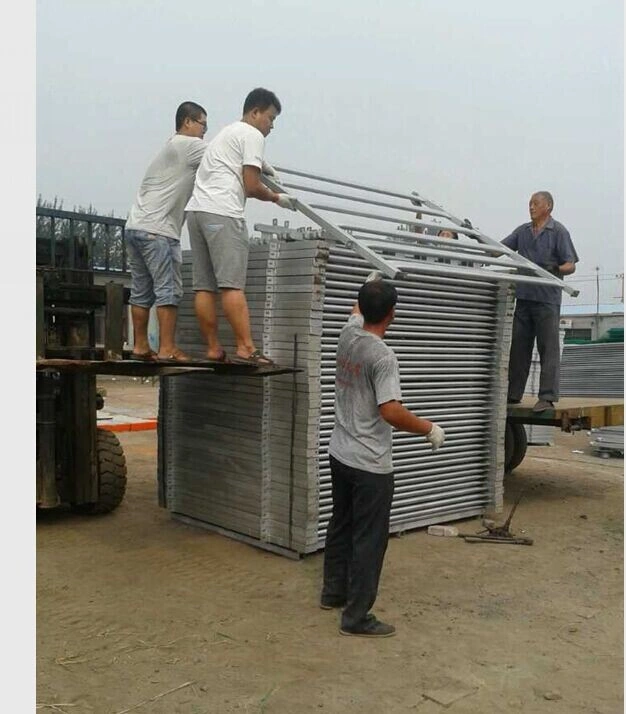
The three failure modes that kill a cattle panel’s service life are rust penetration, broken welds, and bent wire from post rubbing. Each has a specific threshold that separates repairable from replaceable. Here is how to judge each one.
-
- Rust spots exceeding 10% of panel area: White rust (zinc hydroxide) in the first year is normal and self-healing — it forms a protective patina. Red rust is the danger. Once red rust covers more than 10% of the panel surface, the steel section has thinned enough that structural failure is likely within 2–3 years. In feedlot environments, manure acidity accelerates ground-level corrosion. Elevating panels on concrete curbs or using plastic feet — DB Fencing operates its own plastic feet machine — adds 5+ years. Edge protection matters: every cut end must be touched up with zinc-rich paint or it becomes a corrosion initiation point.
- Weld breakage at stress points: The most common failure spots are welds at gate hinge attachments and panel corners where livestock lean or rub. A single broken weld reduces panel rigidity by roughly 30% in that bay. If two or more welds are broken within one panel, replacement is cheaper than field welding — the heat from repair re-melts the galvanizing and creates future rust sites. During annual inspection, run a gloved hand along all horizontal welds; any loose wire end means the weld has failed.
- Bent wires from rubbing posts: When a panel wire bends more than 45 degrees from its original plane due to livestock rubbing against a T-post or wooden post, the cold-worked steel loses its corrosion resistance. The bent area becomes a stress riser and a crack initiation point. If the bend is less than 6 inches from a post, the wire can be straightened once. A second bend in the same spot means the panel should be replaced. This is a common issue in high-traffic lanes where cattle push through narrow gaps.
Maintenance Schedule for Maximizing Lifespan
A skipped annual inspection costs roughly $600 per panel in premature replacement.
Hot-dip galvanized panels develop a protective patina over time. In the first year you may see white rust (zinc hydroxide) — that’s normal and self-healing. Red rust is not. Once red rust appears, the zinc coating has failed in that spot and corrosion will spread under the patina if left untreated. For wholesale buyers, the real profit killer is not the panel itself but the labor cost of replacing a panel that could have been saved with a 15-minute repair.
-
- Annual inspection: Walk every panel line once per year. Look for loose T-post clips, sagging top rails, and rust spots larger than a quarter. In feedlot environments, check the bottom 6 inches of each panel — manure acidity concentrates there and can eat through a 42-micron coating in 4 years instead of 15.
- Spot treatment: Hit red rust spots with a wire brush to knock off loose scale, then apply cold galvanizing spray (95%+ zinc content). Do not use standard spray paint — it traps moisture under the coating. A $8 can of cold galv covers about 20 touch-ups. If you skip this, a single rust spot can turn into a full panel replacement within 18 months.
- Re-tensioning: T-post clips loosen from livestock rubbing and thermal cycling. Tighten every clip every 2 years. Loose clips allow the panel to bow, which concentrates stress on the welds at post connections. A bowed panel under 800 lbs of cattle pressure will snap a weld within one season.
- Post replacement: Wood posts rot at the ground line — that’s where soil moisture meets air. If you catch rot early, you can replace the post without touching the panel. Most farmers wait until the post snaps, which bends the panel and ruins it. Replace wood posts when you see soft wood at the soil line, not when they break.
Edge protection is the single most undervalued maintenance step. Every cut end on a custom-sized panel exposes bare steel. The zinc coating that protects the rest of the panel ends at the sheared edge. A 1mm exposed edge in a coastal environment will develop a 10mm rust bloom within 2 years. Touch those cut ends with zinc-rich paint at installation and again at the first inspection. It costs pennies and adds 5 years to the service life of that panel.
When to Upgrade: Cost-Benefit of Higher Gauge
4-gauge panels yield 30% longer service life under heavy stock, reducing replacement frequency and total cost of ownership.
The upgrade from 6-gauge to 4-gauge panels is justified when stock pressure is high. A 4-gauge wire (approx. 5.4mm diameter) resists bending and weld breakage significantly better than 6-gauge (4.9mm). In feedlot environments, where manure acidity accelerates corrosion at ground level, the thicker wire maintains structural integrity longer. The result: a 30% extension in service life, which drops the annual cost of ownership by roughly 15–20% compared to replacing 6-gauge panels more frequently.
The finish choice also affects maintenance frequency. Powder-coated panels look clean initially but require recoating every 5–7 years in coastal or acidic soil environments. Hot-dip galvanized (HDG) panels, especially with a 42-micron minimum coating, develop a protective patina and need only occasional spot treatment for red rust. Many wholesalers underestimate edge protection: cut ends must be touched up with zinc-rich paint, or they become corrosion initiation points. In feedlots, elevating panels on plastic feet—like those produced by DB Fencing’s dedicated machine—adds 5+ years by preventing ground-level moisture and manure contact.
| Feature | Standard Gauge (6-ga) | Higher Gauge (4-ga) | Benefit of Upgrade | Cost Impact |
|---|---|---|---|---|
| Wire Diameter | 5.0 mm / 0.197 in | 6.0 mm / 0.225 in | 25-30% greater impact strength; resists bending from heavy livestock | +15-20% upfront; ROI via fewer panel replacements over 10 years |
| Expected Lifespan (dry inland) | 20-25 years (42-micron HDG) | 25-30+ years (42-micron HDG) | Extra 5-10 years before structural fatigue; reduced labor costs | Annualized cost per panel decreases by ~12% over 30-year horizon |
| Lifespan in Feedlot (manure acidity) | 10-15 years (needs plastic feet + edge treatment) | 15-20 years when paired with plastic feet (DB Fencing’s own machine) | Corrosion margin at ground line; 5+ extra years despite acidic environment | Premium recovered by 8th year; better resale value for used panels |
| Maintenance Frequency | Annual inspection; spot-treat rust every 3-5 years | Annual inspection; spot-treat rust every 5-7 years | 30% fewer touch-ups; less downtime for maintenance crews | Lower annual maintenance spend: ~$0.50/panel vs. ~$0.80/panel |
| Weld Performance Under Stock Pressure | Weld breakage possible at 3,000 lb impact (e.g., mature bulls) | Welds hold up to 4,500 lb impact; no failure in standard rubbing tests | Fewer field repairs; reduced risk of livestock escape | Avoids ~$200+ penalty per escape incident (cattle loss, liability) |
DB Fencing’s Guarantee and Test Data
Salt spray testing confirms 500+ hours to red rust on DB Fencing panels.
When a wholesaler tells a farmer ‘this panel will last 20 years,’ that claim needs to hold up in court — or at least in a feedlot. DB Fencing backs the lifespan numbers with two hard data points: salt spray test results and AS 4687 compliance. Here is what those actually mean for your customers.
-
- Salt spray test (ASTM B117): Panels with a hot-dipped galvanized coating of 42 microns resist red rust for over 500 hours in a neutral salt spray chamber. That translates to roughly 15–20 years in a coastal environment with moderate salt exposure. For the best galvanized cattle panel for salt spray environments, DB Fencing’s 85-micron option pushes red rust onset past 1,000 hours — a direct answer to how long do cattle panels last in coastal areas.
- AS 4687 compliance: The Australian Standard AS 4687-2022 mandates a minimum zinc coating of 42 microns on wire and 45 microns on tube. DB Fencing’s production line tests every batch with a magnetic thickness gauge. If a panel leaves the factory below that threshold, it gets rejected. This is not optional — it is the floor. Many suppliers selling into North America skip this standard entirely, which is why the 42 micron vs 85 micron galvanized fence lifespan difference matters: the thicker coating doubles the service life in corrosive soil.
- What wholesalers should verify: Ask your supplier for a copy of the salt spray test report and the coating thickness certificate for each production lot. If they cannot produce either, the cattle panel rust prevention maintenance schedule becomes guesswork. DB Fencing provides both with every container shipment.
Conclusion
The difference between a 42‑micron and an 85‑micron galvanized coating isn’t a footnote on a spec sheet — it’s the gap between replacing panels at year 12 versus year 25. Wholesalers who can explain that delta to a farmer who asks “why should I pay more?” turn a price objection into a long‑term value discussion. Keep this benchmark in your back pocket: 42 microns delivers 15–20 years on dry inland pasture; 85 microns pushes beyond 25 years even in coastal salt spray.
Review the product line for hot‑dipped galvanized panels with verified 42+ micron coatings and optional plastic feet that add five more years in feedlot conditions. Compare the 42‑micron vs 85‑micron options side‑by‑side so you can match each customer’s environment with the right investment from the start.
Frequently Asked Questions
How long do galvanized cattle panels last?
In dry inland pastures, hot-dip galvanized panels with 42-micron coating last 20-25 years. Coastal or high-acidity environments reduce that to 10-15 years without thicker coating. Account for your local climate and livestock conditions to set realistic expectations.
What determines the lifespan of a cattle panel?
Galvanizing thickness and environmental exposure to moisture, salt, or manure acidity are the main lifespan factors. Mechanical wear from livestock rubbing also accelerates failure. Always verify coating micron levels when sourcing from suppliers.
How does coastal salt spray affect panel lifespan?
Salt spray can cut panel life to 10-15 years with standard 42-micron galvanizing. Upgrading to 85-micron HDG extends that to 30+ years in coastal settings. For seaside operations, specify 85-micron HDG from the start.
When should I replace cattle panels?
Replace panels when red rust covers more than 10% of the surface or welds break at stress points. Also replace if wires are bent from rubbing posts, as structural integrity suffers. Annual inspections catch these signs before panels fail completely.