Skip to content
bulk cattle panels distributors is the first checkpoint buyers should lock before they approve a supplier, budget, or production slot. You’ve just landed a 20-foot container of 16′ x 50″ cattle panels for your distribution yard in Texas. The pre-production sample looked solid—6-gauge wire, hot-dipped galvanized, clean welds. But when the full order arrives and you spot-check a few panels, the wire diameter measures 5.0mm instead of the agreed 4.8mm. That 0.2mm difference drops the tensile strength by roughly 15%, and now your biggest agricultural customer is rejecting the lot. The cost of that mistake? About $50,000 in freight, duties, and restocking fees. This exact scenario plays out more often than most bulk cattle panel distributors realize—and it almost always traces back to one thing: wire gauge tolerance.
That’s why when you’re evaluating wholesale cattle panel factory direct options, the conversation needs to start with a spec sheet that locks in actual wire diameter (not nominal gauge) under a recognized standard like ASTM A1064, which allows +0.00/-0.10mm. The same diligence applies to coating thickness, panel dimensions, and container loading strategy. Stacking panels vertically on their 50-inch side instead of flat bumps capacity by about 30% in a 40-foot container—roughly 480 panels versus 360—but only if you brace them properly with wooden frames to stop shifting during transit. Then there’s the customs classification: Australia’s anti-dumping duties on Chinese wire mesh hit HS code 7314.20.00, but most cattle panels fall under 7314.39.00. Get that wrong and your landed cost jumps overnight. A 100-panel MOQ from a supplier like DB Fencing, with 10 production lines turning out 2,000 panels a week, gives you the flexibility to test the market without tying up capital in a full container. From there, pricing tiers—6-gauge standard vs. 4-gauge heavy-duty, hot-dipped galvanized vs. pre-galvanized—determine whether you hit a 30% margin or bleed on warranty returns. The numbers are straightforward when you know where to look; the risk is in what you don’t verify before the ship sails.
Why Buy Direct from a Chinese Manufacturer?
Buying direct from Anping cuts panel costs 30–50% — if you verify wire gauge and coating before shipment.
Every sourcing guide tells you to get three quotes and pick the middle one. That advice misses the real lever: cutting out the regional distributor’s overhead. When you buy from a Chinese manufacturer like DB Fencing, you’re paying for steel, welding, and galvanizing — not for the distributor’s warehouse lease, sales commissions, and inventory carrying costs. A standard 16′ x 50″ 6-gauge hot-dipped galvanized panel that costs $45–55 landed from a local supplier comes off the production line at FOB Tianjin for $18–22. Even after freight, duty, and inland trucking, you’re looking at a 30–50% total savings.
But the price advantage only holds if the product actually meets your spec. Buyers have lost the entire savings when a shipment arrives with 5.0mm wire instead of the ordered 4.8mm (nominal 6-gauge). The factory saved $0.30 per panel on wire, and the distributor ended up with panels that fail load tests on a cattle farm. That’s where Anping’s concentration becomes both a risk and an opportunity.
-
- Hub density: Anping has hundreds of wire mesh workshops within a 10 km radius. Sourcing from a factory that runs its own welding lines and hot-dip galvanizing plant — not outsourcing to third parties — gives you traceability. DB Fencing operates 10 in-house welding lines and the only proprietary plastic feet machine in the area, meaning we control quality at every step.
- The gauge trap: Many factories quote ‘6-gauge’ and deliver 5.0mm wire instead of the ASTM A1064 standard of 4.8mm with a +0.00/-0.10mm tolerance. That extra 0.2mm may sound minor, but it reduces the panel’s rigidity by roughly 8%. DB Fencing uses calibrated micrometers and requires caliper verification photos before shipment. Ask for that documentation in your supplier audit.
- Coating consistency: Pre-galvanized wire is cheaper but offers half the corrosion resistance of hot-dipped galvanized (>42 microns). Anping’s best factories run an in-house zinc coating thickness tester. If your supplier can’t provide a coating weight certificate for each batch, assume they’re using pre-galvanized. That 30% price advantage disappears when panels rust out in three years.
Anping gives you the price edge, but only a factory with documented compliance — like AS 4687 certification and ASTM wire tolerances — turns that edge into a reliable margin for your business. The real savings aren’t in the FOB quote; they’re in not having to replace a failed shipment.
Understanding Cattle Panel Pricing Tiers
Gauge and coating choices can swing your landed cost by 30% – know the actual wire diameter.
Pricing for bulk cattle panels hinges on two factors: wire gauge and galvanizing method. A 4-gauge heavy-duty panel costs roughly 20–25% more than a standard 6-gauge panel, but many factories quote ‘nominal’ gauge (6-gauge = 4.8 mm) and actually deliver 5.0 mm wire to shave costs. DB Fencing uses wire diameter per ASTM A1064 with a tolerance of +0.00/–0.10 mm, so you get the specified thickness every time.
Hot-dipped galvanized (HDG) panels with coating >42 microns carry a 15–20% premium over pre-galvanized panels. Pre-galvanized is cheaper upfront but typically rusts within 2–3 years in coastal or feedlot environments. For distributors supplying agricultural clients, the longer service life of HDG justifies the higher FOB price.
-
- Quantity discount tiers: Orders of 100–499 panels receive standard FOB pricing. At 500–999 panels, expect a 5–8% per-unit reduction. For 1,000+ panels, discounts reach 10–15%, making the per-panel cost competitive for landed stock. DB Fencing starts at a low MOQ of 100 panels, allowing you to test the market before scaling.
- Container loading impact: Stacking panels vertically (on their 50-inch side) increases capacity by 30% compared to flat stacking – up to 310 panels per 40ft container vs 240. Lower shipping cost per panel means you can absorb a higher FOB price while keeping your buyer cost flat.
MOQ and Customization Options
100 panels MOQ drops the barrier for distributors testing new markets.
Most factories in Anping won’t touch an order under 500 panels if you want custom specs. DB Fencing operates differently. Their standard production floor accepts a minimum of 100 panels for OEM runs. That gives you enough volume to fill a partial container and validate sell-through before committing to full-scale procurement. The catch? Custom tooling or color runs still follow standard lead times, but the lower entry point means you can sample a market without betting the warehouse.
-
- OEM Dimensions: You specify height, width, and wire spacing. The mesh welders are programmable, so layout adjustments don’t trigger retooling fees. Common requests: 16′ × 50″ for cattle panels, or shorter heights for corral gates. What matters is staying within standard coil widths to avoid waste. DB’s internal spec uses ASTM A1064 wire diameter tolerance (+0.00/−0.10mm) – the wire you specify is the wire you get, not a nominal gauge that shaves 0.2mm off the true diameter.
- Color‑Coded Ends: Plastic feet or end caps can be molded in your color. DB runs its own plastic feet machine – one of the few factories in Anping that doesn’t outsource this. You can assign red for heavy‑duty panels, blue for standard, or match corporate colors for rental fleets. Tooling cost is minimal because existing molds accept color masterbatch changes without a new mold.
- Branded Packaging:Stretch‑wrapped bundles with your logo and SKU labels. Requires a minimum of 100 panels per label variant. For repeat orders, pre‑printed corrugated cardboard edge protectors with your brand can be provided. This isn’t just vanity – it helps your customers identify your product on the yard and reduces returns due to commingled stock.
Container Loading and Shipping Strategy
Stack panels vertically to boost 20ft container load by 30%.
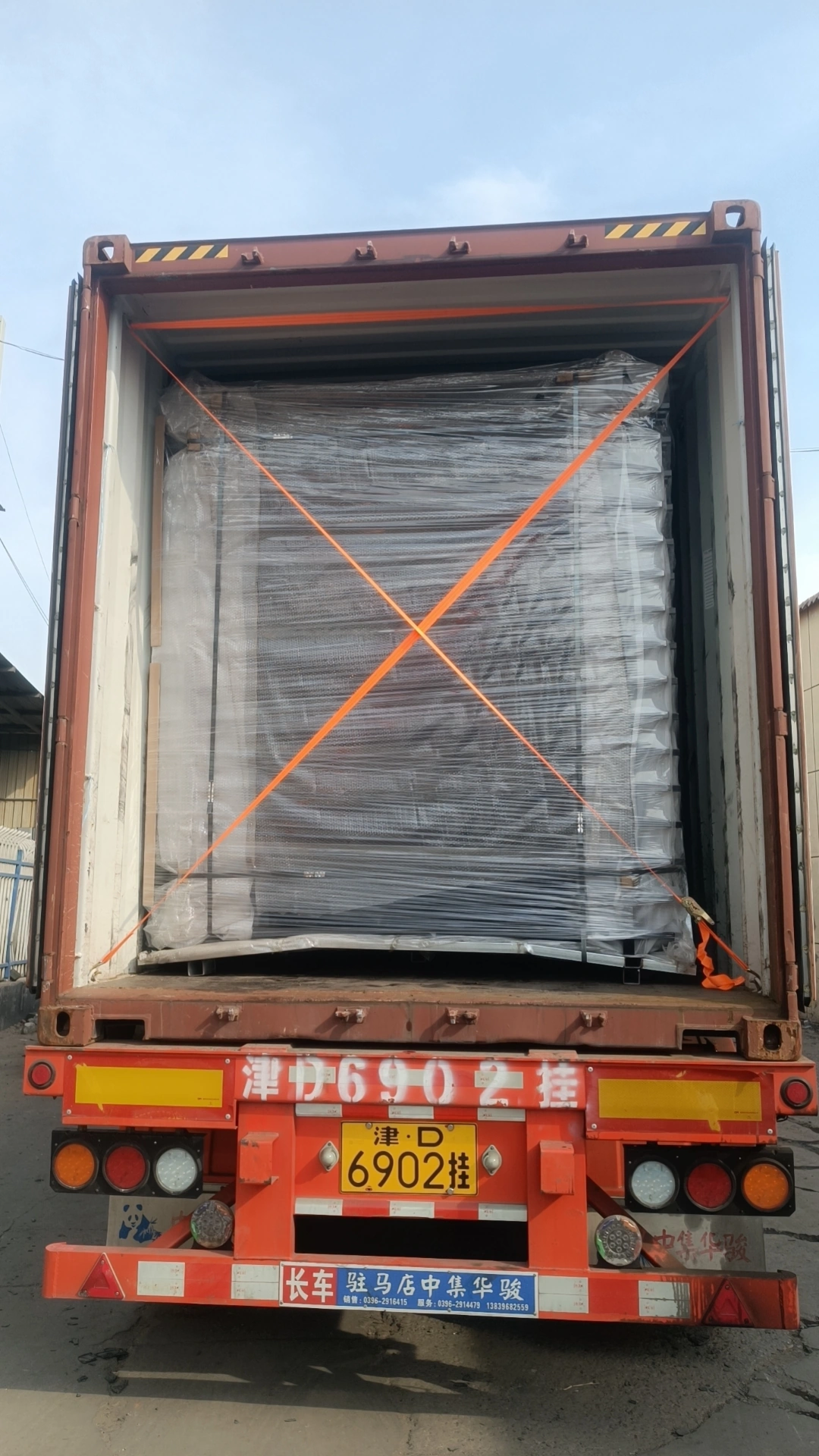
For standard 16′ x 50″ cattle panels, a 20ft container holds approximately 240 panels when stacked flat. Stacking the panels on their 50-inch side (vertically) increases capacity to over 300, but requires internal wooden bracing to prevent shifting during transit.
-
- 20ft container (flat stack): ~240 panels – standard loading without pallets.
- 40ft container (flat stack): ~480 panels, or up to 600+ when vertically stacked with bracing.
- Palletizing option: Panels can be strapped to custom pallets for easier forklift handling, reducing total count by 5-10% due to pallet footprint.
Shipping terms matter for margin. FOB Tianjin gives you control over freight contracts and insurance, often saving 5-8% compared to CIF from the factory. CIF to major ports like Los Angeles, Sydney, or Dubai simplifies logistics but locks you into the supplier’s freight rate. For first-time importers, CIF offers predictable landed cost; seasoned distributors prefer FOB to negotiate their own consolidations.
Landed Cost Calculation Example
Your FOB quote is just the starting point — tariffs and inland truck can add 35%.
To calculate your true landed cost, start with the FOB Tianjin price per panel. For a standard 16’x50″ 6-gauge hot-dipped galvanized panel, a typical FOB price range is $18–$22 per panel at MOQ 100 panels. Add ocean freight — a 20ft container carries roughly 240 panels, with freight to Los Angeles or Melbourne averaging $3,000–$4,500 depending on season. Insurance at 0.3% of cargo value is negligible but mandatory for bank letters of credit.
-
- Ocean Freight per Panel: For a 20ft container at $3,500, that’s ~$14.60/panel. Stacking panels vertically (on their 50-inch side) boosts capacity to 312 panels per container — dropping freight cost to $11.22/panel, but wood bracing is required to prevent shifting.
- Customs Duties – US Section 301: Cattle panels under HS code 7314.39.00 currently face 25% Section 301 tariffs if originating from China. Verify with your customs broker — some welded mesh products are classified under 7314.20.00, which may carry different rates. A $20 FOB panel becomes $25 at customs entry.
- Customs Duties – Australia (TAFTA & Anti-Dumping): Under the China-Australia Free Trade Agreement (ChAFTA), most wire mesh products are duty-free if the certificate of origin is correct. However, Australia’s anti-dumping duties on Chinese wire mesh apply to HS 7314.20.00 (certain welded mesh). Cattle panels are often classified under 7314.39.00 — always confirm with a customs broker to avoid unexpected penalties.
- Inland Trucking (Final Mile): From the port to your warehouse, budget $200–$600 per container depending on distance. A full container from LA to Dallas adds roughly $2.50/panel.
Use this as a cattle panel landed cost calculator: FOB per panel + freight per panel + insurance + duty + inland truck. For a US-bound shipment of 240 panels at FOB $20/panel, expect a total landed cost of $28–$32 per panel. The margin between FOB and landed is where most distributors lose money — get a binding CIF quote before placing your order.
| Cost Component | Calculation Basis | Estimated Cost per Panel (USD) | Notes |
|---|---|---|---|
| FOB Price (Tianjin) | 16’x50″ hot-dipped galvanized cattle panel, 6-gauge, at 1,000+ panels | $11.80 | Includes factory profit; OEM dimensions available at +$0.50/panel |
| Ocean Freight | 20ft container: ~240 panels at $3,000 total freight | $12.50 | Shipping to US West Coast (Los Angeles); peak season may add 15–20% |
| Insurance & Port Fees | 0.3% of CIF value + terminal handling | $0.35 | Typically bundled in freight quote; verify with freight forwarder |
| US Section 301 Tariff | 25% on FOB value (HS 7314.39.00 – confirm classification) | $2.95 | Cattle panels often fall outside anti-dumping scope; verify with customs broker |
| Inland Trucking | Port to distribution center, 200 miles average | $1.80 | Varies by distance; consolidating LTL shipments reduces per-panel cost |
| Total Landed Cost | Sum of above components (FOB + freight + insurance + tariff + trucking) | $29.40 | Compare to local US wholesale price of $38–$45; savings of 25–35% achievable |
Lead Times and Order Planning
Ordering in Q4?
Standard production for bulk cattle panels at DB Fencing runs 2 to 4 weeks after deposit confirmation. That window assumes your order uses 6-gauge wire with hot-dipped galvanized coating — the most common spec among distributors. Thicker 4-gauge or custom OEM dimensions can push it to 5 weeks because the welding line needs retooling. We run 10 dedicated lines, so capacity sits at roughly 2,000 panels per week. That means a 500-panel order clears the floor in under three days; the rest of the timeline is consumed by galvanizing, stacking, and container loading.
The real variable is not production — it’s peak season. Every year from October through December, Chinese factories run at 95%+ capacity shipping orders placed in September. New orders placed in October get slotted behind pre-existing commitments. Lead times balloon to 5-7 weeks, and most suppliers add a 10-15% rush surcharge if you ask for expedited handling. The cheaper play is to place your Q1 inventory order in August or September. That lands your container at port before the holiday logjam, and you avoid paying the peak premium.
-
- Production Capacity: 10 welding lines, 2,000 panels/week. Standard 6-gauge HDG: 2-4 weeks. 4-gauge or OEM dimensions: 4-5 weeks.
- Peak Season Risk: October–December orders face 5-7 week lead times + 10-15% surcharge. August–September orders clear in 3-4 weeks with no premium.
- Insider Warning: If a supplier quotes a firm 3-week lead time in November, they are either lying or front-loading your order with a thinner gauge. Always request a production schedule screenshot.
How to Request a Quote from DB Fencing
A vague quote request wastes everyone’s time—specify gauge tolerance and coating micron target.
When I review incoming RFQs, the ones that get prioritized are the ones that include four hard specs: exact quantity, wire gauge with tolerance, coating type and minimum micron, and destination port. Leave any of those blank and you’ll get a generic quote that needs three rounds of clarification. DB Fencing responds within 24 hours, but the accuracy of that first quote depends entirely on what you send.
-
- Quantity (panels): State the number of panels, not rolls or pallets. MOQ is 100 panels for standard sizes. For 16’ × 50” panels, a full 20ft container holds roughly 240 units (vertical stack with bracing). If you’re under 100, expect to pay a surcharge or look for stock lots.
- Wire Gauge & Tolerance: Say ‘6-gauge, 4.8mm nominal, per ASTM A1064’. Many factories quote nominal but ship undersized wire (e.g., 5.0mm instead of 4.8mm) to save cost. DB Fencing uses a +0.00/-0.10mm tolerance—that means the wire will never be thinner than stated. If you need 4-gauge (5.7mm) for heavy livestock, specify it outright.
- Coating Specification: Do not just say ‘galvanized’. Clarify: pre-galvanized (thin, 20-30 microns) or hot-dipped galvanized (42+ microns per AS 4687). For coastal or feedlot environments, request HDG with a minimum 85µm zinc coating. If you want color coating (e.g., green or black powder coat), mention the RAL number and whether it’s on one side or both.
- Destination Port & Incoterm: Provide the seaport name (e.g., Los Angeles, Sydney, Jebel Ali) and your preferred incoterm: FOB Tianjin (you arrange freight) or CIF/CIP (we handle ocean freight and insurance). Also note whether the container will be deconsolidated at destination or if you need a full container load. This affects palletizing and fumigation certification requirements.
Add any customization needs upfront: OEM dimensions, color-coded panel ends, branded shrink-wrap, or special weld spacing for sheep corrals. The more you include in the first email, the faster you get a landed cost estimate—and the less likely you’ll discover a mismatch when the container arrives.
Conclusion
The margin on a 20ft container of cattle panels often comes down to two things: wire gauge tolerance and container loading density. A supplier who delivers 5.0mm wire on a 4.8mm quote shaves 4% off your material cost—and 4% off the panel’s structural life. Vertical stacking (240 panels per 20ft container vs. 180 flat) cuts freight cost per panel by 25%, but only if the supplier braces the load properly. For Australian buyers, verifying the HS code with your customs broker can save thousands in anti-dumping exposure.
Keep this benchmark on hand when you request a quote: wire diameter per ASTM A1064 (+0.00/-0.10mm), hot-dipped galvanized coating above 42 microns, and a vertical loading plan. Compare your next supplier against that standard. For detailed product specs and factory-direct pricing, browse the cattle panel options and send your quantity, gauge, and destination port for a tailored FOB quote.
Frequently Asked Questions
What is the MOQ for bulk cattle panels?
DB Fencing offers a flexible low MOQ of 100 panels for new distributors testing markets. This applies to standard 16’×50″ hot-dipped galvanized panels. MOQ confirmed at 100 panels for standard specs.
How many cattle panels fit in a 20ft container?
Approximately 240 panels of 16’×50″ size fit in a 20ft container. Capacity increases for 40ft containers and can be optimized with palletizing. Confirm exact count with your logistics partner before booking.
What pricing tiers do you offer for cattle panels?
Pricing varies by gauge—6-gauge standard vs 4-gauge heavy-duty—and coating type, hot-dipped vs pre-galvanized. Quantity discounts apply at 100-499, 500-999, and 1000+ panels. Request a quote with gauge and coating to see tier pricing.
Can I customize panel dimensions and packaging?
Yes, DB Fencing offers OEM customization including dimensions, color-coded ends, and branded packaging. Custom orders require MOQ discussion and longer lead time. Provide your spec sheet for a custom quote.
How long does production take for a bulk order?
Standard production takes 2-4 weeks after deposit, depending on quantity and customization. Avoid Q4 peak season to prevent surcharges and delays. Plan orders 4-6 weeks ahead to secure capacity.