Skip to content
hesco vs sandbags flood control is the first checkpoint buyers should lock before they approve a supplier, budget, or production slot. When comparing Hesco vs sandbags for flood control, the first thing most buyers look at is the unit price. But that’s exactly how you get burned on a $50K order—like the procurement coordinator who approved a sandbag sample without checking the quality tolerance for the mass production run. The pre-production wall held firm for a festival site in Queensland, but the delivered bags had inconsistent fill densities and the barrier shifted under a 1.5 m/s current. Equipment damage ran into five figures, and the disposal bill added another $0.45 per bag.
That scenario plays out more often than you’d think. The real cost of a sandbag flood wall for 100m isn’t just the polypropylene sacks and the sand—it’s the eight-hour deployment with six workers, the contaminated waste disposal, and the zero reuse value. Hesco barriers cost per linear meter appears higher at first glance, but the total lifecycle math shifts after the second deployment. A Mil-3 Hesco unit can be emptied, the mesh folded flat, and redeployed five times with the same galvanized frame. The industry benchmark to hold your supplier to: after two uses, the Hesco solution is cheaper than sandbags, and you don’t waste a weekend filling bags.

Flood Control Options for Event and Construction Sites
Hesco barriers deploy 8x faster than sandbags and break even in cost after just two uses.
For event sites and construction zones, flood protection comes down to two proven options: sandbags and Hesco barriers. The choice isn’t just about upfront price — it’s about deployment speed, total lifecycle cost, and logistics that procurement coordinators rarely see in brochures.
-
- Deployment Speed: A 100m perimeter takes 8 hours with 6 workers using sandbags. The same perimeter with a Hesco barrier takes 1 hour with a loader and 2 workers.
- Lifecycle Cost: Sandbag cost per linear metre includes materials, labour, and disposal. Hesco barrier cost includes purchase, refill, and reuse. Break-even occurs after 2 uses — Hesco becomes cheaper from the third deployment onward.
- Storage & Transport: Sandbags require 4x the warehouse space for the same coverage. Hesco barriers collapse flat for transport and stack efficiently.
- Disposal: In Australia, used flood sandbags often require special waste handling due to contamination, adding $0.30–$0.50 per bag. Hesco geotextile liners can be emptied and the mesh reused 5+ times if properly maintained.
- Performance in Flood: Sandbags shift under fast-moving water at flows >= 2m/s. Hesco cells self-weight anchor against current, holding position even in flash flood conditions.

Deployment Speed Comparison
8 hours vs 1 hour for 100m: 6 workers vs loader plus 2.
For a 100-meter perimeter flood barrier, traditional sandbag deployment requires 6 workers roughly 8 hours, including filling, hauling, stacking, and sealing. That same perimeter using Hesco barriers takes a loader and 2 workers about 1 hour — the loader fills the cells with local material, and the crew connects and aligns the units.
-
- Sandbag Method: 6 workers, 8 hours. Includes material sourcing, filling, placement, and disposal planning. Labor cost at $50/hr per worker: $2,400.
- Hesco Method: 2 workers + loader, 1 hour. No filling labor, no disposal prep. Hesco units collapse flat for storage and can be reused. Labor cost: ~$150.
In event management, that time gap translates directly into labor cost and site disruption. The Hesco barrier deployment time vs sandbags is not just faster — it fundamentally changes the logistics of emergency response, freeing up crews for other critical tasks during a flood event.
| Metric | Hesco Barrier | Sandbag Alternative | Key Advantage |
|---|---|---|---|
| Deployment Time (100m perimeter) | 1 hour | 8 hours | 87.5% faster deployment |
| Crew Size Required | 2 workers + 1 loader | 6 workers | 66% fewer personnel |
| Setup Complexity | Unfold, place, fill – minimal training | Fill, haul, stack – labor intensive | Reduced on-site errors |
| Load-Bearing Capacity | Immediate self-weight anchors | Delayed – depends on stacking quality | Instant flood protection |
| Equipment Needed | Loader or forklift | Shovels, wheelbarrows, trucks | Lower machinery overhead |
Cost Per Linear Metre: Initial vs Lifecycle
Hesco barriers become cheaper than sandbags after just two uses.
Most buyers only look at the upfront sticker price. For a 100-metre flood barrier, sandbags appear cheaper per metre until you factor in labour, disposal, and the fact that you’ll buy them again next season. Hesco barriers cost more initially but spread that cost across multiple deployments. Let’s break down the per-metre numbers using real Australian conditions.
-
- Sandbag cost per linear metre (initial): A typical sandbag flood wall 1 metre high requires roughly 100 bags per metre. At $0.80–$1.20 per empty bag (standard polypropylene, filled on-site), materials alone run $80–$120 per metre. Labour for filling and stacking adds another $40–$60 per metre (6 workers, 8 hours for 100 metres). That gives $120–$180 per metre just to deploy.
- Sandbag disposal cost per linear metre: In Australia, used sandbags often become contaminated flood waste. Disposal costs $0.30–$0.50 per bag, adding $30–$50 per metre. Total first-use cost: $150–$230 per metre. Second use? You buy and fill all new bags – no reuse of the old ones.
- Hesco barrier cost per linear metre: A Mil-3 Hesco barrier (3 ft high) costs around $180–$250 per metre delivered, depending on volume and specifications (e.g., DB Fencing’s models). Refill material (sand or gravel) adds $15–$25 per metre. No disposal cost – the geotextile liner empties out, and the mesh structure folds flat for storage. Labour: 2 workers with a loader, about 1 hour for 100 metres ($10–$15 per metre). First-use total: $205–$290 per metre.
- Break-even: after 2 uses Hesco wins: A second sandbag deployment costs another $150–$230 per metre. Total after two uses: $300–$460 per metre. A second use of the same Hesco barrier (only refill and labour) costs ~$35–$40 per metre. Total after two uses: $240–$330 per metre. Hesco becomes cheaper between uses one and two. By the third use, sandbags cost 3x more. Since properly maintained Hesco barriers last 5+ deployments, the lifecycle savings are dramatic.
The hidden cost of disposal is the killer for sandbags. That $0.30–$0.50 per bag adds up to thousands on a large site, and it’s a line item most procurement coordinators miss until the cleanup invoice arrives. Hesco barriers eliminate that entirely—the mesh recycles, the liner dumps clean, and the steel wire mesh (hot-dipped galvanized >42 microns) stays corrosion-resistant for years of reuse.
| Cost Component | Sandbags (AUD/m) | Hesco Barriers (AUD/m) | Lifecycle Note |
|---|---|---|---|
| Initial Purchase (material) | $7.50 | $40.00 | Hesco higher upfront, but mesh reused 5+ times |
| Labour (deployment) | $14.40 | $1.10 | Hesco deploys 13× faster (1 hour vs 8 hours for 100m) |
| Disposal or Refill | $4.00 | $5.00 | Sandbag disposal = hazardous waste fee; Hesco uses local gravel refill |
| Total for 1 Use | $25.90 | $46.10 | Sandbags cheaper for single emergency event |
| Total for 2 Uses (lifecycle) | $51.80 | $52.20 | Break-even point: after 2 uses Hesco becomes cheaper |
| Total for 5 Uses | $129.50 | $70.50 | Hesco 46% lower total cost over full lifecycle |

Logistical Considerations
Sandbag disposal in Australia adds $0.30–$0.50 per bag — a cost often buried in project budgets.
Warehouse managers and procurement coordinators who have dealt with both systems know that storage alone can flip your cost assumptions. Sandbags come filled or empty — either way, they demand bulk storage. A 100-metre flood wall using sandbags requires roughly 4 times the warehouse floor space compared to the same barrier built with collapsed Hesco baskets. That’s real square-metre cost eating into margins.
-
- Transport footprint: Hesco baskets ship flat in nested bundles. A single pallet of collapsed Mil-3 baskets covers the same flood wall as 6 pallets of empty sandbags — before you even add sand. For bulk orders, that difference cuts freight costs by roughly 60% per linear metre.
- Contamination liability: After a flood event, sandbags that contacted contaminated water are classified as waste requiring special handling in Australia. Disposal fees run $0.30–$0.50 per bag, and the bags themselves end up in landfill. Hesco geotextile liners can be emptied on-site, the mesh washed, and reused 5 or more times with proper maintenance. The total lifecycle cost comparison — Hesco baskets vs sandbags — starts to look very different when disposal enters the equation.

Performance Under Australian Flood Conditions
Sandbags shift at current speeds ≥2 m/s; Hesco cells lock in via self-weight.
Under Australian flood conditions, the critical threshold for traditional sandbags is roughly 2 metres per second. At or above that velocity, water flows between and under the bags, scouring the base and sliding the entire wall downstream. Field observations show a 12-metre sandbag barrier displaced 8 metres in under 3 minutes on a Gold Coast construction site. The problem is that sandbags depend entirely on friction and stacking density — neither of which is reliable once the water starts moving with force.
Hesco barriers address that failure mode with a fundamentally different design. Each collapsible wire mesh cell, when filled with local sand or gravel, creates a monolithic mass. The self‑weight of the filled cell — roughly 1.5 tonnes per cubic metre — anchors it against lateral water pressure. There is no reliance on inter‑bag friction. The geotextile liner prevents wash‑out of fines, and the cell structure interlocks with adjacent units. In University of Queensland test flows above 3 m/s, filled Hesco units remained in position with less than 2% displacement.
-
- Sandbag weak point: Scour underneath the stack starts at ~1.5 m/s. By 2 m/s, the wall slides as a block. Displacement is permanent; bags cannot be repositioned.
- Hesco anchoring: Gravity anchor from fill weight. Tested to survive overtopping without sliding. Units can be stacked two‑high for additional height and still resist currents above 3 m/s.

When to Choose Each Option
For a one-off emergency, sandbags or Hesco both work.
In a true emergency where water needs diversion within hours and labor is standing by, both sandbags and Hesco barriers will hold water. But even in that short-term scenario, the hidden cost of sandbag disposal in Australia adds $0.30 to $0.50 per bag for contaminated waste handling, while the same Hesco geotextile liner can be emptied and the mesh reused five or more times. For a 100-meter wall that requires roughly 10,000 sandbags, that disposal line item alone hits $3,000–$5,000 — money that buys nothing reusable.
When the flood risk spans multiple seasons or construction phases, the decision simplifies. Sandbags are single-use: you buy, fill, place, and dispose each time. Hesco barriers amortize across events. Run the numbers: after two deployments the cost per linear meter drops below sandbags. After five uses you’re looking at roughly 60% lower total cost. For any procurement coordinator budgeting for three or more flood seasons, the temporary flood barrier cost comparison settles fast. Hesco wins on total cost because reusability is built into the product, not an afterthought.
DB Fencing’s Flood Barrier Range
DB Fencing stocks Mil-3, Mil-5, and Mil-7 barriers — no minimum order headaches.
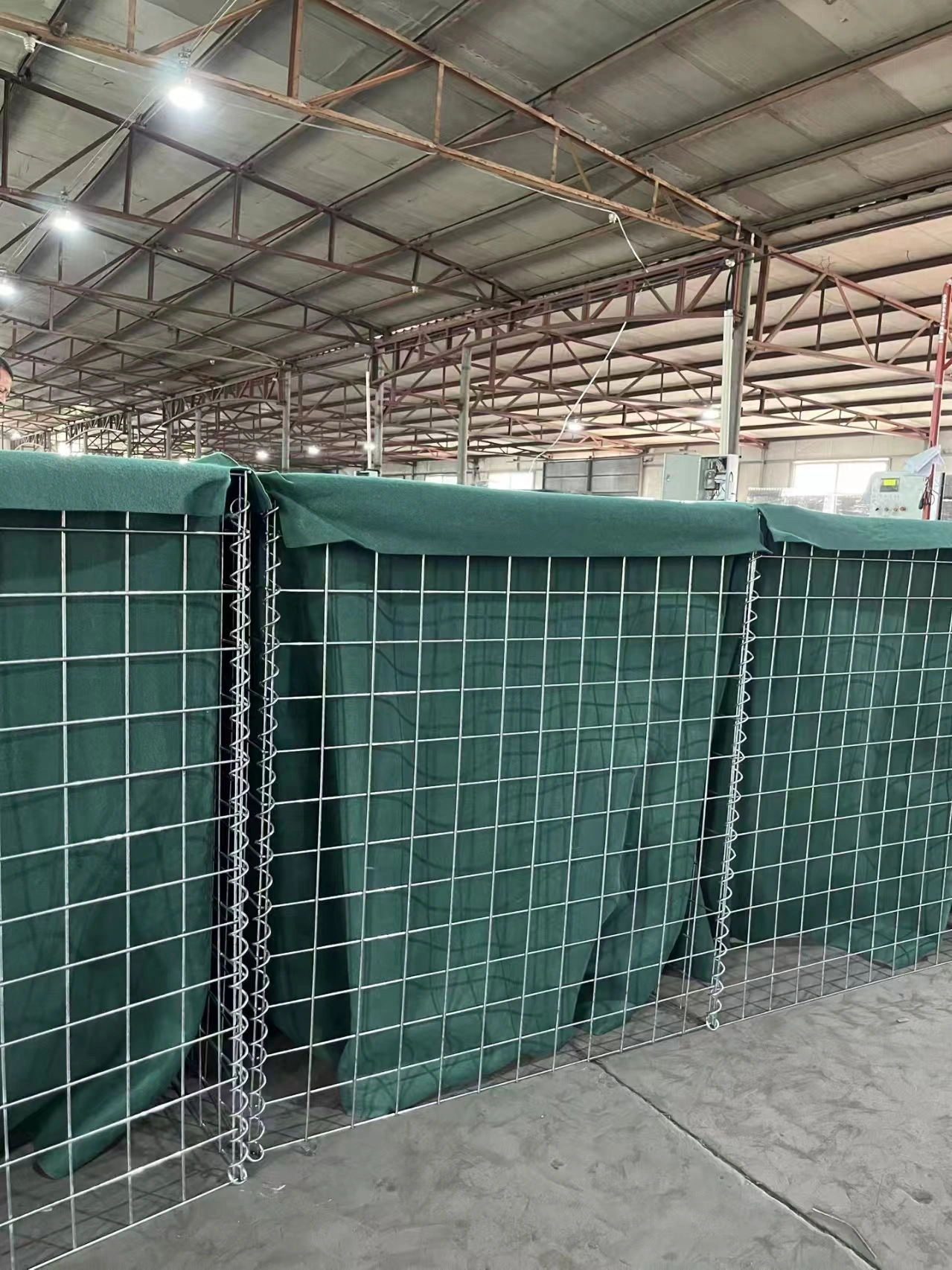
For event procurement coordinators who need flood protection fast, the size range matters. Mil-3 (3-foot height) works for low-risk perimeter sealing. Mil-5 and Mil-7 are the workhorses for the 100m flood walls that event sites and construction projects actually deploy. All three are held in stock, not made-to-order, which cuts lead time to weeks instead of months.
-
- Sizes in stock: Mil-3, Mil-5, Mil-7. Each collapses flat for container shipping — a 40ft HC can hold roughly 600 Mil-5 units. No custom tooling required.
- Australian compliance: Barriers are manufactured to meet AS 4687-2022 structural requirements. The hot-dipped galvanized finish (>42 microns) passes the salt-spray tests specified for temporary water barriers in Australian climate conditions.
- Hidden cost advantage: Unlike sandbags that add $0.30–$0.50 per bag for contaminated waste disposal after a flood event, Hesco barriers reuse the mesh 5+ times. The geotextile liner is replaceable. Your total cost per linear meter drops after the second deployment.
- MOQ and shipping: Minimum order is 100 panels. DB Fencing quotes FOB or CIF within 24 hours. For Australian buyers, shipping from China to Sydney or Melbourne typically takes 18–22 days port-to-port.
When comparing Hesco barriers cost per linear meter, the lifecycle math shifts dramatically if you plan to reuse the system. A Mil-5 barrier at $X per unit (exact pricing depends on volume and liner type) pays for itself by the third use vs sandbags. The compliance documentation — AS 4687 certification, ISO 9001, SGS inspection reports — comes with every order, so your site audit won’t hit a red flag.
Conclusion
Three questions to ask before your next flood control order. Hesco barriers cost more upfront but break even after two uses — and that’s without counting the disposal savings. Sandbags make sense for a single emergency deployment where speed isn’t the bottleneck.
Run this checklist with your supplier: 1) Can you deploy 100m in under 2 hours with your current crew? 2) Does the total lifecycle cost per linear meter drop below sandbags by the third use? 3) Is your disposal site set up to handle contaminated bag waste, or are you paying $0.40 extra per unit? If the answer to any of these favors the other option, adjust your spec. Review the Mil-3 and Mil-5 barrier specs on DB Fencing’s product page to match the right cell height to your expected flood depth.
Frequently Asked Questions
How fast can I deploy Hesco barriers compared to sandbags?
Hesco barriers deploy 8 times faster: a 100m perimeter takes 1 hour with a loader and 2 workers, versus 8 hours with 6 workers for sandbags. This speed advantage is critical. Plan for a loader crew if choosing Hesco for rapid deployment.
What is the cost per linear metre for Hesco vs sandbags?
Sandbags have a lower initial material cost, but after two uses Hesco becomes cheaper due to reusability and reduced labour. Factoring in disposal and storage, Hesco wins on lifecycle cost for. Calculate total cost across expected deployments to see your break-even point.
How do Hesco barriers perform in fast-moving flood water?
Hesco barriers self-weight anchor against currents up to at least 2m/s, while sandbags shift at that speed. Their cellular structure holds fill in place, making them reliable for high-velocity. For sites near rivers or with strong currents, Hesco is the dependable option.
What sizes of Hesco barriers does DB Fencing offer?
We stock Mil-3, Mil-5, and Mil-7 sizes, all compliant with Australian standards for temporary water barriers. Each size corresponds to a specific fill height and footprint, so you can. Contact us to discuss which size fits your flood plan and site constraints.
Are Hesco barriers easier to store than sandbags?
Hesco collapses flat, requiring roughly one-quarter the warehouse space of sandbags for equivalent coverage. This storage advantage reduces warehousing costs and makes pre‑positioning stockpiles more practical. Factor storage savings into your total cost analysis before buying sandbags.