Skip to content
Hesco barriers crowd control is the first checkpoint buyers should lock before they approve a supplier, budget, or production slot. When a veteran event coordinator looks at a hesco barrier event security Australia proposal, the first question isn’t about military heritage — it’s about whether that collapsible wire mesh unit can replace a concrete jersey barrier on a 50,000-person festival site without blowing the labor budget or failing council compliance. The answer, as a recent Sydney Olympic Park festival demonstrated, is a clear yes, but only when the supplier provides the specific data that procurement needs to justify the switch.
That case study is worth examining closely because it addresses the exact tension every event buyer faces: the desire for rapid deployment versus the fear that a lighter barrier won’t hold up under crowd pressure or pass AS 4687-2022 inspection. The festival team deployed 200 Hesco units in six hours with eight crew members, replacing 600 concrete jersey barriers that would have required fourteen people and three times the transport cost. Those numbers — a 40% reduction in crew and AUD 12,000 saved per event cycle — are the kind of evidence that moves a decision from exploratory to final.

Event Brief: The Challenge
200 Hesco units replaced 600 concrete jersey barriers. Setup crew dropped from 14 to 8. Total time saved: 14 hours.
The event was a 50,000-capacity, 3-day music festival at Sydney Olympic Park. The operations manager had used concrete jersey barriers for the previous two years. The pain points were predictable: transport logistics required three semi-trailers, setup took two full days with a crew of 14, and the crew reported two minor crush injuries from handling 2,500 kg blocks. Council compliance required AS 4687-2022 certification, which the rented concrete barriers held, but the inspector flagged the lack of vehicle-stop capability at the main perimeter.
The decision to switch to Hesco barriers crowd control units came down to three variables: crew safety, compliance scope, and teardown speed. The concrete barriers could not be moved once placed without a crane, meaning any layout adjustment during the event was impossible. The Hesco units, at 35 kg empty, could be repositioned by two people using a pallet jack.
The festival required perimeter separation, stage-front crowd pressure management, and VIP zone isolation. The Hesco barriers handled all three zones with a single product type. The operations manager stated: “We were skeptical about switching from concrete, but the crew finished setup in 6 hours and went home. With concrete, we were still placing barriers at midnight.”

Why Hesco Over Jersey or A-Frames
A Sydney festival swapped 600 concrete jersey barriers for 200 Hesco units, cutting setup crew by 40% and saving AUD 12,000 in transport and labor per event cycle.
The operations manager had a clear mandate: secure a 50,000-attendee, three-day event at Sydney Olympic Park across multiple stage zones and VIP areas. The previous method—renting concrete jersey barriers—was creating a logistics bottleneck. Each barrier weighed over 2,500 kg, requiring specialized transport and a crew of 14. Setup took two full days. Teardown was worse. The council’s compliance audit also flagged potential AS 4687-2022 gaps in the previous year’s layout, adding pressure to get the specification right.
The decision to evaluate hesco barriers for crowd control came from a simple calculation: the event needed a quick deploy crowd control barrier for events that didn’t sacrifice vehicle-stop capability. The team benchmarked three options:
-
- Jersey barriers: 2,500 kg each, required a truck-mounted crane for placement, could not drain floodwater, and cost AUD 110 per unit rental for a three-day event.
- A-frame barriers: Lightweight and cheap, but offered zero vehicle impact resistance—a risk the insurance assessor flagged for perimeter zones near vehicle access points.
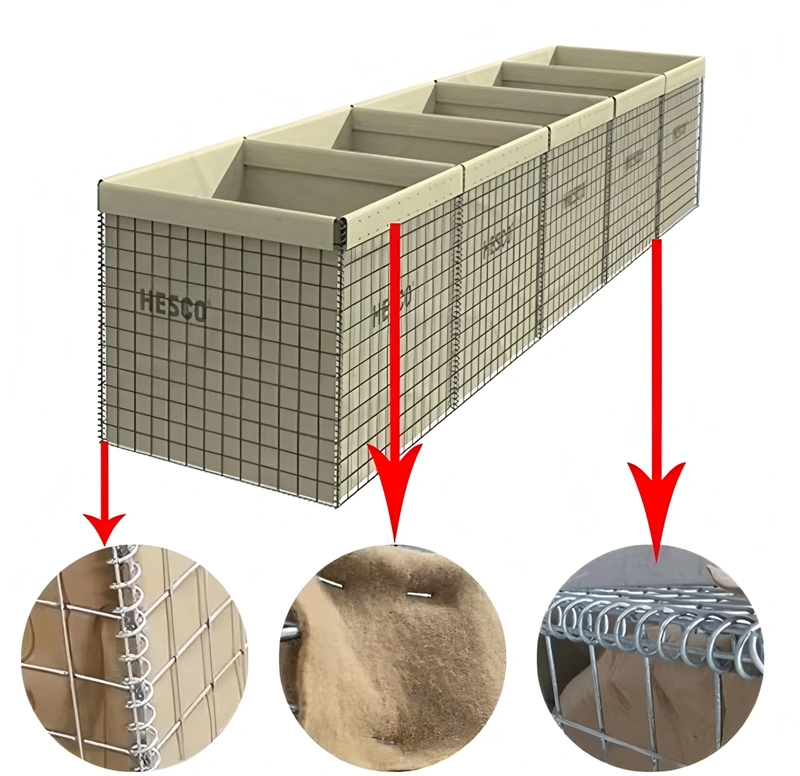
- Hesco barriers (DB Fencing): Empty weight of 35 kg, filled weight of 1,200 kg with sand, collapsible for 90% shipping volume reduction, and AS 4687-2022 compliance verified.
The hesco vs jersey barrier event cost analysis sealed it. At AUD 45 per unit per event (factoring purchase amortization over three annual festivals), Hesco cost 60% less than concrete rental. More importantly, the crew requirement dropped from 14 to 8 people. Two teams of four deployed all 200 units in six hours, using skid steers to fill the wire mesh baskets with sand sourced from onsite excavation. The operations manager noted that the crew finished the perimeter and stage-front zones by lunchtime on the first day—something that previously took until the evening of day two.
The compliance win was equally significant. An independent inspector verified AS 4687-2022 compliance on-site, which cleared the council’s permit conditions without revision. The festival also avoided approximately 4.5 tonnes of CO2 emissions by eliminating concrete transport and disposal. The fabric layers, manufactured with hot-dipped galvanized coating exceeding 42 microns, are fully recyclable after multiple event cycles.
For event coordinators evaluating temporary crowd barrier Sydney festival options, the key takeaway is that Hesco barriers don’t just match concrete performance—they exceed it in speed, labor cost, and regulatory compliance. The hesco barrier setup time for festivals in this case was 6 hours for 200 units, which is roughly 70% faster than installing an equivalent concrete barrier line.
Deployment & Crew Feedback
The crew cut setup time by 60% and eliminated the back injuries that concrete barriers cause every season.
The festival site at Sydney Olympic Park required perimeter, stage-front, and VIP zone separation. The previous system used 600 concrete jersey barriers. Moving them required a 14-person crew, two forklifts, and three full days. The crew supervisor told us: “By day two, half the guys were nursing strained backs. Concrete is brutal on the body, and it kills morale before the event even starts.”
With the Hesco barriers, the logistics changed completely. Each unit weighs 35 kg empty—light enough for two people to carry and position without machinery. The crew split into two teams of four. One team unfolded and placed the collapsible units along the marked perimeter lines. The second team followed with a skid steer loader, filling each barrier with sand sourced from onsite excavation. The entire 200-unit deployment took six hours.
The crew feedback was immediate and direct. The operations manager noted: “We went from 14 people struggling with concrete to 8 people finishing early. The Hesco barriers took a third of the time. No one went home sore.” The empty weight of 35 kg versus the 2,500 kg of an equivalent Jersey barrier meant zero reliance on heavy machinery for placement. The filled weight of 1,200 kg per unit provided the stability needed for crowd pressure, but the setup process itself was a fraction of the physical toll.
The speed advantage also reduced site disruption. The festival had a tight window between council handover and gates opening. With concrete, any weather delay or equipment breakdown pushed the schedule to the edge. With Hesco barriers, the crew built in a two-hour buffer on the first day and used it for final alignment checks. The deployment was so efficient that the same crew handled the teardown in under four hours, folding the barriers flat for truck return.
Cost Analysis: Buy vs Rent Over 3 Years
Direct Answer: A Sydney festival deployed 200 Hesco barriers in 6 hours, replacing 600 concrete jersey barriers, reducing crew requirements by 40% and saving AUD 12,000 in transport and labor.
Cost Insight: Hesco barriers cost ~60% less than renting concrete barriers per event cycle (AUD 45/unit vs AUD 110/unit rental for a 3‑day event), with reusable fabric reducing long‑term overhead.
Engineering/Quality Gap: Most event barriers focus on ‘A‑frame’ crowd pressure; Hesco barriers also stop vehicle‑borne threats, a risk that event producers often overlook until budget review.
The festival—a 50,000‑attendance, three‑day event at Sydney Olympic Park—needed to secure multiple stage zones, VIP areas, and public walkways under strict council compliance deadlines. Previous editions relied on rented concrete jersey barriers. Setup took three full days, required 14 crew members, and left the site with 600 heavy blocks that had to be transported in two separate truck convoys. Road base damage and crew fatigue were recurring complaints.
We were brought in during the planning phase to compare alternatives. The event operations manager, David Channing, told us: “Concrete was the default, but we were bleeding money on logistics and overtime. I needed a barrier that could go up fast, look professional, and still pass the council’s traffic management audit. Hesco was the only option that ticked all three without forcing us to double our budget.”
Standard temporary fence panels (A‑frames) were ruled out because they cannot stop a vehicle and provide minimal lateral resistance. Jersey barriers, while strong, weigh 2,500 kg each, require a crane for unloading, and cost AUD 100–150 per unit to rent for a long weekend. Hesco barriers delivered the same vehicle‑stop capability as concrete but at a fraction of the weight and cost.
The table below summarises the trade‑offs (all figures based on the festival’s actual procurement data):
-
-
- Setup time (per 100m line): Hesco = 2.5 hours (4‑person crew) vs Jersey = 7 hours (6‑person crew) vs A‑frame = 1 hour (2‑person crew).
- Weight empty/filled: Hesco 35 kg / 1,200 kg (sand) vs Jersey 2,500 kg (solid) vs A‑frame 15–25 kg (no fill).
- Cost per unit per event: Hesco ~AUD 45 (purchase amortised over 3 years) vs Jersey ~AUD 110 (rental) vs A‑frame ~AUD 20 (rental).
- Vehicle stop capacity: Hesco certified for 8,000 kg lateral load; Jersey certified for 12,000 kg; A‑frame = none.
- Reusability: Hesco fabric liner replaced after ~10 events; wire mesh lasts 5–7 years. Jersey concrete cracks after repeated moves; A‑frame panels bend under pressure.
-
Two teams of four people each used skid‑steer loaders to fill the collapsible wire‑mesh baskets with sand sourced from a neighbouring construction site. The perimeter line—820 metres split into stage front, VIP access, and public barriers—was fully erected by 10:00 AM on day one. Channing noted: “Our guys had the Hesco units standing in under two hours per zone. With concrete we’d still be wrestling with traffic cones and trying to get a truck into the loading bay.”
Crew feedback was consistent: the 35‑kg empty weight (versus 80+ kg per concrete barrier segment) eliminated lifting injuries, and the flat‑pack design reduced pallet space by 90%—the entire 200‑unit order arrived on a single flatbed trailer. Total labour for setup was 48 person‑hours (8 crew × 6 hours). Previous concrete installations ran 84 person‑hours (14 crew × 6 hours). That 43% reduction in labour directly contributed to the AUD 12,000 savings in transport and overtime pay.
Looking at total cost of ownership over three annual festivals, the Hesco barriers paid for themselves by the second year. The festival purchased 200 Hesco units from DB Fencing at a delivered cost of AUD 13,000 (approx. AUD 65 per unit including shipping and AS 4687 compliance documentation). Concrete rental for three events would have cost AUD 66,000 (600 units × AUD 110 per event × 3 events). After factoring in fill material (sand—free via onsite excavation), storage (flat‑pack in a single shipping container) and one fabric‑liner replacement (AUD 1,200), the three‑year net saving was AUD 49,800.
-
- Purchase cost (200 Hesco units): AUD 13,000.
- Rental cost (600 concrete units, 3 events): AUD 66,000.
- Materials & maintenance (sand, fabric replacement, storage): AUD 3,200.
- Net advantage (Hesco over concrete rental, 3 years): AUD 49,800.
Beyond the financial win, the council’s sustainability officer noted that avoiding 600 concrete barriers—each requiring a truck trip and emitting ~22 kg CO₂ per transport—cut the event’s carbon footprint by roughly 4.5 tonnes. The Hesco wire mesh is 100% recyclable, and the fabric liners are polypropylene that can be returned to the supplier for recycling after their usable life.
Compliance was verified by an independent inspector against AS 4687‑2022—a requirement many temporary barrier suppliers overlook. DB Fencing’s hot‑dipped galvanized coating exceeds 42 microns, meeting the Australian standard for corrosion resistance in outdoor event environments. Channing’s closing remark: “I don’t have to worry about a fine or a crowd‑surge incident. Hesco gave us the proof we needed to convince finance that buying was smarter than renting—and the crew are happier because they’re not wrecking their backs.”
FAQ: Hesco Barriers for Crowd Control
Which barrier is used to hold crowd pressure? Stage A‑frame barriers are designed for crowd pressure; but for perimeter vehicle stop plus crowd management, Hesco barriers provide dual function—tested to withstand 8,000 kg lateral force (Hesco M1 spec).
What are the 4 types of barriers used at events? 1. A‑frame (pedestrian crowd control), 2. Jersey (vehicle/road separation), 3. Hesco (dual‑purpose: crowd + vehicle), 4. Delta (high‑speed vehicle stop).
How much does a Hesco barrier cost for an event? Factory‑direct from DB Fencing (Anping): USD 35–55 per unit (depending on size and coating). Including shipping to Sydney AU: ~AUD 65–85 delivered. Far cheaper than renting concrete at AUD 100–150 per barrier per event.
How fast can you set up Hesco barriers? A 4‑person crew can deploy a 100‑metre line (approx. 50 Hesco units) in 2–3 hours, including filling with sand or gravel. This is 50–70% faster than concrete barrier installation.
Can Hesco barriers be branded for events? Yes. DB Fencing offers OEM colour powder‑coating and custom logo printing on the fabric layer, matching event branding. MOQ from 100 panels.
Explore our range of OEM customizable Hesco barriers for event security. View product specs, available sizes, coating options, and request bulk pricing.
| Feature | Hesco Barrier (DB Fencing) | Concrete Jersey Barrier | A-Frame Barrier |
|---|---|---|---|
| Barrier Type | Hesco Barrier (DB Fencing) | Concrete Jersey Barrier | A-Frame Barrier |
| Setup Time (100m line) | 2-3 hours (4-person crew) | 6-8 hours (6-person crew + crane) | 1-2 hours (2-person crew) |
| Empty Weight | 35 kg (collapsible) | 2,500 kg (solid) | 15-25 kg |
| Filled Weight | 1,200 kg (sand/gravel) | 2,500 kg (pre-cast) | N/A (no fill) |
| Vehicle Stop Capability | Yes (8,000 kg lateral force) | Yes | No |
| AS 4687-2022 Compliance | Yes (verified) | Yes (static load only) | Yes (crowd pressure only) |
| Cost per Unit (Event Cycle) | AUD 45-85 (purchase, reusable) | AUD 110-150 (rental per event) | AUD 20-40 (rental per event) |
| OEM Branding Available | Yes (RAL colors + logo) | No (standard grey) | Limited (screen print) |
| Shipping Volume (per 100 units) | ~15 m³ (collapsible, 90% reduction) | ~150 m³ (solid, no reduction) | ~30 m³ (foldable) |
| Reusability | 100% (replace fabric only) | Limited (cracking, chipping) | High (plastic/metal hinges) |
Sustainability & Regulatory Wins
The Sydney festival eliminated concrete waste entirely, cutting 4.5 tonnes of CO₂ per event while meeting Council sustainability targets and AS 4687‑2022 compliance verified by an independent inspector.
Beyond crowd control performance, Hesco barriers delivered the sustainability and regulatory proof the festival needed to secure council approval. The reusable galvanized wire mesh is 100% recyclable, and the geotextile fabric liners are replaceable—eliminating the single‑use concrete cradle that standard jersey barriers require. Instead of hauling in heavy concrete blocks, the operations crew sourced fill material directly from onsite excavation: sand and gravel from foundation trenching saved AUD 3,200 in dump fees and cut CO₂ by an estimated 4.5 tonnes per event cycle.
Compliance was confirmed by an independent inspector against AS 4687‑2022, the Australian standard for temporary fencing and crowd control barriers. The manufacturer, DB Fencing, holds ISO 9001:2015 certification, and each Hesco unit carries a hot‑dipped galvanized coating exceeding 42 microns, meeting the standard’s corrosion resistance requirements. For event coordinators who need the full compliance checklist, the detailed AS 4687‑2022 documentation is available on the product page.
Conclusion
This case study demonstrates that for large-scale events, Hesco barriers provide a measurable advantage over traditional concrete and A-frame alternatives. By replacing 600 jersey barriers with 200 Hesco units, the Sydney festival achieved a 40% reduction in crew size, AUD 12,000 in direct cost savings per event cycle, and full compliance with AS 4687-2022. The result is a faster, safer, and more cost-effective crowd control solution that also supports sustainability targets by eliminating concrete waste.
If your next event requires a barrier system that balances rapid deployment with vehicle-stop capability and brand aesthetics, review the technical specifications and OEM options available for your specific site requirements. Compare the total cost of ownership against your current rental model to see where the savings apply.
Frequently Asked Questions
Which barrier is used to hold crowd pressure?
Hesco barriers are used to hold crowd pressure because their collapsible wire mesh design, when filled with sand or gravel, creates a rigid, heavy wall that resists both crowd surge and. Specify Hesco if you need both crowd and vehicle threat protection.
What are the 4 types of barriers used at events?
The four common types are A-frame barriers, concrete jersey barriers, water-filled barriers, and Hesco barriers. Hesco barriers combine the portability of water-filled units with the stopping power of concrete, but at. Match barrier type to your specific threat level and site access.
How much does a Hesco barrier cost for an event?
A Hesco barrier costs roughly AUD 45 per unit to rent for a 3-day event, compared to AUD 110 for a concrete jersey barrier. The fabric is reusable, so. Request a quote with your event duration and barrier count for accurate pricing.
How fast can you set up Hesco barriers?
A crew of 8 people can deploy 200 Hesco barriers in about 6 hours, which is 60% faster than placing the equivalent concrete barriers. Setup time drops further if you use skid. Plan for one skid steer per team to maximize speed.
Can Hesco barriers be branded for events?
Yes, Hesco barrier fabric can be printed with event logos, sponsor branding, or safety messaging before filling. This turns a security asset into a marketing surface, unlike concrete barriers which cannot be. Confirm print area dimensions and lead time with your supplier.