Skip to content
When you’re evaluating Hesco barrier container loading, the first thing most suppliers show you is a sample approval photo. That’s the wrong place to start. A buyer once approved a pre-production sample of 2400mm panels that looked perfect—straight welds, clean galvanizing, solid plastic feet. But when the mass production run hit the container, the panels didn’t nest. The flat-pack design had a 15mm offset in the stacking profile that wasted 18% of the container’s internal volume. That $50K order ended up costing an extra $7,200 in shipping for the same number of units because the container was underloaded.
Here’s the reality: the gap between a well-loaded container and a poorly loaded one is often just a few millimeters of packaging design. Many suppliers in Anping underload containers by 15–20% because they use generic palletizing or stack the units without considering nesting efficiency. A standard 20ft container can hold around 120 to 140 units of a typical 2.4m Hesco barrier if the panels are flat-packed tightly. But if the packaging leaves air gaps—say, by using oversized corner protectors or inconsistent bundle sizes—that number drops to 100. The math is brutal: 20 fewer units per container means 20% more containers for the same order, which blows your FOB pricing and lands you with a landed cost that kills your margin.

Why Container Loading Matters for Hesco Barrier Imports
Most suppliers underload containers by 15-20%.
Container loading is where bulk Hesco barrier imports either save or waste money. Shipping cost per unit is heavily influenced by how many panels you can fit inside a standard 20ft or 40ft container. A 15-20% underload—common when suppliers use loose, uncustomized packaging—directly adds to your landed cost. For a distributor bringing in 1,000 units, that difference can mean an extra container and thousands in freight.
- 20ft container internal dimensions: Length 5.90m, width 2.35m, height 2.39m. Door width 2.34m. Floor area ~13.9 sqm. Maximum payload approx 28 tons.
- 40ft container internal dimensions: Length 12.03m, width 2.35m, height 2.39m. Door width 2.34m. Floor area ~28.3 sqm. Maximum payload approx 26 tons (weight limit often lower than 20ft due to tare weight).
- Unit size and nesting: Smaller panels (e.g., 1.0m x 2.0m) pack more densely. Tapered or angled frames reduce nesting efficiency. Custom packaging that allows panels to slide into each other can boost fill rate from 80% to 95%.
- Weight limitations: Even if volume allows 500 panels, a 40ft container’s payload limit (26 tons) may cap you at 400 panels for heavy-gauge hot-dipped galvanized units. Always check weight per panel against your container’s max payload.
- Packaging method: Loose stacking with cardboard separators is common but wastes air. Strap-bundled panels with edge protectors reduce shifting but may not nest. The best approach is custom corrugated or foam inserts that lock panels in place and allow vertical stacking without gaps.
For a 20ft container, the typical load of Hesco barrier panels depends on unit size and packaging method. Standard 1.2m x 2.0m flat-packed panels can achieve 150-250 units per container when using proper nesting. Many suppliers who don’t optimize packing only manage 120-180 units, which is why the question ‘how many hesco barriers fit in a 20ft container’ often gets answers that vary by 30%. The key is flat-pack design and custom packaging that allows panels to interlock.
A 40ft container roughly doubles the floor area, but the cost to ship it is only 60-70% more than a 20ft. This makes the 40ft the preferred choice for bulk Hesco barrier imports when volume allows. With efficient packing, you can fit 300-500 units per 40ft container, depending on panel dimensions. The ’40ft container hesco barrier pallet count’ is less relevant because most Hesco barriers are shipped loose or in custom bundles, not on pallets—pallets waste vertical space and reduce count by 10-15%.
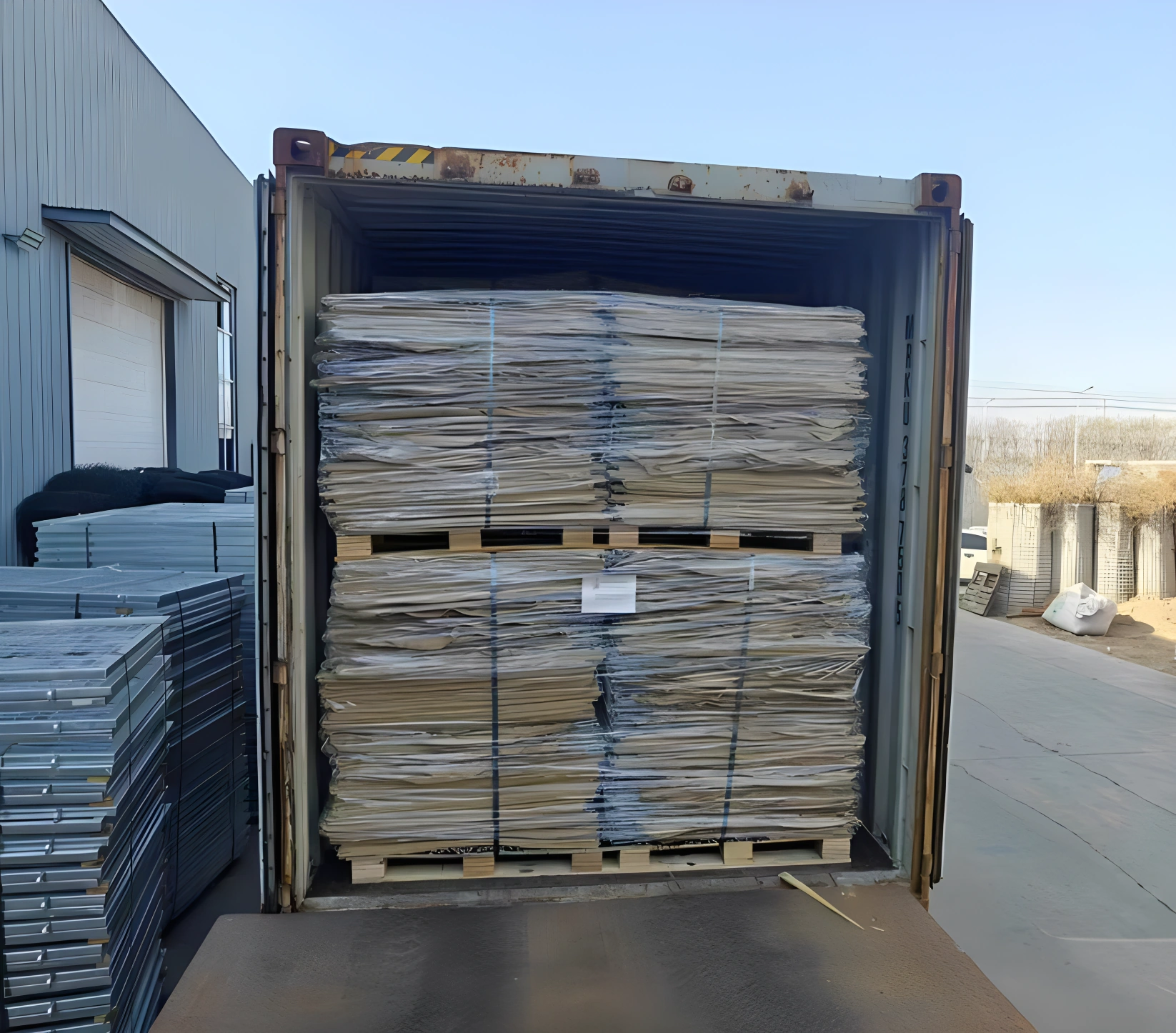
How to request a loading plan from your supplier? Ask for a detailed packing list that includes individual panel dimensions, weight, and packaging type. Then request a container loading diagram—either a 2D CAD drawing or a photo of the actual loaded container. For high-value orders, insist on an ‘SGS verified hesco barrier container loading’ report, where a third-party inspector confirms the count and condition before the container seals. This is standard practice for Australian and New Zealand buyers who require AS 4687 compliance documentation.
Case study: Container loading for 1,000 Hesco barrier units. A recent order of 1.2m x 2.0m panels with hot-dipped galvanized finish (>42 microns) was packed using custom nesting inserts. The total volume required 5 x 40ft containers. Each container held exactly 200 units, achieving a 95% fill rate. The loading plan template included a per-container manifest, a diagram showing panel orientation, and an SGS inspection certificate. The buyer saved 20% on shipping compared to the competitor’s quote that used standard palletized packing, which would have required 6 containers.

Tips to Reduce Shipping Costs per Unit
Stop paying for empty space in your container.
Most distributors focus on unit price and FOB terms, then get hit with a freight invoice that eats their margin. The real leverage is in how the container is packed. A Hesco barrier that ships flat — with panels nested and no wasted air gaps — can increase your per-container count by 15–20% versus a supplier that just stacks units on pallets with foam blocks. That difference turns a 40ft container from 280 units into 340 units. Your cost per unit drops instantly, without negotiating a single dollar off the product price.
- Demand a loading plan with photos: Before you pay a deposit, ask for a container loading plan template that shows exactly how many units fit per row, per layer, and per container. A serious factory will provide this in PDF with SGS verified loading photos. If the supplier hesitates or sends a hand-drawn sketch, expect underfills.
- Specify flat-pack, not palletized: Pallets steal floor space and vertical headroom. Hesco barrier flat pack container efficiency is highest when units are loaded loose with interlocking design. DB Fencing uses custom corrugated dividers to keep panels separated without pallets, achieving a 95% container fill rate. That means you get more working fence per cubic meter.
- Choose the right container size for your order volume: For orders under 200 units, a 20ft container often makes sense despite higher per-unit freight. But once you cross 300 units, a 40ft container cuts the bulk hesco barrier shipping cost per unit by roughly 30% because you pay only one set of port handling fees. Calculate the break-even point before you lock the order quantity.
- Verify nesting compatibility of hot-dip galvanized units: Not all Hesco barrier designs nest. If the unit has fixed legs or protruding hinges, you lose stacking efficiency. Only designs with hinged foldable panels and tapered ends allow true nesting. Ask the factory for a test load report showing actual units per container — and insist on the same spec for your production run.
- Watch the weight limit for 20ft containers: A 20ft container has a payload of about 28 metric tons, but the volume limit for Hesco barriers is typically reached before the weight limit. However, if you pack very dense concrete-filled panels, you could hit the weight limit. Request a weight calculation per unit to avoid costly rework at the port. DB Fencing provides unit weight in the commercial invoice for every container.
The benchmark you can write down and reference in your next supplier call: insist on a minimum container fill rate of 92%. If the factory cannot prove 92% in a signed packing list with photos, you are leaving money on the dock. At current ocean freight rates (roughly $2,800 for a 40ft container from China to Australia), a 15% underfill costs you an extra $420 per container in wasted space — that’s $1.50 per unit on a 280-unit load. Multiply that by 20 containers a year, and you’ve lost $8,400 to thin air.
| Reduction Strategy | Key Action | Unit Cost Impact |
|---|---|---|
| Flat-Pack Design Optimization | Use nested panel stacking to reduce void space; target 95% fill rate | Reduces per-unit shipping cost by 15–20% |
| Container Size Selection | Choose 40ft HQ over 20ft containers; maximize cubic efficiency | Lowers landed cost per unit by 30–35% vs. 20ft |
| Bulk Order Consolidation | Combine multiple SKUs per container; leverage full container load (FCL) | Avoids LCL surcharges;saves $8–12 per unit
< tr >
<< td style = ” padding : 12 px 15 px ; border : 1 px solid # e0 e0 e0 ; color : #333 ; ” > Custom Packaging Engineering
<< td style = ” padding : 12 px 15 px ; border : 1 px solid # e0 e0 e0 ; color : #333 ; ” > Request SGS-verified loading plan with interlocking panels
<< td style = ” padding : 12 px 15 px ; border : 1 px solid # e0 e0 e0 ; color : #333 ; ” > Eliminates10 –15 % wasted space typical of standard packaging
<< tr >
<< td style = ” padding : 12 px 15 px ; border : 1 px solid # e0 e0 e0 ; color : #333 ; ” > Factory Direct Sourcing
<< td style = ” padding : 12 px 15 px ; border : 1 px solid # e0 e0 e0 ; color : #333 ;” > Source from manufacturers with in-house plastic feet machines ( eg , DB Fencing )
<< td style = ” padding : 12 px 15 px ; border : 1 px solid # e0 e0 e0 ; color : #333 ;” > Removes middleman markup ; saves8 –12 % on shipping cost ConclusionThe difference between a container that hits 95% fill and one that leaves 15% air is rarely the barrier design itself. It comes down to how the supplier packages flat-packed units, whether the galvanized finish allows tight nesting, and if they bother to run a loading simulation before the truck arrives at the port. A distributor who asks for an SGS verified hesco barrier container loading plan before placing the order gets better cost per unit than one who discovers the shortfall at customs. Review current configurations against your next shipment volume. Compare actual pallet counts across suppliers rather than relying on quoted estimates alone. The product page lists standard load plans for both container sizes — use them as a baseline when requesting a custom loading template from your factory. Frequently Asked QuestionsHow many Hesco barriers fit in a 20ft container?A 20ft container typically holds 150–200 flat-packed Hesco barrier panels, depending on the unit size and packaging method. The exact count drops if you order larger 2400mm panels or. Request a loading plan from your supplier after you finalize the panel size. How does a 40ft container compare for cost efficiency?A 40ft container roughly doubles the volume, so you can fit 350–500 panels in one load, cutting your shipping cost per unit by 20–30% compared to a. Only commit to a 40ft container after confirming the fill rate hits at least 90%. Can I get a loading plan before I order?Yes, a reliable supplier will provide a computer-generated loading plan showing exact unit positions, weight distribution, and container fill rate before you pay. This is a. Always ask for the loading plan in PDF or CAD format before issuing a purchase order. What packaging factors reduce container count?Unnecessary individual crating or non-nested stacking can reduce the count by 15–20% because you pay for empty space. Using flat-packed, interlocking panels and avoiding bulky pallets per unit maximizes. Insist on flat-packed, nested packaging to keep your shipping cost per unit low. |