Skip to content
event fence panels is the first checkpoint buyers should lock before they approve a supplier, budget, or production slot. An event fence panel is the piece of gear that either makes your weekend run smoothly or turns into a visible headache by Saturday afternoon. For an Event Management Procurement Coordinator, the decision isn’t just about buying a barrier. It’s about managing three things simultaneously: safety liability, setup speed, and whether the fence makes the client’s event look professional or slapped together. You’re balancing the fear of a lawsuit against a setup window that rarely gives you more than four hours.
Most guides treat crowd control barriers as a commodity. They compare rental prices, talk about colors, and stop there. But the real gap is in the manufacturing specs that determine whether a panel survives three seasons of outdoor festivals or starts rusting after one rainy weekend. A 3.0mm wire gauge with hot-dipped galvanization at 42 microns isn’t just a spec sheet line. It’s the difference between a panel that holds up under wind load and one that buckles when the crowd surges. That’s the kind of detail that keeps your safety incident count at zero.

Crowd Control Barrier Standards
Steel panels outperform plastic belts in every metric that matters for crowd control.
For high-density events like music festivals or political rallies, plastic belt barriers are a liability. A crowd surge can snap the webbing or buckle the belt, creating a gap that becomes an uncontrolled exit point. Steel welded mesh panels, by contrast, distribute load across the entire frame. The standard commercial spec is a 6-foot (1.8m) panel with a wire gauge of 3.0mm to 3.5mm. Drop to 2.5mm and you risk panel deformation under lateral pressure from a crowd leaning or pushing.
Height is your first line of defense. 6-foot panels contain a standing person’s reach — they cannot easily hook a foot or hand over the top. For higher-risk perimeters or VIP zones, step up to 8-foot (2.4m) panels. The mesh aperture must be small enough to defeat finger and toe holds: a 50mm x 50mm or 50mm x 100mm grid is standard. Any opening larger than 150mm becomes a climbing ladder.
-
- Anti-Climb Mesh: A tight mesh (e.g., 25mm x 25mm) or a solid sheet insert at the bottom 600mm blocks foot holds and prevents visual distraction. Opaque panels also block external sight lines, keeping crowd focus inside the venue — a psychological control layer most guides ignore.
- Galvanization Floor: Bare steel rusts. The spec is hot-dipped galvanization >42 microns. This is not optional for outdoor events or multi-use inventory. Powder coating over the galvanized base allows brand color matching without sacrificing corrosion protection — see ‘Galvanised vs Powder Coated Fence Panels‘ for the full breakdown.
- Base and Bracing: The panel is only as strong as its feet. Plastic feet fill with water or sand for weight. For wind-prone sites, add diagonal bracing or interlock feet. A 4-person crew can set 500 linear feet in 1-2 hours — but only if the base system is designed for speed, not struggle.
Rapid Event Fence Deployment
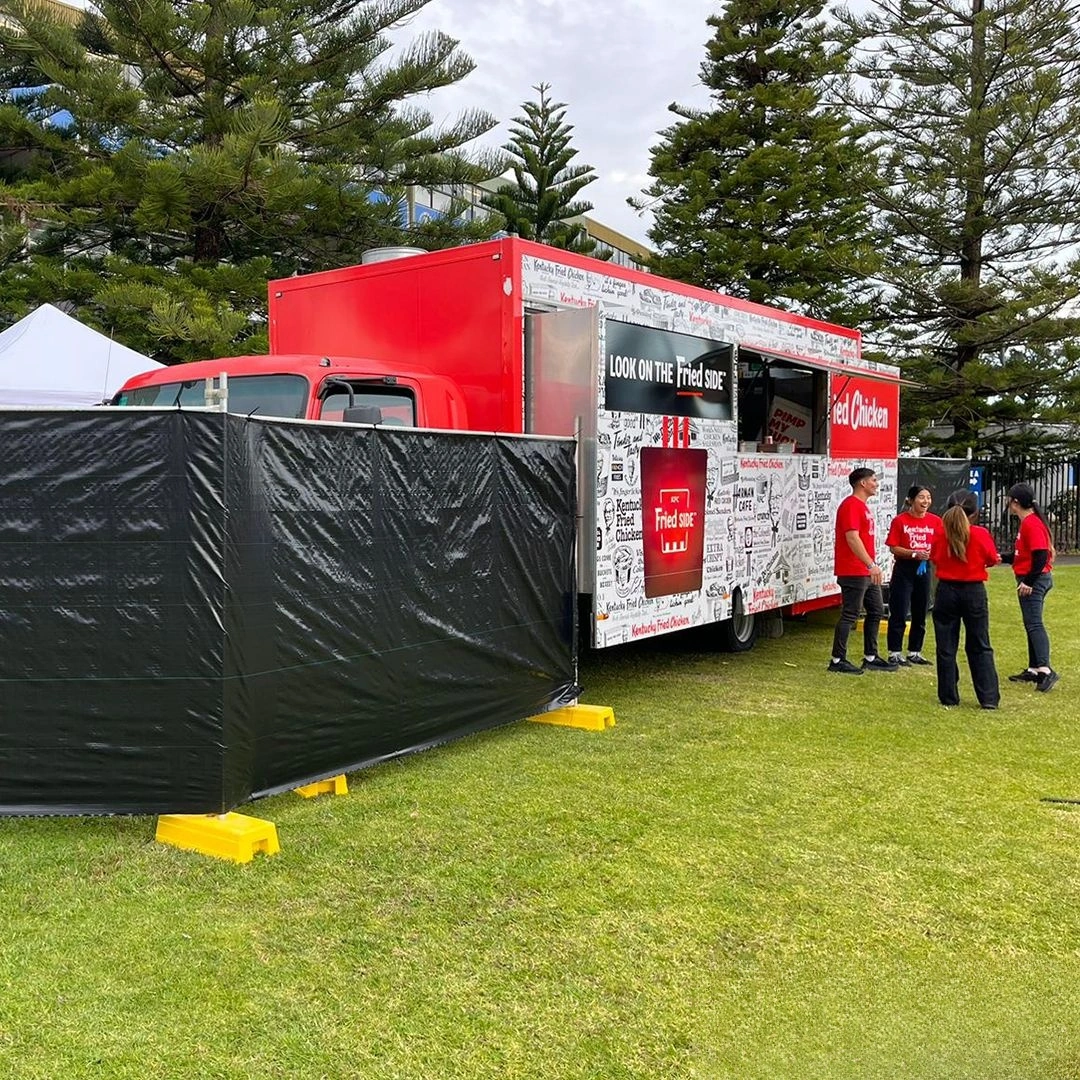
Setup 500 ft of event fencing in 1–2 hours with a 4-person crew — chain-link takes a full shift.
The difference between a bolt-together panel system and traditional chain-link is measured in hours, not days. For a 500-foot run, a crew of four can have heavy-duty commercial event fence panels fully installed in 60 to 120 minutes. That same perimeter with chain-link requires stretching, tensioning, and tying — typically 6 to 8 hours for the same crew. When your event window is tight and labor costs are fixed, that time savings directly protects your margin.
-
- Setup time (500 ft): 1–2 hours with 4-person crew for panel systems vs. 6–8 hours for chain-link.
- Panel weight: Standard 6 ft x 8 ft steel panel weighs approximately 18–22 kg. Light enough for two workers to carry, heavy enough to stay planted without concrete feet.
- Base feet choice: Plastic feet (UV-stabilized PE) weigh 4–5 kg each and are sufficient for most event conditions. Concrete feet add stability in high wind but increase weight to 18–20 kg per block, slowing setup and raising freight costs. For multi-day festivals on grass, plastic feet with optional bracing handles 95% of scenarios.
- Modular reconfiguration: Bolt-together panels can be repositioned in under 15 minutes per 100 ft section. When crowd flow shifts — say a bottleneck forms near the main stage — you don’t tear down and rebuild. You unbolt, slide, and re-pin. That agility is impossible with chain-link.
One detail most guides skip: the connection hardware. Cheap panels use thin-gauge couplers that bend after three setups. A proper system uses forged steel clamps with a minimum 4 mm wall thickness. If your supplier can’t show you the clamp spec, you’re buying a future headache. We’ve seen event coordinators lose 40 minutes on a single gate section because a coupler stripped mid-install. That’s not a weather delay — that’s a design failure.
For a real-world example of how these metrics translate on a tight deadline, see the case study on rapid fence deployment for a Sydney civil site, where a 1,200-panel perimeter was fully installed in under four hours.
Event Fencing Rental Economics
Rentals hide a 30-40% premium over owning panels outright.
Every event coordinator has run the numbers: rent for $12 per panel per week or buy at $45 and own it. The math flips hard once you run more than four events a year. A commercial-grade panel built with 3.0mm wire and hot-dipped galvanization (>42 microns) carries a service life of 10–15 years in outdoor rotation. Rental companies depreciate the same panel in 3–5 years because they buy the cheapest spec — typically 2.5mm wire with a thin zinc wash — and pass the replacement cost to you through damage fees.
The damage fee trap is the real budget killer. Rental contracts routinely charge $35–$60 per bent panel and $15–$25 per cracked plastic foot. A single truck unloading incident can wipe out your entire rental budget for the season. When you own the inventory, a bent panel goes back to your yard for straightening, not to the rental company’s invoice desk.
-
- Ownership break-even: At 6 events per year with 500 panels each, buying at factory-direct pricing (approx. $45/panel) breaks even against rental ($12/panel/week) in under 18 months. After that, every event is pure margin.
- Rental hidden costs: Delivery surcharges, weekend pickup fees, and mandatory on-site damage waivers add 22–35% to the base rental rate. A quote that reads $12/panel often lands at $16–$17/panel after add-ons.
- Lifespan advantage: Factory-direct panels with 3.0mm wire and >42 micron galvanization survive 10–15 years of seasonal use. Rental-grade panels (2.5mm wire, light galvanization) typically fail structurally by year 5.
Procurement coordinators pitching a buy decision to leadership need hard numbers. Use this: a 1,000-panel inventory purchased at factory-direct pricing saves approximately $28,000 per event versus renting, assuming a 5-day event window. Over a 10-year panel lifespan with 6 events per year, that’s $1.68 million in avoided rental costs — minus the initial $45,000 purchase. The business case writes itself.
Crowd Management Safety Compliance
A single crowd surge lawsuit can cost more than 10,000 panels.
Safety compliance in public gatherings isn’t a checkbox exercise — it’s liability math. For event management procurement coordinators, the calculus is simple: one structural failure under crowd load can trigger lawsuits, regulatory fines, and irreparable brand damage. Your KPI of zero safety incidents depends entirely on the engineering integrity of your crowd control barriers.
The non-negotiable baseline is structural integrity under pressure. Steel event fence panels must withstand lateral crowd loads without buckling. Industry standard for high-traffic festival zones is 3.0mm to 3.5mm wire gauge — anything thinner risks deformation when a crowd surges against the barrier. The frame itself should be hot-dipped galvanized to >42 microns to prevent corrosion that weakens welds over time, especially for inventory stored outdoors between events.
-
- Wind load resistance: Open-air event fencing must handle wind gusts without toppling. Standard 6-foot panels require bracing or sandbag weights at intervals no greater than 10 feet. In high-wind regions (coastal festivals, stadium rooftops), specify panels with reinforced feet slots for additional ballast attachment.
- Anti-climb design: Opaque mesh panels (typically 50mm x 100mm aperture) prevent footholds and reduce crowd psychology risks — external distractions are blocked, and unauthorized entry is physically deterred. This is not optional for events serving alcohol or hosting minors.
- Certification verification: Request AS 4687-2022/2007 compliance documentation, ISO 9001 factory certification, and SGS third-party load test reports. A supplier who cannot provide these on request is a liability you cannot afford.
- Setup speed: A 4-person crew can deploy 500 feet of bolt-together panel fencing in 1-2 hours. Compare this to chain-link installation (6-8 hours for equivalent length). Faster setup reduces labor costs and minimizes exposure time for your crew.
Procurement coordinators should add one more item to their supplier verification checklist: ask for the wire gauge measurement from a random sample panel, not just a spec sheet. The difference between 2.5mm and 3.0mm wire is invisible to the naked eye but means a 44% increase in cross-sectional steel strength. If a supplier quotes 30% below market, they are almost certainly cutting wire gauge or galvanization thickness — request caliper verification photos before committing to a bulk order.

Optimizing Fence Container Loading
Panel dimensions directly determine your per-unit freight cost—optimize them or lose margin.
Most procurement coordinators focus on unit price and miss the single largest variable in total landed cost: container utilization. A 40HQ container has a usable internal volume of roughly 2,350 cubic feet. Standard 8ft x 6ft event panels, if stacked efficiently with interlocking frames, yield approximately 2,200 panels per container. Change the panel height to 7ft and that number drops to about 1,900—a 14% reduction in units shipped for the same freight cost. That difference directly erodes your margin per panel.
The math is straightforward. Ocean freight from China to Australia or North America runs roughly $4,000–$6,000 per 40HQ as of early 2026. At 2,200 panels, that’s about $2.27 per panel in freight. At 1,900 panels, it jumps to $2.63—an extra $0.36 per panel that you either absorb or pass to your customer. For a 10,000-panel order, that’s $3,600 in unnecessary cost. The solution is to standardize on a panel dimension that maximizes stacking density. DB Fencing’s standard 8ft x 6ft panel with flat-profile mesh achieves 2,200 panels per 40HQ because the frames nest with minimal air gap. Non-standard heights or protruding feet designs waste space.
-
- Container type: 40HQ (40-foot High Cube) is the standard for fence panels. A 20GP container holds roughly 900–1,000 panels but freight cost per panel is 40–50% higher.
- Panel dimension impact: 8ft x 6ft panels yield ~2,200 units per 40HQ. 8ft x 7ft panels yield ~1,900 units. 8ft x 8ft panels yield ~1,700 units. Always request a loading plan from your supplier before confirming dimensions.
- Loading method: Flat-stacked panels with interleaved plastic sheets prevent scratching and allow vertical stacking up to the container roof. Panels with welded-on feet or protruding hinges reduce stack height by 15–20%.
- Freight negotiation lever: Ask your manufacturer for a ‘per-panel freight cost’ breakdown. If they cannot provide a loading plan with exact unit counts, that is a red flag. A factory that ships 2,000+ sets per week, like DB Fencing, can offer verified loading data because they ship containers daily.
For a deeper breakdown of 20-foot container loading and how to calculate your own freight-per-unit, refer to the detailed guide: ’20-Foot Container Loading: How Many Temporary Fence Panels Fit?’ That article walks through the exact calculation for smaller orders and how to avoid the common mistake of overestimating usable container volume.
Conclusion
Choosing the right event fence panels comes down to balancing setup speed, safety compliance, and long-term cost. Panels with 3.0mm wire and hot-dipped galvanization (>42 microns) handle multi-season use without rust, while anti-climb mesh provides the psychological barrier that keeps crowds calm. That combination directly protects your KPIs: zero safety incidents, setup under 4 hours, and a clean look your client will notice.
Review your current inventory against the specs outlined here. If your panels use 2.5mm wire or lack a galvanized base layer, the math on replacement costs shifts quickly. Compare factory-direct options on the product page to see how container loading and OEM customization affect your per-unit freight.
Frequently Asked Questions
What is temporary event fencing?
Temporary event fencing is a modular, portable barrier system used to control crowds and secure perimeters at festivals, concerts, and public gatherings. The industry standard is a 6- to 8-foot steel panel with anti-climb mesh, which. Spec steel panels for high-density events.
Should I rent or buy event fencing?
Renting hides a 30-40% premium over owning panels outright, making purchase more cost-effective for recurring events. Factory-direct procurement from a manufacturer like DB Fencing eliminates distributor markups, but you must factor in. Buy if you run more than two events per year.
What is the best portable fence for outdoor events?
A hot-dipped galvanized steel panel with 3.0mm+ wire and anti-climb mesh is the best portable fence for outdoor events. It withstands harsh weather and seaside corrosion, unlike lightweight 2.5mm wire panels that rust quickly. Specify >42 microns galvanization for outdoor use.
Where can I buy event fencing for sale?
You can buy event fencing directly from manufacturers like DB Fencing in Anping, China, who offer factory-direct pricing and low MOQs of 100 panels. This avoids 30-40% distributor markups, but you must arrange. Request a quote with your target standard and volume.
How fast can you deploy movable temporary fence?
A 4-person crew can set up 500 ft of modular panel fencing in 1-2 hours, compared to a full shift for chain-link. The bolt-together system allows rapid reconfiguration based on crowd flow. Plan for 4 workers and 1 hour per 500 ft.