Skip to content
The hesco barrier geotextile liner is the one component almost nobody inspects at the quotation stage, and it is the component that decides whether a deployed wall holds. Buyers compare wire diameter, mesh spacing and unit price across suppliers, yet a barrier with an underweight or badly sewn liner fails by leaking fill — not by breaking wire. In flood defences and defensive emplacements alike, the fabric carries as much engineering as the steel around it.
This article sets out what separates a military-grade liner from a budget copy in measurable terms: fabric weight tiers, polymer type, seam construction and the checks you can run before a deposit leaves your account, with factory-level details to confirm at the enquiry stage flagged.
Key Takeaways
- The liner does three jobs: retains fine fill that would wash through the mesh, drains water so the wall does not become waterlogged, and shields the mesh interior from abrasion.
- Industry-common spec: non-woven polypropylene in 250 / 300 / 400 g/m² tiers, in colours including beige, green, white, brown and black — common market offerings, not any factory’s standard; confirm the weight per order.
- The MIL 1 unit, a commonly cited industry-standard configuration, measures 1.37m high × 1.06m wide × 10m long with 10 cells.
- Verify weight yourself: cut a 100mm × 100mm square from a production sample, weigh it and multiply the gram reading by 100 — that is the fabric’s g/m².
- DB Fencing baseline: bulk production 20–25 days, FOB / CIF / CFR / DDU / DDP terms, negotiable payment, quotes within 24 hours; hesco MOQs are set per project — confirm with the factory.
What the Geotextile Liner Actually Does
A hesco barrier — the concertainer-type unit — is a two-material system. The outer structure is a collapsible welded wire mesh container, hinged so the unit folds flat for shipping and opens into a rigid basket on site. The inner structure is the geotextile liner: a fabric sleeve, sized to the mesh basket, filled with sand, gravel or site spoil. Neither component works alone — the mesh gives the wall its shape and impact resistance; the liner gives the fill somewhere to stay.
The liner’s first job is retention. Mesh apertures sized for structural wire are far too open to hold sand or crusher dust, and a wall that loses its fines loses density, then height, then its whole profile. The second is drainage — non-woven geotextile passes water while holding soil particles, the difference between a flood wall that sheds hydrostatic pressure and one that becomes a saturated, unstable mass. The third is separation: keeping abrasive fill off the mesh’s galvanised interior for the life of the emplacement.
Industry-Common Geotextile Specifications

Across the hesco/concertainer market, the liner is almost universally a non-woven polypropylene geotextile — needle-punched fabric chosen for tensile strength and puncture resistance. The spec that separates grades is weight per square metre. Suppliers commonly offer tiers around 250 g/m², 300 g/m² and 400 g/m², with beige, green, white, brown and black the usual colours (a camouflage or aesthetic choice, not a performance one). These tiers are the market’s shared vocabulary, not one manufacturer’s factory standard — use them as the reference frame for comparing quotes.
| Fabric weight (commonly offered tier) | Typical application | Selection logic |
|---|---|---|
| 250 g/m² non-woven polypropylene | Dry-site fill, short-duration emplacements | Lower cost; clean sand fill, single-season use |
| 300 g/m² non-woven polypropylene | A commonly specified tier for military / flood-control use | Balanced strength and cost for mixed fill and water exposure |
| 400 g/m² non-woven polypropylene | Rocky fill, repeated handling, longer service | Highest puncture and tear resistance; heavier shipping weight |
Weight buys polymer. A 400 g/m² fabric carries 60 per cent more fibre per square metre than a 250 g/m² one, and that fibre resists puncture from sharp fill and tearing at the seams during machine filling. One opinion from the sourcing side: if a single specification decides whether a deployed wall survives its first flood season, it is liner weight.
DB Fencing quotes the hesco barrier geotextile specification per order — fabric weight, colour and UV stabilisation requirements are confirmed with the factory in writing before production. A liner weight that lives only in a salesman’s email is not a specification.
The MIL Unit System: Sizing Context

Hesco-style barriers are specified under a unit naming system (MIL 1, MIL 2 and so on) that is public and widely referenced. The MIL 1 unit, in its commonly cited configuration, measures 1.37 metres high × 1.06 metres wide × 10 metres long and consists of 10 internally divided cells. The dividers are part of the engineering: they stop fill migrating along the unit’s length, keeping the wall’s face vertical and its footprint stable. Taller and longer configurations across the range serve higher walls and perimeter works.
Sizing matters to liner procurement because fabric area scales with the unit, and every cell needs a liner cut and sewn to its exact geometry — the sewing at each internal divider is as load-bearing as the fabric itself.
Where Budget Copies Cut Corners
Budget-tier units reach their price by taking material out of places you cannot see from a photograph:
- Unlabelled or underweight fabric: the quote says “geotextile liner” with no g/m² figure, or commits to one tier and ships a lighter one — without a stated weight, there is nothing to enforce.
- Downgraded polymer: recycled or blended fibre instead of virgin polypropylene — lower tensile strength, faster UV degradation, and a failure that only shows after deployment.
- No UV stabilisation statement: folded units often sit in storage or open on site for months before filling; unstabilised fabric embrittles in that window.
- Weak seam construction: single-run stitching, low-grade thread, or seams short of the divider attachments; machine filling loads the seams harder than any other part of the liner.
- Mesh-side shortcuts: lighter wire, sparse welding at joints, or a thin galvanised coating that will not survive salt-laden coastal air. The welds are the basket’s skeleton — our weld quality inspection guide covers the tear-down checks that expose them.
None of these shortcuts show up in a container-load photo, and all of them show up in service. The fix is not to pay more — it is to make the specification enforceable.
How to Verify Liner Quality Before You Order
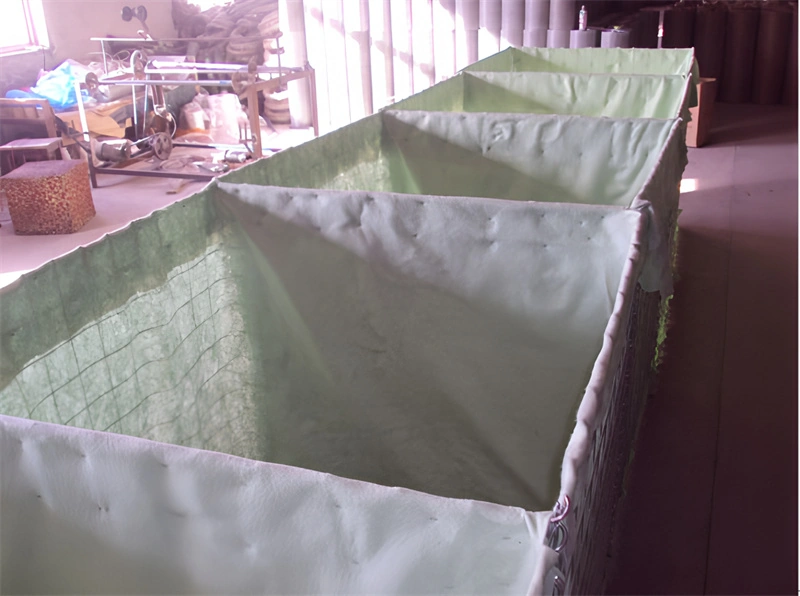
Fabric weight is the easiest claim to verify, because the check is a pocket scale and a knife. Cut a 100mm × 100mm square from a production sample — not a showroom sample — and weigh it in grams. A 100cm² swatch is one hundredth of a square metre, so multiply the gram reading by 100 to get the fabric’s weight in g/m²: a 300 g/m² liner gives a 3-gram swatch, and a 2.2-gram swatch tells you everything you need to know about the supplier.
Four more checks round out the verification:
- Written weight commitment: the contract states fabric weight in g/m² and material as non-woven polypropylene — not “heavy-duty fabric”.
- Mill documentation: request the geotextile supplier’s weight and material test report for the production batch, the way you would request a mill test report for steel tube.
- UV stabilisation in writing: if the deployment sits in Australian or New Zealand sun for months before filling, get the stabilisation stated, not implied.
- Seam pull test on the sample: grip the liner on both sides of a sewn divider and load it by hand; a production-grade seam resists firm steady loading without thread elongation.
Buyers combining hesco units with broader fencing programmes out of Anping should add a factory audit or third-party pre-shipment inspection — our Anping factory audit checklist lists the documents, floor evidence and sample protocols to walk through before a deposit.
Sourcing and Commercial Terms
DB Fencing (Anping Deban Metal Wire Mesh Products Co., Ltd) has manufactured and exported from Anping, Hebei — the world’s wire mesh production hub — since 2009, ISO9001 certified and SGS audited, with ten welding production lines behind capacity. Hesco barrier units for defence, flood control and environmental protection are part of the product line — the full range is on the heavy-duty hesco barrier product page.
The commercial baseline for bulk orders: production runs 20–25 days, shipping terms quoted FOB, CIF, CFR, DDU or DDP, payment negotiated per contract, and quotes returned within 24 hours of a specification. Hesco minimum order quantities are set per project rather than published — confirm the MOQ and the liner weight tier together at the enquiry stage, because both drive unit price.
One sourcing habit worth building: submit the same written specification sheet to every supplier you compare — unit designation, liner weight, polymer, UV requirement, seam standard, wire and coating — and see who pushes back on specifics. Suppliers who cannot answer a weight question at quotation rarely discover precision in production.
Frequently Asked Questions
What is the geotextile liner in a hesco barrier made of?
Non-woven polypropylene is the industry-standard material, commonly offered in 250, 300 and 400 g/m² tiers. Confirm the exact weight and UV stabilisation with the factory at the enquiry stage.
What size is a MIL 1 hesco barrier unit?
The commonly cited industry-standard MIL 1 configuration measures 1.37m high × 1.06m wide × 10m long with 10 internal cells. Taller and longer configurations exist across the standard range.
How can I check the liner weight myself?
Cut a 100mm × 100mm swatch from a production sample, weigh it in grams and multiply by 100 — a 3-gram swatch is a 300 g/m² liner.
What are the lead time and trade terms for bulk hesco barrier orders?
Bulk production runs 20–25 days, with FOB, CIF, CFR, DDU and DDP terms available and payment negotiated per contract. Quotes are returned within 24 hours; MOQs are confirmed with the factory per project.
Conclusion
Military-grade and budget hesco barriers differ less in appearance than in specification: a stated fabric weight in g/m², virgin non-woven polypropylene, UV stabilisation, reinforced seams and properly welded mesh — all in the contract, not implied. The MIL unit system gives you the sizing vocabulary; the cut-and-weigh check gives you the enforcement tool.
Before your next order, put the liner specification in writing and request a production sample to verify. Send the sheet to us for a quote with the liner tier you need — specifications come back within 24 hours, and the exact g/m² is confirmed with the factory before production begins.