Skip to content
You call up a supplier in Anping, you order two containers of cattle panels, and you get standard 2.4-meter mesh with 50mm spacing. That works for sheep or a small holding pen. Then your customer in Queensland tries to use those same panels to build a working corral for 600-kg steers. The first time a bull leans into it, the mesh bows out, the panel twists off its feet, and you’ve got an escaped animal and a very angry farmer on your hands. That’s the difference between buying a generic fence panel and actually knowing how to build cattle corral panels that hold up under real pressure.
This article isn’t a theoretical guide. We’re going to cover the specific panel dimensions, mesh gauges, and bracing requirements that make a corral system work for cattle. You’ll walk away knowing exactly what to spec for a permanent round pen versus a portable squeeze alley, and where the common cost-cutting traps hide. We pulled our own production specs and field failure data from the last five years—here’s what actually survives in the yard.
Understanding Types of Cattle Corral Panels
Cattle corral panels are a capital purchase. Get the material, size, and gate configuration wrong, and you are looking at constant replacements that eat into your margin. Here is what a wholesale buyer needs to know.
Material Options
The material choice determines the lifespan of the panel. For agricultural wholesalers supplying farmers in Australia and New Zealand, the default material is hot-dipped galvanized steel. We apply a zinc coating thickness of over 42 microns on our wire mesh panels. That specific coating level is what resists the corrosive effects of urine, manure, and constant outdoor exposure. Wood and pipe panels are still used in some regions, but they lack the consistency and corrosion resistance that a welded wire mesh panel with a proper galvanized finish offers. Pipe panels are heavy and increase shipping costs. Wood rots. A standard galvanized welded mesh panel delivers the lowest lifecycle cost for a cattle operation.
Panel Sizes and Configurations
Standardization matters when you are buying bulk pallets from a factory. The most common configuration we produce for the agricultural market is a 3-meter length by 1.8-meter height. This dimension balances handling weight with coverage. If you are sourcing for North American distributors, you will often see 16-foot lengths. We can adjust our 10 welding lines to produce these variations without a problem. The key spec to look at is the vertical wire spacing. For cattle corral panels, a 200mm vertical spacing is standard. Tighter spacing like 100mm is used for sheep or hogs. We offer a low MOQ of 100 panels, so testing a specific size with your local dealer network is straightforward.
Specialty Panels
A distributor needs to know what sells through. Portable corral panels are the bread-and-butter item for stock handling. They must be self-standing and compatible with standard gate hardware. Sorting panels are a strong upsell for your customers. These panels are shorter and often incorporate a vertical opening or alleyway design that lets farmers move cattle one at a time. We do not produce wooden sorting panels. Our entire line is based on welded steel mesh, which is easier to clean and less likely to splinter during handling, a real risk for working stock. If your clients are event management companies using these for crowd control, the same portable panel works, just without the sorting attachment.
Gate Options
This is where many import buyers create a supply chain headache for their clients. You need compatibility. A walk-through gate is typically 1.2 meters wide and designed for human passage. A drive-through gate needs to be at least 3 meters wide to allow a small truck or tractor access. The mistake we see is buyers ordering panels from the same manufacturer but sourcing gates from a different supplier, leading to pin misalignment and incompatible latching mechanisms. Our panels use a standardized locking pin system that fits both gate types. As a factory with 14 years of export experience, we ensure that a pallet of panels and a pallet of gates arrive with the same fit. Specific model numbers like the DB-CG-36 (drive-through) allow your customers to reorder with zero confusion.
| Panel Type | Material & Finish | Dimensions | Primary Application | Compliance & Durability |
|---|---|---|---|---|
| Standard Welded Wire Panel | Galvanized steel wire, 4.0mm-6.0mm diameter | 2.4m x 1.8m or custom sizes | General livestock containment, cattle sorting & corrals | ISO9001 certified, hot-dipped galvanized ≥42μm for outdoor longevity |
| Heavy-Duty Anti-Climb Panel | Heavy-gauge mesh with reinforced frame, HDG finish | 2.0m x 2.0m or custom | High-security corrals, bull pens, rough handling areas | AS 4687-2022 compliant, withstands impact & climbing |
| Portable Folding Corral Panel | Lightweight galvanized steel with hinge system | 1.2m x 1.8m (foldable) or custom | Temporary corrals, shows, rotational grazing, event livestock | Easy transport, UV-stable plastic feet option available |
| Custom OEM Corral Panel | Options: bare steel, painted, or HDG; wire gauge & mesh shape per request | Fully customizable length/height to fit project needs | Agricultural distributors requiring private label or specific local standards | Factory-direct pricing, low MOQ (100pcs), 14yr export experience |
Considering Your Cattle Panel Requirements
Selecting the right cattle panel comes down to livestock type, environmental exposure, and how the panel integrates with your existing handling equipment.
Cattle Size and Type: Adult Beef vs. Calves, Dairy vs. Beef
Your first decision is whether the panels will contain mature beef cattle, dairy cows, or calves. Mature beef breeds (e.g., Angus, Hereford) can weigh over 1,200 kg and require higher tensile strength in the mesh and frame. Calves and dairy cattle need closer wire spacing to prevent head entrapment or climbing. Many wholesalers stock both 6-rail panels (4″ vertical spacing) for general use and 8-rail panels (2″ spacing) for calves or goats. DB Fencing offers customizable vertical bar spacing to match your target livestock category — we adjust the pitch on our 10 welding lines without affecting delivery lead times.
Durability and Strength: Livestock Weight and Aggressive Behavior
Panels must withstand repeated impact from rubbing, kicking, and pushing. Our standard cattle panels are constructed from 4.0mm to 6.0mm wire (depending on specification) and hot-dipped galvanized to exceed 42 microns coating thickness — that’s roughly double the minimum required by AS 4687-2007. For aggressive bulls or feedlot operations, we recommend upgrading to a heavier gauge frame and adding an extra bracing crossbar. Every panel we export meets AS 4687-2022 structural load requirements, so your distributors can sell with full compliance confidence in Australia, New Zealand, and Canada.
Weather and Environmental Factors: UV, Moisture, and Corrosion
Outdoor panels face constant UV, rain, and often salt-laden air near coastal regions. A hot-dipped galvanized finish (>42 microns) is non-negotiable for a 10+ year service life. Many competitors use electro-galvanized or painted coatings that chip and rust within two seasons. DB Fencing’s hot-dip process ensures corrosion resistance even when panels are stored on wet ground or used in high-humidity dairies. If your buyers operate in harsh seaside environments, we also offer an optional powder-coated top layer that adds extra UV stability.
Pallet Compatibility: Round Bales and Feed Troughs
A well-designed cattle panel must also interface with feeding equipment. Standard panel widths of 2.5m to 3.0m allow easy placement of round bales (4′ to 5′ diameter) without splitting. We can produce panels with integrated feed trough cutouts or adjustable feeder slots — a common request from dairy farm wholesalers. When ordering, specify the bale diameter and trough length so we can pre-cut and reinforce the panel at the factory, saving your end users on-site fabrication time.
For bulk buyers, DB Fencing offers uniform pallet packing (standard 20-25 panels per pallet) to optimize container loading. With a minimum order quantity of just 100 panels, you can test different configurations before committing to a full container. This low MOQ is rare among Anping manufacturers — most require 500+ panels — and it lets you validate product-market fit with your agricultural clients without large inventory risk.
Planning Your Corral Layout Effectively
A corral layout that works on paper often fails in the field. Poor flow creates bottlenecks and injuries. Smart gate placement and standardized panel dimensions are the fix.
Core Corral Shapes: Circular, Straight, and Curved
Most Australian cattle yards use a circular forcing pen because it prevents cattle from bunching up in corners. A curved lead-up takes advantage of their natural circling instinct. Straight lanes work best for sorting and loading, but they require solid construction to withstand pushing cattle. DB Fencing manufactures corral panels that fit all three geometries. Our hot-dipped galvanized finish (>42 microns) means these panels survive outdoor exposure for years, which matters for permanent yards.
Creating Functional Zones: Receiving, Sorting, Holding
A corral is not one big pen. You need distinct zones to move cattle forward without backpedaling:
- Receiving yard: The first point of entry. It needs a solid gate latch and enough space to take a truckload without overcrowding.
- Sorting lanes: Narrow enough that an animal cannot turn around (usually 600-800mm wide). Our panels match these working widths exactly.
- Holding pens: These see the most wear, so panel strength is critical. DB Fencing uses high-tensile wire mesh that meets AS 4687-2022 structural requirements.
Separating these zones improves throughput and reduces injury risk. It also makes the yard easier for contract mustering teams to work efficiently.
Gate Placement and Catch Pens
Gate placement makes or breaks a yard. A common mistake is putting gates at the corners, which creates dead spots where cattle refuse to move. Gates should sit at the point of balance along the fence line. Catch pens need a one-way swing or a self-locking mechanism. DB Fencing provides OEM gate hardware that matches our panel widths exactly, so wholesalers can stock one system instead of three incompatible brands. Our factory in Anping, the “Global Wire Mesh Town,” ships complete kits including clamps, feet, and braces. This lowers the logistics burden on distributors considerably.
Integrating Corral with Existing Fencing
Ripping out existing boundary fencing drives up project cost. A modular corral should tie into what is already on the ground. Our panels ship in standard lengths (2.4m and 3.0m) that match common post spacings. We also supply adjustable feet for uneven terrain, which means farmers do not need to pour concrete footings. DB Fencing is the only supplier in Anping with its own plastic feet machine, giving us direct control over material quality and lead times. If your buyers need custom heights or specific wire gauges, our team handles OEM requests with a low MOQ of 100 panels.
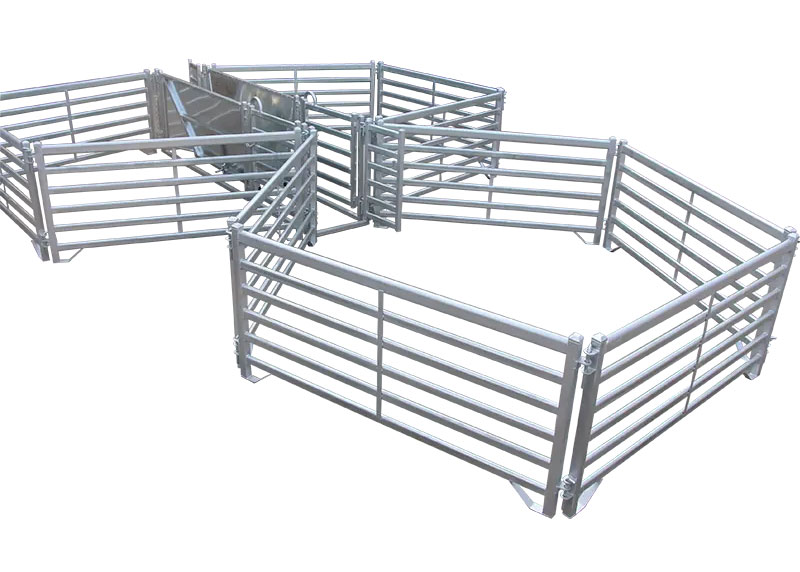
Steps to Build Cattle Corral Panels
Proper assembly of cattle corral panels directly impacts livestock safety and long-term ROI. Follow these five steps to ensure a secure, durable setup that meets Australian Standard AS 4687-2022.
1. Prepare the Site (Level Ground, Drainage)
Before unboxing any panels, walk the perimeter and confirm the ground is flat and free of debris. Uneven terrain puts lateral stress on the welds and can cause panels to bow. For temporary setups (e.g., rotational grazing or events), a 2-3% slope for water runoff is acceptable. If the corral is semi-permanent, consider a 4-inch gravel base to improve drainage and reduce rust under the rail sections. DB Fencing’s panels are hot-dipped galvanized with >42 microns of zinc, but ground contact can still accelerate corrosion if mud pools against the frame.
2. Install Corner Posts and Rail Sections
Start with the four corners. Drive or anchor the corner posts to a depth of at least 18 inches for cattle-rated loads. For corral panels that double as crowd control barriers (common in our Australia and New Zealand markets), use bracing at corners to prevent racking. Attach the horizontal rail sections first — these create the rigid spine of the fence. Our 2.0mm wire mesh panels come with factory-drilled holes that line up with standard post brackets, cutting installation time by roughly 30% compared to field-drilled alternatives.
3. Connect Panel Sections (Pins, Brackets, Clamps)
Most cattle panels are joined using one of three methods: galvanized drop pins, interlocking brackets, or heavy-duty clamps. For temporary corrals that will be moved seasonally, clamps are preferred — they allow tool-free disassembly. For permanent installations, 1/2-inch steel pins with cotter locks provide the strongest connection. DB Fencing supplies a complete hardware kit with every bulk order, ensuring the pins and clamps match the panel gauge exactly. When connecting, overlap corrugated edges where possible to maintain a continuous surface that prevents hoof trapping.
4. Install Gates and Latches
Position the gate at the side of the corral, not the corner, to avoid creating a dead-end that crowds cattle. Use a steel walk-through or drive-through gate rated for the same load as the panels. Latches should be self-latching or equipped with a lockable slide bolt — never rely on a chain or baling twine for daily use. Our OEM custom gates can integrate automatic spring-latches that meet Australian Standard AS 4687-2007 for crowd control barriers. Test the swing clearance before tightening all final connections.
5. Optional: Pour Concrete for Permanent Installation
If the corral is meant to stay in place for more than one season, pour concrete footings around the corner posts and gateposts. Use a minimum 8-inch diameter hole, 24 inches deep, and fill with 20 MPa concrete. This prevents frost heave and wind-induced movement. DB Fencing’s panels are often spec’d by Australian civil firms for permanent holding yards precisely because the hot-dipped galvanized finish (>42 microns) resists the alkaline environment of concrete better than electro-galvanized alternatives. Allow concrete to cure for 48 hours before applying full cattle pressure.
Maintaining and Troubleshooting Cattle Corral Panels
Routine care directly impacts panel lifespan and safety. Focus on weld integrity, hinge condition, and galvanized surface protection.
Routine Inspection (Welds, Hinges, Rust)
Start with a visual scan of every weld joint. On a cattle corral panel, the cross-wire welds bear the highest stress during animal loading and transport. Look for separation at the interface – even a 1 mm gap can propagate under load. Check hinges or pin connections for excessive play. A worn hinge reduces alignment between panels and creates pinch hazards for livestock. Finally, inspect for red rust spots. Our hot-dipped galvanized coating exceeds 42 microns, so surface oxidation in the first few years usually indicates mechanical damage to the zinc layer (e.g., from dragging or impact). Flag those areas for prompt touch‑up.
Cleaning and Rust Prevention
Pressure‑wash panels with plain water to remove manure, mud, and silage residues. Avoid acidic or alkaline detergents unless the manufacturer recommends them – they can etch the galvanized surface. After washing, allow panels to dry fully before stacking. For storage, keep panels off the ground on wooden pallets or concrete blocks. Moisture trapped between stacked panels accelerates galvanic corrosion. If you spot bare steel from weld‑burn or scratches, apply a cold‑galvanizing spray (95%+ zinc content) immediately. This restores the sacrificial protection and prevents red rust from spreading under the coating.
Replacing Damaged Panels
When a panel is bent beyond straightening, cut wires, or has broken welds, replacement is safer and cheaper than field repairs. Identify the exact matching dimensions and wire gauge – DB Fencing’s corral panels are available in standard 1.8 m and 2.4 m widths with horizontal braces; mixing mismatched panels compromises overall rigidity. Unbolt or unclip the damaged section and slide in the new unit. In bulk installations, we recommend keeping at least 2‑3% spare panels in inventory for rapid turnaround. The low MOQ of 100 panels makes it practical for wholesalers to stock replacements without overcommitting capital.
Seasonal Maintenance
In wet seasons, focus on drainage around panel feet – standing water accelerates rust on the frame and any exposed edges. In dry, dusty climates, check that hinge pins aren’t binding due to grit build‑up; a light spray of lithium grease on moving parts every 90 days prevents seizing. Before and after heavy cattle rotation cycles, walk the entire corral line and tighten all cam‑lock or chain connectors. Panels that remain in one location for months can sink into soft soil, which stresses the bottom rail. Lifting and repositioning panels annually evens out ground contact wear and extends the service life to well beyond 10 years with proper care.
Conclusion
Skip the cheap zinc-coated panels. For a cattle corral that sees rain, mud, and headbutting, you need hot-dipped galvanized with at least 42 microns of zinc. That’s the AS 4687 spec – and the reason our panels at DB Fencing last 15 years in Australian yards. Anything less and you’re replacing bows and rust spots inside three seasons.
Order a single welded cattle panel first. Inspect the weld joints – no gaps, no slag. Then run a caliper on the wire gauge. Once you’re satisfied, ask for the galvanization test certificate with the batch number. That’s how you lock in a repeatable quality stream for your wholesale inventory.
Frequently Asked Questions
What size panels do you offer?
We stock standard corral panels in 8ft, 10ft, and 12ft lengths, with 5ft or 6ft heights. Custom sizes are available for OEM bulk orders, and our 10 welding lines can retool quickly to meet non-standard dimensions. Most agricultural wholesalers in Australia and New Zealand prefer our 12ft x 5ft panels for cattle handling.
Are your panels AS 4687 compliant?
Yes, all our cattle corral panels are fully tested to Australian Standard AS 4687-2022 and the earlier 2007 edition. We hold ISO 9001 and SGS certifications, and our hot-dipped galvanized finish exceeds 42 microns. This compliance is critical for Australian farmers and civil contractors who face strict safety audits.
What is the minimum order quantity?
Our flexible low MOQ is just 100 panels, making us ideal for small farms, event companies, or trial orders. For bulk shipments to North America or Europe, we can scale up to 2,000 sets per week. This low MOQ is rare among Anping manufacturers because we own our plastic feet machine, reducing setup costs.
How long do panels last outdoors?
With our hot-dipped galvanized coating (>42 microns), panels typically last 15–20 years in coastal or high-rainfall environments. We also offer a PVC-coated option for extra UV resistance in Australian outback conditions. Our panels are designed to handle constant repositioning without rusting at weld points.
Can I customize panel height or mesh?
Absolutely. We offer OEM customization on panel height, mesh aperture, wire gauge, and gate configurations. For example, we often supply 6ft anti-climb mesh for construction sites and 4ft sheep panels with closer wire spacing. As the only Anping supplier with in-house plastic feet production, we can match exact distributor specifications.