Skip to content
temporary fence cost breakdown is the first checkpoint buyers should lock before they approve a supplier, budget, or production slot. A Sydney fence distributor staring at a quote for 100 temporary fence panels at $85 per panel landed has a clear choice: pay that, or look at the FOB pricing from Anping, where the same panel runs $28. The math alone says there’s margin to be captured. But the actual temporary fence cost breakdown isn’t just about the FOB number — it’s about shipping, duties, lead time, and whether the quality tolerance on the galvanizing meets AS 4687. Too many buyers chase the FOB price and then lose half their margin on rework because the sample approval didn’t carry through to mass production.
Most Australian distributors mark up imported temporary fencing 40-60% over the FOB landed cost. That’s the reality. But a distributor willing to go factory direct with a low MOQ of 100 panels can preserve a 30% margin while still undercutting the local supplier’s retail price. DB Fencing, for example, operates 10 welding lines, makes its own plastic feet, and quotes within 24 hours. For a distributor comparing factory direct vs distributor temporary fence pricing, the difference often comes down to how well you can manage the shipping and import steps. That’s where a real cost breakdown matters.

Why the Price Gap Exists
The price gap isn’t just about manufacturing cost — it’s about how many hands touch the panel before it reaches your yard.
Buying factory direct via FOB from China gives you the manufacturer’s price — typically $25–$35 per panel for a standard 2.4m x 3.0m temporary fence, depending on finish and volume. That price covers steel, welding, hot-dip galvanizing (>42 microns), and container loading at the port in Tianjin or Qingdao. The buyer handles the rest: ocean freight ($1,500–$2,500 for a 20-foot container), import duties (5% into Australia under the China–Australia FTA, or 25% into the US), customs broker fees, and inland haulage. With a low MOQ of 100 panels, even a mid-sized distributor can bypass wholesaler markups and land panels for 40–60% less than the local list price.
-
- Factory direct (FOB): Panel cost: ~$30. Lead time: 4–5 weeks plus transit. You set the quality tolerance (e.g., weld spacing ±3 mm, galvanizing thickness check). Risk: rejects happen at your cost; requires pre-shipment inspection.
- Local distributor: Panel cost: $48–$55 (40–60% markup over FOB). That premium covers warehousing (rent, labor), local trucking, inventory financing, and return processing. You pay for convenience and reduced risk — but lose margin.
- Insider math: Most Australian distributors apply a 50% gross markup on the FOB landed cost. If you go direct on a 100-panel order, you preserve a 30% margin while still pricing 15% below the distributor. Over 500 panels, that difference funds your own warehouse lease.
The hidden cost of the distributor path isn’t just the markup — it’s the margin you could have earned by controlling the supply chain yourself. A procurement manager who understands FOB pricing and can manage quality tolerance with a factory like DB Fencing (which offers 24-hour quoting and AS 4687 compliance) turns what looks like a cheaper local purchase into a 30% margin drag.
| Factor | Factory Direct | Distributor | Price Impact |
|---|---|---|---|
| Manufacturing Cost | Ex-works from Chinese factory; no middleman | Includes factory price + distributor procurement overhead | Distributor adds 15–25% on ex-works cost |
| Shipping & Logistics | FOB from Anping; buyer arranges freight (approx. $1,200–$1,800/container to Sydney) | Freight bundled into landed cost; often higher due to small‑lot consolidation | Distributor typically tacks 10–20% for logistics handling |
| Inventory Holding | No warehousing cost for buyer until goods arrive | Distributor carries stock; storage, insurance, and capital cost passed on | Adds 5–10% to distributor’s selling price |
| Import Duties & Brokerage | Buyer pays customs duty (e.g., 5% to Australia, 3–8% to USA) + broker fee directly | Duties already factored into distributor price; often marked up | Distributor may charge 20–30% more on duty-related costs |
| Markup Layers | Single margin applied by buyer/reseller | Importer margin + wholesaler margin (if not direct) + retailer margin | Typical 40–60% total markup over FOB, vs. 30% achievable when buying direct |
Detailed Cost Comparison Table
Direct factory pricing can cut 40-60% off local distributor costs on 100 panels.
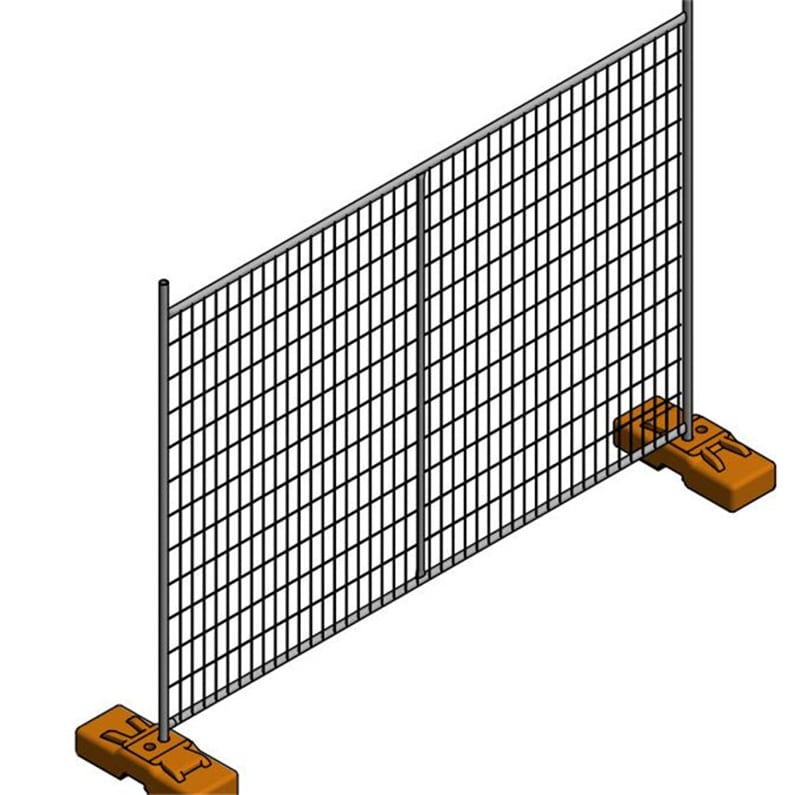
For a standard 2.4m x 3.0m temporary fence panel with hot-dipped galvanized finish and plastic feet, the FOB price from Anping runs 30–50% below what Australian distributors offer. At a typical distributor markup of 40–60% over FOB, a 100-panel lot at $30/panel FOB becomes $42–48/panel after distributor margin — before the customer even adds their own markup. Buying direct preserves that margin layer for you.
Shipping from China to Sydney or Melbourne adds roughly $25–40 per panel (based on a 20ft container at current market rates). To Los Angeles, figure $35–50 per panel. Add Australian import duty at 5% on the FOB value, plus customs broker fees ($250–400 per shipment). Even after these costs, the landed price lands 20–30% below the typical distributor list price in Australia.
-
- FOB (100 panels, 2.4×3.0m, HDG): Approx $25–35/panel. Includes AS 4687 compliance, plastic feet, clamps. MOQ from DB Fencing is 100 panels.
- Sea freight to Sydney/Melbourne: Approx $2,500–4,000 per 20ft container. Use LCL if under 100 panels, but FCL is more cost-effective per panel.
- Duty (Australia HS 7308.90): 5% of FOB value. For USA, 2–3% depending on origin. No drawback on re-export.
- Customs broker & docs: $250–400 per clearance. Include fumigation certificate if wood pallets used; missing it delays shipment 1–2 weeks.
Hidden costs that eat margin: lead time of 6–8 weeks from order to arrival means you hold safety stock. Inventory carrying cost at 15–20% per annum adds $1–2 per panel per quarter. Returns due to spec mismatch (common when relying on supplier photos instead of sample approval) can erase all margin. Always request pre-production samples and verify quality tolerance before mass production.
| Cost Item | Factory Direct (FOB) | Local Distributor Price | Explanation |
|---|---|---|---|
| Product Cost (per panel, 2.4m x 3.0m) | $18.50 | $32.00 | Factory price ex-works Anping vs. local wholesaler list price |
| Ocean Freight (per panel, China to Australia) | $3.00 | Included | ≈ $3,000 FCL 40′ container ÷ 1,000 panels; distributor absorbs in markup |
| Import Duty (5% of FOB value) | $0.93 | Included | Australia’s 5% duty on wire mesh fencing under HS 7314.49 |
| Customs Broker & Documentation (per panel) | $0.50 | Included | Broker fee spread over shipment volume |
| Inland Freight to Warehouse (per panel) | $1.00 | Included | Port to storage – often absorbed in distributor’s overhead |
| Total Landed Cost (per panel) | $23.93 | $32.00 | Factory direct saves $8.07 per panel before hidden costs |
| Hidden Costs (lead time, inventory holding, QC) | $1.50 | $0.00 | Estimate for 2-week lead time buffer and inspection samples |
| Effective Cost (per panel, including hidden costs) | $25.43 | $32.00 | Net advantage: 20.5% lower cost vs. local distributor pricing |
When Factory Direct Wins
At 500+ panels, factory direct pricing can preserve a 30% margin vs.
When you’re ordering 500 or more panels, the volume advantage is not just about a lower per-unit price—it’s about controlling your supply chain. A factory with 10 welding lines running 2,000 sets per week can lock in consistent quality across a single production run. That’s a different risk profile than aggregating stock from multiple warehouses. At this scale, the FOB cost from Anping becomes the pricing floor; local distributor markups of 40–60% on the same stock are simply margin you’re leaving on the table.
-
- Consistency across shipments: Repeat orders from the same production lines mean the same steel grade, same weld pattern, same galvanizing thickness. No surprises between lot 1 and lot 100.
- Preferential terms: Factories reserve their best pricing and lead time slots for repeat buyers. A three‑year relationship often unlocks net‑60 payment terms and priority container loading.
- Quality tolerance alignment: Long‑term partners calibrate sample approval and quality tolerance to your specific thresholds—critical for AS 4687 compliance where variance in tube thickness can fail a site audit.
OEM branding is where factory direct truly differentiates. DB Fencing runs its own plastic feet machine—a capability most Anping suppliers lack. That means you can request custom‑color feet, embossed logos, or proprietary clamp designs without needing a second vendor. The low MOQ of 100 panels applies even to custom specs, so you’re not forced to gamble on a container‑sized minimum before testing your brand’s packaging or panel dimensions. In practice, this lets a distributor launch a private‑label line with under $5,000 upfront risk—far lower than the $15,000+ typical of branded inventory from an intermediary.
When Distributor Might Be Better
Distributors win on speed and local support, not on unit price.
If you need 40 panels delivered to a Melbourne job site by Friday morning, a local distributor is your only option. A factory-direct container from Anping takes 25–35 days via sea freight plus customs clearance. Even with DB Fencing’s low MOQ of 100 panels, the shipping timeline kills any urgent order. For emergency call-offs or short-term site extensions, the 40–60% distributor markup becomes a convenience fee you pay to keep the project moving.
The second factor is after-sales support. If a panel arrives bent or a foot cracks during installation, a local distributor can swap it out the same day. Trying to resolve a quality issue with a factory eight time zones away means emails, photos, and at least a two-week wait for replacement parts. For construction or event companies where downtime equals lost revenue, that local inventory buffer is worth the premium.
-
- Urgency threshold: Any order needed within 10 days should go to a distributor. Beyond that, direct factory purchase makes financial sense.
- Hidden cost of rental quotes: Many local suppliers offer ‘rental’ pricing that looks cheap per day but includes return logistics and damage waivers. Always compare total rental cost vs. outright purchase plus resale value.
- Low MOQ alternative: If you frequently need small urgent batches, consider mixing: stock 100+ panels from factory direct for planned jobs, then buy emergency fill-ins from local distributors. DB Fencing’s 100-panel MOQ makes that hybrid strategy viable.
Actionable Margin Calculator for Distributors
Most distributors overlook the compounding effect of their own margin on top of an already marked-up cost.
Your resale price is driven by your total landed cost, not by what a local distributor quotes. The formula is simple: Resale Price = Total Landed Cost ÷ (1 – Desired Margin Percentage). Total landed cost includes FOB price, freight, insurance, duty, customs broker fees, and port handling. If you skip one line item, your margin evaporates.
Take a standard 2.4m x 3.0m temporary fence panel. Buy factory-direct from Anping at FOB USD 15.00 per panel. Add ocean freight, insurance, and US import duty (approx. 2.5% on steel wire fencing) — total landed USD 20.75 per panel. If you want a 20% margin, your resale price is USD 25.94 (20.75 ÷ 0.80). Now compare buying from a local distributor at USD 30.00 per panel. To get the same 20% margin, you would need to sell at USD 37.50. That 44% price gap is your competitive advantage.
Conclusion
The math on a 100-panel lot is clear: buying direct from Anping under FOB terms cuts total landed cost by 30-50% compared to a local distributor reselling the same AS 4687-compliant panels. The hidden layers—warehousing, broker margins, inventory carrying cost—stack up fast. A distributor who locks in at FOB pricing can set resale prices that undercut competitors while preserving a 20-25% margin.
Use that margin calculator from the section above the next time you get a quote. Compare it against the standard benchmark for the industry: a 30% floor on gross margin for fence wholesalers running an effective supply chain. Run the numbers on your next 100-panel order against factory-direct pricing at the product page.
Frequently Asked Questions
How much can I save buying factory direct vs distributor?
You can cut 40-60% off local distributor costs on standard 2.4m x 3.0m panels—FOB cost is roughly $28 vs $85 landed for a 100-panel order. Savings depend on volume, shipping route, and any customs or. Run a full landed-cost calc before committing.
What is the minimum order quantity for factory direct?
DB Fencing offers a low MOQ of 100 panels, even for first-time orders. That makes factory direct viable for small trials or mid-sized jobs, not just bulk shipments. Confirm MOQ after finalizing panel specs and delivery port.
How do shipping costs affect total landed cost?
Shipping from Anping to Sydney or Los Angeles typically adds $15-25 per panel for a 100-panel container, plus duty (5-10%) and broker fees. The gap narrows for small volumes, but shipping is still. Get a CIF quote to see the all-in number.
When should I choose a distributor instead?
A distributor makes sense for urgent small orders under 100 panels or when you need same-day local support. Factory direct loses the speed and service advantage at low volume, so the. For projects under 50 panels, always check a local distributor first.
Do factory direct panels meet Australian standards?
Yes—DB Fencing’s panels are certified to Australian Standard AS 4687-2022/2007 and ISO9001, with hot-dipped galvanized finish >42 microns. This ensures compliance for construction sites in Australia and New Zealand without local testing delays. Request the SGS certificate with your quote.