Skip to content
Hire fleet checks commonly cover bent rails and missing feet. The coupling that holds one barrier to the next gets less attention, because the four crowd barrier pages read here describe the same joint in four ways and state no engagement figure for any of them. That leaves lift-out resistance a phrase on an enquiry rather than something you can order against.
A panel weighs 14-18 kg, according to the barriers page, and the specification row on that page reads Load Capacity 200kg horizontal. None of the four pages states a vertical figure. Meanwhile the feet are specified as welded on the frame or removable, and a removable part is a part that can come home short.
Key Takeaways
- Four pages describe the same joint differently: an industry-standard hook and half-loop, hook and eyes marked Australia Standard, interlocking mechanisms, and heavy-duty connecting clamps.
- The only load figure on the barriers page, as read here, is horizontal — 200 kg — against a panel weight of 14-18 kg.
- Feet are offered welded on the frame or removable, and the removable reading is sold for transport and storage.
- A removable foot puts another separable part on every barrier: one or two bases, plus whatever the joint releases.
- Heights run 1.1 m, 1.25 m and 1.5 m across the specification blocks, so two lots share a joint only if hook and receiver meet at the same level.
- Replenishment turns on a question none of these pages answers: do replacement hooks ship loose, or does a damaged end mean a panel?
Four Names for One Part
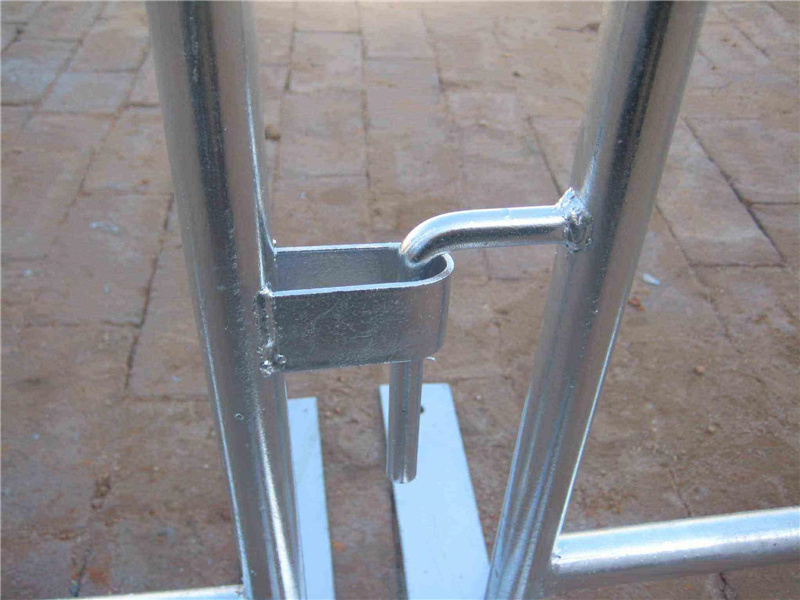
The steel barrier page is the plainest of the four: “We usually use an industry-standard hook and half-loop, sturdy flat feet bases, bridge bases to connect steel barrier.” Hook into half-loop, and a base underneath. The wording describes a joint with no bolt in it.
The flat base product page carries a row reading “Hook and eyes: Australia Standard”, with no document number beside it. The temporary fencing pages cite AS 4687 for fencing and hoardings, so which document that row points to is worth closing with the factory rather than assuming.
The barriers page adds a third and a fourth wording: interlocking mechanisms for secure connection in its design list, and heavy-duty connecting clamps in its safety list. That page also mentions adjustable feet, anti-trip bases and optional wheeled gates.
Four wordings, one family. An enquiry that says “interlocking crowd barriers” matches every page and identifies no particular part, which is where a spares list starts going wrong.
The Published Number Measures the Wrong Axis
The barriers page prints a compact block: 2.1 m standard height, 2.4 m width, galvanised steel, 14-18 kg per panel, and Load Capacity 200kg horizontal. That height row does not agree with the 1.1 m, 1.25 m and 1.5 m options on the supplier pages for the same family, so confirm it per lot. The horizontal reading is the one that matches what a crowd does, which is push.
Lift-out is not a push. It is a panel taken up and away, at the joint, and none of the four pages read here states a vertical or uplift figure, a minimum engagement depth for a hook in its receiver, or what happens when one panel is raised straight up. The geometry that could answer that question is described nearby: the flat base page records a steel flat base with 1 or 2 vertical tube, and the barriers page calls the feet adjustable for uneven ground.
The published numbers therefore do not settle the question. Where a venue or organiser treats lift-out resistance as a requirement, ask the factory in writing what the coupling does under a vertical load, and check the venue’s own conditions as a separate matter.
What Comes Off, and What Stays
The separable parts decide what can go missing. One specification block lists the foot as welded on the frame or removable, and the flat feet are described as making transportation and storage much easier. A third page sells removable-feet barriers as designed to be quickly set up and taken down for short-term events.
The market notes point the same way: flat feet barriers are listed as popular in Brisbane, Melbourne, Sydney and New Zealand, bridge feet as the best seller in America and Canada, and cross feet in the UK, South Africa and the Middle East. Different foot, different stack, different spares.
The base is a bore question too. Frame tube is given as 32, 38, 42 and 48 mm on one page and 25 mm outside diameter on the flat base page, while the recycled rubber base offered for straight leg crowd barriers lists a hole to suit 32 mm or 38 mm pipe. A spare base ordered on the wrong reading does not rescue that line.
| Page | Coupling wording | Foot wording |
|---|---|---|
| Steel barrier | Hook and half-loop | Flat feet bases, bridge bases |
| Flat base product page | Hook and eyes, Australia Standard | Steel flat base with 1 or 2 vertical tube |
| Trusted supplier page | Not stated | Welded on the frame or removable; fix, flat or bridge base |
| Barriers page | Interlocking mechanisms; connecting clamps | Adjustable feet; anti-trip bases; rubber bases |

Counting a Line, Replenishing Between Events
Count from the fleet, not from the next event. Every barrier has two ends, so 100 barriers present 200 coupling points before a gate, a corner or a damaged panel is added. Feet go one or two per barrier depending on which specification you bought, and only the removable reading puts that part in a spares count.
After the second event, the return log tells you more than any catalogue. The items worth a column each:
- Hook and receiver ends: bent, torn or deformed, and on which side. How the hook is fixed to the frame is not stated on these four pages, so confirm it — a hook that is part of the frame is a repair question, not a spare question, unless the factory sells the part loose.
- Feet against barrier count: the gap between the two numbers is your own loss rate, and only your fleet produces it.
- Base bore: which frame diameter each lot was built on, so a replacement base ordered for lot three fits lot one.
- Clamp hardware: if your line uses the connecting clamps wording rather than a hook, its bolts and clips are the loose parts to log.
- Height mix: whether the lot at 1.25 m or 1.5 m shares a joint with the 1.1 m fleet, or only sits beside it.
None of these four pages states a spares ratio, and none lists a loose hook or receiver as an accessory line; bases, gates and clamps appear there, replacement couplings do not. Put that to the factory before the next season, alongside which of the four couplings is on your lot and what the joint does under a vertical load. Where no loose coupling is offered, a damaged end becomes a panel-level decision.

A spares ratio written after one event is a guess; written after two it is a fleet record, and a fleet record is what a hire desk can price. Line rigidity and how to check a set-up line belong to this site’s earlier piece on interlocking crowd barriers, and choosing the base for the ground you set up on is covered in the guide to outrigger bases on sloping turf.
Frequently Asked Questions
What stops a crowd barrier being lifted out?
None of the four barrier pages read here describes an anti-lift device. The published joints are a hook and half-loop, hook and eyes marked Australia Standard, interlocking mechanisms and connecting clamps, and no engagement dimension is given for any of them. Where lift-out matters, ask the factory and check the venue’s own conditions.
Are the feet on a crowd barrier removable?
Both readings are published. One specification block lists the foot as welded on the frame or removable, and the flat feet are described as making transport and storage easier. Which one ships decides how many loose parts your line carries.
What does the 200 kg figure on the barriers page mean?
It is printed as a load capacity measured horizontally, in the same specification block as a panel weight of 14-18 kg. It is not a vertical or uplift figure, and none of these four pages states one.
How many spare couplings should a fleet hold?
None of these pages states a ratio, so a round number would be invented. Count coupling points and feet on your own build, log what returns short after two events, and set the next order from that record.
Conclusion
Crowd barrier couplings sit in the gap between a hook whose fixing the pages do not describe, a foot that may be welded on or removable, and a load figure measured on the wrong axis. What is published identifies a family rather than a joint, so a between-events loss record has to be built from parts and counts instead of from a specification block.
Name the coupling on your drawing, ask what the joint does under a vertical load, ask whether hooks and receivers ship loose, and check that the bases in lot two fit the frame in lot one. The company quotes within 24 hours and states 7-day dispatch on stock items, so a spares line can travel with the replenishment order.