Skip to content
Interlocking crowd barriers are sold as a line and inspected as a set of joints. One barrier standing on its own feet is a stable object; a long run linked end to end becomes a structure whose stiffness is decided by the hook where two frames meet, not by the steel in the middle of each panel. A hire fleet can still pass a visual frame check and feel soft at the joints: the frames are fine, and the connection hardware is what has been worn.
The published specification for this site’s flat-base barrier puts the pieces in order — 1100 mm high, 2200 mm long, a 25 mm outer-diameter frame tube, 20 mm infill pickets at 200 mm centres, steel flat feet with one or two vertical tubes, and hook-and-eye connections listed to the Australian standard on the product page. Everything downstream of that list — how straight the line stands, how much a banner adds to it, how the joints behave after repeated hire cycles — follows from the interlock.
Key Takeaways
- A barrier line is a chain of joints: the hook-and-eye connection, not the mid-panel steel, decides how rigid the finished line feels.
- Published baseline for the flat-base model is 1100 mm high by 2200 mm long, 25 mm outer-diameter frame, 20 mm pickets at 200 mm centres.
- Frame and wall thickness are a specification choice, not a constant: the supplier page lists frames from 32 mm to 48 mm in 1.2, 1.5 and 2.0 mm wall options.
- Feet come welded or removable, with one or two vertical tubes; the page links removable feet to easier transport and storage, and foot type changes how the line sits on uneven ground.
- Standardise the interlock across the fleet. Mixed hook patterns leave joints that hinge before the frame does.
What the Interlock Actually Does
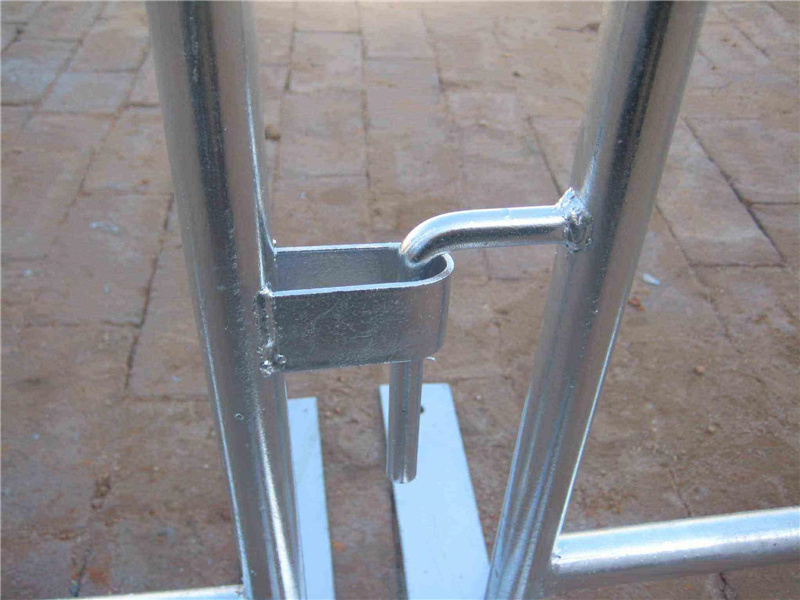
A hook-and-eye joint does two jobs at once. It stops the panels separating sideways under load, and it lets the line articulate over ground that is not perfectly flat. Those two jobs fight each other. A joint taken up tight resists lateral movement well and transfers load into the neighbouring panel’s feet; a joint with wear in the hook or the receiver lets each panel lean a degree, and a long run of those small leans ends as a visibly bowed fence line.
Wear concentrates where the hook seats into the receiver box, and where the hook itself is welded to the frame. That weld sees prising force when barriers are dragged into place with a vehicle rather than walked into line. The flat-base product page lists 360-degree full welding on the barrier itself, which is worth asking about for the hook and receiver too; they carry the line’s loads and are rarely inspected first.
Reading the Specification Behind the Joint
Two published product pages cover this family, and they are not the same document. The flat-base barrier page gives one fixed configuration; the barrier supplier page gives the ranges a buyer can order against. Put side by side, they show what is actually negotiable:
| Element | As listed | Why it matters at the joint |
|---|---|---|
| Height and length | 1100 mm × 2200 mm; the supplier page lists 1.1 / 1.25 / 1.5 m high, widths 2.0 to 2.5 m | Longer panels mean fewer joints and more unsupported span between feet |
| Frame tube | 25 mm outer diameter; the supplier page lists 32, 38, 42, 48 mm in 1.2 / 1.5 / 2.0 mm wall | The hook welds to the frame; wall thickness sets how much load that weld holds |
| Infill | 20 mm pickets at 200 mm centres; the supplier page lists 12 × 0.7 up to 25 × 1.2 mm | Picket spacing carries crowd pressure into the frame rather than bowing locally |
| Feet | Steel flat base with one or two vertical tubes; welded on or removable | Where a foot loses contact, more of the load falls on the joint |
| Connection | Hook and eyes, listed to Australian standard on the product page | Mixed hook patterns across a fleet leave articulating joints |
| Finish | Hot dip galvanised, or powder coated orange, yellow, green, black | Coating wear at the hook seat is where corrosion starts on a rehandled barrier |
Two rows are decided by fleet logic rather than by a supplier. Feet: the overview page offers welded-on or removable, and describes flat feet as steadier than claw feet, which are listed as a tripping hazard. Colour: a fleet sorted by event type uses coating as the visual tag, so the powder-coat choice is operational, not decorative.
Line Rigidity: Buyer-Side Checks
None of the following is a certification: crowd loading and wind action on a barrier line are site engineering questions for a qualified person. What a buyer or site crew can do is verify the hardware before an event and record what was found.
- Seating depth. Each hook should sit home in its receiver, not rest on the lip. A hook that drops under its own panel weight is worn or bent.
- Weld line at the hook. Look for cracking or weld spatter that has been ground through, which is what prising with a vehicle leaves behind.
- Sideways play. Push a joined pair laterally and watch the gap open and close; a joint with visible play is usually where movement is felt first once the line is loaded.
- Foot contact. On uneven ground, check every foot is carrying weight before the line is loaded, and re-shim rather than letting a joint take the difference.
- Attachments. A banner or shade cloth adds sail area to a line that was specified without it, so treat any attachment as a reason to re-check bracing and ask for an engineering view rather than adding weight ad hoc.
- Gate units. Any opening in a line is a break in the chain; check its hinge side and its latch as a joint, not as a door.

Specification Language for the Order
A purchase order that reads simply “crowd barriers” invites a substitution. The one that survives a dispute names the joint and the metal around it:
- Name height, length, frame outer diameter and wall thickness together — 1.1 m × 2.2 m, 25 mm frame, for example, or the supplier page’s 48 mm frame at 2.0 mm wall.
- State the connection type and ask the supplier to name the standard and edition their conformity document cites; AS 4687 is the Australian temporary fencing standard series, with a 2007 and a 2022 edition in circulation.
- Specify feet as welded or removable, and how many vertical tubes, because the page links removable feet to easier transport and storage, and foot type changes how the line sits on ground.
- Ask whether the hook and receiver welds fall under the same full-welding statement the page makes for the panel.
- Fix the finish per fleet role: hot dip galvanised for general hire, powder-coated colours where the fleet is sorted by event type.
- Confirm order minimums and lead time per line rather than assuming the panel terms apply — this factory quotes within 24 hours, dispatches stock items within 7 days and runs bulk production in 20-25 days.
Base choice is the one decision to make before the joint is discussed, because feet and interlock interact — our comparison of crowd barrier base types covers flat, bridge and arched feet, and the stage-barrier article looks at load ratings and front-of-stage layout where crowd pressure is designed for rather than absorbed.
Frequently Asked Questions
What keeps a line of interlocking crowd barriers rigid?
The joints and the feet. A hook seated fully in its receiver transfers load into the neighbouring panel; where joints are worn the line often softens before any frame bends.
What size are standard crowd control barriers?
This site’s flat-base model is listed at 1100 mm high by 2200 mm long. The barrier supplier page lists heights of 1.1, 1.25 and 1.5 m and panel widths from 2.0 m to 2.5 m.
Can you mix barrier brands on one crowd line?
Physically, often yes — and it is where lines go soft. Different hook heights and receiver depths leave joints that articulate or sit proud, so standardise the interface across the fleet where you can.
Does adding a banner to crowd barriers change the engineering?
It changes the loads. A solid or part-solid attachment adds wind-catching area to a line specified without it, so treat banners and shade cloth as a reason to get a site-specific engineering review.
Conclusion
Interlocking crowd barriers are only as good as the joint the buyer forgets to inspect. The frame, pickets and feet are visible on a datasheet; hook wear, receiver welds and foot contact are only visible on the ground, and they are what a crowd actually loads.
Specify the interface on the order, keep one hook pattern across the fleet, and check seating depth and weld lines before every event. If you are comparing feet first, settle that against the base-type guide before applying these checks.