Skip to content
Most aluminium stage barriers are quoted with a load rating, and most buyers never see the document behind it. The stage barrier load rating decides whether a barrier line holds a crowd or becomes the thing a crowd pushes over.
DB Fencing has made fencing in Anping, Hebei Province, the Global Wire Mesh Town, since 2009. Its crowd control line covers standard barriers, flat-base barriers, police barriers and aluminium stage barriers, backed by 14 years of export. Load ratings are the headline of that family, and the event management companies who hire these lines are the buyers who ask about them first. This guide covers how to read a rating, what the specification sheet must state, and how pit design and front-of-stage layout change the load a barrier actually sees.
Key Takeaways
- Rating first: a barrier quoted without a figure, its units and the test method behind them is a brochure, not a product.
- Ask for documents: the test report reference, a dimensioned drawing of frame, infill and base, and the finish specification.
- Aluminium buys handling speed, not automatic strength. Section, joints and base decide capacity.
- A pit boundary is typically the highest-loaded line on site — a sustained push along the top rail, not a lean.
- Ratings assume a base condition. Grass, hardstanding and a stage deck each change it, so confirm what the figure was established on.
- Ordering: 100 panels is the published fencing-category minimum here, 20–25 days for bulk production, 7-day dispatch on stock, quotes within 24 hours.
Why the Stage Barrier Load Rating Comes First
Site fencing tends to fail by leaning. A barrier line at the front of a stage fails by being pushed. That is why the rating belongs ahead of metal, finish and colour in the conversation.
A load rating is a stated capacity: the horizontal force a barrier section is credited with carrying, applied in a defined way at a defined height against a defined pass condition. The pass condition is the damage a panel may take and still be accepted. Three parts, and a sheet missing any one of them is incomplete. The figure and its units are the visible part. The method is what makes two suppliers’ numbers comparable, because a load spread along a run and a load pulled at one point will not give the same answer on the same frame.
Weight is a poor proxy for capacity and the first thing buyers reach for. A lighter aluminium panel can carry a higher declared load than a heavier steel one when the section, joints and base are better. Judging barriers by feel is how a hire fleet ends up with a mixed line and no idea which section is weak.
What the Specification Sheet Must State
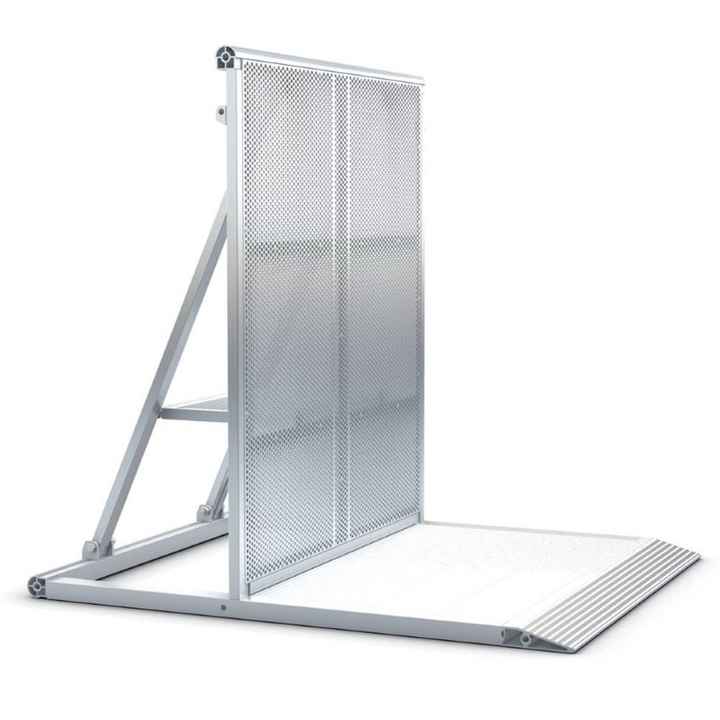
Ask for the specification sheet, then read it as a list of gaps. A sheet supporting a real purchase states the rating with units and method. It lists frame material and section, wall thickness, infill fixing, the base geometry the rating was established with, and the finish.
The base line is the one people skip. A rating measured with the barrier held in a test rig is not the same claim as one measured on the production base with its ballast. Ask which you are being quoted. The same discipline applies at the joints: our guide to fence panel weld quality inspection covers what a good weld looks like and what a bad one costs.
| Procurement item | What the sheet should state | What to ask for |
|---|---|---|
| Load rating | Figure, units, applied height, pass condition, method | The test report reference |
| Frame and infill | Alloy or steel grade, section, wall thickness, infill fixing | A dimensioned drawing with tolerances agreed |
| Base and ballast | Base geometry, foot type, ballast condition assumed | Confirmation the rating covers this base |
| Panel linkage | Hook, pin or clamp type and the load path | A sample pair to link before you commit |
| Finish | Mill, powder coat or anodised, with coating spec | The finish named on the order |
Aluminium or Steel at the Front of Stage
Aluminium’s case is handling. A crew lifting a lighter panel sets a longer run in the same hour, and the fatigue that arrives at the third barrier of a long build stays lower. That is why the aluminium stage barrier is the common format where a line is built and struck the same day.
Corrosion follows from the other direction. Aluminium is not galvanised — galvanising is a zinc coating applied to steel, and finding that word on an aluminium datasheet means the sheet was copied from another product. Aluminium weathers through its own oxide, so a mill-finish barrier dulls rather than rusts.
Steel keeps its ground on cost and rough handling. A hot-dip galvanised steel crowd barrier is often the lower-cost line item, and it tolerates being dragged. The image below shows that familiar type — vertical bars, arched feet, no solid panel. It is a crowd barrier rather than a stage barrier, and the two do different jobs.

Pit Design: Where the Barrier Carries Load
A pit is the working strip between the front barrier line and the stage edge. It keeps the audience off the stage, gives security and medical crews somewhere to work, and gives the barrier room to take the load. Those three purposes pull against each other, which is why pit geometry is a safety decision rather than a layout preference.
The load case at a pit boundary is not someone leaning. It is a sustained push from the back of a crowd pressing forward, carried along the top rail, through the posts and into the base. That is where the highest rated barrier on site typically belongs, and where the weakest section in a mixed line becomes the failure point.
Dimensions are the part nobody outside your event can give you. Pit depth typically depends on the venue, expected attendance, the nature of the performance, the egress provision and the authority signing the event off. The figure that matters is the one in your safety plan, so confirm current requirements with the event’s safety authority before ordering barrier, gates or ballast.
Layout, Linkage and Ballast
A front barrier is usually straight sections with returns at the ends, and the returns do much of the work of keeping the line upright. A free-standing barrier resists a forward push through its own base and geometry. Turn the end of a run back on itself and the line stops behaving as a row of independent panels and starts behaving as a structure. Corners, gate units and the junction with the stage deck belong on the drawing rather than in a site argument.
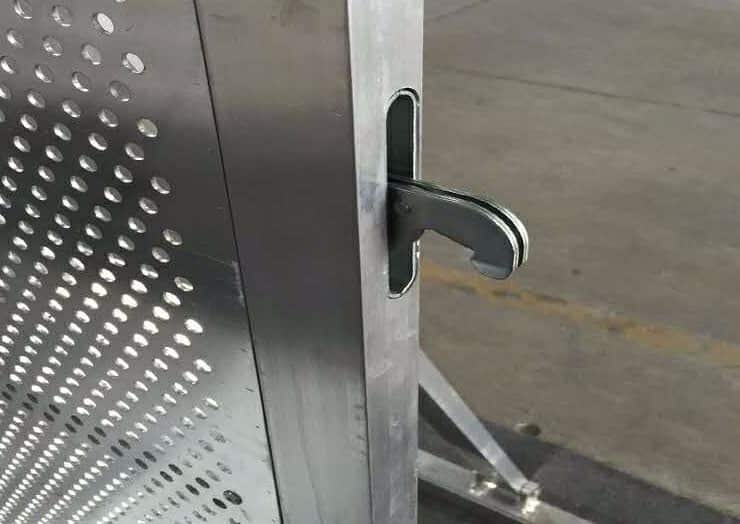
Panels join through hooks, pins or clamps at the posts, and the joint is where load passes from one section into the next. A hook resting in a slot without a positive stop can lift out under a bounce, and one section walking out of line turns a rated barrier into an unrated one. Link a sample pair before the container is booked. Our comparison of crowd barrier base types covers the same question from the foot side.
On hardstanding you may be able to anchor through the base. On a stage deck, a roof or a protected lawn you cannot, and the barrier holds its rating on weight and geometry alone — so ask which condition the figure was established in. The weight saved on an aluminium panel is weight you can spend on ballast without exceeding your crew’s manual-handling limit.
Ordering From Anping
Commercially the barrier line behaves like the rest of the range. The published minimum order for this factory’s fencing category is 100 panels. For a stage barrier line, the practical minimum is set on the quotation. Treat 100 panels as the category reference point and confirm the barrier figure in writing. Bulk production runs 20–25 days from order confirmation, stock configurations dispatch in 7 days, and quotes come back within 24 hours.
Trade terms are FOB, CIF, CFR, DDU or DDP, and payment terms are negotiable to the order. Australian and New Zealand buyers make up 75% of the market this factory sells into, with North America at 15%. DB Fencing is ISO9001 certified and SGS audited — the paperwork standing behind a specification sheet, not a replacement for it.
Australian buyers often work from AS 4687 (the Australian standard for temporary fence panels), which this factory’s fencing line is built to. Whether a stage barrier line at a public event sits inside that scope depends on the deployment and the authority reviewing it, so confirm the applicable requirements with the event’s safety authority. Our guide to buying temporary fencing from China covers the documentation sequence.
Frequently Asked Questions
What does a stage barrier load rating actually mean?
A stated capacity: the horizontal force a barrier section is credited with carrying, applied in a defined way at a defined height against a defined pass condition. Without the method, two suppliers’ numbers cannot be compared.
Are aluminium stage barriers weaker than steel barriers?
Not as a rule. The metal sets weight and corrosion behaviour; the frame section, joints and base set capacity. A lighter aluminium panel can carry a higher declared load, and the rating is the only way to know.
How deep should a stage pit be?
There is no universal depth. Pit dimensions typically depend on the venue, expected attendance, egress provision and the authority signing off the event, so build to the figure in your safety plan.
Do aluminium barriers need ballast?
The rating may assume a particular base condition, and that changes between grass, hardstanding and a stage deck. Where you cannot anchor through the base, ballast restores the assumption behind the figure.
What is the minimum order for aluminium stage barriers?
The published fencing-category minimum at this factory is 100 panels, and stage barrier quantities are confirmed on quotation. Bulk production runs 20–25 days, with 7-day dispatch on stock configurations.
Conclusion
A barrier line is specified on one document and tested on another, and the gap between them is where a line fails or a shipment gets rejected. Close it by demanding the rating with its method, the base condition that rating assumes, and the joint that transfers load between panels. Metal, finish, quantity and trade terms are procurement questions once those three are settled.
Send your layout drawing with the gate positions and the surface you deploy on, and ask for the test report reference and dimensioned drawing to come back with the 24-hour quote.