Skip to content
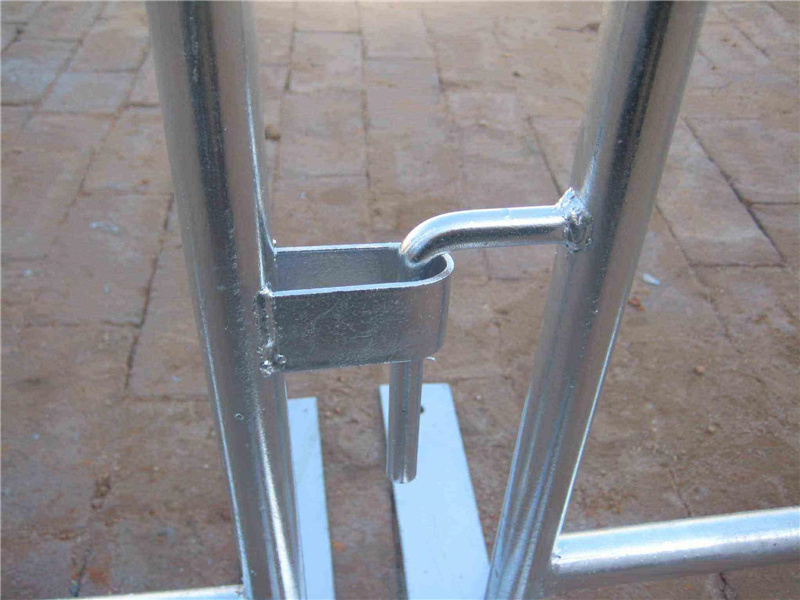
Outrigger crowd barrier bases are the part of a barrier line that meets a showground’s worst surface: cross-fall, worn turf and a kerb nobody drew on the plan. It is a shorthand crews use on site rather than a word these product pages use. DB Fencing’s barrier pages name the same hardware a flat base, a bridge base or a fix base, and describe the flat version as a steel base carrying one or two vertical tubes, so the first job on a sloping site is agreeing what the enquiry is buying.
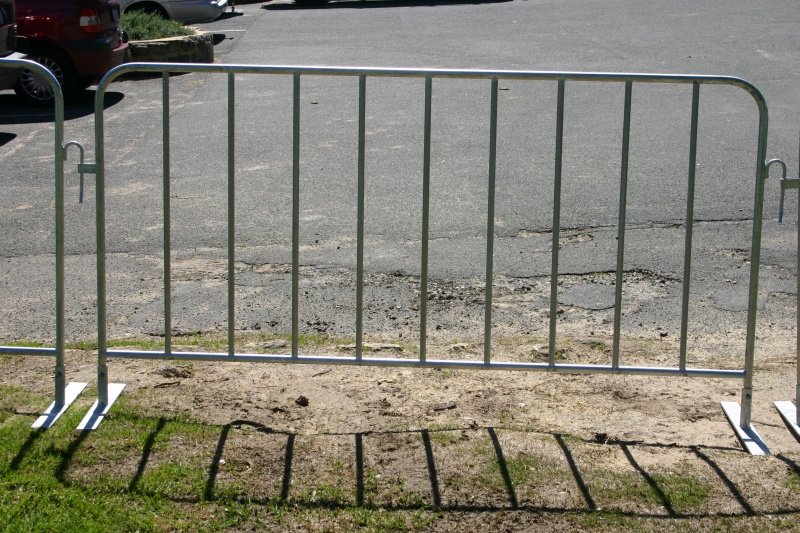
Panel geometry makes the problem visible. One page publishes heights of 1.1 m, 1.25 m and 1.5 m on widths to 2.5 m, and another gives a common size as 2.3 m long by 1.1 m high. A straight run of rigid frames laid across a fall shows the ground in its joints and under its rails, not in the infill.
Key Takeaways
- The three steel barrier pages checked here do not use the word outrigger. They name fix base, flat base, bridge base and cross feet, and one specifies the steel flat base as carrying 1 or 2 vertical tubes.
- No foot dimensions, footprint length, slope tolerance or ground-bearing figure is published for the steel barrier lines — those four are the questions to send before a turf order.
- A slope shows up in three places: the base contact patch, the gap under a bottom rail, and the offset each joint absorbs.
- Three levelling routes exist — step the line, rack it at the joints, or work the ground — and each asks something different of the base.
- On a cross-fall, look and press each flat plate before relying on the page note that flat feet reduce tripping: check whether it sits fully down or lifts an edge into the walking line.
- The barrier page ties the flat-foot style to Brisbane, Melbourne, Sydney and New Zealand; base-type comparison across families is covered separately on this site.
What The Pages Actually Name
Start with the vocabulary, because a showground RFQ and a factory specification sheet rarely use the same word. One barrier page lists feet types as flat, bridge and cross, gives a common size of 2.3 m long by 1.1 m high, and names its hook and lug options as interlocking hooks, bridge lugs and triangle lugs. A second carries the ladder this article keeps returning to: panel heights at 1.1 m, 1.25 m and 1.5 m, widths from 2.0 m to 2.5 m, the foot welded on the frame or removable, and base types given as fix base, flat base or bridge base. A third narrows to one model — height 1100 mm, length 2200 mm, frame tube 25 mm outside diameter, feet stated as a steel flat base with 1 or 2 vertical tube, hooked and eyed to an Australia Standard.
What is missing is the point. No page publishes the length of that base plate, how far it projects from the frame, what either vertical-tube variant does to the standing footprint, or how much ground bearing anything imposes on soft turf. Comparing one base family against another is a job this site has already done, in the crowd barrier base types guide; what follows is only about the sloping-turf case.

How A Slope Shows Up In A Rigid Line
A barrier frame is a rigid rectangle and a showground is not a plane, so the fall resolves itself in three places at once. The first is contact: a flat plate set across a slope touches down where it touches, and whether that is the whole footprint or a corner of it is the difference between a parked line and one that rocks when someone leans. Test it on the day by loading the top rail by hand at the ends of a run and at every corner, and record what moves.
The second is the gap. Level the frame and the downhill edge of the base lifts; keep the base flat and the frame tips off the vertical, which is the trade a stepped line makes deliberately and a racked line makes at the joint. Where the line also has to read as a straight edge to a crowd, that trade becomes a decision for the event controller rather than the crew.
The third is the hardware, and it is the one nobody checks until the second panel is out of hand. The pages list interlocking hooks, bridge lugs and triangle lugs, and describe a locking system on the flat-foot barriers, but publish no offset tolerance and no angular limit — the joint itself is covered in this site’s guide to interlocking crowd barriers. Ask which fitting is quoted, and how far two frames can sit apart in height or in angle and still engage and release by hand.
Three Ways To Level The Line
Stepping keeps each panel horizontal and lets the line drop, bay by bay, so the joints take a vertical offset. It reads tidily on a bank, needs nothing from the ground, and puts the whole question on the fittings: how much offset the hooks and lugs absorb before a crew has to lift rather than hang the next panel.
Racking keeps the base on the ground and tilts the frames relative to one another at the joint, which suits a continuous cross-fall along a footpath edge or a mounting yard. It asks the opposite thing — an angular tolerance the pages do not state — and it is the route where a removable foot is most likely to be re-set, since the foot is placed after the frame is leaned.
Ground works covers what steel cannot: packing, turf board over soft patches, or moving the line to the level side of a drain. That is the showground conversation, not the factory one — ask what the surfaces allow, whether anything may be driven into turf, and what the ground is like after rain on the days you need it. Then measure along the ground rather than across the plan and state the fall on the enquiry: panel count, corner count and accessory ratio all follow from that number, and a 2.2 m frame covers less than 2.2 m horizontally on a slope.
Specifying The Base For A Turf Perimeter
Read the base against the route you have chosen, not against the catalogue. The table is that pairing.
| Levelling route | What it asks of the base | What to confirm in writing |
|---|---|---|
| Stepped line, panels held level | A plate long enough to sit fully down at each step | Hook and lug offset tolerance |
| Racked line, base kept down | Welded feet, or removable feet that re-seat by hand | Angular tolerance at the joint |
| Packed or boarded ground | A footprint wide enough not to trip on the packing edge | Foot projection from the frame line |
| Soft or saturated turf | More bearing area, or a board under the foot | Ground bearing — no figure is published |
| Kerb, drain or hard-edge crossing | Feet that sit clear of the obstruction | One or two vertical tubes, and what each does to the footprint |
Six lines settle it. Which base family, and whether the foot is welded or removable; the footprint length and its projection from the frame; what the 1 and 2 vertical-tube versions change when standing; which hook and lug style is fitted and what offset or angle it tolerates; the coating under the foot, since a watered-in line lives or dies there — this site specifies outdoor hot-dip galvanising above 42 microns and asks which figure covers the feet; and, if the perimeter carries a crowd-density expectation, what load rating the supplier will put in writing, because none appears on these pages.
Frequently Asked Questions
What are outrigger crowd barrier bases?
A shorthand crews use for the stabiliser foot that projects from a barrier frame to the ground; it is not a term these pages use. The three pages checked here name the same parts flat base, bridge base, fix base and cross feet, and specify one as a steel flat base with 1 or 2 vertical tubes. Foot dimensions are not published, so ask for them.
Can a crowd barrier line be levelled on a sloping site?
Yes, by stepping each panel level, racking the frames at the joints, or packing and boarding the ground. No slope or offset tolerance is published for these barriers, so the limit of each route is set by the hook and lug geometry you confirm in writing before delivery.
Do removable feet matter on turf?
The pages list feet as welded on the frame or removable, and state that removable flat feet make transport and storage easier. On soft ground the working question is different: whether the foot still seats flat and true after being struck and re-set every event, which is a site check rather than a published figure.
Which barrier height suits a showground perimeter?
Panel heights are published at 1.1 m, 1.25 m and 1.5 m, with a common size given as 2.3 m long by 1.1 m high. Choose on what the line has to do. No load rating appears on these pages, so put any crowd-density or barrier-load expectation to the supplier and to your event safety controller in writing.
Conclusion
Outrigger crowd barrier bases are where a showground slope stops being a drawing and becomes a crew problem, and the pages behind this article are honest enough about what they do not say: no footprint length, no offset tolerance, no ground-bearing figure, no load rating. Those four gaps decide whether a line stands level on turf, so they belong in the enquiry rather than in a hope.
Walk the site once with a level and a tape, write the fall down beside the panel count, and send the six confirmation lines with it. Start from the crowd barrier specification page, which carries the feet types and the common 2.3 m by 1.1 m size, and put the height and width ladders and the missing foot dimensions to the supplier on the same enquiry.