Skip to content
Diagonal bracing props are the accessory line that every temporary fencing quote seems to size differently. Quotes for the same line commonly drift between “one prop every ten bays” and “one at each end” — and neither number came from the catalogue. DB Fencing sells bracing as a standalone accessory — alongside panels, feet, clamps and ballast blocks — and the Australian temporary fencing product page ties it to two conditions: a particularly long fence line, and a line exposed to strong winds.
The honest answer to “how many end bays need one” is not published on the pages read for this guide. A buyer who demands the count position by position gets a safer line than one who accepts a rule of thumb.
Key Takeaways
- The product page presents bracing as extra support for a long fence line or one exposed to strong winds (per the product page wording).
- Two parts share the word bracing: a mid-panel brace tube across a panel’s centre, and a diagonal prop leaning from a post to a base. This article is about the prop.
- No page read for this article publishes a bay count — props per end bay, return or gate are not numbers the catalogue gives, and no one should sell them to you as a universal rule.
- Panel size changes the arithmetic: the heavy-duty panel is 2400 x 2100 mm on a 40 mm tube, the maxi is 3300 x 2100 mm, so the same perimeter carries a different number of joints — and of default bracing positions — depending on which one you order.
- The fix: draw the perimeter, mark every free end, return and gate, and get the prop count per marked position signed by whoever signs the site layout.
One Word, Two Parts
Ask for bracing and two different parts can arrive under that name. The first is a brace tube fitted across the middle of a panel — a stiffener for the mesh and the frame pipe. The second is the diagonal prop: a steel stay that leans from high on a post down to a base at the ground, taking the line’s push into the footing.
They answer different questions. Where the mid-panel tube sits, and what a 3300 mm maxi run does to spacing, is worked through in this site’s guide to maxi panel bracing centres and deflection. The prop is the post-side part: it braces at joints, ends and gates.
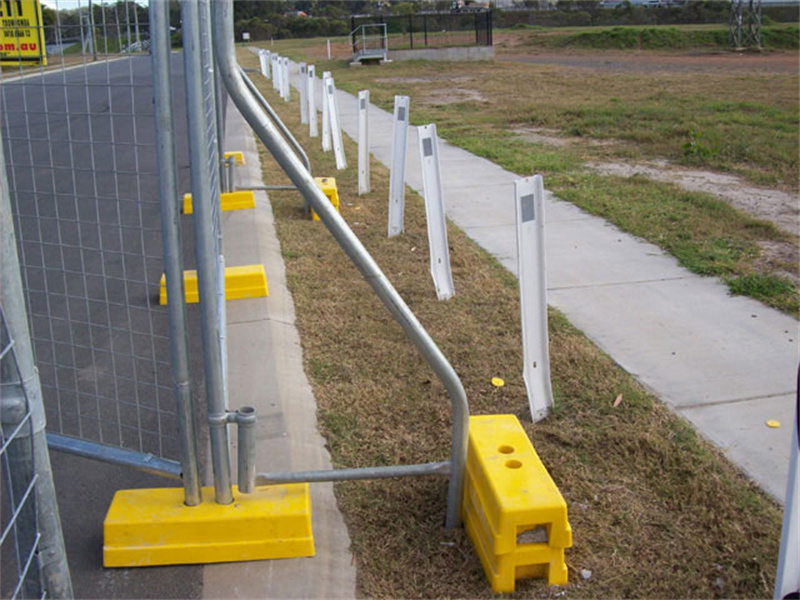
Quote sheets muddle this because the vocabulary drifts — stay, prop, brace, end brace — and a line reading “bracing: 10 off” without positions cannot be checked. Write the part and the place together: prop at the north end, prop both sides of the return. The product page describes the bracing line as easy to install and remove without specialised tools (per the product page), so props can move as site conditions change. What should never move is the agreed count per marked position.
Why the End Bays Carry What Mid-Runs Do Not
Down the middle of a long run, every panel has two neighbours. Wind pushes one panel, the clamped joint hands part of that push to the next frame, and the load spreads before it reaches a base. At the end of the line there is no next panel. The last post takes the push alone, and it leans toward the open side unless something props it.
A return — where the fence turns ninety degrees — concentrates the same push into one shared post pulled from two directions. A gate is a deliberate hole in the line: the two posts framing a swing leaf carry what the missing panel used to. Read that way, “how many end bays need one” resolves into a simpler instruction — every free end, every return and every gate frame is a bracing position first, and mid-run spacing is a separate decision.
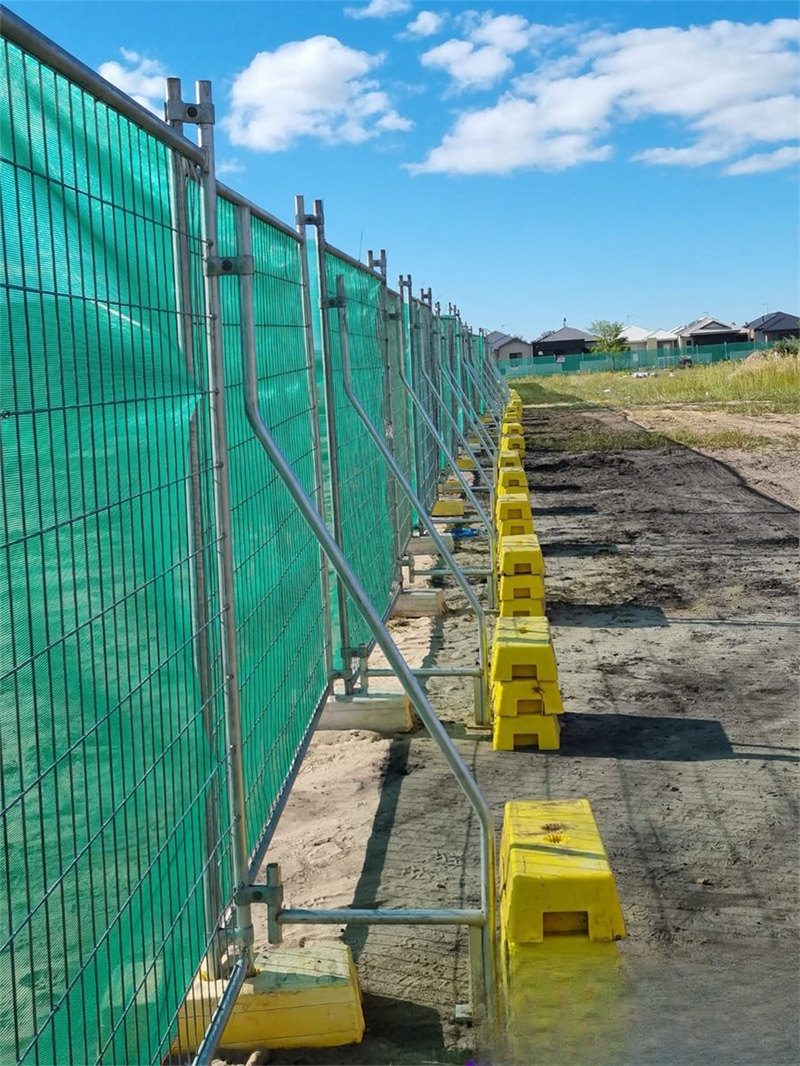
Sheeting raises the stakes, and this is the one place the catalogue speaks: the Australian temporary fencing page presents bracing as the answer for a particularly long line or a wind-exposed one (per the product page). If your line is sheeted — the run in the photo above is a sheeted one, and a sheeted line behaves differently from a bare mesh — ask the sheeting supplier and your hire company, in writing, what the sheeted sail area does to the prop count. No page here publishes that number.
Opinion, stated plainly: the ends, not the middle, are where a bracing budget earns its keep. A run with sparse centres and properly stayed ends stands up better than the reverse — and the reverse is what a per-ten-bays rule buys you.
The Count Nobody Publishes — Ask Position by Position
Here is what a buyer can check. The pages read for this article — the Australian temporary fencing solutions page, the temp fence manufacturer page and the maxi panel page — list bracing as an accessory and explain its job, but none states a prop-per-bay figure, an end-bay rule or a corner requirement. That is not a factory oversight: stay counts depend on the site, the panel choice and the ground. Treat any number as a site-specific instruction and get it from the person who signs the layout — the hire company’s estimator or the site engineer — not from a product page.
Australian site work runs against AS 4687 for temporary fence systems, and the temporary fence pages here state compliance with AS 4687-2022 and AS 4687-2007 (per the site’s compliance wording). No clause number is quoted in this article, and no one selling to you should wave a clause number as a universal bay rule — system compliance is the standard’s subject; the count per position is a project decision.
| Position on your sketch | What to state on the order | Published here? | Who settles it |
|---|---|---|---|
| Every free end | Props per end, and which way each leans | No | Estimator or site engineer |
| Corner / return | Prop either side of the corner post | No | Noted on the layout sheet |
| Gate frames | Gate-end treatment per leaf, matching swing direction | No | Site manager signs openings and bracing together |
| Mid-run centres | Spacing for the panel you order — 2400 x 2100 mm heavy-duty or 3300 x 2100 mm maxi | Sizes yes, spacing no | Confirm against wind and any sheeting |
The asymmetry is the trap: the sizes that change the arithmetic are published, and the count that depends on them is not. A 100 m perimeter works out to roughly 30 maxi bays instead of roughly 42 standard panels — about 30% fewer joints and default bracing positions — so a copy-pasted prop count from a previous job quietly under-braces the new one.
Turning the Bracing Question Into an Order Line
Start from a sketch, not a catalogue. Draw the perimeter, count the bays, then mark E at every free end, R at every return, G at every gate frame. Those marks are your bracing positions. Total them and put the per-position count on the order — “props: two E, three R, two G” beats “bracing: 10 off” on every check that follows.
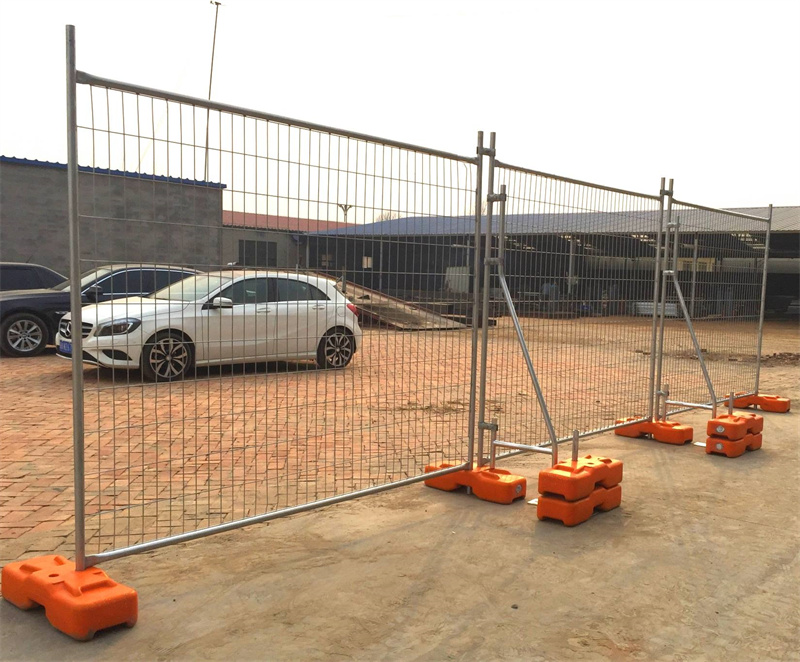
Then fasten the answer to the rest of the order. A prop is only as good as how it meets post and ground: ask which clamp or bracket each prop uses and count that hardware separately from panel-to-panel couplers — the site’s guide to counting fixings in a joint works through the clamp arithmetic. At exposed ends, ask whether the base under the prop is a plastic foot, a ballast block or reusable ballast; all three are accessory lines here, and the right answer is a site answer.
On coating, the factory states hot-dip galvanising above 42 microns for the temporary and outdoor fencing line — make the quote state the coating on the props as the same hot-dip galvanised line used for the panels. On commercials, the known parameters hold: MOQ of 100 panels on production, 20-25 days bulk lead time, 7-day dispatch on stock items, quote inside 24 hours. ISO9001 certification and SGS audit status are stated by the factory; no certificate number is quoted here, and no test instrument for props is published on the pages read here. Where a figure is missing, the written confirmation is the deliverable.
Frequently Asked Questions
Does every end of a temporary fence run need a diagonal brace?
Treat every free end as a bracing position, then get the per-position count in writing. No page read for this guide publishes a bay rule; the number that fits your line comes from length, wind exposure and any sheeting, signed by the estimator or site engineer.
Is a diagonal prop the same part as a mid-panel brace?
No. A mid-panel brace is a tube stiffening the panel across its centre; a diagonal prop leans from a post down to a base and braces the frame. They solve different failures, and a quote that says only bracing covers neither.
Do gate openings need extra bracing?
The posts framing a gate carry what the removed panel used to, so a gate frame is a bracing position before anything else on the line is. State the treatment per leaf, matching the swing direction, and have the site manager sign it with the opening.
How many clamps does each brace need?
It depends on the fixing you choose. Clamps and bracing are listed as separate accessory lines without a published per-prop clamp count, so ask for the fixing list per position and count it apart from panel couplers.
Conclusion
The end-bay question has a real answer, just not a published one: every free end, every return and every gate frame needs a stated treatment, and mid-run centres are a second decision sized by the panel you actually ordered. Putting that on paper costs less than the first gust that tests an unbraced end.
Before your next temporary fencing order, mark the ends, returns and gates on a perimeter sketch and send it with the request. The prop count, the fixing list and the base choice all change with that answer — and a quote built position by position reads very differently from one built by rule of thumb.