Skip to content
Every month, a distributor somewhere loses a few thousand dollars because a farmer asked their crew how to cut cattle panels on-site, and the crew did exactly what you’d expect—they grabbed an angle grinder. The cut looks fine for a week. Then animal urine hits that bare, exposed steel at the weld node, and within three months, you get a pallet of rusted panels shipped back to your warehouse. You voided your own warranty the second that abrasive wheel destroyed the 42-micron hot-dipped galvanization, but the farmer doesn’t care about metallurgy. They just want a refund or a replacement.
We pulled the rust-failure data from our warranty claims over the last three years and mapped it against field modification versus factory pre-cutting. The difference in total cost per panel is staggering once you factor in the 15 to 20 minutes of manual labor, the cold-galvanizing spray, and the freight on returned goods. This breakdown walks through exactly what happens to that zinc layer when you cut a 4mm wire, why ordering custom lengths from our manufacturing lines shifts the liability back to us, and the exact labor math you should hand your field crews before they modify another stock panel.
Best Tools to Cut Cattle Panels
For 4mm-5mm galvanized cattle panels, 24-inch bolt cutters and 4.5-inch angle grinders with 1.6mm discs are the only field-viable tools. Everything else wastes labor or destroys panel integrity.
Bolt Cutters vs Angle Grinders
We test cutting tools against our standard cattle panels—4mm to 5mm diameter wire with a >42 micron hot-dipped galvanized finish. The results are clear: 24-inch bolt cutters make clean single-wire cuts with minimal edge deformation. A 4.5-inch angle grinder fitted with a 1.6mm cutting disc slices through the same wire faster, but it vaporizes the zinc coating at the cut edge and throws hot metal sparks into the surrounding galvanization.
The 14-inch bolt cutter is a common mistake we see distributors make. On 4mm-5mm wire, the longer handles flex before the jaws generate enough force to shear the steel. The result is a mangled, partial cut that forces your field crew to finish the job with a grinder anyway. You just doubled the labor cost on a single panel for no reason.
- 24-inch Bolt Cutters: Cuts one wire in 3-5 seconds. Leaves a clean edge. No sparks, no heat damage to adjacent zinc. Best for low-volume field adjustments.
- 4.5-inch Angle Grinder (1.6mm disc): Cuts one wire in under 2 seconds. Destroys local zinc layer by heat. Requires immediate cold galvanizing spray within 2 hours to prevent flash rust.
- 14-inch Bolt Cutters: Fails consistently on 4mm-5mm wire. Jaws spread under load. Adds unnecessary steps to the workflow.
Reciprocating Saw Limitations
Some of our distributor clients tried reciprocating saws with metal-cutting blades to speed up panel modification. Our engineers inspected the results and found two structural problems that make this tool unacceptable for galvanized cattle panels.
First, the reciprocating action transfers excessive vibration through the welded wire joints. On a standard 4.8m panel weighing roughly 32 kg, this vibration causes micro-cracking at the weld nodes—the exact points where the 4mm or 5mm wire meets the vertical stay wires. Second, the blade’s aggressive push-pull motion warps the panel geometry. A corral panel that leaves your warehouse flat arrives on-site with a visible bow, and the farmer will reject it on sight.
The real cost is not the blade or the tool. It is the 15 to 20 minutes of labor per panel to cut, inspect for warped joints, and apply cold galvanizing spray. At that burn rate, ordering factory pre-cut panels at a slight per-unit premium costs less than paying a crew to butcher stock panels in the field and absorbing the warranty returns when those cut edges corrode.
Step-by-Step Cattle Panel Cutting Guide
Field-cutting a 4.8m cattle panel destroys the factory >42 micron zinc layer, exposing your distribution business to preventable rust returns and warranty disputes.
Marking and Securing the Panel
At roughly 32 kg per panel, a standard 4.8m cattle panel will sag under its own weight if improperly supported. Place two heavy-duty sawhorses approximately 1.2 meters from each end. Use C-clamps or locking pliers to secure the vertical stay wires directly to the sawhorses to prevent the panel from spinning or vibrating during the cut.
We strongly recommend assigning two workers for this process. One person operates the tool while the other manages panel stability. Attempting to cut a 4.8m panel solo on sawhorses creates an unbalanced pivot point that pulls the grinder blade off-line, resulting in jagged edges that farmers will reject on delivery.
Mark your cut line exclusively at a wire intersection. Position your mark on the vertical stay wire where you want the new panel end to terminate. Never cut in the middle of a horizontal wire span, as this leaves sharp, unsupported barbs that fail safety compliance and injure livestock.
Cutting Between Wire Intersections
For 4mm to 5mm diameter galvanized wire, an angle grinder equipped with a 1.6mm or 2.0mm cutting disc is the most efficient tool on-site. Position the grinder blade to cut the horizontal wires flush with the marked vertical stay wire. Your goal is to sever the horizontal wires while leaving the vertical wire intact to serve as the clean, finished edge of the new panel.
Cutting directly through the weld nodes is the critical mistake your field crews must avoid. Slicing through the weld joint breaks the factory hot-dipped galvanization seal at that exact node. When this exposed raw steel sits in moist soil or contacts animal urine, it triggers accelerated crevice corrosion at the cut edge.
Even with a perfect flush cut, you have locally destroyed the >42 micron zinc protective layer. To prevent flash rust, your crew must apply a cold galvanizing compound spray containing 93% zinc within two hours of cutting. This restores roughly 30 to 40 microns of protection, but it will never match the metallurgical bond of factory hot-dipping. When you calculate the 15 to 20 minutes of labor per panel for cutting, cleaning, and spraying, the hidden costs escalate quickly. For distributors fulfilling specific corral configurations, ordering factory pre-cut livestock panels eliminates this field labor, prevents premature edge rust, and legally shifts the warranty liability back to our production lines.
| Step | Action Required | Tool / Material Spec | Hidden Cost / Risk | B2B Solution |
|---|---|---|---|---|
| 1. Measurement | Mark the 16ft (4.8m) panel to specific corral configurations requested by the farmer. | Tape measure, industrial marker | Mismeasurement wastes a 32kg panel and drives up on-site modification time. | Order factory pre-cut panels to exact lengths, eliminating field measurement errors. |
| 2. Physical Cutting | Manually shear through the heavy gauge wire to separate the panel. | 24-inch bolt cutters (for 4mm-5mm wire thickness) | Consumes 15-20 minutes of labor per panel; instantly destroys the >42 micron hot-dipped zinc layer. | Automated factory cutting executes in seconds without damaging the base galvanization. |
| 3. Edge Treatment | Immediately coat all bare edges, specifically at weld nodes, to prevent oxidation. | Cold galvanizing spray (93% zinc content, restores 30-40 microns) | Must apply within 2 hours to stop flash rust; untreated weld nodes suffer crevice corrosion from urine/moist soil. | Factory pre-cuts preserve the original hot-dip coating, requiring zero field rust treatment. |
| 4. Curing & Deployment | Allow the zinc spray to properly cure before moving the panel into the livestock corral. | Standard drying time per spray manufacturer | Improper field treatment voids the factory warranty, triggering costly customer returns and disputes. | Ship intact panels to retain 100% of the manufacturer’s warranty and protect per-panel margins. |
Preventing Rust on Cut Panel Edges
Field-cutting cattle panels breaks the factory zinc seal, triggering rapid edge rust and warranty disputes. Factory pre-cutting eliminates this liability entirely.
Cold Galvanizing Spray Application
When your crews cut 4mm to 5mm wire on-site, the hot-dipped zinc layer is destroyed at the shear point. Exposed bare steel begins oxidizing within hours, and in agricultural environments where panels contact moist soil and animal urine, this accelerates into crevice corrosion at the weld nodes. The only viable field repair is a cold galvanizing compound containing 93% pure zinc in a carrier solvent.
This spray works by depositing zinc particles onto the bare steel, restoring cathodic protection through sacrificial action. The critical constraint is time. Our field tests show that flash rust begins forming on freshly cut carbon steel within 90 to 120 minutes in humid conditions. The spray must be applied within that 2-hour window after wire brushing any burrs. Even with perfect execution, the resulting coating averages only 30 to 40 microns of zinc.
Why Factory Pre-Cut Lasts Longer
The durability gap between factory-coated edges and field-treated edges is not marginal. Our automated welding lines at DB Fencing produce panels with a continuous hot-dipped galvanized finish exceeding 42 microns across the entire wire surface, including the edges. This thick zinc-iron alloy layer is metallurgically bonded to the steel, making it highly resistant to physical abrasion during transport and installation.
A field-applied cold galvanizing spray cannot replicate that bond. The 30 to 40 micron layer sits on the surface as a mechanical coating. It scratches off easily when panels are stacked, loaded onto trucks, or dragged across gravel. Once that thin spray layer is compromised, the edge rusts exactly as if it were never treated at all.
For wholesalers, this creates a direct financial exposure. A farmer receives a field-modified panel, sees rust forming at the cut edges within months, and returns the product. The distributor absorbs the replacement cost and the labor. When DB Fencing supplies factory pre-cut panels at custom lengths down to a 100-panel MOQ, the full >42 micron factory coating remains intact on every edge, and the manufacturing warranty stays valid. The labor cost of 15 to 20 minutes per panel spent cutting and spraying in the field gets eliminated from your operational overhead entirely.
Safe Cattle Panel Transport Methods
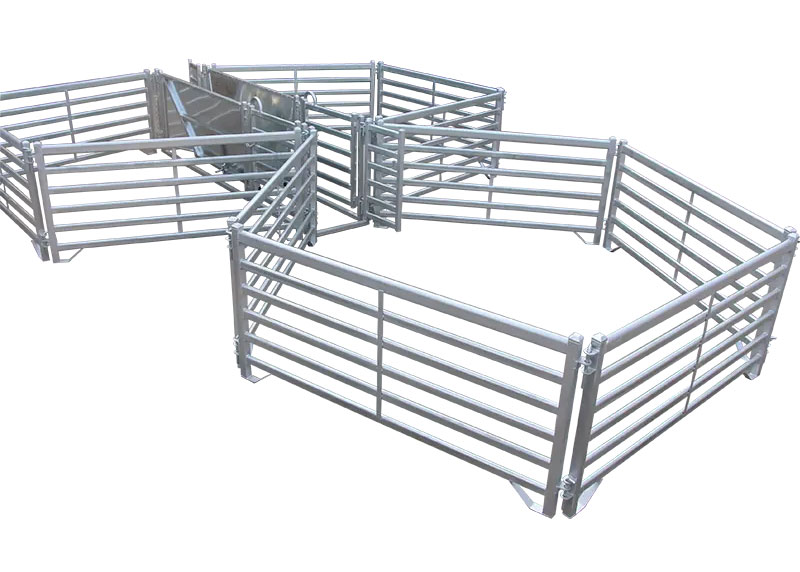
Improper freight handling bends panel legs, turning a profitable bulk order into a field modification nightmare. Here is how we secure 32 kg panels to prevent transit damage.
Flat Stacking for Bulk Orders
When calculating temporary fence panels per container loading for FOB China shipments, flat stacking is the mandatory method for cattle panels. A standard 4.8m panel weighing approximately 32 kg requires strict stacking density parameters to prevent structural deformation during ocean transit.
The critical mistake we see from less experienced freight handlers is point-loading. If you stack panels directly on uneven dunnage or let the bundle sag mid-span, the vertical 4mm to 5mm wire legs bear concentrated weight. This permanently bends the panel feet, forcing your field crews to spend 15 to 20 minutes manually straightening each panel before installation.
- Dunnage Placement: Use a minimum of three equally spaced wooden runners across the 4.8m length to distribute weight evenly and eliminate mid-span sagging.
- Stacking Density: We standardly band 50 to 60 panels per bundle, secured with steel strapping at four equidistant points to prevent lateral shift.
- Weight Distribution: The total bundle weight rests entirely on the runners, ensuring zero compressive stress transfers to the individual panel legs.
A-Frame Hauling for Small Loads
For domestic distributors moving partial loads—such as our 100-panel MOQ—on flatbed trucks, A-frame racks are the preferred choice. While efficient for maximizing trailer floor space, A-frame hauling introduces a high risk of panel warping if the rack geometry is wrong.
The primary cause of warping is an A-frame angle that is too steep. When panels lean past a 30-degree angle from vertical, gravitational force shifts from compressive support to lateral shear. This bends the horizontal wires and twists the heavy gauge mesh out of square, ruining the panel for tight corral connections.
- Rack Angle: Maintain a lean angle between 10 and 25 degrees from vertical to keep gravity pushing the panels flush against the rack.
- Support Points: A-frame crossbars must contact the panel at the vertical stay wires, never the open mesh spaces, to prevent diamonding.
- Securing Method: Apply ratchet straps over the top third of the stack only. Strapping over the middle creates a pivot point that bows the panels under vibration.
Specifying proper flat stacking or A-frame configurations protects your margin from the moment it leaves our dock. Bending a galvanized panel to straighten it micro-cracks the zinc layer at the stress points, inviting the exact premature rust your agricultural customers will reject.
Conclusion
Stop field-cutting panels for your customers. Paying a crew 20 minutes per panel to slice 4mm wire and spray cold galvanizing costs more than ordering pre-cut lengths. We run custom sizes through automated lines in seconds, keeping the >42-micron hot-dip zinc intact so you never eat a return over edge rust.
Send us your exact corral layouts next time a farmer requests odd sizes. We will quote the pre-cut lengths so you can run the math against your field labor rate.
Frequently Asked Questions
Best tool for cutting cattle panels?
While 24-inch bolt cutters offer excellent portability for agricultural wholesalers making field adjustments, they require significant manual effort for heavy-duty wire. At DB Fencing, we utilize factory automated cold saws for bulk custom cuts, guaranteeing precise dimensions without warping the 4mm-5mm wire. Leveraging our 10 advanced welding production lines, we provide precise factory pre-cutting that eliminates the need for your end-users to risk uneven cuts on-site.
Do cattle panels rust easily?
Premium factory hot-dipped galvanized cattle panels, like those manufactured by DB Fencing with a >42-micron zinc coating, are specifically designed to resist rust in harsh seaside or outdoor agricultural environments. However, any field-cut edge immediately exposes bare steel, which will begin to oxidize within weeks in high-moisture climates if not treated. This is why we recommend our wholesale distributors order factory pre-cut panels to ensure the full galvanized rust-proof integrity is maintained across the entire product.
How thick are cattle panels?
Standard heavy-duty livestock panels typically utilize a robust 4mm to 5mm diameter wire to safely contain cattle and sheep. Slicing through this gauge in the field demands heavy-duty 24-inch bolt cutters or an angle grinder equipped with a 1.6mm metal-cutting disc. As a leading manufacturer with 14 years of export experience, DB Fencing precisely engineers this heavy-gauge wire to meet rigorous standards like AS 4687-2022, ensuring maximum structural integrity for your customers.
How to transport cattle panels safely?
To transport cattle panels safely without damaging the >42-micron galvanized finish, stack them flat on a flatbed trailer and secure them tightly with ratchet straps over the top and bottom thirds. For smaller loads of fewer than 10 panels, utilizing an A-frame rack prevents warping and optimizes trailer space for mixed freight. At DB Fencing, our robust packaging protocols ensure these heavy-duty panels arrive at your Australian or North American distribution centers in pristine, ready-to-sell condition.
Should I buy pre-cut panels?
Absolutely, purchasing factory pre-cut livestock panels is the most strategic choice for global fence distributors and agricultural wholesalers. Pre-cutting at our Anping facility eliminates costly field labor, ensures consistent dimensions for streamlined inventory management, and guarantees that all edges retain their full rust-proof warranty. With our low MOQ of just 100 panels and 24-hour quoting, DB Fencing makes it highly efficient to source custom-sized, fully protected panels directly from the manufacturer.