 Skip to content
A rental operator in Texas lost a $90,000 summer contract last year because the temporary fencing he shipped to a 5,000-person music festival buckled under crowd surge at the stage front. He specified site panels on his purchase order instead of crowd-rated barriers, and his supplier fulfilled it without flagging the error. When you build a concert crowd control plan around the wrong steel gauge and a missing interlocking hinge system, those panels collapse under lateral load, people get hurt, and your insurance carrier drops you.
This playbook covers the exact barrier configurations for stage front V-formations, pedestrian routing, and choke point mitigation using the 2300mm by 1100mm double-interlocking spec that actually holds. You will also find the 40ft HQ container capacity math and the galvanization thresholds that separate a rental fleet lasting five seasons from one that rusts out after a single rainy festival circuit.
Crowd Barriers vs Site Fencing
Section generation failed for Crowd Barriers vs Site Fencing.
Why Site Fences Fail Under Pressure
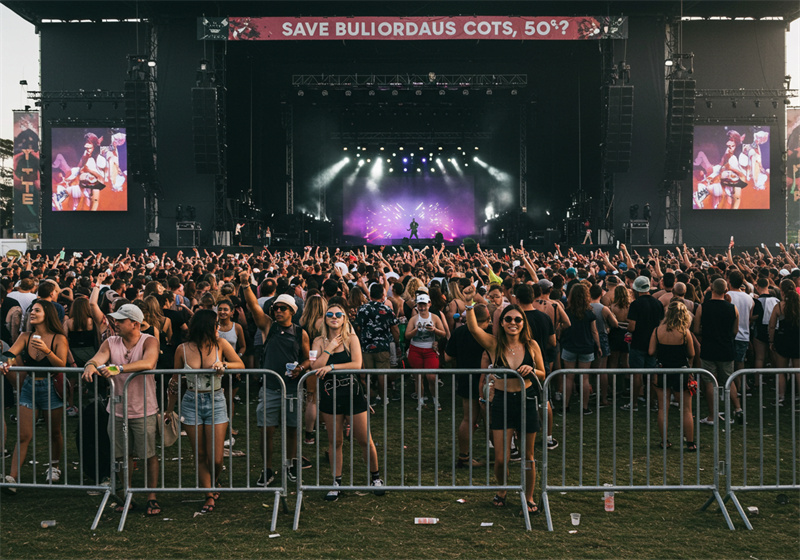
Site fencing is engineered for perimeter delineation, not dynamic lateral crowd loading. Deploying it at a concert creates a negligence liability that lands on the rental company, not the factory.
The Load Rating Mismatch
Temporary site fencing panels are designed to keep casual trespassers out and mark boundaries. The Australian Standard AS 4687-2022 covers these panels for construction and temporary hoarding applications. It does not certify them for crowd compression scenarios.
When a crowd surges against a site fence panel, the load is dynamic and sustained. The weld joints at the mesh-to-frame connection points experience shear forces they were never tested to handle. The panel bows inward, the base feet lift off the ground, and the fence folds flat. At that point, it stops being a barrier and becomes a tripping hazard across a packed crowd.
The 2010 Love Parade disaster demonstrated what happens when crowd management infrastructure fails under compression. While that incident involved tunnel design, the underlying physics are identical: crowd force multiplies rapidly in confined spaces, and the barrier system is the last line of defense.
Why Standard Clamps Separate Under Pressure
Site fences connect using simple gravity clamps or bolt-on couplers. These connections have lateral play by design, allowing panels to be set at angles on uneven ground. Under steady crowd pressure, that play becomes a failure mechanism. Each panel shifts slightly, the clamp loses its grip on the vertical frame, and the chain reaction collapses a 20-meter fence run in seconds.
Crowd control barriers use a fundamentally different connection geometry. DB Fencing’s crowd barrier systems use double interlocking hinge points at each panel junction. This configuration transfers lateral force from one panel to the next down the entire run, distributing load rather than concentrating it at a single clamp joint.
Spec Thresholds That Separate the Two Product Classes
If you are quoting a festival contract and a supplier offers you “metal barriers” without specifying the product class, request these exact data points before committing:
- Panel dimensions: Crowd-rated barriers run 2300mm (L) x 1100mm (H). Site fence panels are typically taller and narrower, 2100mm x 1800mm or similar.
- Connection type: Double interlocking hinge points indicate crowd-rated design. Gravity clamps or separate bolt couplers indicate site fencing.
- Frame profile: Crowd barriers use a flat, low-center-of-gravity frame (typically 32mm or 40mm round tube) designed to stay grounded under lateral push. Site fences use boxed or heavier sections optimized for wind resistance, not crowd load.
- Base footprint: Crowd barriers use a wide, flat foot profile. The plastic feet DB Fencing manufactures in-house are specifically sized for crowd barrier stability, not generic fence bases.
If a supplier cannot confirm these specifications or responds with “they’re all the same,” you are dealing with a vendor who does not understand the application. For a rental company, that is a contract-killing risk.
The Galvanization Problem for Outdoor Rental Fleets
This is where margin erosion happens silently. Electro-galvanized barriers, which represent the bulk of low-cost exports from China, apply a zinc coating of 8 to 15 microns. In a coastal festival environment or a region with high summer rainfall, that coating begins oxidizing within a single season. The barriers look corroded by year two, and your clients start requesting “new stock” or switching to a competitor.
DB Fencing applies a hot-dipped galvanized finish exceeding 42 microns across its crowd control barrier range. Based on our export data to Australia and New Zealand, where 75% of our production ships, barriers with this finish consistently last five or more seasons in outdoor deployment without visible corrosion. The per-unit landed cost is higher, but the depreciation schedule is dramatically longer.
For a distributor calculating margin per rental unit over a fleet lifecycle, the galvanization spec is not a detail. It is the difference between a barrier that pays for itself in three rentals and one that becomes scrap metal after twenty.
Crowd-Rated Barrier Specifications
Section generation failed for Crowd-Rated Barrier Specifications.
Table generation failed.

Concert Barrier Layout Configurations
Section generation failed for Concert Barrier Layout Configurations.
Stage Front V-Shape and T-Shape
Section generation failed for Stage Front V-Shape and T-Shape.
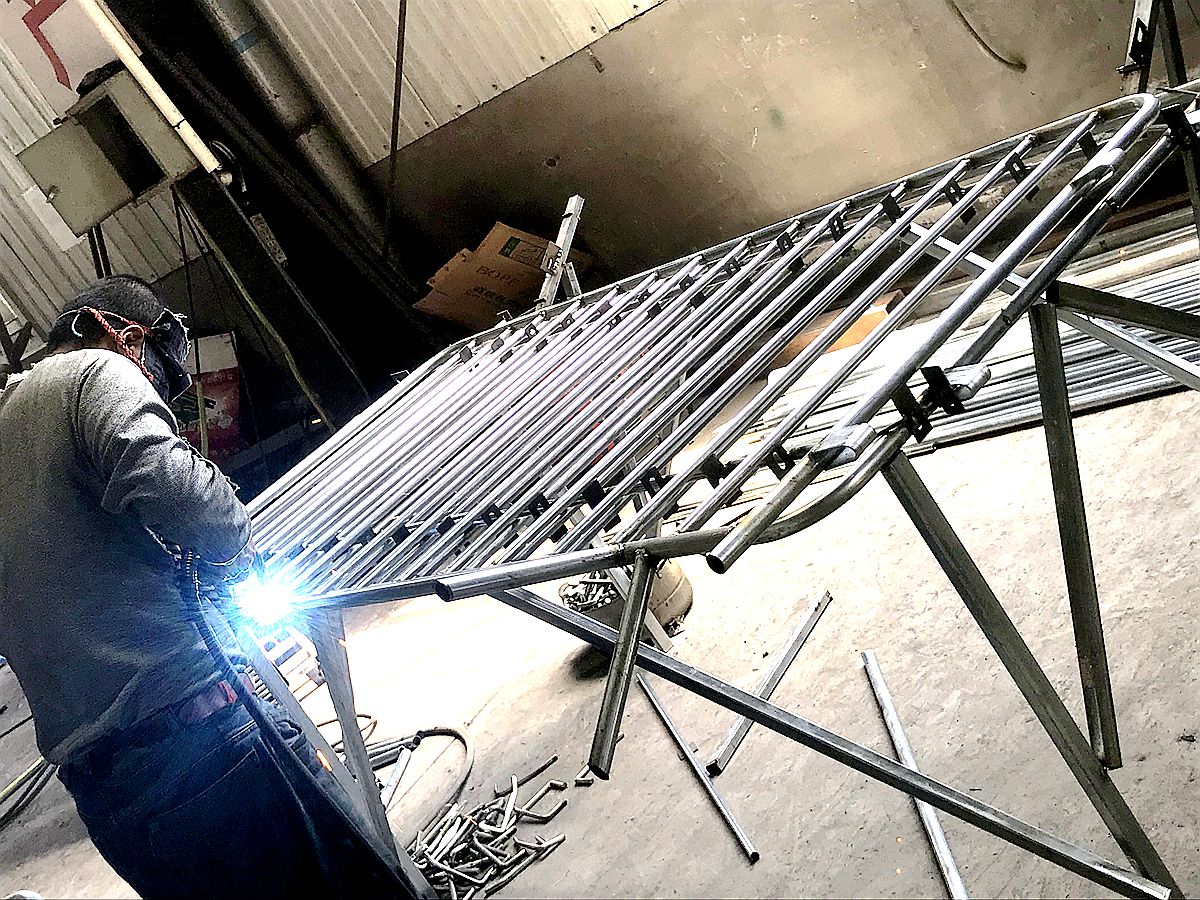
Discover Professional Crowd Control Barrier Solutions.
Queuing Lane Design for Entry
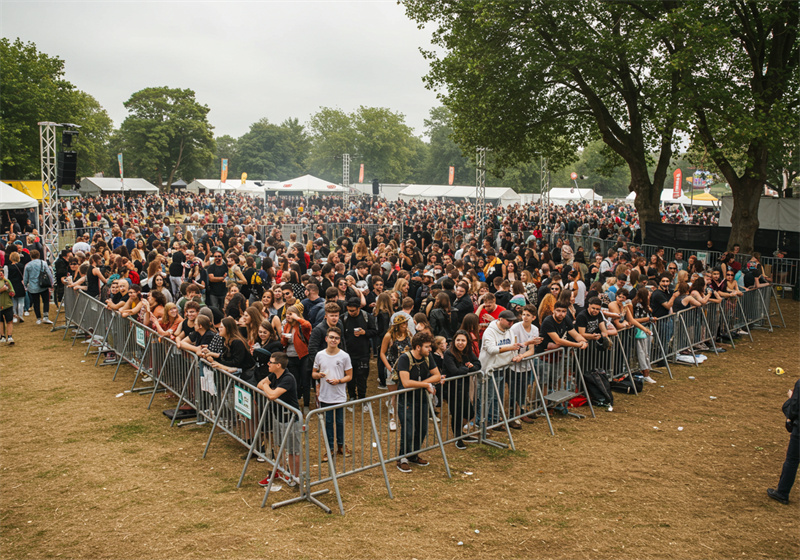
Queuing lane width dictates barrier count. Miscount by 10% and your crew is short on site. Calculate per 2300mm segments, not vague “lane meters.”
Lane Width Standards and Barrier Segmentation
Single-file queuing lanes require a minimum clear width of 1100mm to accommodate one person with bags. Since a standard crowd control barrier panel measures 2300mm in length, a single barrier placed as a lateral divider spans slightly more than two body-widths. This means one panel per segment is sufficient for standard single-lane queuing. For double-file lanes where two streams converge toward a single entry point, the required clear width jumps to 2300mm to 2750mm, translating to one to two barrier panels per lateral segment depending on the venue’s target throughput rate.
Serpentine Configuration Math
The most common queuing layout for venue entries is the serpentine or switchback pattern. Each switchback turn requires a minimum turning radius of 1500mm to prevent crowd friction at the pivot point. In practice, this means each U-turn consumes three barrier panels: two parallel lateral dividers and one short connecting segment. A standard 20-meter queuing lane with four switchback turns will require approximately 18 to 20 panels for the lateral walls plus 4 to 6 panels for the internal cross-connections and end caps.
The interlocking hinge system on DB Fencing’s 2300mm x 1100mm barriers is the critical spec here. Each panel features double interlocking hinge points that allow a swivel angle up to 90 degrees without losing lateral structural integrity. Cheap site fencing with single hook-and-eye connections will separate at the pivot point under crowd compression when configured at angles. For a rental company, that separation is a liability event, not just a setup inconvenience.
Entry Funnel and Choke Point Spacing
The funnel zone is where queuing lanes narrow into the actual ticket scan or entry gate. This is the highest-risk area in the entire queuing system. The lane must narrow gradually over a distance of at least 4600mm (two full barrier lengths) rather than abruptly. An abrupt funnel creates a compression point where crowd surge converts into lateral force against the barriers. The 2010 Love Parade disaster demonstrated the fatal consequence of funneling thousands of attendees through a single narrow tunnel access without metered throughput. While that was an extreme case, the engineering principle applies at every scale: throughput must be metered by barrier geometry, not gate width alone.
For the funnel section, barriers should be placed at a converging angle no tighter than 30 degrees from the parallel lane direction. At DB Fencing’s standard 2300mm panel length, a 30-degree angle reduces the lane width by approximately 1150mm per segment. This allows the contractor to calculate exactly how many panels are needed to narrow a 2300mm double lane down to a 1100mm single-file gate entry: typically two angled segments on each side, totaling four panels for the funnel walls.
Sizing a Queuing System for Event Capacity
A common rule of thumb for outdoor concert entries is one linear meter of queuing capacity per 10 to 15 attendees. For a 5,000-capacity event with peak arrival congestion, you are designing for roughly 2,000 people in the queue simultaneously (40% of capacity arriving within a one-hour window). That translates to 130 to 200 linear meters of queuing lane. At 2.3 meters per barrier panel, the raw panel count for lateral walls alone sits at 113 to 174 panels, before adding internal cross-connections, funnel segments, and a 10% buffer for uneven terrain or layout adjustments.
This is the math Distributor Dave needs when quoting a festival contract. A 5,000-person event typically requires a barrier package of 150 to 200 panels for entry queuing alone, plus additional units for stage front, VIP segregation, and emergency egress lanes. At DB Fencing’s low MOQ of 100 panels and production capacity of 2,000 sets per week across 10 welding lines, a distributor can fulfill a full festival package in a single factory-direct order without splitting across multiple suppliers. The hot-dipped galvanized finish exceeding 42 microns ensures that same inventory survives five or more outdoor festival seasons without the rust degradation that kills resale value on electro-galvanized alternatives.
Choke Point and Tunnel Mitigation
Choke points and tunnel configurations are the highest-risk zones in any concert crowd control plan. Barrier specification here is a liability decision, not a purchasing decision.
Defining Choke Points in Live Event Layouts
A choke point is any location where crowd width narrows and throughput is forced into a constrained channel. At festivals and concerts, these form naturally between stages, at entry corridors, and around concession clusters. The physics are unforgiving: crowd density behind a bottleneck does not decrease as people pass through. It compounds. If the bottleneck is a single-file tunnel formed by barriers, compression forces escalate exponentially.
The 2010 Love Parade disaster in Germany is the industry’s defining case study. A single tunnel access route into the venue grounds became a fatal compression zone when crowd density exceeded safe thresholds and attendees had no lateral egress. The engineering takeaway is absolute: multiple open egress options and barrier-metered throughput are non-negotiable in any concert crowd control plan.
Why Site Fencing Fails Under Crowd Compression
This is where most distributors get burned. Temporary site fencing and crowd-rated barriers are fundamentally different product classes, yet suppliers frequently ship one when the other was ordered. Site fencing is designed to mark boundaries and resist casual intrusion. It is not engineered for dynamic lateral load. When crowd compression hits a choke point lined with site fencing, the panels buckle, the connections separate, and the collapsed fence becomes a tripping hazard that accelerates panic.
Crowd-rated barriers must maintain structural integrity under sustained lateral pressure while remaining stable. The specification that separates the two categories is the connection system. DB Fencing crowd control barriers use a double interlocking hinge point at each end of the 2300mm x 1100mm panel. This creates a continuous, semi-rigid line that distributes lateral force across multiple units rather than concentrating it at a single joint. If a distributor sources barriers without verified interlocking hinges for a high-density concert choke point, that is a negligence exposure the moment something goes wrong.
Choke Point Mitigation Layouts
The goal is not to eliminate choke points entirely. That is impossible in venue design. The goal is to control the rate at which people enter the constrained zone and ensure they have escape routes if compression builds. Three standard configurations address this:
- Staggered Entry (Z-Formation): Barriers are angled in alternating directions to slow approach speed and break the visual “funnel” effect that causes crowds to accelerate toward a perceived opening.
- V-Shape Metering: Two barrier lines converge at a controlled entry point, creating a measurable holding zone. Crowd density can be monitored in the V before releasing groups through the apex.
- Tunnel with Lateral Breakaway Gaps: When a straight tunnel corridor is unavoidable, gaps are left every 4 to 6 barrier panels (roughly every 9 to 14 meters) without connections, allowing crowd overflow to spill laterally rather than compress forward.
This last configuration assumes flat terrain. Sloped venues or ramp approaches to tunnels require ground anchor modifications, as barrier feet alone will not resist downhill crowd surge on an incline.
Specification Requirements for Choke Point Barriers
Barriers deployed in choke point and tunnel configurations face the most aggressive physical stress of any layout on site. The specification baseline for rental fleets intended for festival and concert work must account for this. Three factors determine whether a barrier is fit for choke point deployment:
- Galvanization Class: Hot-dipped galvanized finish at a minimum of 42 microns thickness. Electro-galvanized barriers begin surface rusting within a single outdoor festival season in coastal or high-rainfall environments. For a distributor calculating 5+ season fleet life, this is the single largest margin killer. DB Fencing applies >42 micron hot-dipped galvanizing as the standard finish on all crowd control barrier production runs.
- Connection Integrity: Double interlocking hinge points, not hooks or loose rings. The hinge must allow 360-degree articulation for layout flexibility but lock under lateral compression to prevent panel separation.
- Base Stability: Flat anti-trip feet with sufficient surface area. In tunnel configurations where crowd sway is synchronized, narrow feet cause lateral rocking that compounds across the barrier line.
Procurement Implications for Distributors
When you are quoting a 5,000-capacity festival contract and the client asks for a crowd control barrier layout, the barrier count for choke point mitigation typically adds 15 to 25 percent more units than the perimeter alone would suggest. The metering zones, staggered entries, and lateral breakaway gaps consume panel inventory that does not obviously “enclose” anything. If you price based on a simple perimeter calculation, the choke point specification eats your margin.
DB Fencing runs 10 welding production lines in Anping with a throughput of 2,000 sets per week, which means a distributor can source choke point and perimeter barriers from a single factory run with consistent specification across the entire order. The 100-panel minimum order quantity allows you to test the double interlocking hinge system and galvanization quality on a pilot batch before committing to full container quantities for peak season. For a distributor who has previously received mixed shipments where perimeter panels met spec but choke point panels were substituted with lighter site fencing, this consistency is the actual product value.
Preventing Crowd Compression Zones
Section generation failed for Preventing Crowd Compression Zones.
Frequently Asked Questions
What is a crowd control barrier?
A crowd control barrier is a physical and psychological boundary system — typically a galvanized steel panel (standard 2300mm x 1100mm) with interlocking hinges — used to define no-access zones, designate queuing areas, and prevent vehicular intrusion. Unlike temporary site fencing, crowd-rated barriers are engineered to withstand sustained lateral force from crowd compression without collapsing or becoming a tripping hazard.
How long is a crowd control barrier?
Standard crowd control barriers measure 2300mm in length and 1100mm in height, constructed from galvanized steel with double interlocking hinge points for stability. This dimensions standard allows for predictable layout calculations — approximately 4.3 barriers cover 10 linear meters of perimeter or queuing lane.
What should be included in a crowd management plan?
A comprehensive crowd management plan must cover five pillars: (1) Crowd dynamics and behavioral analysis for the specific event type, (2) Risk assessment including choke point identification, (3) Infrastructure and physical design — including barrier type selection and layout configurations, (4) Training, communication protocols, and emergency response procedures, (5) Real-time monitoring with planned intervention triggers. Barrier layout is pillar 3 — it is necessary but not sufficient without the other four.
What are the 5 P’s of event planning?
The 5 P’s framework covers Person (audience profiling and expected behavior), Place (venue layout, choke points, egress routes), Product (the event experience and infrastructure including barriers), Price (budget allocation for safety equipment vs. experience elements), and Promotion (signage and wayfinding integrated into barrier systems). For crowd control specifically, ‘Place’ and ‘Product’ are where barrier procurement and layout planning intersect.
What is the difference between a crowd barrier and a site fence?
A site fence (e.g., temporary construction hoarding) is designed for perimeter demarcation — it defines boundaries but is not engineered to resist lateral crowd pressure. Under crowd compression, site fences buckle and collapse, creating crush and tripping hazards. Crowd-rated barriers feature reinforced frames, double interlocking hinges, and weighted bases designed to absorb and distribute dynamic lateral loads. Using site fencing for concert crowd control is a safety compliance failure.


