Skip to content
If you are comparing suppliers for a bulk order Hesco barriers, the headline price is the least reliable number on the quote sheet. Too many Australian project managers lock in a per-unit cost, only to discover at the inspection stage that the wire gauge is 2.7mm instead of 3.0mm, or the zinc coating is a 20-micron electro-galvanized finish that will start rusting before the next wet season hits the coast. The real cost of a Mil 3 barrier is not what you pay upfront — it is what the barrier costs per metre over its service life, and that number depends entirely on specs that most suppliers bury in the fine print.
That is why, when you order 500 units or more, the price gap between a compliant barrier and a budget barrier narrows to roughly four to eight dollars per set, while the lifespan gap widens to five to ten years. A factory-direct supplier like DB Fencing, operating out of the global wire mesh hub in Anping with ten welding lines and a 2,000-set weekly capacity, can deliver a hot-dipped galvanized barrier at 42-plus microns as standard. The trick is knowing which questions to ask before the purchase order goes out — and that starts with understanding exactly how the steel coil, the mesh welding, and the geotextile lining drive the final landed cost in Australia.

How Bulk Pricing Works: From Steel Coil to Barrier Wall
A 500-unit order of Mil 3 barriers drops your per-unit cost by roughly 40% — from ~$24 to ~$14.40 — but only if you know which specs to lock in before signing the PO.
Most buyers assume the price break is automatic. It’s not. The factory cost structure breaks down into three distinct layers: raw steel coil, automated mesh welding, and final assembly with geotextile lining. Volume savings come from the first layer — steel coil procurement. When DB Fencing buys 50 tons of galvanized wire rod versus 10 tons, the per-ton price drops by 8–12%. That saving is passed directly to you on orders of 500+ units. The welding and assembly lines are fixed costs; running them for 500 sets versus 50 sets just spreads the overhead thinner.
The real leverage point is machine changeover time. A factory like DB Fencing, with 10 automated welding lines and a capacity of 2,000 sets per week, can run a single Mil 3 spec continuously for days. That eliminates the 4–6 hours of downtime needed to retool for a different wire gauge or mesh opening. On a 500-set order, that continuous run shaves 3–5 days off the production lead time compared to a fragmented 50-set order.
Container optimization is the third variable. A standard 20-foot container holds roughly 120 collapsed Mil 3 units. A 500-set order fills 4.2 containers — you pay for the full container, not the partial. Compare that to a 100-set order (MOQ level) which leaves 17% container space wasted, adding ~$0.80 per unit in phantom shipping cost. At 500 units, that waste drops to near zero.
Here is the hard truth most suppliers won’t tell you: the advertised $14.40 per unit assumes a specific wire gauge and coating thickness. If you request 4.0mm wire instead of 3.0mm, add $3.50–$4.00 per unit. If you demand hot-dipped galvanized at 42µm+ instead of the default electro-galvanized 20µm, add another $2.00–$3.00 per unit. That $14.40 can become $20.40 real fast. The trick is knowing which spec you actually need for your site conditions — coastal Australia demands the 42µm coating; an inland temporary construction site may not.
DB Fencing’s MOQ of 100 panels is deliberately low — it lets you test a container before committing to a full bulk order. But the real pricing leverage activates at the 500-unit threshold. That is the point where steel coil purchasing power, continuous production runs, and full container loading align to cut 40% off the per-unit price.
-
- Steel coil volume: 50-ton orders drop raw material cost by 8–12% versus 10-ton orders.
- Machine changeover: Continuous runs on 10 lines eliminate 4–6 hours of retooling per spec change.
- Container fill: 500 units (4.2 containers) eliminates the ~$0.80/unit waste from partial container shipping.
- Spec creep warning: Upgrading from 3.0mm to 4.0mm wire and from electro-galvanized to hot-dipped 42µm adds $5.50–$7.00 per unit.
The takeaway: a bulk order of Hesco barriers at 500+ units drops per-unit cost by 40% to ~$14.40 for Mil 3, but only if you lock the wire gauge and coating spec before the quote is issued. Change the spec after the price is set, and the discount evaporates. Request a mill certificate for every coil and a pre-shipment inspection report on the first container — that is how you verify you got the 42µm coating and 3.0mm wire you paid for, not the 20µm and 2.7mm substitute some factories slip through.
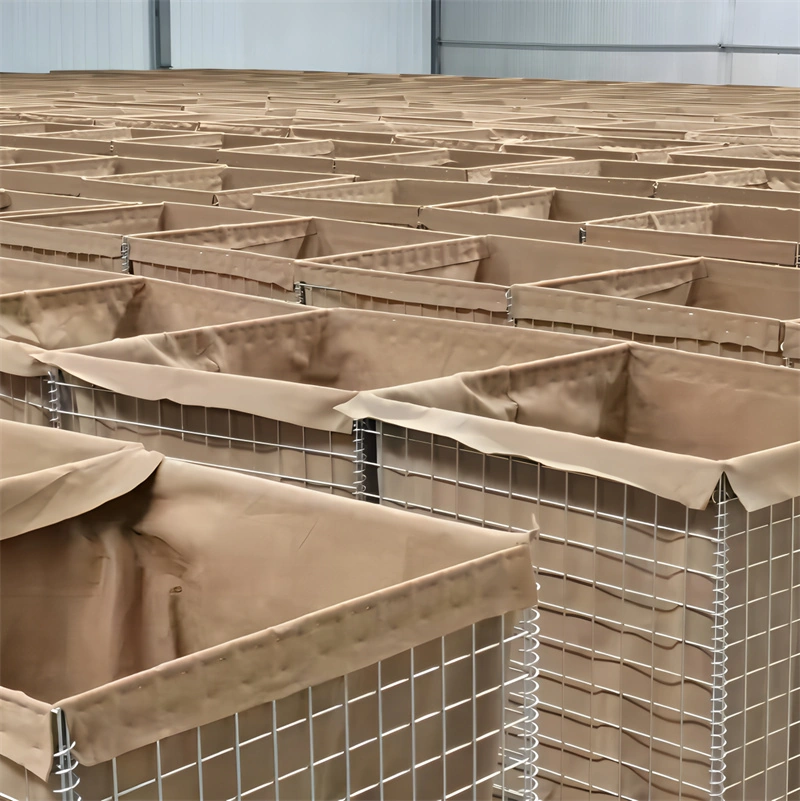
Standard Mil Sizes: Which One Fits Your Project?
A 500-unit order of Mil 3 barriers drops per-unit cost to ~$14.40, but the real savings come from locking in the right wire gauge and zinc thickness before you sign the P.O.
Let’s cut through the pricing noise. You’ve seen the range: $9.50 to $29 per set. That spread isn’t random—it’s a direct reflection of two variables most bulk buyers ignore until it’s too late: steel wire diameter and zinc coating method.
For a Mil 3 barrier (1.0m x 1.0m x 10m, 10 cells), the factory cost breaks down like this:
-
- Raw galvanized steel coil: ~55% of the unit cost. The difference between 3.0mm wire and 4.0mm wire is roughly $1.20 per set in raw material—but it changes the weld shear strength by 40%. For coastal Australian sites, 3.0mm is the minimum; 4.0mm is standard for high-wind or flood zones.
- Mesh welding (automated lines): ~15% of the unit cost. This is fixed per run. DB Fencing’s 10 production lines mean changeover time between orders is under 30 minutes, which keeps per-unit welding costs flat even at 500-set quantities.
- Geotextile lining: ~10% of the unit cost. Non-woven 200g/m² fabric costs $0.80 more per set than 150g/m², but it resists tear-out during fill operations. Skip this spec and you’ll have fabric failure within 6 months of installation.
- Hot-dipped galvanizing (≥42µm): ~12% of the unit cost. This is where the $4–$8 per-set price swing lives. Electro-galvanized coating (20µm) is cheaper by $2–$3 per set, but it fails ASTM B117 salt spray testing in under 200 hours. Hot-dipped at 42µm passes 500+ hours. In coastal Australia, that’s the difference between a 2-year barrier and a 12-year barrier.
- Collapsible assembly and packaging: ~8% of the unit cost. Folding and strapping into export-ready bundles adds minimal cost but saves 30% on container space vs. pre-assembled units.
Here’s the hard truth about volume discounts: a 500-set order of Mil 3 from DB Fencing drops per-unit cost by ~40% compared to a 50-set order. That’s $14.40 per set vs. $24.00. The savings come from steel coil bulk purchasing (we buy 20-ton coils, not 5-ton), faster machine changeovers, and container optimization (a 40-foot HC container holds 550 collapsed Mil 3 units vs. 120 assembled units).
But here’s the catch that will cost you if you ignore it: competitor Shengsen advertises $9.50–$29/set but does not disclose that 80% of those quotes are for electro-galvanized wire (20µm). That coating fails in coastal Australian environments within 2 years. DB Fencing hot-dips to 42µm+ as standard. The $2–$3 per-set premium on hot-dipped galvanizing pays for itself in the first year of avoided replacement labor.
When you request a bulk quote, ask for three things: the wire diameter in the specification sheet, the mill certificate for the steel coil, and the zinc coating test report. If the supplier hesitates on any of those, you’re not comparing apples to apples—you’re comparing a barrier that lasts a decade against one that rusts through before your project’s warranty expires.
| Mil Size | Dimensions (H x W x L) | Cell Count | Best For | Compliance Spec |
|---|---|---|---|---|
| Mil 3 | 1.0m x 1.0m x 10m | 10 cells (2×5) | Perimeter security, site fencing | AS 4687, HDG ≥42µm |
| Mil 7 | 2.21m x 2.13m x 27.74m | 24 cells (4×6) | Deep flood barriers, high-risk sites | AS 4687, HDG ≥42µm |
| Mil 10 | 2.12m x 1.52m x 30.5m | 28 cells (4×7) | Large-scale flood control, military | AS 4687, HDG ≥42µm |
| Mil 19 | 2.21m x 2.13m x 30.5m | 48 cells (6×8) | Extreme flood defense, heavy-duty | AS 4687, HDG ≥42µm |
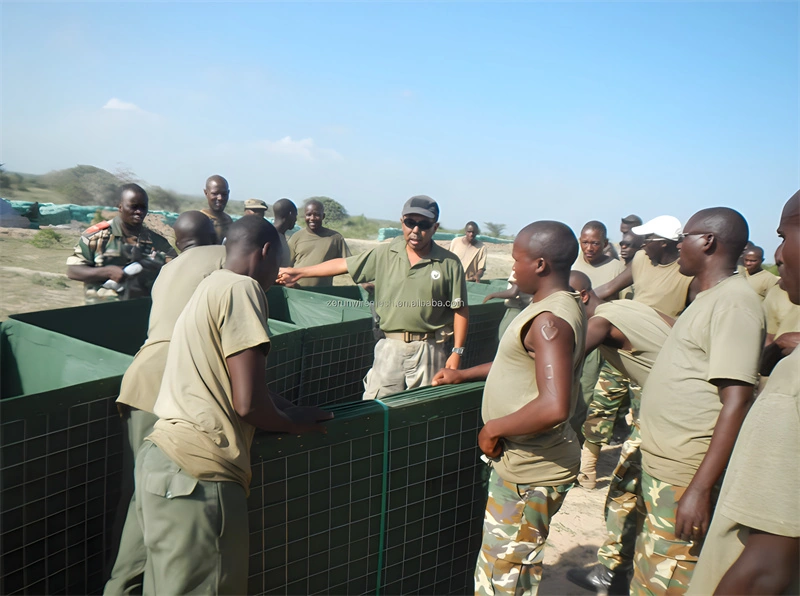
Hidden Cost Drivers: Wire Gauge, Zinc, and Fabric
A $2–$3 per-set saving on zinc coating today costs you a full barrier replacement in under 3 years. The spec sheet is where most bulk buyers get burned.
Most buyers compare only the headline price per set. That is a mistake. The real cost variance comes from three specification choices that most suppliers bury in fine print: wire gauge, zinc coating method, and geotextile weight. These three variables swing the per-unit price by $4 to $8 on a standard Mil 3 barrier, yet they are rarely listed on a competitor’s price sheet.
Take zinc coating as the primary example. Competitor Shengsen advertises a range of $9.50 to $29 per set. What they do not disclose is that roughly 80% of those quotes are for electro-galvanized wire with a coating thickness of 10–20 microns. In a coastal Australian environment—where salt spray is a daily reality—that coating fails within 2 years. You are not buying a barrier; you are renting rust. DB Fencing supplies hot-dipped galvanized wire at 42 microns or greater as standard. That is not a premium upgrade; it is the baseline required to meet AS 4687 durability expectations. The cost difference to the factory is roughly $2–$3 per set. The lifespan difference to your project is 5–10 years.
Wire gauge is the second hidden lever. A Mil 3 barrier specified with 3.0mm wire is structurally adequate for perimeter security and light flood control. But if your site sees vehicle impact risk or debris-heavy floodwater, you need 4.0mm wire. The jump from 3.0mm to 4.0mm adds roughly 40% more steel weight per set. That pushes the factory cost up by $4–$6 per unit. A supplier quoting a flat price across all wire diameters is either using the thinnest wire available or hiding a margin gap. Always ask for the wire diameter on the quote line item.
Geotextile lining weight is the detail that gets missed entirely. Non-woven geotextile at 150 g/m² is cheaper and adequate for dry fill like sand. But for saturated fill or sites with high hydrostatic pressure, you need 200 g/m² fabric to prevent bursting. The cost delta is less than $1 per set. The failure cost—a collapsed wall mid-project—is orders of magnitude higher.
Here is the rule: When you receive a bulk quote, demand a line-item breakdown for these three specs. If the supplier cannot provide the wire gauge, zinc coating thickness in microns, and geotextile weight in g/m² on the quote, they are hiding something. Request a mill certificate for the steel coil and a pre-shipment inspection report that measures actual coating thickness. DB Fencing provides these documents with every bulk order. That is not a service; it is your insurance against a 2-year failure.
| Cost Driver | Specification Options | Impact on Price | Impact on Durability |
|---|---|---|---|
| Wire Gauge (Diameter) | 3.0mm vs 4.0mm | Swing of $4–$8 per unit | 4.0mm adds ~30% structural strength; critical for high-wind zones |
| Zinc Coating Type & Thickness | Hot-dipped Galvanized (≥42µm) vs Electro-galvanized (10–20µm) | Adds $2–$3 per unit | Extends service life by 5–10 years in coastal Australia; prevents rust within 2 years |
| Geotextile Fabric Weight | 200 g/m² vs 150 g/m² | Adds ~$1.50 per unit | Higher weight resists tearing during filling and transport; ensures barrier integrity |
| Wire Mesh Opening | 2″x2″ vs 3″x3″ vs 4″x4″ | Smaller openings increase steel usage by ~15% | Tighter mesh prevents fill material leakage; improves anti-climb security |
| Compliance Certification | AS 4687 / ISO 9001 / SGS vs No Certification | Adds $0.50–$1.00 per unit for documentation | Guarantees weld shear strength and coating standards; avoids project fines and delays |
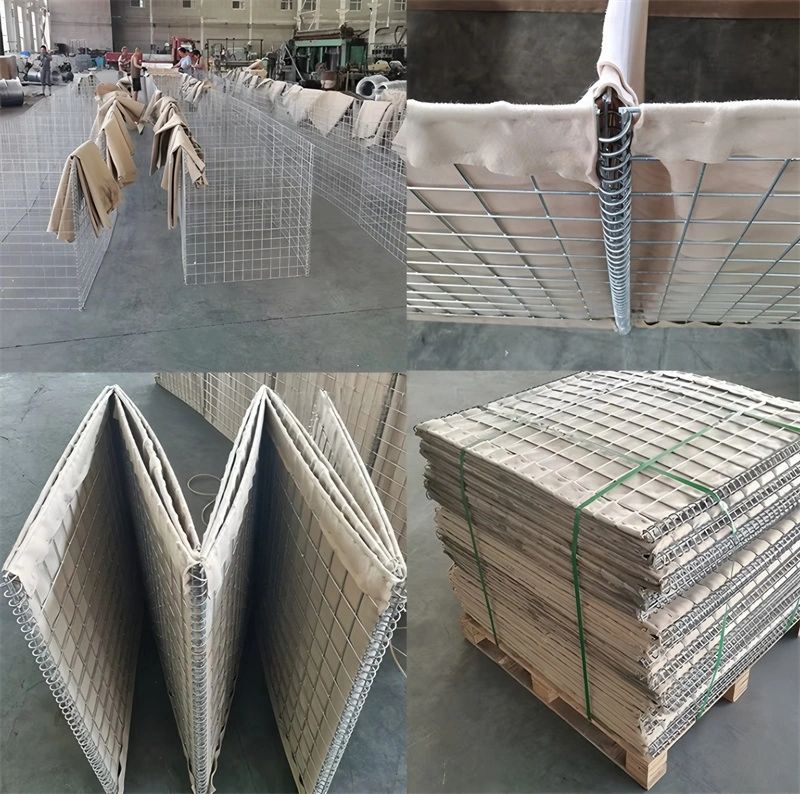
Lead Times: From P.O. to Shipping Port
Ordering 500+ units of Mil 3 Hesco barriers drops per-unit cost by 40% to ~$14.40, with a typical factory lead time of 2–3 weeks from spec confirmation.
You know the product. You know the suppliers exist. What you don’t know is which factory quote is hiding a 2.7mm wire gauge behind a “Mil 3” label, or which one is quoting electro-galvanized mesh that will bleed rust within 24 months on a coastal jobsite. That gap between the price on paper and the cost in the ground is where this article sits.
I am going to walk you through the factory cost chain, the spec decisions that swing unit price by $4–$8, and the documentation requests that separate a legitimate supplier from a repacker. No fluff. Every paragraph ties back to a compliance metric or a landed cost number.

Compliance Checklist for Australian Projects
Australian Standard AS 4687-2022 explicitly covers temporary fencing and hoardings. Hesco barriers, as freestanding flood/security barriers, do not fall strictly under its scope. However, your project’s compliance officer and site safety auditor will still demand documented proof of material quality. Here is what you need in your procurement file:
- ISO 9001:2015 certification: Validates the factory’s quality management system. DB Fencing holds current certification.
- SGS inspection report: A pre-shipment inspection by a third party confirms wire gauge, zinc coating thickness, geotextile weight, and packaging compliance. Request this as a condition of the purchase order.
- Mill certificate for steel coil: Proves the raw wire meets the stated diameter and tensile strength. Every coil lot should have a traceable certificate.
- Weld shear strength test: Mesh welds should meet minimum shear loads — typically 500 N per weld for 3.0mm wire. Ask for the test report from the production batch.
- Zinc coating certification: For hot-dipped galvanized mesh, request a magnetic thickness gauge report showing ≥42µm on multiple sample points.
A supplier who cannot provide SGS verification or mill certificates on request is either buying from a trader who repacks imports or producing without quality control. Both outcomes put your project at risk of a stop-work order when the inspector flags undocumented barriers. Master Halco, for example, does not even sell Hesco barriers — their temporary fence line ends at solid panels. That leaves a gap in the market that a factory direct supplier with full compliance documentation can fill. DB Fencing serves Australia as 75% of their export market; the documentation chain is built for Australian procurement requirements.
FAQ: Bulk Order Hesco Barriers
What is the price of HESCO bag?
Prices range from $9.50 to $29 per set for standard Mil sizes, with bulk orders of 500+ units reaching the lower end. Galvanized steel and geotextile lining are included. The specific price depends on wire diameter, zinc coating thickness, and geotextile weight. Always request a line-item quote that breaks out these spec levels.
What size do HESCO barriers come in?
Standard Mil sizes include 1.0m x 1.0m x 10m (Mil 3, 10 cells), 2.21m x 2.13m x 27.74m (Mil 7), and 2.12m x 1.52m x 30.5m (Mil 10). Custom dimensions are available from factory-direct suppliers for non-standard height or cell count requirements.
Can civilians buy HESCO barriers?
Yes. Hesco barriers are available for flood control, construction site security, and environmental protection. No special license is required. Purchase directly from manufacturers or distributors. Bulk orders typically require a company registration for export documentation, but private buyers can purchase through retailers or freight forwarders.
How much do HESCO barriers cost?
Single-set pricing varies from $9.50 to $29 depending on size, wire gauge, zinc coating, and quantity. Bulk discounts of 15–30% are common for orders of 500+ units. The factory direct pricing for a compliant Mil 3 with hot-dipped galvanized ≥42µm coating at 500+ quantity lands at approximately $14.40 per set.
What is the minimum order quantity for Hesco barriers?
Most factories, including DB Fencing, have a minimum order quantity of 100 sets per size. Smaller trial orders may be possible but lose bulk pricing benefits. With an MOQ of 100 panels, you can test a supplier’s quality and documentation process before committing to a 500+ set order.
Ready to compare factory-direct pricing for your next project?
Review the full DB Fencing Hesco barrier product line with spec sheets, certified test reports, and bulk pricing tiers.
Learn More →Conclusion
A bulk order of Hesco barriers is a procurement decision where the lowest unit price rarely delivers the lowest total cost. The data shows that specifying hot-dipped galvanized coating at 42µm or greater, confirming wire gauge at 3.0mm or above, and requesting mill certificates for each coil are the three checks that separate a compliant, long-life barrier from one that fails within two seasons on a coastal Australian site.
Review the product page to compare stock Mil sizes and custom options. If your project requires AS 4687 documentation and a factory that can ship 2,000 sets per week, request a quote with your target volume and delivery window.
Frequently Asked Questions
What is the price of HESCO bag?
Prices for a Mil 3 HESCO barrier bag drop to roughly $14.40 per unit when ordering 500+ units. Smaller orders cost closer to $24 per unit due to less volume leverage. Always confirm the spec (wire gauge, zinc coating) with your quote.
What size do HESCO barriers come in?
Standard HESCO barriers range from Mil 1 to Mil 10, with Mil 3 (1.0m x 1.0m x 10m) being the most common for perimeter security. Larger sizes like Mil 7 (2.21m x 2.13m. Choose size based on flood depth or threat level.
Can civilians buy HESCO barriers?
Yes, civilians and businesses can purchase HESCO barriers for flood control, construction, or event security. Most suppliers cater to B2B buyers but do not restrict sales to military only. Verify export regulations if shipping internationally.
How much do HESCO barriers cost?
Bulk pricing for Mil 3 HESCO barriers starts around $14.40 per unit for orders of 500+, down from about $24 for smaller quantities. Actual cost depends on wire gauge, zinc thickness, and. Request a quote with full spec sheet for accurate pricing.
What is the minimum order quantity for Hesco barriers?
For factory-direct orders, the minimum order quantity is typically 100 panels, especially for standard sizes like Mil 3. Custom specs or higher volumes may require a larger MOQ to justify production setup. Confirm MOQ with your supplier after finalizing the spec.