Skip to content
A wpc composite fence is quoted as a panel size and a colour list. The composition is stated plainly on the page — 60% bamboo or wood fibre, 30% HDPE, 10% chemical additives — but the consequences of that mix are not: how far the boards travel across a season, how a 1800 mm bay sits between posts, and what the metal parts do in salt air.
DB Fencing’s composite page gives two standard sizes, a service range of -40 to 60 degrees and a wind figure expressed in scales. As a product specification that is a generous page. As an installation brief it leaves three decisions to the buyer, and all three cost less to settle before the pallets are strapped than after.
Key Takeaways
- The page commits to two sizes — W1800 × H1150 mm and W1800 × H1800 mm — with eight named panel colours, two post colours and five surface finishes.
- Composition is 60% bamboo/wood fibre, 30% HDPE and 10% additives: a polymer-rich board, which is why movement is the first number to pin down.
- No expansion coefficient, installation gap or maximum run appears on the page, against a stated service range of -40 to 60 degrees — a 100 degree span.
- The page’s own install guide spaces posts 6-8 feet apart. Six feet is 1829 mm against a 1800 mm panel, so the bay allowance is about 29 mm before anything is specified.
- “9 Scale Wind Load Resistance” and “fireproof” are page wording with no scale, test standard or classification attached — ask for the basis or treat them as unproven.
What 60% Fibre and 30% HDPE Buy You
The feature block on the composite fencing page lists the boards as waterproof, rotproof, slip resistant, UV resistant and insect resistant, with no painting required. The maintenance answer on the same page is equally short — occasional washing with soap and water, no staining or sealing — and that pairing is the practical difference this product is claiming against a painted board.
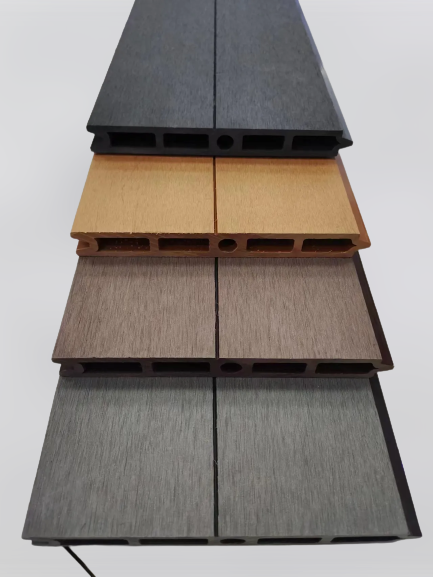
The same profile is the part worth questioning. A hollow board is lighter to freight, but every cut end, corner and fixing point opens into a void, and the page publishes no wall thickness, no board cross-section drawing and no capping detail. The claim that the compound is 100% recycled also sits in copy without a certification attached, so if a tender asks for documented recycled content, request the paperwork rather than quoting the sentence.
Expansion Allowance: The Missing Number
A board that is 30% polyethylene moves more per degree than the aluminium post it is screwed to, and considerably more than a steel one. The page states the service range as -40 to 60 degrees, which is a 100 degree span — a winter install and a February afternoon. What the page does not state is a linear expansion figure, a required gap between boards and posts, or a maximum continuous run before a movement joint.
That makes three lines to ask for in writing: the movement allowance per 1800 mm bay, the gap to leave at the installation temperature, and the longest run the supplier will stand behind without an expansion joint. One caution about the drawing that does circulate with this range — it is an assembly view, not the missing board cross-section. It labels a part as “expansion screws”, and the callout points at the base of the post, where an anchor fixing goes. That is not a thermal allowance, and nowhere does the drawing dimension a movement gap between the boards and the posts.
| Item | Page wording | What to confirm |
|---|---|---|
| Panel size | W1800 × H1150 mm, W1800 × H1800 mm | Post length per height |
| Temperature | -40 to 60 degrees | Movement per bay, install gap |
| Wind | 9 Scale Wind Load Resistance | Which scale, and the design basis |
| Fire | Listed as fireproof | Test standard and classification |
| Accessories | Aluminium with oxidation treatment | Finish for salt exposure |
| Packing | Cardboard or bubble film, plastic band, film wrap, wooden pallet | Pallet count and stacking |
Post Compatibility and the 6-8 Foot Guide
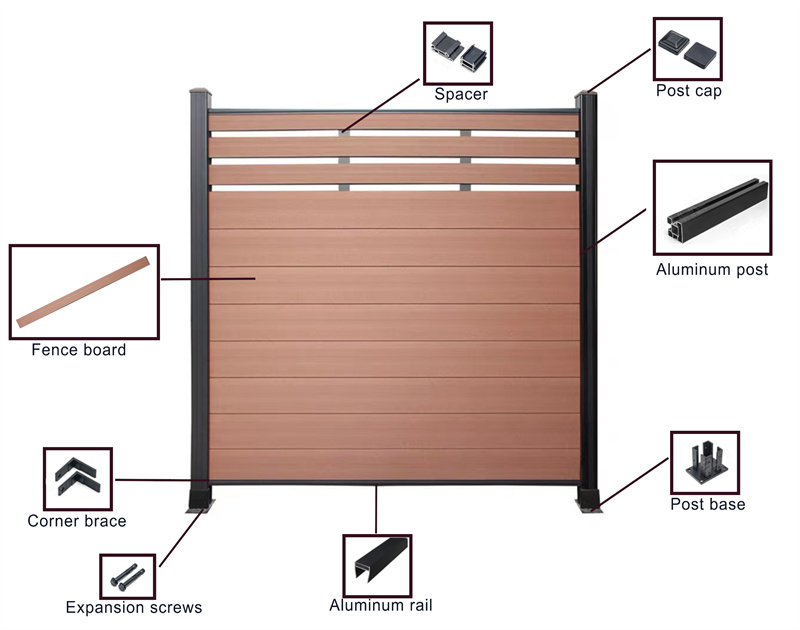
The install guide on the page puts posts “usually about 6-8 feet apart”, and the same page sells a 1800 mm wide panel. Six feet is 1829 mm, so a one-panel bay at that spacing leaves roughly 29 mm in total for whatever the system needs — spacers, shims and any movement gap. Eight feet is 2438 mm, which is 638 mm wider than one panel: at that spacing you are either running two panels between posts with a mid-post, or filling the difference with something not on this page. The guide itself is flagged as general, with the note that the exact process may vary.
Depth is the second half of the same question. The guide says to dig holes “about 2 feet deep” — around 610 mm — which, against the taller W1800 × H1800 mm panel standing above ground, puts roughly a quarter of the total post length in the soil. For a slatted screen that may pass; for a solid privacy board acting as a sail, have embedment and footing confirmed for your site, with the wind basis signed off by a local engineer rather than a catalogue line.
Then there is the gate. The page’s own sequence ends by fixing a gate to a post with hinges and a latch, but it never lists gate hardware as a purchasable line beyond that one sentence on metal accessories. Screws, hinges and latches therefore arrive as a separate specification, and in coastal or hosed-down positions the finish on those parts is decided by you, not by the board colour — the guide to fence fittings corrosion covers how to write that line.
Coastal Care Starts With the Metals
Salt is the one exposure the feature list does not address. The page covers water, rot, UV and insects, and it says nothing about salt spray hours, a test standard or a classification — so a coastal claim has to be requested rather than assumed. The salt-spray and cross-hatch testing guide sets out what a meaningful report looks like and which numbers to ask for if you want the board and the hardware tested to the same basis.
The metals are where a coastal fence actually fails first. This line specifies aluminium accessories with an oxidation treatment, which is the sensible pairing for a composite board in salt air — and it is also why a substituted steel screw on site is worth refusing. Mixed metals, cut threads and drilled holes are the same three failure routes that govern galvanised hardware anywhere else in the catalogue.
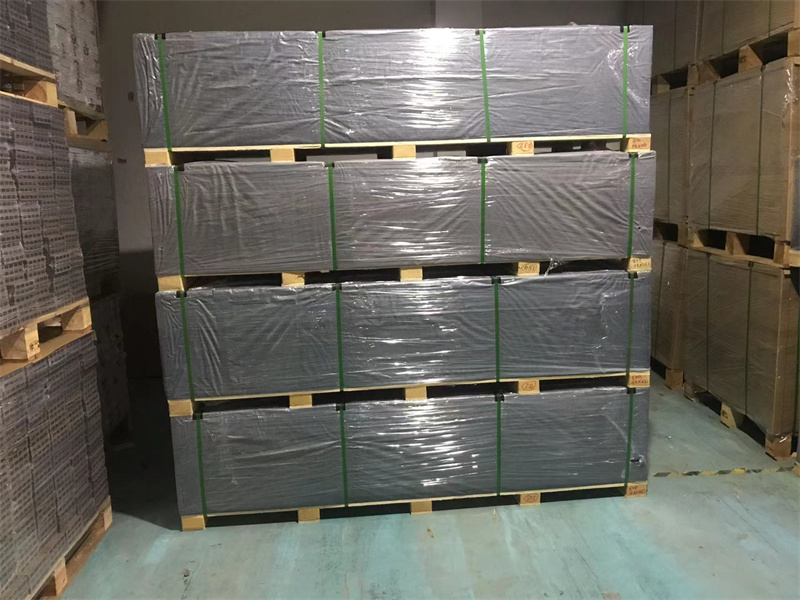
Packing is the last coastal variable. Boards travel separated by cardboard or bubble film, banded, film-wrapped and stacked on wooden pallets, with posts bagged and accessories into cartons. Read as a handling instruction, it says panels should stay flat and supported until installed rather than stood on edge against a fence line.
Frequently Asked Questions
How big is a wpc composite fence panel from this supplier?
Two standard sizes are stated: W1800 × H1150 mm and W1800 × H1800 mm. Both are 1800 mm wide, so the bay maths is the same at either height and only the post length changes. Customisation is offered on colour and surface finish.
What gap should I leave between composite fence boards?
The page does not publish one, so it has to be asked for as a figure per bay at your installation temperature. With a stated service range of -40 to 60 degrees, a gap set on a mild day is not the gap the board runs at on either end of that span.
Is a WPC fence better than timber for a coastal site?
For the board, the case is rot and water uptake: this page lists the panels as waterproof and rotproof with no painting. For the fixings it is not automatic — aluminium accessories with an oxidation treatment are the stated pairing, and any steel substituted locally needs its own coating basis.
Can I get samples before ordering pallets?
The supplier’s answer on this product’s Q&A is yes — sample boards of the composite fencing are offered before a purchase. Ask for the finish you intend to buy, since the page lists five surface treatments alongside the eight colours.
Conclusion
A wpc composite fence specification is only complete once three numbers are added to it: the movement allowance per bay, the post spacing that matches a 1800 mm panel, and the embedment depth for a board that presents a solid face to the wind. The page supplies composition, sizes and packing; it does not supply those three.
Ask for them with the quotation — responses come within 24 hours, stock items dispatch in 7 days and production runs sit at 20-25 days — and settle the gate hardware in the same exchange, so the fence arrives as one system rather than panels plus assumptions.