Skip to content
Panels get the galvanising claim. Hardware gets the default finish. That gap is where fence fittings corrosion actually starts: not on the run of fence you quoted, but on the clamps, bolts, latches and hinge studs holding it up.
The failure points are mostly set before the steel is coated — a cut thread, a drilled hole, a welded joint — or decided where two different metals meet. A packing list rarely separates them.
Key Takeaways
- The temporary fence page itemises its clamp as its own line — suit for a φ32 mm frame tube, hot dip galvanised — so hardware finish must be checked component by component.
- The farm gate hinge page offers two finishes on every gudgeon type, hot dip galvanisation or dacromet, and splits the four types by thread length: 300 mm or 350 mm against 150 mm or 200 mm.
- Washers and nuts are itemised there for the through and lock-through types only.
- The livestock panel page describes anti-rust paint over polished welds, then a silver spray coat. A weld is coated after the fact, not galvanised with the pipe.
- Stainless hardware is not itemised on these fittings pages. Where you need it, buy it as a named line with grade marking and coating data.
Where Hardware Really Starts to Rust
A coating is usually quoted for one component and inherited by everything else in the container — a paperwork problem before it is a metallurgy problem. On the temporary fence manufacturer page, the panel carries its own specification (4.0 mm wire, 60 × 150 mm openings, a 32 × 2 mm frame, hot dip galvanised) and the clamp is a separate sentence: suit for a φ32 mm frame tube, hot dip galvanised. That clamp is described as galvanised only because someone typed the line. Ask for the same sentence beside a bolt or a latch pin and you may get a different answer.

Geometry is the next problem. Zinc covers the surface the bath reached, and hardware is made almost entirely of shapes a coating figure does not describe: threaded runs, drilled holes, sheared edges. The livestock panel page is candid here. After the pipes are cut and welded, the welds are polished, painted with anti-rust paint, then given a silver spray coat — a coating applied to a joint after the galvanised pipe was made. A weld line is therefore a specification question.
Fitment is the last trap. A clamp quoted for a φ32 mm frame tube is a fitment statement, not a universal part: order a heavier frame and that hardware no longer matches it.
The Finishes This Site Itemises
| Component | What the page itemises | Question |
|---|---|---|
| Temporary fence clamp | Suit for φ32 mm frame tube; hot dip galvanised | Are pins and braces quoted likewise? |
| Farm gate hinge and gudgeon | Hot dip galvanisation or dacromet on all four types; ø20 × 70 mm stud | Which one is priced? |
| Chain link wire and line posts | Electric galvanised, hot dip galvanised, or PVC coated | Wire finish or post finish? |
| Livestock panel welds | Anti-rust paint over polished welds, then a silver spray coat | What protects the weld after wash-down? |
| Temporary fence feet | HDPE, blow moulded, concrete infilled, 600 × 230 × 150 mm, 26 kg each | Plastic cannot rust — what fails instead? |
Electric galvanising and hot dip galvanising are different processes with different coating thicknesses, and the chain link page lists them beside PVC coating as selectable finishes on one product line. That is why “galvanised” in a quotation is not a specification: two honest factories can sell different durability classes. Our hot-dip versus pre-galvanised comparison covers the panel side; hardware is the same argument in miniature.
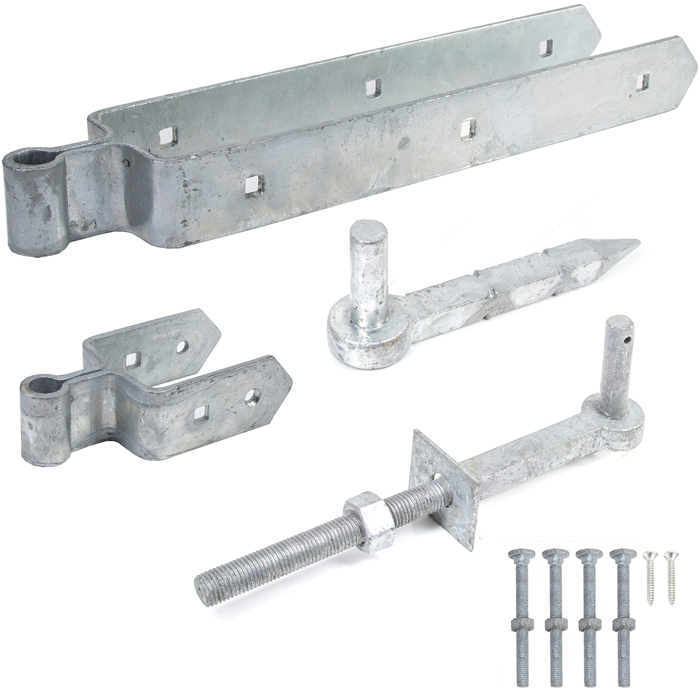
Dacromet is named on the hinge page without a chemistry breakdown, so treat it as a line to get data on rather than a conclusion: ask what the flake coating is specified to resist, and whether the washers and nuts arriving with it carry the same treatment. The page is precise about the steel — a low carbon Q235 stud — and silent about which finish you are buying until you choose.
Galvanised or Stainless: Where They Diverge
Start with a limitation: the fittings pages here itemise hot dip galvanising or dacromet on carbon steel, and stainless clamps, bolts and latches are not itemised on them. If your project needs stainless hardware, buy it as a named line with its own grade marking and alloy data.
Stainless earns its price where a seized or stained fitting stops work rather than merely looking untidy: latches and hinge pins on a working race, hardware hosed or disinfected regularly, sites within sight of salt water. Coated carbon steel is the rational buy where hardware is consumable — clamps on a hire fleet get lost, kicked and replaced as a matter of course. Our position is simpler than the metallurgy: specify finish line by line instead of writing “galvanised” once at the top of the order.
Two cautions matter more than the material choice. First, stainless is not a permanent answer: austenitic fasteners can still pit under chloride exposure, and threaded stainless can gall — seize while you tighten it. Buy by grade marking rather than the word “stainless”; the A2 and A4 families stamped on bolt heads behave differently near the coast, and an order that says only “stainless bolts” is filled with whichever is cheaper. Second, mixing the two is a decision, not a default: stainless fasteners clamped into galvanised steel on a wet, salty site raise a dissimilar-metal question whose answer depends on the detail and the exposure. Have it confirmed by whoever engineers the job.
What to Write on the Purchase Order
Six lines, written before the proforma invoice comes back. Each maps to something a product page already states, so a supplier who cannot answer one is telling you something.
- Finish per line item, in page words. “Hot dip galvanised”, “dacromet”, “PVC coated to RAL ___”. Not “as per standard”.
- Clamp bore against the frame tube ordered. The published clamp is quoted for φ32 mm; state your frame size and ask for the matching clamp.
- Thread length by gudgeon type. 300 mm or 350 mm on through and lock-through types, 150 mm or 200 mm on screw-in and drive-in types, all on an ø20 × 70 mm stud.
- Nuts and washers: what they are, and whether they are in the box. Ask per type, not per order.
- Spare hardware counted the factory’s way. Ask how clamps and pins tally per panel or per gate before setting spares.
- Packing stated for hardware, not only panels. Panels travel on steel pallets under film, feet in wooden or steel pallets, clamps in cartons.
At receiving, spend ten minutes on the small parts: compare a clamp’s finish with a bolt’s from the same order, and count nuts against the itemised list. Ask for coating figures per component rather than accepting “weather-resistant”, an adjective in marketing copy that settles nothing.

Frequently Asked Questions
Should fence fittings corrosion be treated the same as panel corrosion?
No, because the two are quoted differently. Panels carry a named coating plus frame and wire figures. Hardware is described by fitment — a clamp suited to a φ32 mm frame tube, a gudgeon stud at ø20 × 70 mm — and its finish can stay at a default unless you state it.
Is dacromet better than hot dip galvanising for gate hardware?
The hinge page offers both across all four gudgeon types without ranking them, so there is no honest single answer. For a dry inland yard either is defensible. For salt exposure, wash-down or disinfectant, ask for coating data behind whichever option is priced and check that the nuts match it.
When is stainless hardware worth the premium?
Where a seized or stained fitting stops work: latches and hinges on a working race, hardware that is hosed or disinfected, sites near salt water. Where hardware is consumable, coated carbon steel is usually the sensible buy. Buy stainless by grade marking, never by the word alone.
What is usually missing from a hardware order?
Nuts and washers for the fitting types whose pages do not itemise them, spare clamps counted the way the factory counts them, and a stated finish for anything that is not a panel. Treat inclusion as a question per type.
Conclusion
Hardware corrodes on its own clock because it is bought on its own terms: quoted by fitment, packed separately, finished by default. The fix is a finish named per line item, a clamp bore matched to the frame, thread lengths set by gudgeon type, and nuts and washers counted rather than assumed.
Ask for hardware coating data when you request a gate hinge quotation. Stock items dispatch within 7 days and production runs sit at 20-25 days, so a hardware correction made before packing costs neither.