Skip to content
A quotation for double wire fence panels lands on your desk with a line that reads “twin wire panel, 6mm-5mm-6mm, mesh 50×200mm”. If you specify fencing in Australia or New Zealand, you have seen this notation on drawings and supplier quotes. It is not marketing shorthand — it is the industry-standard configuration naming that tells you the wire diameters before you see a sample panel.
This article decodes that numbering, compares 6-5-6 with 8-6-8, and lists what to confirm with the factory before you commit to a container. The wire and mesh figures below are industry-standard configurations, not one factory’s proprietary specification. The sourcing parameters come from DB Fencing (Anping Deban Metal Wire Mesh Products Co., Ltd), an Anping fencing manufacturer established in 2009 with 14 years of export experience.
Key Takeaways
- The naming system: 6mm-5mm-6mm means twin 6mm horizontal wires sandwiching a single 5mm vertical wire — an industry-standard configuration convention, not a factory spec sheet. Common mesh: 50×200mm (50×100mm for higher security).
- Coatings: Industry practice is hot-dip galvanised wire plus polyester powder coating; confirm the twin-bar coating schedule with the factory on enquiry.
- Sourcing baseline (DB Fencing): MOQ 100 panels, 20–25 day bulk lead time, quotes within 24 hours.
What “6mm-5mm-6mm” Actually Means
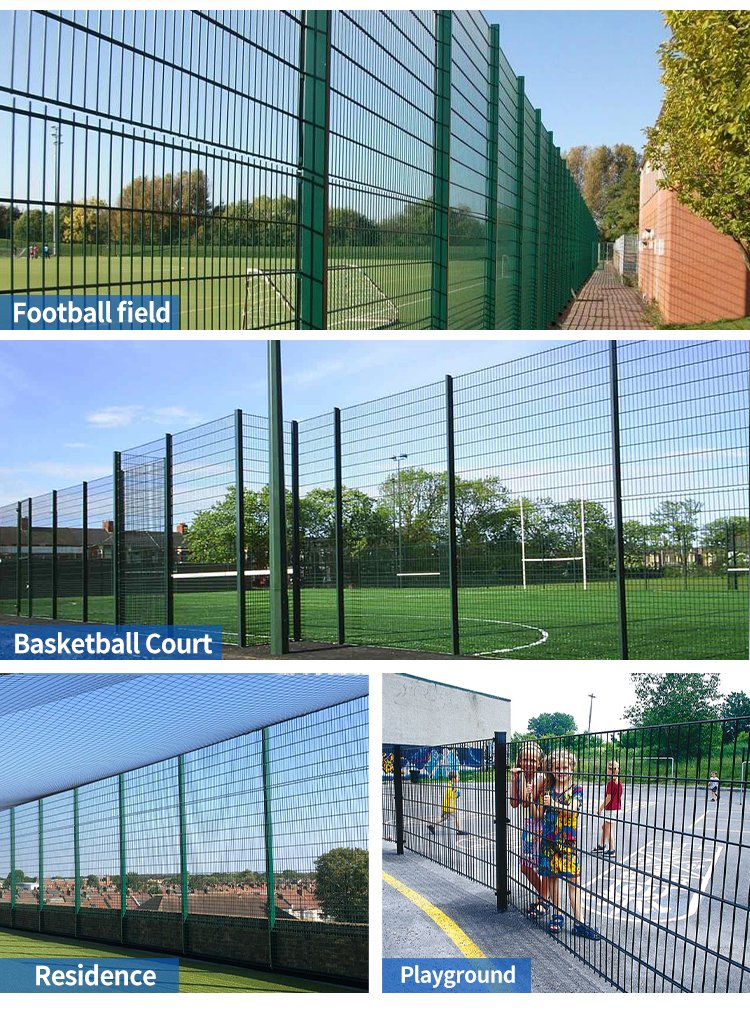
A twin-bar panel — also sold as double wire or twin wire fencing — welds a single vertical wire between two parallel horizontal wires at every intersection. The two horizontals sit on opposite faces of each vertical, so the vertical wire is clamped in a steel sandwich.
Read the numbers in order: in a 6mm-5mm-6mm panel, each horizontal wire is 6mm in diameter and the vertical between them is 5mm; in 8mm-6mm-8mm, the horizontals step up to 8mm and the vertical to 6mm. This three-number format is the industry-standard configuration naming used across twin-bar product lines worldwide — it is not a single manufacturer’s factory specification. Any supplier’s actual wire diameters, tolerances, and steel grades should be confirmed against your project drawings before you order.
Around that wire skeleton, the industry-standard panel configurations run like this:
- Mesh aperture: 50×200mm is the most common industry configuration; a 50×100mm variant halves the vertical spacing between horizontal wire pairs for higher-security perimeters.
- Panel dimensions: widths commonly 2,000–2,510mm, heights roughly 1,030mm to 2,430mm (industry-standard ranges).
- Fixing: security clips or anti-vandal bolts, typically on 60×40mm or 80×60mm rectangular posts (industry-standard configurations).
Every intersection is resistance-welded: a 2,000mm-wide panel at 50×200mm mesh carries about 40 vertical wires, each welded top to bottom between twin horizontals.
6-5-6 vs 8-6-8: Which Configuration for Which Job
Both configurations use the same twin-bar geometry; the difference is steel content. More steel buys impact resistance and stiffer spans between posts — and a heavier panel that costs more per square metre and packs fewer units into a container.
Our position: 6-5-6 is the right default for schools, parks, and commercial perimeters — it survives occasional impacts and stays presentable through many years of service. Step up to 8-6-8 only when the perimeter faces repeated abuse: sports ball impact, industrial plant traffic, or public-transport corridors.
| Configuration | Wire layout | Typical applications | Handling and cost profile |
|---|---|---|---|
| 6mm-5mm-6mm | Twin 6mm horizontals, 5mm vertical | Schools, parks, commercial estates, carparks | Lighter panel; lower steel and freight cost per panel (industry-standard configuration) |
| 8mm-6mm-8mm | Twin 8mm horizontals, 6mm vertical | Sports grounds, industrial sites, rail and transport corridors | Heavier panel; higher impact resistance; more steel per square metre (industry-standard configuration) |
Both rows describe industry-standard configurations; which diameters a factory actually runs — and in which steel grade — is a question for the factory, not the brochure.
Why Twin Horizontal Wires Change the Panel’s Behaviour
The sandwich structure is the whole point of the system. A single horizontal wire welded to one side of a vertical loads the weld in shear when something strikes the panel. Twin horizontals grip the vertical from both faces, so the load path runs through the wire itself rather than tearing at a single weld nugget. The panel absorbs impact by flexing and returning, not by shedding welds.
Rigidity is the second gain. Because horizontal wire pairs repeat every 200mm up the panel height on the common mesh, the panel behaves like a deep truss. It spans between posts without the sag you see in chain link fabric, and it holds its line on uneven ground where a tensioned fabric would belly.
Climb resistance comes from the apertures: a 50mm horizontal gap is too small for a boot edge, and the 200mm vertical gap denies a comfortable handhold. The panel stays transparent, so CCTV coverage is unobstructed. For a cost-of-ownership comparison against woven alternatives, our article on chain link gauge and coating lifecycle costs sets out the trade-offs.
Coating Systems: Galvanised Plus Powder-Coated
Industry practice for twin-bar panels is a two-layer system: galvanised steel wire, then a polyester powder coat applied and cured. Green RAL 6005 is the default colour; black and other colours are standard options. The powder layer carries the colour and shields the zinc from abrasion and UV.
One honest caveat: not every galvanising figure a supplier publishes applies to every product line. DB Fencing’s documented hot-dip galvanising thickness above 42 microns belongs to its temporary fencing and outdoor fencing lines — a coastal-durability specification for hire fleet and construction use. Its twin-bar panels follow the industry-standard galvanised-plus-powder-coated approach, with the zinc and powder specifications confirmed with the factory at enquiry. A supplier who answers coating questions per product line is one you can build a programme on.
For AU/NZ buyers, salt-laden coastal air is the coating’s main enemy, so put the coating schedule — zinc thickness, powder type, pre-treatment — in writing on the purchase order rather than relying on the word “galvanised” alone.
How Twin-Bar Compares With Other Wire Mesh Systems
Twin-bar sits in the middle of the welded-mesh spectrum; knowing its neighbours helps you brief the right product.
- vs chain link: Chain link is a woven fabric tensioned between posts — cheaper and faster to roll out, but it sags, it can be cut and peeled, and it needs tensioning maintenance. Twin-bar is a rigid panel with no tensioning hardware at all.
- vs BRC roll top: Roll top panels fold the top and bottom edges into rolled profiles, removing raw wire ends — the reason they dominate school fencing in some markets. Twin-bar counters with heavier wire and higher rigidity.
- vs 358 anti-climb mesh: 358 (prison mesh) uses roughly 76×12mm apertures from 4mm wires — far harder to climb, but visually heavy. Twin-bar trades some security for transparency and a cleaner architectural line.
Sourcing From the Factory: MOQ, Lead Times and Trade Terms

DB Fencing manufactures in Anping, Hebei — the “Global Wire Mesh Town” — and was established in 2009, with 14 years of export experience. Twin-bar / double wire panels are one line in its wire mesh range, alongside chain link, BRC roll top, 358, and woven meshes. The company is ISO9001 certified and SGS audited, runs 10 welding production lines, and turns quotations around within 24 hours. Full specifications are on the twin-bar double wire fence product page.
| Parameter | Value | Basis |
|---|---|---|
| Minimum order quantity | 100 panels | DB Fencing confirmed |
| Bulk order lead time | 20–25 days | DB Fencing confirmed |
| Production capacity | Up to 2,000 sets per week across 10 welding lines | DB Fencing confirmed |
| Trade terms | FOB, CIF, CFR, DDU, DDP | DB Fencing confirmed |
| Payment terms | Flexible / negotiable | DB Fencing confirmed |
| Quotation turnaround | Within 24 hours | DB Fencing confirmed |
Two market notes. First, the 100-panel minimum makes twin-bar viable for a single medium-sized project, not just distributor programmes. Second, if the site pairs the permanent fence with temporary hoarding, DB’s temporary fencing lines are manufactured to AS 4687-2022 and AS 4687-2007 compliance — a separate compliance track from a permanent welded-mesh perimeter, so keep the two specifications on separate drawings.
What to Verify Before You Place the Order
A twin-bar order travels a long way between weld and site, so verify the specification before the wire is drawn:
- Wire diameters and steel grade: Confirm the delivered horizontal and vertical wire diameters against your drawings — the 6-5-6 label is an industry naming convention — plus the steel grade and mill test report availability.
- Weld integrity: Ask how weld strength is checked on the line and request the inspection criteria in writing. Our guide to fence panel weld quality inspection lists the checks a buyer should insist on.
- Coating schedule: Zinc thickness, powder type, and pre-treatment process — in writing, on the purchase order.
- Panel dimensional tolerances: Height, width, and post centres, so the panels land on the posts your installer has quoted.
- First-article inspection: Approve a sample panel or first-article photos before the balance of production runs.
None of this takes long against a 20–25 day production window, and every item is cheaper to fix on paper than in a container at the wharf.
Frequently Asked Questions
Is 6-5-6 or 8-6-8 better for school perimeters?
The 6mm-5mm-6mm configuration is the standard choice for schools — it handles everyday abuse and costs less per panel. Reserve 8mm-6mm-8mm for sports grounds and industrial perimeters that take repeated heavy impacts.
What mesh aperture do double wire fence panels use?
The most common industry configuration is 50×200mm; a 50×100mm variant halves the vertical spacing between horizontal wire pairs for higher security. Confirm the aperture and wire diameters for your order with the factory.
What is the minimum order and lead time for twin-bar panels?
DB Fencing’s minimum order is 100 panels with a bulk lead time of 20–25 days; the factory quotes within 24 hours and ships on FOB, CIF, CFR, DDU, or DDP terms.
Are twin-bar panels the same as 358 anti-climb mesh?
No. 358 mesh uses roughly 76×12mm apertures with 4mm wires for maximum climb resistance, giving it a dense, security-focused appearance. Twin-bar panels use larger apertures and heavier wires, prioritising rigidity, visibility, and architectural finish.
Conclusion
The 6mm-5mm-6mm label is simply the industry’s shorthand for twin 6mm horizontal wires around a 5mm vertical — a configuration that trades steel content against impact resistance in a predictable, comparable way. Choosing between it and 8mm-6mm-8mm is a decision about what the perimeter will absorb over its service life, not a guessing game.
Before you order, confirm the delivered wire diameters, steel grade, weld inspection criteria, and coating schedule with the factory in writing. Then review the twin-bar product specifications and request a quote — at a 100-panel minimum and a 20–25 day lead time, the numbers come back quickly.