Skip to content
Every chain link quote carries two decisions that rarely show up in a product photo: the chain link fence gauge of the wire and the coating wrapped around it. Those two choices set cut resistance, corrosion behaviour and — the part that surprises buyers on the second container — how often the perimeter gets rebuilt.
DB Fencing has manufactured wire mesh fencing from its Anping plant — the “Global Wire Mesh Town” of Hebei Province — since 2009. Fourteen years of export orders behind it. The pattern is easy to reason out: compare on invoice price alone and you reorder early. The chain link line runs galvanised and PVC-coated fabric side by side, with twelve accessory categories behind them.
Key Takeaways
- Gauge is wire thickness, and the scale runs backwards: the lower the gauge number, the thicker the wire and the higher the entry price.
- One number, two meanings: gauge figures land on different diameters under Birmingham Wire Gauge and US Stubs — confirm the measured diameter on the drawing.
- Galvanised fabric buys with zinc: sacrificial protection that self-heals at small scratches, at the lower entry price.
- PVC-coated fabric adds a polymer jacket over the galvanised core: higher initial cost, defence against salt air, and colour that takes the UV load instead of the zinc.
- The lifecycle comparison is structural: lower price and shorter replacement cycle versus higher spend and lower maintenance.
- Ordering: minimum 100 panels, 20–25 days bulk production, 7-day stock dispatch, FOB through DDP terms.
What Chain Link Fence Gauge Decides
Chain link is woven, not welded: wire spirals interlock into a diamond mesh, and the knuckles — the folded twists where wires join — carry the load. Gauge — the wire’s thickness — is the first number on every fabric specification. The scale runs backwards, so a lower gauge number means a thicker wire. Thicker wire costs more per roll because it contains more steel, and it resists cutting, bending and knuckle pull-out.
The trap is that “gauge” is not one scale. North American quotes run in gauge numbers, and two imperial systems circulate: Birmingham Wire Gauge (BWG) and US Steel Wire Gauge, known as Stubs. The same number on each lands on a different diameter. Australian and New Zealand buyers often skip the argument and specify millimetres. Put the measured diameter on the drawing — a bare gauge number invites two shipments that do not match.
Use tiers stay qualitative. Light fabric suits residential and park boundaries where the threat is a curious dog. Mid-weight fabric is the commercial default — schools, depots, back-of-house yards. Heavier wire with a tighter mesh aperture (the diamond’s diagonal opening) suits sites where cutting and climbing are the design threats. Exact tier thickness varies by market, so treat any supplier’s table as a starting point.
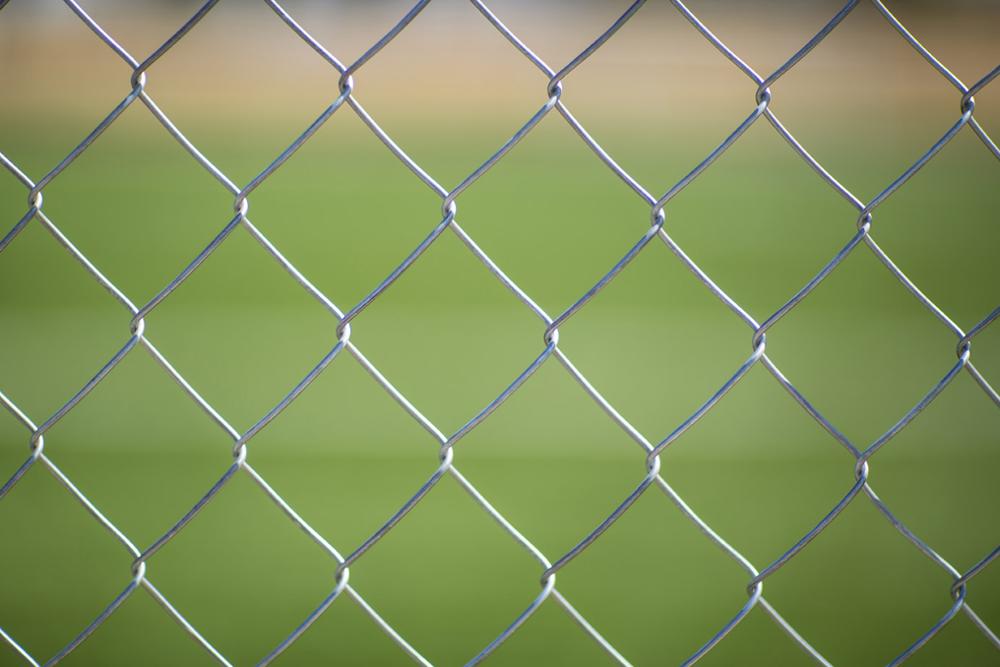
Gauge drives lifecycle cost through one mechanism. Thin wire sags, catches and tears sooner, and every repair mobilises a crew. Heavier wire raises the invoice today and reduces how many times you stand in the yard this year.
Galvanised vs PVC-Coated: Two Ways to Protect the Same Steel
Both products start with the same steel wire. Galvanised fabric protects it with zinc: hot-dip galvanising dips the wire or finished weave in molten zinc, so the coating itself is the corrosion protection. The silver mesh you walk past is the zinc. Small scratches are survivable — zinc sacrifices itself ahead of the steel underneath, so a scraped galvanised fence rusts slowly.
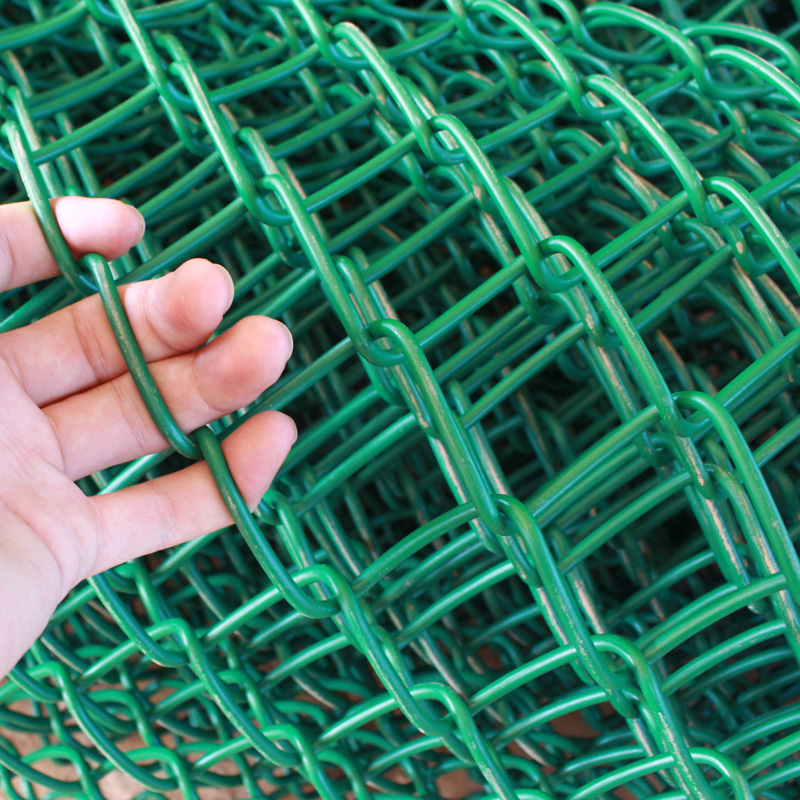
PVC-coated fabric adds a second skin. An extruded polyvinyl chloride jacket — the same polymer family used in water pipe and cable sheathing — wraps galvanised wire, commonly in green or black. The jacket shrugs off what eats zinc — salt air — and carries the pigment that UV, not zinc, degrades. Colour is cosmetic, but it is why councils and schools order green fabric that disappears against a treeline.
The failure modes are mirror images. Zinc scratches self-heal; a breached jacket does not. Where the coating is cut or scuffed through, water reaches the galvanised core and corrosion works underneath. The coating question is really an exposure question: what the fence faces, and what hits it first.
The Lifecycle Cost Frame: Cheap to Buy vs Cheap to Own
Nobody can print an honest lifespan figure for your site, and a supplier who quotes one for both coatings is guessing. What can be compared is the structure of the spend. Galvanised fabric: lower entry price, shorter replacement cycle — buy more often, repair less. PVC-coated: higher initial spend, lower maintenance — buy once, then budget for inspection and spot repair of jacket breaches.
| Cost driver | Galvanised fabric | PVC-coated fabric |
|---|---|---|
| Entry price | Lower for the same weave and wire diameter | Higher — the polymer jacket is an added manufacturing stage |
| Corrosion protection | Zinc sacrifices itself; small scratches self-heal | Jacket shields the galvanised core; protection tracks jacket integrity |
| UV and salt exposure | Zinc weathers to dull grey and thins steadily in salt air | Barrier salt cannot consume; UV attacks the pigment, so colour fades first |
| Damage behaviour | Abrasion removes zinc gradually; the wire keeps working | A cut or scuff exposes the core exactly at the breach point |
| Maintenance pattern | Low effort; inspect knuckles and cut ends periodically | Inspect for jacket breaches and repair before rust lifts the coating |
| Where it fits | Rental fleets, temporary duty cycles, budget-first perimeters | Coastal and high-UV sites; schools and councils where colour matters |
Our position: match the coating to the exposure, and the exposure decides which side of the ledger you fund. A depot fence that takes a forklift knock monthly is a galvanised asset — each repair is an event, not a project. A beachfront or pool-adjacent perimeter under full sun is where the jacket earns its premium: that site delivers UV and salt daily.
Where Each Choice Pays, Market by Market
Australia and New Zealand take 75% of this factory’s exports, and the region runs two pressure points: ultraviolet light and salt air. High UV breaks polymer down over time but does little to bare zinc; salt air attacks zinc constantly. Coastal projects lean PVC-coated; inland yards stay galvanised and count the replacement cycles.
North America, at 15% of exports, adds a third agent in de-icing salt and freeze-thaw cycling. Canadian rental fleets build perimeters around woven chain link panels on tube frames with orange or yellow plastic feet. Our guide to chain link temporary fence panels for Canada covers those formats. The coating logic carries across. Winter salt concentrates on the bottom rail, exactly where jackets scuff and zinc thins first.
The same galvanising questions recur across the woven-wire family. Our hexagonal wire mesh guide walks through the zinc classes on a lighter product, and the habit transfers. Ask what protects the steel, how it is applied, and what happens the moment it is scratched.
The Fence Is a System — and Fittings Age Separately
Fabric gets the attention; hardware sets the service plan. The chain link accessory set on this line runs to twelve categories, from barb wire arms and tension bands to gate fittings and the rest. Every one is a coating boundary. Brackets clamp, bolts penetrate, and cut ends sit exposed. Corrosion starts at the fitting-fabric handshake, not mid-panel.
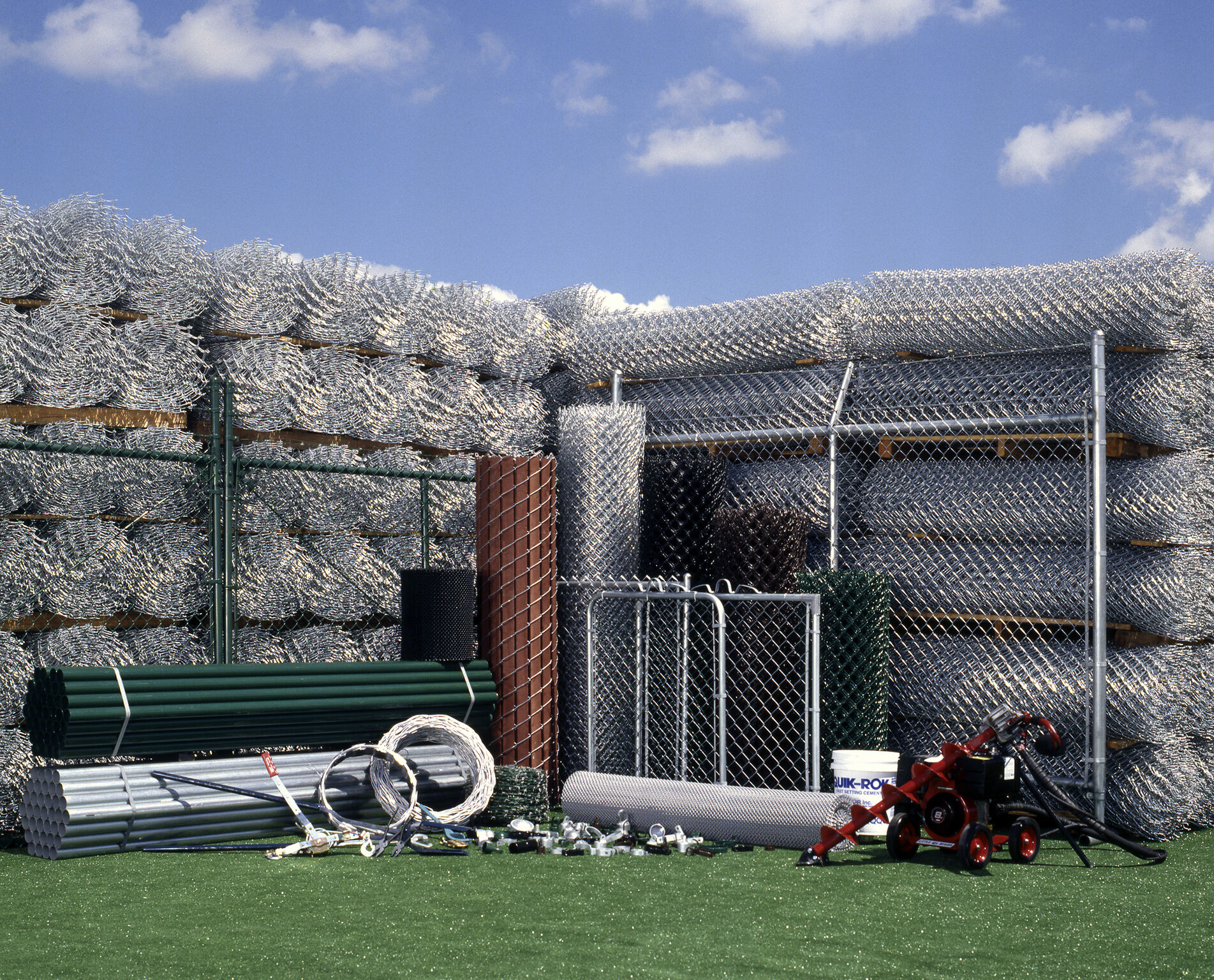
Budget maintenance where the system is weakest. Bare clamps on a coated fence let rust run through the green; coloured arms on galvanised wire fade before they rust. Specify the fitting coating on the same drawing line as the fabric. When a quote says “galvanised” without saying how, our breakdown of hot-dip versus pre-galvanised fence steel explains why post-fabrication coating outlasts pre-coated strip at every cut and clamp point.

Specifying Without Regret: What Goes on the Drawing
Five lines on one drawing prevent most lifecycle arguments from becoming replacement orders:
- Wire: gauge system named and measured diameter in millimetres, so the BWG-versus-Stubs question dies before booking.
- Coating: hot-dip galvanised or PVC-coated over a galvanised core, stated per component — fabric and fittings as separate line items.
- Weave: mesh aperture and fabric depth (roll height), matched to the threat the site faces.
- Order terms: minimum 100 panels on the fencing line, 20–25 days bulk production, 7-day dispatch on stock configurations, FOB/CIF/CFR/DDU/DDP, and flexible, negotiable payment terms.
- Verification: the factory is ISO9001 certified and SGS audited; ask for the coating and material report with the batch, not the brochure.
The 24-hour quote window doubles as an audit. Answers on all five lines describe a process, and a supplier who cannot answer those questions is quoting price alone.
Frequently Asked Questions
Does a lower gauge number mean thicker chain link wire?
Yes. Gauge scales run backwards — the lower the number, the thicker the wire. Confirm which scale a quote uses, because Birmingham Wire Gauge and US Stubs assign different diameters to the same number.
Is PVC-coated chain link always better than galvanised?
No — it is better only where UV and salt justify the extra spend. Rental fleets and inland yards often save on galvanised fabric and accept a shorter replacement cycle instead of paying for a jacket they never use.
What fails first on a PVC-coated chain link fence?
The jacket at cut ends, clamp points and abrasion marks. Once water reaches the galvanised core through a breach, corrosion runs underneath and lifts the coating — inspect those spots, not the middle of the panel.
Can I order galvanised and PVC-coated fabric in one shipment?
Yes, both coatings run on the same line, with a minimum of 100 panels and 20–25 days for bulk production.
How do I compare lifecycle costs without a lifespan guarantee?
Compare structure, not years: entry price, protection mechanism, failure mode and repair effort. Put the coating type and measured wire diameter on the drawing and demand the batch report — those control what you replace, and when.
Conclusion
Gauge decides how much steel stands on your perimeter. Coating decides what attacks it and how fast. A heavier galvanised fabric and a mid-weight PVC-coated one can cost the same over an asset plan. The first adds replacement cycles, the second adds inspection and touch-up. Which one is cheaper is a question about your site’s exposure, not about the catalogue.
Write the gauge system, measured diameter and coating per component onto one drawing, and send it with your panel count. The 24-hour quote either answers all of it or shows you exactly what to ask next.