 Skip to content
Sustainability Highlights in Steel Fencing
- Steel fencing offers a unique sustainability profile combining high recycled content, energy-efficient manufacturing, and full recyclability supporting circular economy goals.
- Choosing sustainable steel fencing can deliver LEED points and reduce the lifecycle carbon footprint compared to other common fencing materials.
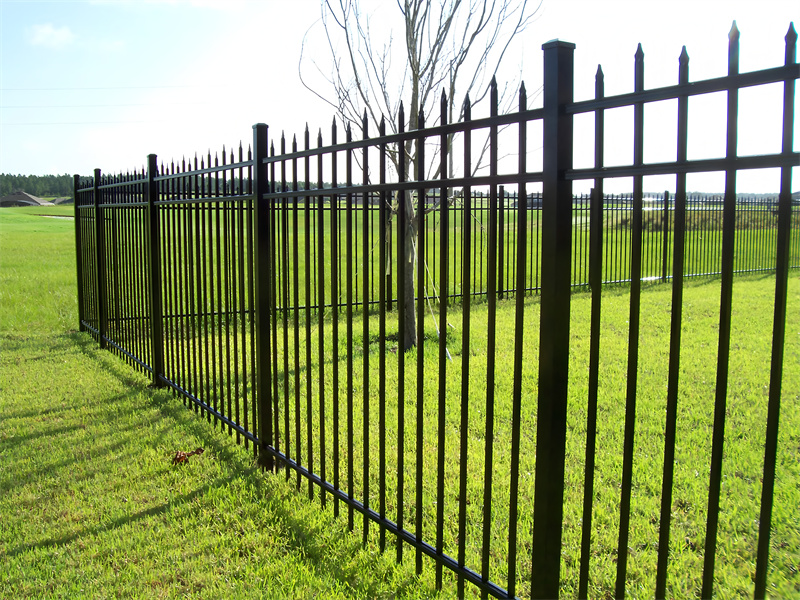
Overview of Sustainable Steel Fencing
For decades, steel fencing has been the go-to choice for security and durability. Today, however, its most compelling attribute may be its robust sustainability profile. As organizations intensify their focus on environmental, social, and governance (ESG) criteria, the materials specified in building projects are under greater scrutiny than ever. Steel fencing emerges as a powerful contributor to green building, not by accident, but due to the intrinsic properties of the material and the advanced state of its industry’s supply chain. The conversation around sustainable steel fencing extends far beyond simple material choice; it encompasses a complete lifecycle perspective, from responsible sourcing to end-of-life circularity.
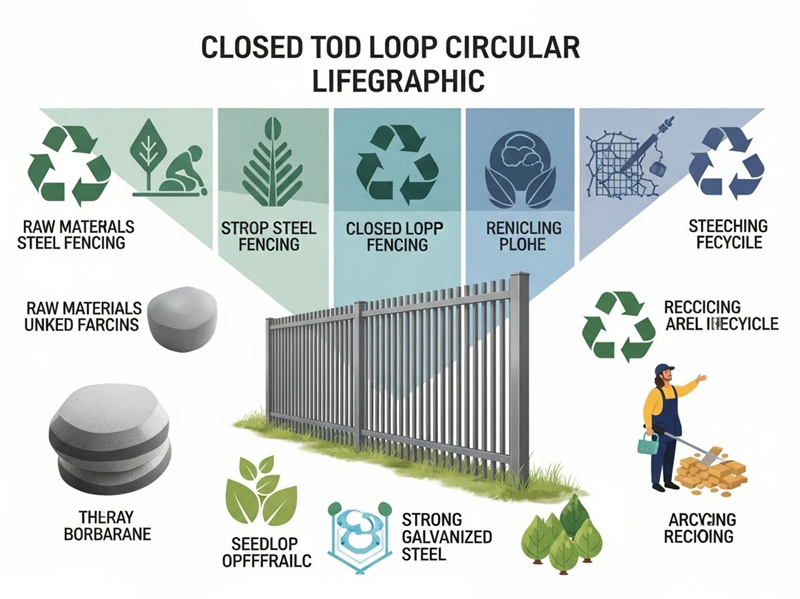
The fundamental driver behind steel’s sustainability is its unique position in the circular economy. Unlike materials that degrade with each recycling loop, steel retains its core properties, allowing it to be infinitely recycled without loss of quality. This creates a closed-loop system where an old fence can be melted down and reformed into a new structural beam, a car part, or another high-performance fence. This principle of material circularity stands in stark contrast to the linear “take-make-waste” model of many alternative materials. By leveraging a high percentage of recycled content, the steel industry significantly reduces its reliance on virgin ore, conserving natural resources and drastically cutting the energy and emissions associated with production.
What Defines Sustainable Steel Fencing?
Sustainable steel fencing is defined not just by the material itself, but by its performance across its entire lifecycle within a circular economy framework. It represents a system where material sourcing, manufacturing, use, and end-of-life management are all optimized to minimize environmental impact. The key attributes that form its sustainability credentials include exceptional durability, high recycled content, complete recyclability, and a comparatively low long-term environmental footprint. When you specify a steel fence, you’re not just installing a perimeter; you’re investing in a material asset that can be perpetually recovered and reused.
When compared to common alternatives, steel’s advantages become clear. Wood fencing, while sourced from a renewable resource, often requires chemical treatments to prevent rot and insect damage, has a shorter lifespan, and its end-of-life options are typically limited to landfilling or energy recovery. Vinyl (PVC) fencing is a petroleum-based product with a significant carbon footprint during manufacturing, and its recycling streams are far less mature and efficient than steel’s. While aluminum is also highly recyclable, steel often provides superior strength and durability for security applications, reducing the likelihood of damage and the need for premature replacement.
Ultimately, longevity is a cornerstone of sustainability. A steel fence’s ability to withstand harsh weather, physical impacts, and the test of time means fewer resources are consumed for repairs and replacements over its service life. This extended lifespan, combined with minimal maintenance requirements—especially for powder-coated varieties—translates directly into a lower total cost of ownership and a reduced lifecycle carbon footprint. For sustainability directors and architects, this makes material circularity and durability a powerful combination for meeting long-term environmental goals.
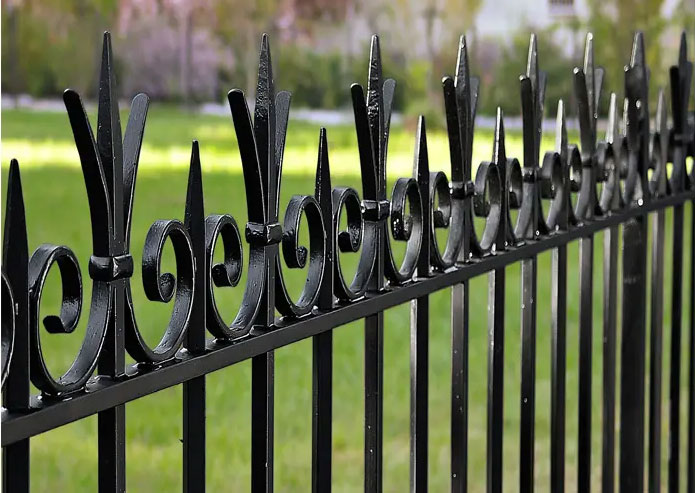
Steel Recycling: Industry Context
The sustainability of steel fencing is underpinned by a mature and highly efficient global recycling infrastructure. It is not an emerging “green” trend but a long-established economic and environmental practice. According to authoritative sources like the World Steel Association, the global steel industry already operates on a massive scale of circularity. It is estimated that approximately two-thirds of all new steel production globally incorporates reclaimed metal. This widespread use of scrap is not just an environmental nicety; it is a core component of modern steelmaking.
The benefits are substantial. Utilizing recycled steel in an electric arc furnace (EAF) typically saves roughly 60% of the energy required to produce steel from virgin iron ore. This energy efficiency directly corresponds to a comparable reduction in CO₂ emissions, making recycled steel a critical tool in the decarbonization of the construction industry. The process involves collecting scrap steel from various sources—including demolished buildings, old vehicles, and decommissioned infrastructure like fences—sorting it, and melting it down to be cast into new products. The magnetic properties of steel make it relatively easy to separate from mixed waste streams, ensuring a high-quality recyclate.
To further drive this demand, many governments and industry bodies have instituted policies that encourage or mandate the use of recycled materials. Four key legislative forms include minimum recycled content mandates, which specify a required percentage of recycled material in new products, and utilization rates, which offer manufacturers more flexibility in meeting recycling targets across their operations. Procurement policies for government projects often give preference to products with high recycled content, and clear product labeling helps specifiers make informed choices. While challenges exist, such as ensuring the purity of scrap, the steel recycling industry continuously innovates to improve processes and maintain the high quality necessary for demanding applications.
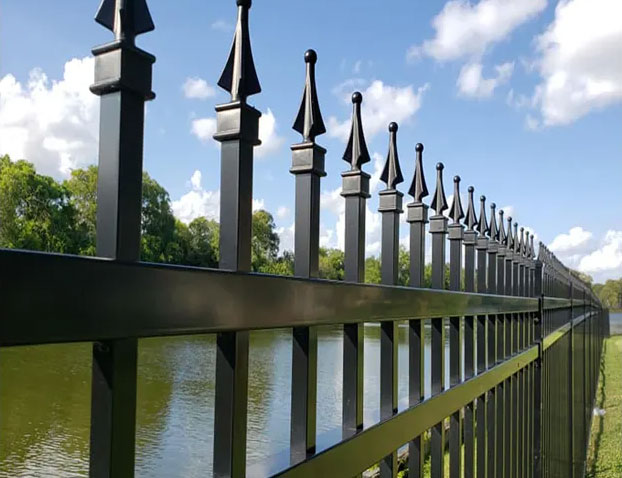
Recycled Content in Steel Fencing
As a LEED project manager for a new science center, achieving a high score in Materials & Resources was a primary goal. When we specified a perimeter steel fence, it became critical not just to request its recycled content percentage, but to understand its composition for our LEED documentation. This required a deep dive into how recycled content is measured, specifically learning the crucial distinction between post-consumer content—material from end-of-life products like old fences—and post-industrial (or pre-consumer) content, which is scrap from the manufacturing process. While both types reduce virgin material use, green building standards like LEED often prioritize post-consumer content because it directly diverts waste from landfills, making that distinction essential for accurate and impactful reporting.
Measuring Recycled Content
The amount of recycled content in steel fencing can vary significantly, typically ranging from 30% to over 90%, depending on the production method and the manufacturer’s sourcing strategy. Steel produced via an Electric Arc Furnace (EAF) can utilize up to 100% scrap steel, a common method for producing sections used in fencing. In contrast, the Basic Oxygen Furnace (BOF) process uses a smaller proportion of scrap, typically around 25-35%, supplemented with virgin iron ore. Therefore, knowing the manufacturing process is a key indicator of potential recycled content.
To ensure these claims are accurate, project teams should look for industry standards and third-party certifications for recycled content certification. Organizations like SCS Global Services and UL Environment provide validation services that verify manufacturer claims. Manufacturers typically report recycled content on product data sheets or Environmental Product Declarations (EPDs), breaking down the percentages of post-consumer and post-industrial material. It’s important to note that a high level of recycled content has no negative impact on the quality or performance of the steel; the material’s metallurgical properties are fully restored during the remelting process, ensuring the final product meets all required strength and durability standards.
Benefits of High Recycled Content Steel
Choosing steel fencing with a high percentage of verified recycled content delivers a cascade of environmental, economic, and project-specific benefits. Environmentally, it directly translates to significant energy conservation, reduced CO₂ emissions, and conservation of natural resources like iron ore and coal. Every ton of steel recycled saves approximately 1.5 tons of iron ore, 0.5 tons of coal, and a substantial amount of water. These quantifiable reductions in embodied carbon are critical for organizations striving to meet ambitious sustainability targets and report on their ESG performance.
From an economic perspective, using recycled scrap can often be more cost-effective than relying on the volatile global market for virgin raw materials, potentially creating more stable pricing for fencing products. Most importantly for green building professionals, this attribute is a direct contributor to certifications like LEED and the WELL Building Standard. Projects can earn points under the Materials & Resources (MR) credit category for specifying products with high recycled content, making it a straightforward way to boost a building’s overall sustainability rating. Leading manufacturers now proactively provide transparent documentation, including EPDs and recycled content reports, to simplify the verification process for project teams.
| Recycled Content % | Energy Savings vs. Virgin Steel | CO₂ Reduction | Typical Applications |
|---|---|---|---|
| 30-50% | Approx. 40% | Significant | Standard commercial fencing |
| 50-70% | Approx. 50% | High | Residential and municipal fencing |
| 70-90% | Up to 60% | Very High | High-performance green building projects |

Lifecycle Environmental Impact of Steel Fencing
As a facilities director for a large industrial park, I once conducted a 20-year cost and impact analysis comparing a proposed wood security fence with a galvanized and powder-coated steel option. While the wood fence had a lower initial cost, the lifecycle assessment told a different story. The steel fence’s projected lifespan was more than double that of the wood, it required virtually no maintenance beyond occasional cleaning, and its end-of-life value as scrap was a net positive. The wood fence, by contrast, would need replacement at least once and require regular staining, with disposal costs at the end. The clear winner for long-term value and reduced environmental burden was steel.
To truly grasp the sustainability of steel fencing, one must analyze its entire journey using a methodology known as a Life Cycle Assessment (LCA). An LCA for a steel fence evaluates environmental impacts at every stage: raw material extraction and processing, manufacturing, transportation, installation, use and maintenance, and finally, end-of-life disposal or recycling. This holistic view prevents “burden shifting,” where a product might seem green in one phase (e.g., low-impact use) but carries a heavy environmental load in another (e.g., resource-intensive manufacturing). For steel fencing, the production and manufacturing phase typically dominates the overall environmental impact, which is precisely why the use of recycled content is so critical. By replacing energy-intensive virgin production with efficient EAF recycling, manufacturers can dramatically lower the fence’s embodied carbon from the very start.
Production and Manufacturing Impact
The manufacturing process is the most impact-heavy stage in a steel fence’s life. The difference between producing steel from virgin iron ore versus recycled scrap is stark. Virgin production requires mining, transportation of raw materials, and a high-temperature blast furnace, consuming immense amounts of energy and releasing significant CO₂. In contrast, steel made from recycled scrap in an EAF bypasses these initial steps, cutting energy use and associated emissions by approximately 60%, as confirmed by industry reports. After the steel itself is formed, the finishing processes—namely galvanizing and powder coating—also contribute to the environmental footprint, but offer substantial benefits in durability and longevity.
Modern innovations are continuously working to reduce these impacts further. For example, advancements in furnace technology and the use of renewable energy sources in steel mills are lowering the carbon footprint even for virgin material production. On the finishing side, powder coating is a standout sustainable choice. Unlike solvent-based liquid paints, powder coatings contain no or very low levels of Volatile Organic Compounds (VOCs), which are harmful air pollutants. The overspray from powder coating can also be collected and reused, leading to extremely high material efficiency and minimal waste.
Galvanizing Environmental Impact
Galvanizing is the process of applying a protective zinc coating to steel to prevent rust and corrosion. This step is fundamental to the longevity of a steel fence, potentially extending its service life from a few years to several decades, depending on the environment. This lifespan extension is a major sustainability benefit, as it drastically reduces the need for replacement materials and the associated embodied carbon over time. However, the galvanizing process itself has environmental trade-offs. It requires the consumption of zinc, a finite resource, and involves the use of chemical baths, which can generate hazardous wastewater that must be treated according to strict environmental regulations. Responsible manufacturers mitigate this impact through closed-loop acid regeneration systems and advanced wastewater treatment facilities to ensure compliance and minimize their footprint.
Powder Coating VOC Benefits
Powder coating provides both a durable, colorful finish and significant environmental advantages over traditional liquid painting methods. The process involves electrostatically applying a dry powder to the galvanized steel, which is then cured under heat to form a hard, resilient “skin.” A key benefit is the near-zero emission of Volatile Organic Compounds (VOCs). VOCs in liquid paints contribute to smog formation and can be harmful to human health. By eliminating these solvents, powder coating helps protect both outdoor and indoor air quality, a factor that can contribute to credits in green building schemes like LEED’s Indoor Environmental Quality (IEQ) category. Furthermore, its superior durability and resistance to chipping, fading, and scratching mean less frequent repainting and maintenance, further reducing long-term environmental impact.
Use Phase Impact and Longevity
The use phase of a steel fence is where its sustainability truly shines, primarily due to its exceptional durability and low maintenance needs. A well-manufactured steel fence is highly resilient to weathering, UV degradation, and physical stress. This robustness means it will not need to be replaced for many decades, dramatically reducing the demand for new materials and the embodied carbon associated with manufacturing and installation. A typical galvanized and powder-coated steel fence in a commercial application can have a service life of 20 to 50 years or more, depending on the thickness of the coatings and local environmental conditions. By extending the lifecycle, the initial environmental impact of production is amortized over a much longer period, resulting in a lower annualized carbon footprint compared to less durable materials that require multiple replacement cycles in the same timeframe.
End-of-Life and Recyclability
Steel’s end-of-life story is perhaps its most compelling sustainability feature: it is 100% recyclable. This isn’t just a theoretical possibility; it’s a practical reality supported by a robust global market for scrap steel. When a steel fence is decommissioned, it does not become waste. Instead, it becomes a valuable commodity. Demolition contractors can easily reclaim the steel components—panels, posts, and rails—and sell them to scrap dealers. The material is then processed and sent back to steel mills to be melted down into new steel products. This creates a perfect closed-loop system, embodying the core principles of the circular economy.
This complete recyclability has direct implications for green building projects. Under LEED and similar rating systems, using materials that can be easily recovered and recycled at the end of their life contributes to a building’s overall sustainability score. For project teams, specifying a steel fence means making a choice that avoids future landfill waste and ensures the material’s embodied energy is preserved for future generations. Practical logistics are straightforward; coordinating with demolition and waste management contractors to segregate steel on-site ensures maximal recovery and financial return for the scrap material.
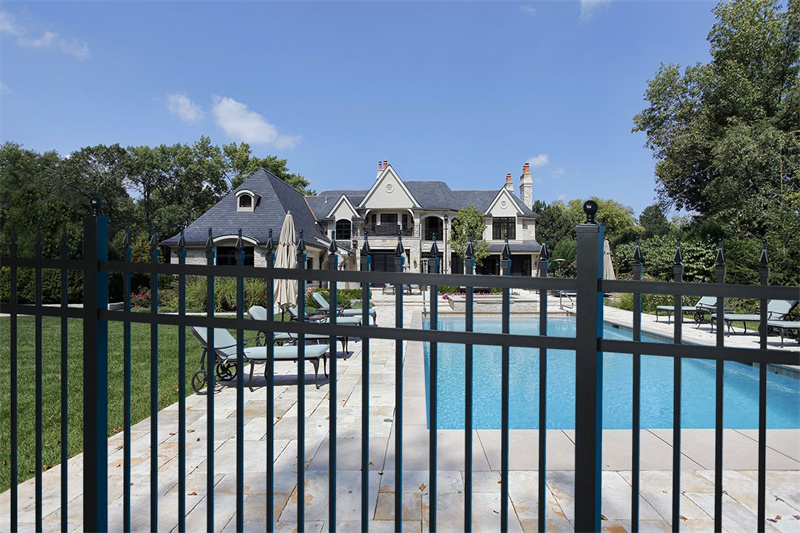
High-Quality Metal Fences Built to Last
DB Fencing offers durable steel picket fences and specialized metal fencing solutions crafted with precision and backed by strict quality standards. Enjoy fast sample delivery, expert support, and competitive factory prices designed for international customers.
LEED and Green Building Contributions
On a recent high-profile urban renewal project, our architectural firm was pushing for LEED Gold certification. Every material choice was under the microscope. We specified a modular steel fence with a verified 85% recycled content and a product-specific EPD. The manufacturer’s clear, third-party-verified documentation allowed us to confidently claim points under two separate LEED v4.1 credits in the Materials & Resources category. That fence didn’t just secure the property; it secured crucial points that helped us achieve our certification goal, demonstrating to the client and the community our commitment to measurable sustainability.
For green building professionals, a material’s sustainability is only as valuable as its ability to be documented and contribute to certification goals. Sustainable steel fencing excels in this regard, offering multiple pathways to earn points under the Leadership in Energy and Environmental Design (LEED) rating system. The key is to understand which attributes of the fence align with specific LEED credit categories. The primary contributions come from its high recycled content, the availability of lifecycle data, and the use of low-emitting coatings. Project teams can strategically leverage these features to bolster their applications in categories like Materials & Resources (MR) and Indoor Environmental Quality (IEQ).
LEED Credit Categories for Steel Fences
Steel fencing can directly contribute to several key LEED credits, making it an attractive option for certification-focused projects. In the Materials & Resources (MR) category, the most significant contributions are related to product disclosure and optimization. Credits are available for “Building Product Disclosure and Optimization – Sourcing of Raw Materials,” where using steel with a high percentage of certified recycled content qualifies. Another credit, “Building Product Disclosure and Optimization – Environmental Product Declarations (EPDs),” can be achieved by selecting fencing products for which the manufacturer has published a third-party-verified EPD. This document provides transparent data on the product’s lifecycle environmental impact.
Furthermore, while fencing is an exterior product, the choice of coating can contribute to sustainability goals related to air quality. The “Low-Emitting Materials” credit, often associated with the Indoor Environmental Quality (IEQ) category, rewards the avoidance of VOCs. By specifying a powder-coated steel fence instead of one with a solvent-based paint, a project demonstrates a commitment to reducing harmful emissions, which aligns with the credit’s intent. Several case studies of LEED-certified projects showcase how high-performance steel fencing was used not just for its functional role, but as a strategic tool to secure these valuable points.
| LEED Credit Category | Credit Name | How Steel Fencing Qualifies | Documentation Needed |
|---|---|---|---|
| Materials & Resources (MR) | Building Product Disclosure and Optimization – Sourcing | Use of steel with verified recycled content and responsible sourcing | Manufacturer’s recycled content report and supplier info |
| Materials & Resources (MR) | Environmental Product Declarations | Availability of EPDs for steel fencing products | EPD documentation aligned with project goals |
| Indoor Environmental Quality (IEQ) | Low-Emitting Materials | Powder coating VOC benefits reduce emissions | VOC testing data and manufacturer declarations |
Documentation and Verification Process
Successfully claiming LEED credits requires meticulous documentation. For steel fencing, the process begins during procurement. Project teams must request specific documentation from the manufacturer or supplier. To prove recycled content, a manufacturer’s letter or a product data sheet stating the post-consumer and pre-consumer percentages is required. For greater credibility, this information should be backed by a third-party certification from an organization like SCS Global Services.
For EPD credits, a copy of the product-specific or industry-wide EPD must be submitted. This document must conform to ISO standards to be valid for LEED purposes. Similarly, for low-emitting materials, a manufacturer’s declaration and third-party testing data certifying the VOC content of the powder coating is necessary. Best practices from experienced LEED project teams suggest compiling all this documentation into a clear, organized submission package for the LEED review. Proactively communicating these documentation requirements in the specification and procurement phases prevents last-minute scrambles and ensures all claims are defensible.
Circular Economy and Future Trends
The concept of a circular economy—a system designed to eliminate waste and promote the continual use of resources—is moving from an abstract ideal to a practical business strategy. Steel fencing is a prime example of a product that naturally fits this model. Its production is deeply integrated with recycling, its use phase is defined by longevity, and its end-of-life is not an end at all, but a rebirth. Innovations in “design for disassembly” are making it even easier to reclaim components. For instance, modular fence systems that use mechanical fasteners instead of welds allow panels and posts to be easily separated, repaired, or reconfigured, extending their life even before they enter the recycling stream. This approach turns a linear product into a durable, adaptable asset.
Steel Fencing and Circular Economy
The core principles of the circular economy involve designing out waste, keeping products and materials in use, and regenerating natural systems. Steel fencing embodies the first two principles perfectly. Its 100% recyclability and the industry’s closed-loop flow mean that the material is perpetually kept in use, drastically reducing landfill waste and the need for virgin resource extraction. Forward-thinking manufacturers are now exploring take-back programs, where they facilitate the recovery of their own products at the end of their service life, ensuring the material is funneled directly back into their production process.
This closed-loop model offers significant benefits for sustainability directors and those responsible for ESG reporting. By specifying materials that are part of a functioning circular economy, companies can provide tangible evidence of their commitment to sustainable practices. It creates a compelling narrative for stakeholders, investors, and customers, demonstrating a long-term vision that moves beyond simple compliance to active environmental stewardship.
Innovations in Sustainable Steel Fence Manufacturing
The future of sustainable steel fencing is being shaped by continuous innovation across the supply chain. Advanced sorting and recycling technologies are emerging that use AI and sensor-based systems to improve the purity of scrap steel, enhancing the quality of the final product. In the finishing stages, new low-impact galvanizing processes are being developed that use less zinc and generate less waste. Likewise, innovations in powder coatings include lower-temperature curing powders, which reduce energy consumption during manufacturing, and formulations derived from renewable biological sources.
Perhaps most exciting is the move toward “design for longevity and modularity.” Fence systems are being engineered with replaceable components and adaptable designs, allowing them to be repaired or modified rather than replaced. To enhance transparency, some companies are beginning to use digital tools like blockchain to create an immutable record of a product’s material origins, recycled content, and lifecycle journey. These innovations in steel manufacturing are not only improving the environmental profile of steel fencing but also enhancing its value as a long-term, sustainable infrastructure asset.
Conclusion: Sustainability in Steel Fencing
The evidence overwhelmingly supports steel fencing as a premier choice for sustainable construction and site management. Its unique combination of attributes—high recycled content, an exceptionally long service life, and complete, infinite recyclability—sets it apart from many alternatives. These features are not marginal benefits; they are core to the material’s identity and its role in a modern circular economy. By specifying steel, project teams are choosing a material that minimizes resource depletion and reduces long-term environmental burdens.
- Steel fencing combines high recycled content, long service life, and full recyclability, making it one of the most sustainable fencing options.
- Its manufacturing processes, when optimized, significantly reduce lifecycle environmental impacts.
- Use of sustainable steel fencing supports LEED credits and green building goals.
- Ongoing innovations in manufacturing and circular economy models promise further sustainability improvements.
For sustainability directors, architects, and procurement teams, the message is clear. When evaluating materials for durability, security, and environmental performance, sustainable steel fencing should be a primary consideration. It is not merely a functional product but a key contributor to achieving ambitious environmental, certification, and ESG reporting goals, making it a truly future-proof investment.
Frequently Asked Questions
- What percentage of recycled content is typical in sustainable steel fencing?
- The recycled content in steel fencing can vary widely, typically ranging from 30% to over 90%. The final percentage depends heavily on the manufacturer and the specific production process used. Steel made in an Electric Arc Furnace (EAF) can utilize nearly 100% recycled scrap, while steel from a Basic Oxygen Furnace (BOF) uses a lower percentage. Industry averages often hover near two-thirds, or about 66%, reflecting the global steel industry’s deep integration of scrap material into its supply chain.
- How does steel fencing contribute to LEED certification?
- Steel fencing can contribute to earning points in several LEED credit categories. Primarily, under Materials & Resources (MR), it qualifies for credits related to sourcing raw materials due to its high recycled content. It can also earn points if the manufacturer provides an Environmental Product Declaration (EPD). Furthermore, if the fence is finished with a powder coating, it can support the “Low-Emitting Materials” credit under the Indoor Environmental Quality (IEQ) category by avoiding the release of harmful VOCs.
- Is steel fencing fully recyclable at end-of-life?
- Yes, steel fencing is 100% recyclable. Unlike many other materials, steel can be melted down and reformed into new, high-quality steel products an infinite number of times without degrading its structural properties. This quality makes it a perfect material for a closed-loop circular economy, preventing landfill waste and preserving the energy and resources embodied in the material.
- What environmental impacts are associated with galvanizing steel fences?
- Galvanizing provides critical corrosion protection that can extend a fence’s lifespan for decades, which is a major sustainability benefit. However, the process does have environmental trade-offs. It consumes zinc, a finite resource, and uses chemical solutions that can produce hazardous wastewater. Responsible modern manufacturers mitigate these impacts by operating under strict environmental regulations, employing closed-loop systems to regenerate chemicals, and using advanced wastewater treatment facilities to neutralize harmful byproducts before discharge.
- How does powder coating improve the sustainability of steel fences?
- Powder coating offers significant sustainability advantages over traditional liquid paints. It contains virtually no Volatile Organic Compounds (VOCs), which are harmful air pollutants. The application process is also highly efficient, as any overspray can be collected and reused, minimizing material waste. Additionally, powder coatings create an extremely durable and long-lasting finish that resists chipping and fading, reducing the need for maintenance and repainting over the fence’s long life.
- What is the lifecycle impact of steel fencing compared to wood or vinyl?
- When comparing lifecycle impacts, steel fencing often comes out ahead. Its embodied carbon can be significantly reduced by using high recycled content. Its main advantages are superior longevity and 100% recyclability. A wood fence has a shorter lifespan, often requires chemical treatments, and is typically landfilled at end-of-life. A vinyl fence is made from fossil fuels, has a high carbon footprint in manufacturing, and has limited, less efficient recycling options. Steel’s long service life and perfect circularity mean its initial environmental impact is amortized over a much longer period, and the material itself is never wasted.


