Skip to content
A splice socket is what a buyer types when the joint between two temporary fence panels stops holding. No part on this site’s Australian fencing lines carries that name. Three joints get called a splice — panel to panel, post into foot, brace into post — and each has its own line item. Collar is not a separate name of its own here; it travels with whichever joint you mean.
Published lines separate them. The clamps page states one clamp type connecting panels, feet and bracing; the Econo sheet counts one clamp inside a set; the bracing page counts two coupler clamps per brace; the feet page lists openings from 32 mm to 50 mm. What no page publishes is a repair.
Key Takeaways
- Nothing on the Australian temporary fencing pages is called a splice socket. One clamp component is published doing three jobs: panels, feet and bracing.
- Packing counts one clamp per set — 1 panel, 1 foot with concrete, 1 clamp with bolt and nut, 550 sets in a 40′ HC. The bracing page states its clamp count outright: 2 coupler clamps each.
- Anatomy is specified more carefully than the joint: 0.42 kg a set of 2 clips, 1 bolt and 1 nut, 4.0 mm clip wall, pitch 75 to 100 mm.
- Feet are published across hole sizes 32 to 50 mm and the clamps name 32 mm, 40 mm or “other specs”, so a worn seat only swaps cleanly if you know your tube.
- Two finishing routes are published — pre-galvanised then sprayed, or welded black then hot-dip galvanised above 42 microns. Only the second puts zinc over the weld.
Which Joint Gets Called a Splice
Splice, socket and collar are pipe-fitting words, and enquiries inherit the confusion. Against the site’s own hardware guide, buyers mean one of four things: standard couplers, two metal pieces and a bolt; security couplers, whose anti-tamper nut needs a specialised socket tool; saddle clamps, C-shaped and stated as not interchangeable with standard couplers; and ring connectors, which tie a panel to a driven post.
Those four are hardware. The seat is the post-into-foot joint, and no page sells a part called a seat — the feet line answers it. A temporary fence post does not enter a machined socket; it drops into a moulded or formed opening and stays there on weight, sometimes clamped. When a hire fleet reports a worn splice, ask which joint you mean — panel to panel, post into foot, or brace into post. That answer belongs on the enquiry.
How many fixings a joint needs is another argument, already worked through in the site’s guide to counting fixings in a fencing joint. This article asks the wear question instead.
What Wears, and What You Can Buy
Four wear points, three orderable. Take the seat first in the inspection. Plastic feet are published in two mouldings — 560 x 240 x 130 mm injection moulded, 610 x 230 x 150 mm blow moulded — and concrete feet are stated as generally suitable for hole sizes 32, 38, 40, 42, 48 and 50 mm. A foot that has carried a season on gravel is a parts-line replacement rather than a panel decision, and the feet page gives inspection for wear and damage as its maintenance route.
Fasteners come next, specified to the piece: 2 clips, 1 bolt and 1 nut at 0.42 kg a set, clip wall 4.0 mm, pitch 75, 80, 90 or 100 mm centre to centre. Bolts are the consumable — handled, torqued, lost — and the set definition buries them in the panel packing.

Bracing is third. A stay is published at 1.5 m or 1.8 m in 32 x 1.3 mm tube on a 600 x 290 x 6.0 mm plate, needing 2 clamps and 2 plastic feet, and the bracing page places 1 brace at every third panel in windy, heavy-traffic or public areas. Work the bracing check from the stay plate and its two clamps, and ask which wears first — no page ranks wear rates.

Fourth is the frame tube, and the published list stops there. Feet, clamps, bracing and ballast blocks appear as accessory lines; a loose frame tube or a machined socket does not. The heavy duty panel is framed in O.D. 40 x 1.5 mm tube with infill welded front and back twice and corners hand welded; the Econo is 32 mm outside diameter at 1.3 mm wall. Once that tube is crushed or a corner opens, the wear has moved into the panel.
The Coating Route Decides a Re-weld
Whether a re-joined panel is still a galvanised panel depends on how it was made; both routes are published on the panels page. First, pre-galvanised wire becomes the mesh infill, the frame pipe is hand welded front and back, and the assembly is sprayed in a zinc silver colour. Second, black wire and pipe are welded, then the finished panel is hot-dip galvanised at more than 42 microns. A specification table gives the same choice as galvanising before welding with silver protection on the weld joints, or after welding.
That distinction matters at a worn joint: a coating above 42 microns is a bath result, and a bath is not practically repeated on an installed panel. A touched-up joint is not the same surface as the panel beside it.
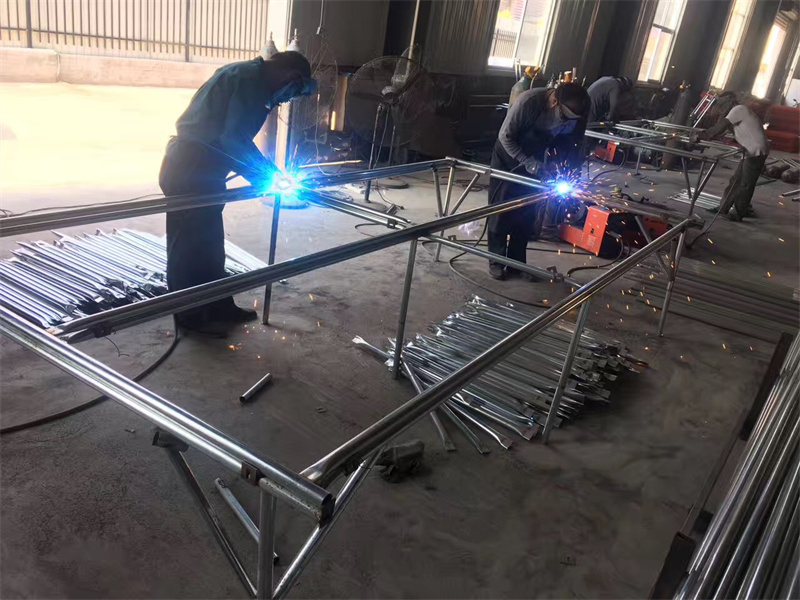
Compliance rides on the assembly. The Econo page states the 240 x 210 cm panel complies with Australian Standard AS4687-2022 when installed with feet and clamps, so a joint that no longer holds a clamp, or a foot opening worn past its tube, is a compliance question. Frames are welded in a factory, as the photograph below shows; no page here offers a field re-weld or re-galvanising of used panels, so treat either as a written question, not an assumed service.
Rejoin or Replace: What to Settle Before You Order
Match the symptom to the line and check the number that sizes it.
| Symptom | Published line | Number on the site | Ask in writing |
|---|---|---|---|
| Post rocks in its foot | Feet | Holes 32 to 50 mm; two mouldings | Which opening suits the tube you hold |
| Clamp bites one tube only | Clamps | Bores 32, 40 or other; pitch 75-100 mm | Which pitch and bore, per joint type |
| Bolt sheared or stripped | Clamp sets | 0.42 kg: 2 clips, 1 bolt, 1 nut | Do bolts and nuts ship as spares? |
| Brace pulls off the post | Bracing | 2 clamps and 2 feet a stay | Are those 2 bases extra to the line? |
| Tube crushed, weld open | Panels | O.D. 40 x 1.5 mm; Econo 32 x 1.3 mm | Is a loose frame supplied at all? |
The panel minimum order is published at 100 panels, bulk production at 20-25 days, stock items at 7-day dispatch and quotations inside 24 hours; the heavy duty page states 15 days after a deposit. Forty clamps and a dozen feet sit nowhere inside a 100-panel floor, so ask what the floor is on the accessory lines.
Feet are the one wear item you can re-order from the source that moulds them — the site states it runs its own feet machine and stocks feet to ship alongside panels. Order the joint, not the panel: a foot opening, a 4.0 mm clip and a stay bolted twice are replaceable, and the write-off begins where the tube is deformed or a corner has opened.
Frequently Asked Questions
What is a splice socket on a temporary fence?
A buyer’s word, not a name on these pages. One clamp component is published doing three jobs — panels, feet and bracing — and the hardware guide splits that into standard couplers, security couplers, saddle clamps and ring connectors.
Can a worn joint be repaired instead of replacing the panel?
Feet, clamp sets and bracing are published as orderable lines. No page lists a loose frame tube or a welded corner as a spare, and none offers a field re-weld or re-galvanising of used panels.
Which wear parts are worth stocking for a hire fleet?
The four pieces inside a clamp set — 2 clips, 1 bolt and 1 nut at 0.42 kg — and the feet. The site states it moulds its own plastic feet and keeps them stocked.
Does a re-worked joint still meet AS 4687?
The Econo page states compliance with AS4687-2022 when the panel is installed with feet and clamps, so an assembly that no longer holds its clamp is a compliance question. Ask which coating route your panels took.
Conclusion
Wear at a joint is where a temporary fence stops being one product and becomes four: the foot holding the post, the clamp holding two frames, the brace taking the wind and the tube carrying all of it. Three are published lines with published numbers; the fourth is the panel.
Send the symptom, the tube you own and the coating route you bought, and ask what the minimum order is on the accessory lines. Quotations come back within 24 hours and stock items dispatch in 7 days, so a worn joint can stay a parts decision.