Skip to content
A spearhead tubular picket quotation usually arrives with three lines that look like a specification: panel sizes, picket sizes and post sizes. None of them tells you how thick the steel is. On the three sheets this site publishes for that family, the figure that decides whether a line is light or heavy duty appears only on the post, never on the picket.
That gap is a formatting habit rather than a matter of opinion. It is why two buyers can pay for the same “25 x 25 mm spearhead fence” and receive lines that behave differently. Here is how to read those sheets line by line, and what to ask for in writing before the first pallet moves.
Key Takeaways
- The spearhead sheet lists vertical pipe as 25 x 25, 19 x 19 and 16 x 16 mm — outside dimensions only, with no wall thickness for the picket.
- The only thickness figure on that sheet is on the post: 60 x 60 and 50 x 50 mm with 1.0-2.0 mm wall.
- The Australian spear top sheet adds the two figures the spearhead sheet omits: 135 mm centres and pickets welded through the rail.
- 2400 mm divided by 135 mm is 17.8, so a 2.4 m panel does not land on whole bays. Ask how the end bays are settled.
- Coating is quoted in two units on the same page: powder coating at 0.1 mm thick and hot-dip galvanising at over 42 microns.
- One set is defined as one panel plus one post plus accessories, so a run’s post count depends on whether intermediate posts are shared.
What the Three Sheets Actually Say

Three published sheets cover this family: the spearhead tubular page, the Australian spear top page, and the flat-top tubular sheet beside them. Read only the specification blocks and you get this.
| Field | Stated on the sheets | Not stated |
|---|---|---|
| Picket | 25 x 25, 19 x 19, 16 x 16 mm | Wall thickness |
| Rail | 40 x 40, 40 x 30 mm | Rails per panel, wall thickness |
| Post | 60 x 60, 50 x 50 mm; also 80 x 80 and 100 x 100 on one sheet | Which size gets which wall |
| Panel | Heights 1.5, 1.8, 2.1 m; lengths 1.8, 2.1, 2.4 m | Pickets per panel |
The picket is the element a spearhead fence is made of, and its wall thickness appears on none of the three sheets. The one thickness figure in the family sits on the post: 1.0-2.0 mm. That is a range whose extremes differ by a factor of two, listed across two post sizes with no pairing, so it answers nothing on its own.
Two details do appear, and they are worth more than the ladders. The Australian sheet states pickets are welded through the rail, welded with silicon bronze, on a structure with 135 mm centres. That fixes how the picket joins the rail and how many joins exist per metre — both of which are checkable on a delivered panel. Head style is a different question and is settled elsewhere on this site, in the spear top versus flat top comparison; this article stays on what the numbers on the sheet mean.
The 135 mm Line and the Arithmetic Nobody Runs
Take that 135 mm centre figure and put it against the panel lengths on the same page. Divide 2400 by 135 and you get 17.8. For 2100 mm it is 15.6, for 1800 mm it is 13.3, and for 1500 mm it is 11.1. None of the published panel lengths divides into whole 135 mm bays.
So one of four things is true of the panel you will be sent, and the sheet does not say which: centres are nominal and the end bays are narrowed, the pitch varies by panel length, the picket count is fixed and the pitch flexes, or the quoted length is rounded. That is not a trivia point. Picket count per panel decides the steel in the container, the weight of each panel when it is unloaded by hand, and whether two deliveries of the same “2400 mm panel” look alike on site.
Ask for the picket count per panel length and how the end bays are set, and put the answer into the order. Without it, the 135 mm line on the sheet describes intent rather than a specification.

Feet, Metres and the Meaning of One Set
The spearhead sheet writes the envelope in feet first: heights of 5 ft (1.5 m), 6 ft (1.8 m) and 7 ft (2.1 m), lengths of 6 ft (1.8 m), 7 ft (2.1 m) and 8 ft (2.4 m). Read the two lines carefully, because 6 ft appears as a height and as a length. The metric pairing resolves nothing either, since 1.8 m is offered on both axes, so only the line label tells you which one your quotation means.
The Australian sheet writes the same envelope the other way round and then extends it: 900, 1200, 1500, 1800 and 2100 mm, with lengths custom made and priced per linear metre. Three of those five heights match the foot ladder exactly. Two — 900 and 1200 mm — have no foot equivalent on the other sheet at all, so a border height can be quoted from one ladder and checked against a ladder that does not carry it.
The set definition is the line that moves money. The Australian sheet states one set equals one fence panel plus one fence post plus accessories, including clamps, bolts and nuts and anti-theft screws. On a 30 m run of 2.4 m panels you are looking at 13 panels, which is either 13 posts or 14 if corners and terminals need their own. Ask which convention your quotation uses, and whether the posts on the corner runs are the 80 x 80 or 100 x 100 mm options the sheet mentions but never pairs with a thickness.
Packing reads the same way. One sheet says steel pallet, the flat-top sheet says steel or wooden pallet — a difference in what your clearing agent expects and what your site disposes of. Gates are listed as matching on both, in swing or slide form, with the flat-top sheet also naming remote-controlled electric sliding.
Asking the Gauge Question Properly
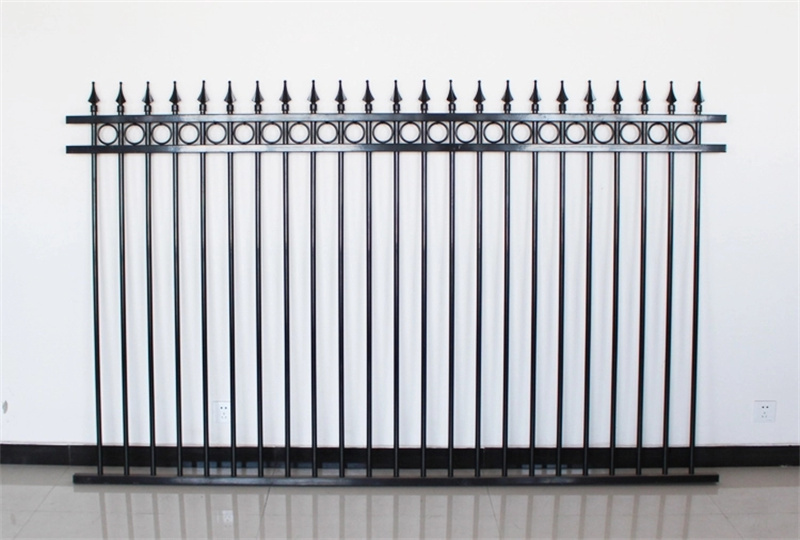
Coating is where these sheets stop being comparable with each other. The Australian page names two treatments with figures attached: powder coating at a spraying amount of 0.1 mm thick, and hot-dip galvanising at over 42 microns. Converted into the same unit, that is a 100 micron powder layer plus a zinc layer the page puts at more than 42 microns — arithmetic a buyer can run to roughly 142 microns if both are specified on the same line. The sheet lists them as alternative finishes, not as one stack. The spearhead page, meanwhile, names pre-galvanised steel plus powder coating in any RAL colour, quoting RAL6005 dark green and RAL9005 black as the normal two, and publishes no thickness figure for either layer.
So the gauge question has three parts, not one. Fix the picket wall thickness. Fix which post size gets which of the 1.0-2.0 mm options. Fix how many coating layers and in what unit. Ask for them as three numbered answers to one email rather than as a conversation, because the sheets will not answer them for you.
| Ask for, in writing | Why the sheet is not enough |
|---|---|
| Picket wall thickness, per section size | Three outside sizes listed, no thickness anywhere |
| Picket count and end-bay rule, per panel length | 2400 / 135 = 17.8; bays do not close |
| Which post size carries which thickness | 1.0-2.0 mm given across two sizes, unpaired |
| Post count convention for your run | One set = one panel + one post |
| Coating stack in one unit, per layer | 0.1 mm powder and over 42 microns zinc on one page; nothing on the other |
| Fastener material and screw type | Stainless or galvanised steel; anti-theft screws named without a spec |
| Pallet material and gate hardware inclusions | Steel on one sheet, steel or wooden on the other |
Set the position plainly: ask for the picket wall thickness in the same sentence as the section size. A sheet that gives 25 x 25 without a thickness has described a shape, not the steel.
Frequently Asked Questions
What does 25 x 25 mm mean on a spearhead picket spec?
The outside dimensions of the square tube, measured on two faces. None of this site’s three picket sheets states a wall thickness for the picket, so the figure describes the shape only. Ask for the wall in millimetres before comparing two quotations.
How many pickets are in a 2400 mm spearhead panel?
The published 135 mm centres do not answer it: 2400 divided by 135 is 17.8, so the bays do not close on whole pickets. Ask for the count per panel length and how the end bays are set.
Is a 6 ft fence panel a height or a length?
Both readings exist on the same sheet. The spearhead page lists 6 ft (1.8 m) under panel height and again under panel length, so confirm which axis your quotation sits on before a line is manufactured.
Which coating figure should a buyer compare first?
Whichever one is in microns on both lines. The Australian sheet gives 0.1 mm powder and galvanising at over 42 microns as two alternative finishes; the spearhead sheet names pre-galvanised plus powder coating with no thickness. Ask both to restate in microns.
Do the sheets say how many rails a panel has?
No. They list rail sections of 40 x 40 and 40 x 30 mm without a count per panel, while a summary on the flat-top sheet mentions three horizontal rails. Ask for rails per panel in your specification.
Conclusion
Reading a spearhead tubular picket sheet is mostly noticing what is absent. Section sizes appear on every page in the family, the picket wall thickness appears on none of them, and the one thickness figure on the post is a range nobody has paired with a size. The 135 mm centres and the welded-through-rail detail are the two real specification lines on the Australian sheet.
Send those seven questions as one numbered list and ask for the answers in writing before production is approved. The company publishes a 24-hour response on enquiries, so no fence order should rest on a shape list when the steel was never described.