Skip to content
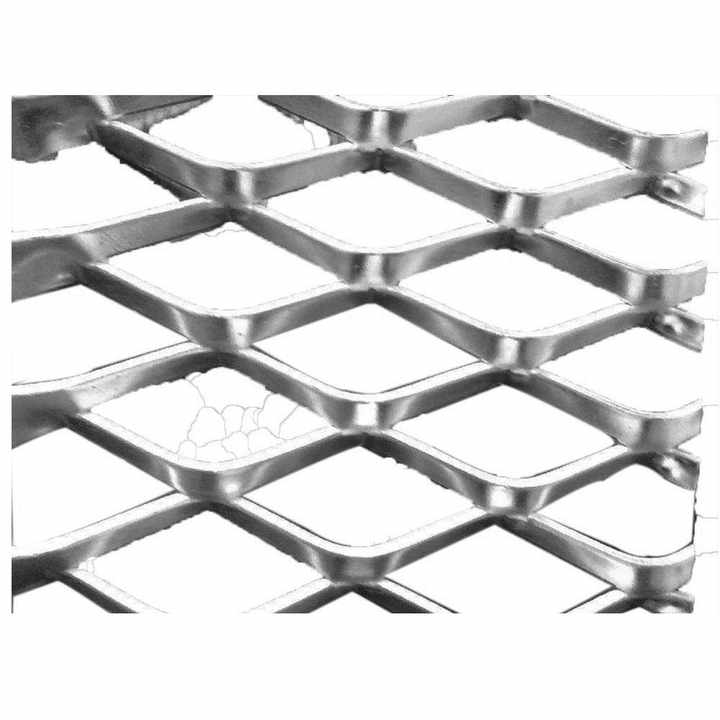
Expanded metal mesh is the fencing product that looks like mesh and is not one. A sheet is slit and stretched, so the diamond openings and the strands framing them are one continuous piece of metal — no welded intersections, no woven wires. That single fact drives what a buyer has to check.
The heavy duty page on this site publishes a wide geometry band and one weight band: thickness 0.5mm to 2.0mm, SWD 2.5mm to 22mm, LWD 4.5mm to 60mm, stem width 0.5mm to 2.1mm, widths from 0.5m to 2.0m, lengths from 1.0m to 4.0m, and weight from 0.73kg/m² to 3.69kg/m². It publishes no load rating, no shear figure and no cut-resistance claim. The useful work is reading what is there, catching where the page disagrees with itself, and knowing what to ask for.
Key Takeaways
- The specification table and the description paragraph on the same page give different ceilings: SWD 22mm versus 23mm, stem width 2.1mm versus 2.6mm.
- Thickness, LWD, width and length match between the two readings. Weight appears only in the prose, at 0.73kg/m² to 3.69kg/m².
- Stem width is the number everything hangs on: 0.5mm thickness on a 0.5mm stem is a 0.25mm² strand, 2.0mm on 2.1mm is 4.2mm² — a 16.8-fold range.
- Weight implies openness. On steel at 7.85 g/cm³, 0.73kg/m² of 0.5mm sheet is about 19 per cent metal; 3.69kg/m² of 2.0mm sheet is about 24 per cent.
- No shear, cut or load rating is published, and no border option or fixing pitch, so security behaviour is settled on a sample, not on a datasheet line.
- Six materials and five hole shapes are listed, with coatings from hot-dip galvanising and powder coating to PVC dipping, spray paint and anodising.
What the Datasheet Actually Says
The strands and the bonds between them are the same metal as the sheet itself, which is why the geometry table carries three numbers where a welded mesh carries two. The page describes the product the same way: diamond-pattern openings that provide strength and visibility, in a choice of aluminium, low carbon steel, stainless, AL-Ag alloy, copper or nickel plate, with hole shapes listed as diamond, square, round, triangle and scale.
SWD is the short way of the diamond and LWD the long way — the two diagonals of one opening. In the usual reading of these terms, thickness is the sheet gauge before stretching and stem width the strand’s finished width after it. Read together they say what a panel will do. SWD and LWD decide how much passes through. Thickness and stem decide what the strand resists.
The feature list leans on that geometry: an excellent weight-to-strength ratio, low wind resistance and ventilation properties, offered for machinery protection, window protection, construction and aquatic breeding. Those are qualitative claims. The table below is what you can actually check.
| Parameter | Specification table | Description paragraph |
|---|---|---|
| Thickness | 0.5-2.0mm | 0.5mm to 2.0mm — same |
| SWD | 2.5-22mm | 2.5mm to 23mm |
| LWD | 4.5-60mm | 4.5mm to 60mm — same |
| Wire stem width | 0.5-2.1mm | 0.5mm to 2.6mm |
| Width and length | 0.5-2.0m and 1.0-4.0m | same two ranges |
| Weight per m² | No row for it | 0.73kg/m² to 3.69kg/m² |
The Two Readings Do Not Match
Ask which reading governs before you write a specification. The stem width gap is the larger: 2.1mm in the table, 2.6mm in the prose. That is 0.5mm, about a quarter of the table’s own ceiling, on the dimension that decides strand cross-section, stiffness and how the panel behaves when someone puts a tool through it.
The SWD gap is 1mm at the top of the range and matters less, but it is the same class of problem: two numbers on one page, no note on which is current. Both trace to the same listing, so the fix is one line in the enquiry: confirm the governing table and get the answer inside the quotation.
Two items the page leaves open, and that a security or guarding specification cannot: no border or frame option is listed, and no fixing pitch is published. A stretched sheet fixed at its edges behaves differently from one fixed through the field, and the easy-to-handle claim in the feature list does not cover edge finishing. Ask both in the same email that settles the table.
Weight per Square Metre, and the Open Area It Implies
Weight is the most useful figure on the page and the only one that appears in prose rather than the table. 0.73kg/m² to 3.69kg/m² is a five-fold band, and it converts directly into how much of the sheet is hole.
Run it on steel at 7.85 g/cm³, and note this is buyer-side arithmetic from published numbers, not a factory figure. A solid 0.5mm sheet would weigh 3.925kg/m²; the lightest listing is 0.73, so about 19 per cent of that surface is metal. A solid 2.0mm sheet would weigh 15.7kg/m²; the heaviest listing is 3.69, about 24 per cent. At those two end pairings, about three quarters to four fifths of the panel is opening; the page never pairs a weight with a thickness, so intermediate boards sit between the two figures. That is the quantitative version of the page’s low wind resistance and ventilation claims.
It also sizes your handling. A 1.0 x 2.0m sheet at the light end is 1.46kg; at the heavy end, 7.38kg. Multiply by the panel count for your run and you have the mass a crew lifts and the load on the pallet, before any border you ask them to add. The expanded metal mesh listing carries both ends of that band.

Shear, Cut Resistance and Where It Works as Infill
There is no shear rating on this page, and no cut-resistance or load figure either. For a product sold partly on security, that is the gap a buyer closes personally. What the geometry does give you is cross-section: 0.5mm thickness on a 0.5mm stem is 0.25mm² of metal in the strand, and 2.0mm on a 2.1mm stem is 4.2mm² — 16.8 times more. That is the number a pair of cutters meets, and the security-related figure you can calculate straight from the table.
Compare how this site’s own security line argues. The 358 panel page puts its case on geometry — 4mm wire in 76.2 x 12.7mm openings — and states that the fence is difficult to attack with conventional hand tools. The expanded metal page makes no equivalent claim. Both are catalogue statements, so the test that decides is yours: take a sample, use the tool your own risk profile implies, and record the time. No cut or shear standard is cited on either page. AS 4687-2007 appears on this site as a temporary fence panel reference, so do not read it as a security rating for an infill.
Where expanded metal earns its place is where openness and stiffness both matter. The page names machinery protection, window protection, construction and aquatic breeding, across six materials and coatings from hot-dip galvanising, powder coating and PVDF to spray paint, electric galvanising and anodising. One caution: this site’s machine fencing system is specified in welded mesh — 3.0mm wire in a 100 x 20mm grid — so ask whether expanded infill is offered in that frame rather than assuming it.
Coating choice is where the two pages diverge again. The expanded metal listing offers hot-dip galvanising and anodising among its surface treatments but publishes no coating thickness in microns. The >42 micron figure recorded for the temporary and outdoor fencing lines is not printed here, and the 18-28 micron band on the livestock panel pages does not belong here either. Ask for the coating basis of the sheet you are buying, by name and by figure.

Frequently Asked Questions
Is there a shear or cut rating for expanded metal mesh?
None is published on the product page — no shear, cut or load figure. Specify strand cross-section instead, thickness multiplied by stem width, and test a sample with the tool your site’s risk actually implies.
Which of the page’s two dimension ranges should I quote?
Neither is marked as governing. The table gives stem width to 2.1mm and the description to 2.6mm, and SWD to 22mm against 23mm. Ask which table governs and have the answer written into the quotation.
How open is expanded metal to wind and light?
On the page’s own weight band, roughly 19 to 24 per cent of the surface is metal, so about three quarters to four fifths is opening. That is arithmetic from the published weights and steel density, not a factory test.
Can expanded metal be used for machine guarding?
The page lists machinery protection among its uses. This site’s machine fencing system is specified in welded mesh at 3.0mm wire and a 100 x 20mm grid, so ask whether expanded infill is offered in that frame rather than assuming it.
Conclusion
Expanded metal is bought on geometry, and the geometry on this page is real but double-booked: two ceilings on one dimension, one figure only in prose, and no security rating at all. The weight band is the most useful line on it, because it converts straight into open area and handling mass.
Send the thickness, SWD and LWD you want, the sheet size and the coating, then ask three questions: which table governs, what the stem width is on that table, and whether a border and fixing pitch are supplied. Coating life on the wire products this sheet competes with is compared in our gauge and coating lifecycle guide, and quotations come back within 24 hours.