Skip to content
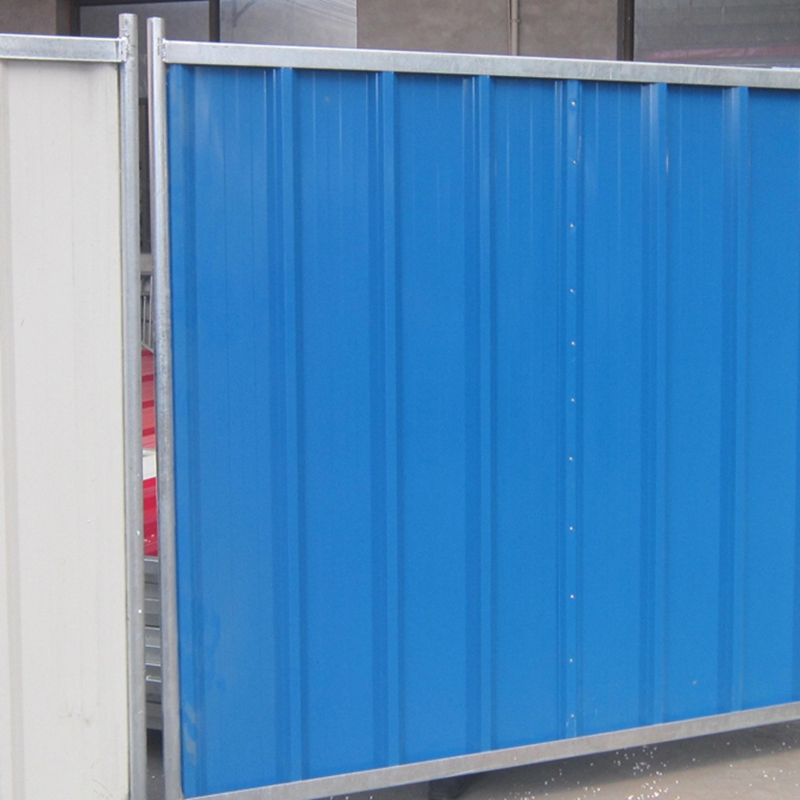
Construction hoarding panels and mesh temporary fencing close an Australian site in two different ways. A hoarding panel is a corrugated steel sheet screwed into a tubular frame and stood on block feet. A mesh run is welded wire in a tube frame on feet, and most of its surface is hole.
The product pages make the trade-off concrete. The hoarding page lists sheet thickness from 0.4mm to 0.65mm, four panel sizes, and wind resistance of more than 165 km/hr. The 2400 x 2100mm mesh panel page lists 4.0mm wire in 70 x 100mm openings, a 32 x 2.0mm frame, hot-dip galvanising over 42 microns, and three feet from 17kg to 32kg. The mesh pages name AS 4687-2007 (temporary fencing and hoardings) — the Perth panel in its specification table, the maxi page as a certification line. The hoarding table names no standard, and infill, feet and labour decide.
Key Takeaways
- Hoarding infill is a 0.4mm to 0.65mm corrugated galvanised sheet; the mesh grid works out to about 9 per cent steel, 91 per cent open.
- The string 2400 x 2100mm appears on both pages, but the hoarding table row is headed Height x Length. Confirm which number is the length before counting panels or comparing heights.
- The hoarding page claims wind resistance of more than 165 km/hr with no foot mass or brace spacing beside it. Ask which assembly produced that figure.
- The rubber foot page states the block supports hoarding panels, straight-leg crowd barriers and Heras fencing, with holes suiting 32mm or 38mm OD pipe.
- Hoarding frame pipe comes at 32mm, 40mm and 48mm. Only the 32mm tube suits both published foot holes.
- Features say one worker assembles the panel; the installation section says two people finish the job. Get the crew size in writing.
Two Screens, Two Build Details
The hoarding page describes three parts: a round tube frame, an inner corrugated galvanised steel sheet, and a U-channel top and bottom the sheet is screwed to. Vertical tubes drop into blocks on the ground, and adjacent panels join with swivel or fixed couplers. Listed options are U-profiles of 50-30-50mm, 50-40-50mm and 60-40-60mm, frame pipe of 32mm, 40mm or 48mm, and four panel sizes under a specification row headed Height x Length, in pre-galvanised steel powder coated on one side.
The mesh line is built the other way. The Perth panel is 2400 x 2100mm with 4.0mm wire at 70 x 100mm openings in a 32 x 2.0mm frame, Q235 low carbon steel, hot-dip galvanised over 42 microns. The 3300 x 2100mm maxi panel keeps that frame and wire, moves spacing to 150 x 60mm centres, and puts finished weight at 30kg.
Do the arithmetic on the mesh page’s own grid. Treat 70 x 100mm as clear openings and add the 4.0mm wire to each pitch: a 74 x 104mm cell carries 696mm² of steel against 7696mm² of area — 9 per cent steel, 91 per cent hole. A hoarding panel of the same footprint is 100 per cent sheet.
| Line item | Solid hoarding panel | Mesh fence panel |
|---|---|---|
| Infill | Corrugated galvanised sheet, 0.4mm to 0.65mm | 4.0mm wire at 70 x 100mm; 150 x 60mm centres on maxi |
| Sizes published | Row headed Height x Length: 1800 x 2240, 2000 x 2160, 2000 x 2100, 2400 x 2100mm | 2400mm long x 2100mm high, and 3300 x 2100mm maxi |
| Panel weight | Not listed on the page | 30kg for the maxi panel |
| Standard named | Not in the specification table | AS 4687-2007 |

Wind, Sail and the 165 km/hr Claim
A solid sheet takes the wind square on. That is the argument for hoarding and the structural problem that comes with it. The page lists wind resistance up to more than 165 km/hr as a feature and nothing beside it: no foot mass, no brace spacing, no maximum unsupported run.
Ask which assembly produced the number: panel size, frame pipe, foot, and whether bracing stood in the line. A claim carried on a 48mm frame with bracing is not the same purchase as one on a 32mm frame without it. Wind speed at your site is a designer’s input, and in wind regions C and D, screen choice and bracing are settled by site-specific engineering — our high-wind fencing guide covers that side of it.
Mesh starts from the other end of the same physics. With roughly 91 per cent open, most of the pressure passes through — one reason exposed sites and hire fleets often reach for it, though the bracing a hire fleet actually specifies is worth confirming. The mesh pages publish what you can check: bracing in 1.5m or 1.8m heights, hot-dip galvanised steel clamps, and three foot types with stated masses, which our temporary fence feet compatibility chart matches against panel weights. One line gives a wind figure without the parts; the other gives the parts without a wind figure.

Feet, Clips and What Joins the Line
The block foot is where the two systems meet. The recycled polymer foot page lists 760 x 200 x 125mm, a normal 17kg adjustable between 16.5kg and 22kg, three groups of two round holes for corners and straight lines, and holes suiting 32mm or 38mm OD pipe. It states the block acts as ground support for straight-leg crowd barriers, temporary hoarding panels and Heras fencing. The hoarding page lists its own block feet at 760*125*200mm in recycled PVC — the same nominal block with the last two dimensions in a different order — ask which axis is which before comparing two quotations.
Fit is the trap. Frame pipe is offered at 32mm, 40mm and 48mm, and the foot holes are published for 32mm or 38mm OD. Only the smallest tube suits both hole sets, so a line quoted with 40mm or 48mm posts needs a different foot, named on the order rather than discovered at delivery. The accessories list itself is short: two clips with bolt and nut, hot-dip galvanised, plus the blocks.
Labour is the number the pages disagree on. Features say the panel is assembled easily and quickly by one worker; The installation section says the process can be completed by two people. Ask which crew size the delivered price assumes, and treat the foot page’s compliance with Australian national one-man lift rules and its Wind Rating B claim as questions for the engineer.
Then count the line, not the panel. On the mesh side, where the page gives 2400mm as the length, a 60m frontage takes 25 panels at 2.4m or 19 at the maxi panel’s 3.3m — six fewer panels, and six fewer pairs of feet and clamps if you count two feet per panel. That is arithmetic from the published lengths, not a factory figure, and it does not transfer to hoarding until you know which number in the Height x Length row is the length.
Choosing the Street Face and the Rear Line
Pick by what the boundary has to do. Containment and site image pull toward hoarding. The page’s question section describes limiting access and helping to contain dust and debris, and its Features claim improved security and privacy for the site boundary compared with mesh fencing. RAL colours and the spare openings in the block foot exist because someone wants the frontage to read as a project rather than a cage. Metro work, road works, hospitals, airports and worker accommodation are among the applications the page names.
Visibility, turnover and wind pull toward mesh. You can see through it, which matters for hired plant left on site. It strips down panel by panel, the feet are the blocks already used on the crowd line, and the open grid is why it is commonly chosen for exposed ground.
On a job with one public frontage and a long rear boundary, a mix that often works is hoarding on the footpath face and mesh on the rear and internal lines, subject to the bracing and screen choice your site engineer settles. You buy the sail and the containment only where the public walks. The hoarding panel page carries the sizes quoted above.
One distinction before the order goes out. Hoarding is temporary. If the boundary stays after handover, the permanent colour-coated steel line is a different product with its own numbers — 0.35mm sheet, 0.8mm high-tensile posts standing 600mm above the panel, rails usually 3000mm, 10-16 x 16 self-tapping screws and 20mm to 50mm panel gaps.
Frequently Asked Questions
Do construction hoarding panels comply with AS 4687?
AS 4687-2007 covers temporary fencing and hoardings, and the mesh pages name it — the Perth panel in its specification table, the maxi page as a certification line. The hoarding page’s own question section states that its systems meet Australian standards and are engineer certified. Ask for that certification against the exact panel size, foot and brace you are ordering.
Can a hoarding panel sit on standard temporary fence feet?
The recycled polymer foot page lists holes suiting 32mm or 38mm OD pipe and states the block supports hoarding panels as well as crowd barriers and Heras fencing. Hoarding frame pipe is offered at 32mm, 40mm and 48mm, so only the 32mm tube matches both published hole sizes.
Which screen is heavier to install?
Ask for the number, because the hoarding page publishes no panel weight. The 3300 x 2100mm mesh maxi panel is listed at 30kg. Weigh either one against the foot page’s one-man lift compliance claim before you plan a crew.
Does hoarding keep site dust on the site?
The hoarding page’s question section says it helps contain dust and debris, and a continuous 0.4mm to 0.65mm sheet has no openings for air to carry it through. A mesh panel at roughly 91 per cent open area cannot do the same job.
Conclusion
The screen choice is three choices: what the infill does to wind and dust, what the feet have to be, and how many fixing points a crew touches each week. The pages give sizes, thicknesses, masses and one wind figure, and leave panel weight, brace spacing and the assembly behind the 165 km/hr claim unsaid.
Send the frontage length, the height you need and how long the line stays up, then ask for five line items in writing: sheet thickness, frame pipe OD, foot mass, brace height, and which number in the size row is the length. The same email settles which build the wind claim rests on. Quotations come back within 24 hours, and stock items carry a 7-day dispatch claim.