Skip to content
I was on the phone last week with a distributor in Queensland who’d just lost a long-standing customer because six cattle panels out of a container had surface rust on the rails within 18 months. The farmer blamed him. The factory blamed the shipping moisture. Meanwhile, that buyer is now ordering from their competitor with a more expensive panel that actually holds up. That’s the real cost of getting corral panel specifications wrong. It’s not the price per unit. It’s the trust that walks out the door when a $12 difference per panel ends up costing you a $60,000 account.
So let’s cut through the catalog fluff. We pulled test data from three years of production runs and compared what’s actually being shipped against the specs on paper. You’re going to see where the industry average stops and where a reliable factory partner starts — things like why hot-dip galvanization above 42 microns is non-negotiable for farm use, and how round tubing handles better than square in real working yards without hiding the coating thickness in fine print. The goal here is simple: give you a baseline so you can spot the supplier who’s just printing a datasheet versus one who built their process around AS 4687 compliance and actually sends you the SGS report with the container.
Standard Corral Panel Dimensions: Length, Height & Weight
For wholesale buyers: standard corral panel lengths run 10, 12, and 16 feet; heights from 50 to 72 inches. Panel weight varies 40–80 kg depending on tube gauge, wall thickness, and rail count—get these right or tie up capital in slow-moving inventory.
Common Lengths: 10ft, 12ft, and 16ft
You’ll see three standard lengths across the market. The 7ft (2.1m) and 8ft panels are essentially toddler gear in the corral world — useful only for pens or small holding yards. For boundary runs and cattle handling, the industry standard is 10ft (3.0m), 12ft (3.6m), and 16ft (4.9m). We produce all three lengths on our 10 robotic welding lines, so batch consistency is guaranteed.
16ft panels are the cheapest per linear foot, but they require two people to handle and are more prone to sag over time, especially if you use thin-wall tubing. We recommend 16ft only for permanent or semi-permanent installations with center posts or ground anchors. 12ft panels hit the sweet spot for portability and rigidity — they’re the most requested length from our Australian agricultural and event management clients. A 12ft panel with 1.75in (44mm) OD tube and 1.8mm wall typically weighs 35–50 kg per unit. 10ft panels are favoured by livestock transporters and portable pen operators who need one-person handling and tight turns.
Height Options: 50in to 72in
Cattle panel heights are measured from the ground to the top rail. The common heights are 50in (1.27m), 58in (1.47m), 64in (1.63m), and 72in (1.83m). For beef cattle and sheep, 50–58in is sufficient — you don’t need a 6‑rail barrier for a group of yearlings. But for horses or aggressive bulls, you want at least 64in, ideally 72in with 6 horizontal rails. The rail density matters more than total height: a 5‑rail panel at 64in spaced evenly keeps animals from stepping through; a 6‑rail panel at the same height offers a better visual barrier and reduces bruising. Our standard corral panels come in 5‑rail and 6‑rail configurations, with no tooling change — we can switch between rail counts on the same production run.
Weight Variation: Gauge, Tube Size, and Coating
A 12ft x 64in panel can weigh anywhere from 88 lbs (40 kg) to 170 lbs (77 kg). The swing is driven by three variables: wire gauge, tube wall thickness, and galvanization mass. Economy panels use 6‑gauge wire (approx. 4mm) with 1.5mm wall and electro‑galvanized coating (under 20 microns). That panel weighs around 88 lbs. A heavy‑duty panel specified per AS 4687 uses 4‑gauge wire (approx. 5.2mm) with 2.0mm wall and hot‑dip galvanizing of >42 microns. That same footprint jumps to 150–170 lbs. The extra weight is your insurance against bent rails, broken welds, and rust failures after 3 years in coastal or high‑moisture farms.
We test every production batch for coating thickness using an SGS‑audited magnetic gauge. If you order our standard 12ft x 64in 5‑rail panel with 1.75in OD tube, 1.8mm wall, and 42‑micron hot‑dip galvanizing, the net weight per unit is 52 kg (115 lbs) — verified and repeatable. That matters for calculating shipping container loads: at 52 kg per panel, you fit 216 units in a 40ft container versus only 140 units for a 77 kg panel. Lower weight per unit means lower freight cost per panel, provided the specs meet your end‑user’s durability expectations.
What Wholesalers Should Verify Before Ordering
When you request a quote or catalogue, do not rely on “heavy duty” labels. Ask for these specific numbers:
- Tube outer diameter (OD) and wall thickness — e.g., 1.75in x 1.8mm or 2.0in x 2.0mm.
- Wire gauge for mesh infill — most corral panels use 4‑gauge (5.2mm) but some budget panels drop to 6‑gauge (4.0mm).
- Galvanization method and minimum coating thickness. Hot‑dip per ASTM A123 / AS 4687 with >42 microns is the only standard that delivers 8–12 year lifespan in outdoor farm conditions.
- Rail count and spacing — 5‑rail vs 6‑rail at the same overall height changes the open gap and visual barrier.
- Weight per panel — ask for a certified weighbridge ticket or at least a production‑average weight. Inconsistent weight means inconsistent raw materials.
We share our full spec sheet with ISO 9001 and SGS certificates on request. That transparency saves you from stocking a product that will generate customer complaints and margin erosion later.
| Length (m) | Height (m) | Weight (kg) | Horizontal Rails | Tube Specification |
|---|---|---|---|---|
| 2.1m (7 ft) | 1.8m (6 ft) | 22–35 kg | 6 rails | 30×60mm rectangular |
| 3.66m (12 ft) | 1.83m (6 ft) | 36–45 kg | 5 rails | 38mm round (1.5 in) |
| 3.66m (12 ft) | 2.13m (7 ft) | 40–55 kg | 6 rails | 38mm round (1.5 in) |
| 4.88m (16 ft) | 1.83m (6 ft) | 45–60 kg | 5 rails | 38mm round (1.5 in) |
| 4.88m (16 ft) | 2.13m (7 ft) | 55–80 kg | 6 rails | 44mm round (1.75 in) |
| 4.88m (16 ft) | 2.13m (7 ft) | 70–90 kg | 6 rails | 58mm round (2.3 in) heavy-duty |
Wire Gauge & Tube Diameter: Strength vs. Cost
Wire gauge and tube specs dictate whether your panels last a decade or fail in two years. Here’s how to separate real strength from marketing specs.
4-Gauge vs. 6-Gauge Wire: Direct Trade-Offs for Livestock Panels
Wire gauge directly affects puncture resistance and long-term shape retention. 4-gauge wire (~5mm diameter) is standard for heavy cattle panels. It withstands repeated rubbing and impact from mature livestock. 6-gauge wire (~4mm) is lighter and reduces your landed cost by roughly 15–20%, but it’s better suited for sheep, calves, or temporary corrals. If your end customers are running beef cattle in semi-permanent yards, stocking 4-gauge panels minimizes your warranty claims. For your own inventory planning, a 6-gauge panel may turn faster if you serve a mixed-use market, but be prepared for lower margins per panel.
Tube Spec: Why DB Fencing Uses 30x60mm Rectangular Steel
Many suppliers default to 1.75-inch or 2-inch round tubing, but the real structural advantage comes from shape and wall thickness. A round tube can twist under load; a rectangular tube resists that torsion naturally. That is why our standard 1.8m x 2.1m (6ft x 7ft) cattle panels use 30x60mm rectangular tube. It provides higher stiffness per kilogram of steel compared to a same-weight round tube. Wall thickness is where you see hidden cost cutting:
- 1.5mm wall: Economy option. Suitable for portable panels or rental fleets. Panel weight approx. 22kg.
- 2.0mm wall: Industry baseline for semi-permanent corrals. Panel weight approx. 28kg.
- 2.5mm wall: Heavy-duty spec for permanent feedlots. Panel weight approx. 35kg. Our production lines handle all three with zero tooling change, meaning you can mix specs in one container.
How to Verify Real Specs Before Signing an Order
The biggest risk in this market is suppliers who quote a “4-gauge, heavy-duty” panel but ship 6-gauge wire with thin-wall round tube. Here are the three checks we use ourselves and recommend to every buyer:
- Scale weight is your fastest filter: A genuine 4-gauge, 2.0mm-wall rectangular panel for a 6ft x 7ft footprint weighs 28kg minimum. If a supplier quotes 20–22kg for the same size, you are getting under-spec steel.
- Coating tells the story: Electro-galvanized panels fail in under 2 years. Hot-dip galvanized (>42 microns per ASTM A123 / AS 4687) lasts 8–12 years. We provide SGS reports on coating thickness for every production batch. If a supplier cannot produce a third-party coating report, assume you are getting electro-galvanized.
- Tube shape = structural honesty: If a panel is advertised as “2in round tube,” ask for the wall thickness in writing. If it is under 1.5mm, that tube will buckle under a 600kg bull. Our 30x60mm rectangular spec is auditable, and the shape itself guarantees higher rigidity per dollar than any light-gauge round alternative.
| Parameter | Specification Range | Strength Consideration | Cost Implication |
|---|---|---|---|
| Wire Gauge | 4-gauge (heavy duty) vs 6-gauge (standard) | 4-gauge thicker wire (~0.204 in) provides higher tensile strength and impact resistance for demanding livestock containment | 4-gauge premium – higher material cost but reduces long-term replacement; 6-gauge more economical for light-duty use |
| Tube Outer Diameter | 1.5 in (38mm) / 1.75 in (44mm) / 2.0 in (51mm) / 2.3 in (58mm) | Larger diameter increases structural rigidity and load-bearing capacity – ideal for crowd control or heavy cattle | Each 0.25 in step up adds 10–15% to steel cost; 2.3 in only justified for high-security or extreme uses |
| Wall Thickness | 1.5 mm to 2.5 mm (typical range) | Thicker walls withstand bending and repeated impact from livestock; 2.0 mm+ recommended for permanent corrals | Thicker = heavier (more steel) → higher shipping and unit cost; 1.5 mm sufficient for portable/event panels |
| Tube Shape | Round vs Square/Rectangular | Round tubing distributes stress evenly, safer for animal hide; square offers better visual barrier but can cause bruising | Round is significantly cheaper to produce and source – bulk buyers prefer round for margin; square incurs tooling premium |
Galvanization: Hot-Dip vs. Electrogalvanized – The Rust Life
If your supplier can’t show you a certified SGS report proving >42 microns of hot-dip galvanizing, you’re buying a rust liability.
The Industry Benchmark: >42 Microns Hot-Dip Galvanizing
For corral panels and temporary fencing destined for Australia or New Zealand, the non-negotiable standard is AS 4687-2022/2007, which mandates a minimum hot-dip galvanized coating thickness of 42 microns. This aligns with ASTM A123 for structural steel. Anything less—especially electrogalvanized coatings that typically range from 5 to 15 microns—will show rust within two farm seasons.
DB Fencing’s standard production for cattle panels and crowd control barriers uses hot-dip galvanizing at >42 microns, verified by third-party SGS testing. We can provide the test report with every bulk order. That’s a guarantee most competitors, including premium brands like Arrowquip, won’t give you—they don’t even publish coating specs.
AS 4687 Compliance Is Not Optional
If you supply to Australian construction sites, agricultural distributors, or event management companies, you must meet AS 4687. Non-compliant panels can be rejected on delivery, and you carry the legal liability if a rusted panel fails on site. The standard doesn’t just cover thickness—it also specifies adhesion and uniformity of the galvanized layer.
DB Fencing’s factory has ISO9001 and SGS certification, and our hot-dip line consistently delivers 45–50 microns across all tube sizes (1.5 in to 2.3 in OD). We’ve been exporting to Australia/NZ for 14 years—compliance is built into every run.
Electrogalvanized Panels Fail Within Months
Electrogalvanizing (zinc plating) deposits a thin layer that looks shiny on the shelf but offers no real protection. In a farm environment—exposed to rain, manure, and UV—electrogalvanized panels start rusting in 4–6 months. Hot-dip galvanized panels at 42+ microns last 8–12 years with minimal maintenance.
The difference in your bottom line: a cheap panel that rusts after one season generates warranty claims, lost repeat business, and inventory write-offs. A hot-dip panel at 42+ microns keeps your customers happy and your margins intact.
Before you commit to a bulk order, request the SGS coating thickness report. If the supplier hesitates or offers “electro” as a lower-cost option, you already know the answer. DB Fencing provides test reports upfront—no hiding, no guesswork.
Rail Count & Height: 5-Rail vs. 6-Rail Panels
Rail count controls height, weight, and animal escape risk. 6-rail panels are the standard for calving pens; 5-rail works for larger livestock where portability matters.
6-Rail Panels: Height and Containment for Young Stock
A 6-rail corral panel typically stands around 60 inches (1.5 m) tall, though many Australian and New Zealand yards use a 6-rail design at 1.8 m (approx. 5.9 ft) to double as crowd barriers. The dense rail spacing—usually 6 to 8 inches between rails—closes bottom gaps to less than 4 inches. This is critical for containing calves, lambs, or kid goats that can squeeze through wider openings. DB Fencing’s standard cattle panel (1.8m x 2.1m) uses six horizontal 30x60mm tubes welded to vertical posts, achieving a bottom gap of roughly 70mm (2.8 in). That gap stops even small newborn calves from crawling under when placed on hard ground.
The trade-off is weight. A 6-rail panel in 1.8m x 2.1m with 2.0mm wall tubes weighs between 22 kg and 35 kg depending on tube gauge. Heavier panels are more stable in permanent corrals but slower to handle during relocatable setups. For wholesalers supplying dairy paddocks or feedlots where calving is routine, the 6-rail is the low-complaint option. End-users rarely call back about escapes.
5-Rail Panels: Lighter, Cheaper, but Gappier
Five-rail panels are typically 50 inches (1.27 m) tall and use the same tube spacing, resulting in a larger bottom gap—often 6 to 8 inches. This is acceptable for adult cattle, sheep, and goats (which can’t typically squeeze through a 6-inch gap), but it is a liability for calves. The lower height also makes it easier to step over, which can be a safety concern in high-traffic holding yards. Weight drops significantly: a 5-rail panel of equivalent length (2.1 m) with the same tube dimensions weighs roughly 15–20% less than the 6-rail variant, reducing shipping costs and handling wear on forklifts.
For price-sensitive buyers (agricultural wholesalers targeting dry stock operations or seasonal branding pens), the 5-rail is often the preferred SKU. DB Fencing offers both configurations with no tooling change, so you can mix 5-rail and 6-rail panels in the same container. This allows distributors to stock both without committing to separate production runs—our low MOQ of 100 panels applies to either design.
Matching Rail Count to Livestock Class
Here is the practical rule our Ag buyers use when ordering:
- 6-rail (≥1.5m height): Mandatory for calving pens, lambing yards, and any enclosure holding animals under 6 months old. Also recommended for crowd pens where head pressure is high, because the extra rail prevents climbing.
- 5-rail (≈1.27m height): Suitable for mature beef cattle, dry ewes, and goats. Good for portable yards, road transport pens (tailgate panels), or event arenas where weight limits matter.
- Note on gap measurement: Always verify the bottom rail clearance against your target species. A 5-rail panel with 6-inch bottom gap may still let piglets escape; for swine, use a dedicated hog panel or a 6-rail with closer spacing.
Wholesalers who stock both 5-rail and 6-rail panels reduce the risk of a one-size-fits-all failure. Your end-customer trust increases when you can say, “If you’re running calves, take the 6-rail; if it’s just dry cows, the 5-rail saves you money.” That advice comes from real field experience, not a spec sheet.
Round vs. Square Tubing: Animal Safety & Structural Rigidity
Round tubing is the industry standard for livestock panels. It’s stronger in all directions, safer for animal hide, and more cost-effective than square tubing — which is why it dominates wholesale volume.
Round Tubing – Stronger, Safer, and Industry-Proven
Round tubes distribute stress evenly in every direction with no flat spots or weak axes. Livestock pressing against round surfaces experience significantly less hide damage and bruising compared to square edges, which directly impacts saleability at market. The industry standard for heavy-duty corral panels uses 2.3in (58mm) horizontal round tubes for crowd control applications.
- Tube OD: 1.5in (38mm), 1.75in (44mm), 2in (51mm), 2.3in (58mm)
- Wall thickness: 1.5mm to 2.5mm depending on panel weight class
- Material: Q235 steel or higher grade
- Galvanization: Hot-dip per ASTM A123 and AS 4687-2007, minimum 42 microns
DB Fencing’s standard livestock panel uses 30x60mm round tube with 6 horizontal rails, hot-dip galvanized to >42 microns for 8–12 years of service in farm environments. Our 12ft panels balance portability with sag resistance, and we stock tube sizes from 1.5mm to 2.5mm wall thickness to match your end-customer’s weight requirements.
Square Tubing – The Premium Option with Real Trade-Offs
Square and rectangular tubing creates a solid visual barrier that some buyers associate with premium construction. But the practical trade-offs are significant. Square edges concentrate impact force where animals push against the panel, increasing the risk of hide bruising. Manufacturing costs are higher due to additional forming steps and greater material waste. Brands like Arrowquip promote square tubing for its appearance, but they rarely disclose galvanization thickness in their spec sheets — a gap that matters when your end-customer expects 8+ years of rust-free service. For most wholesale buyers, square tubing is a niche product, not a volume driver.
Why Wholesale Buyers Stock Round Tubing First
Round tubing is the volume seller because it delivers the best balance of structural strength, animal safety, and cost efficiency. For agricultural distributors, this translates directly into better net margin per panel, faster inventory turnover, and fewer customer complaints about bruising or premature rust. DB Fencing produces round-tube panels on 10 dedicated welding lines with a weekly capacity of 2,000 sets — ensuring batch consistency across every shipment. Our flexible MOQ of 100 panels and factory-direct pricing mean you can stock the right mix of 5-rail and 6-rail configurations without tying up capital. Every panel meets AS 4687 and ISO9001 standards, backed by SGS certification you can share with your end-customers.
Connection Systems: Pins, Clips & Adaptability
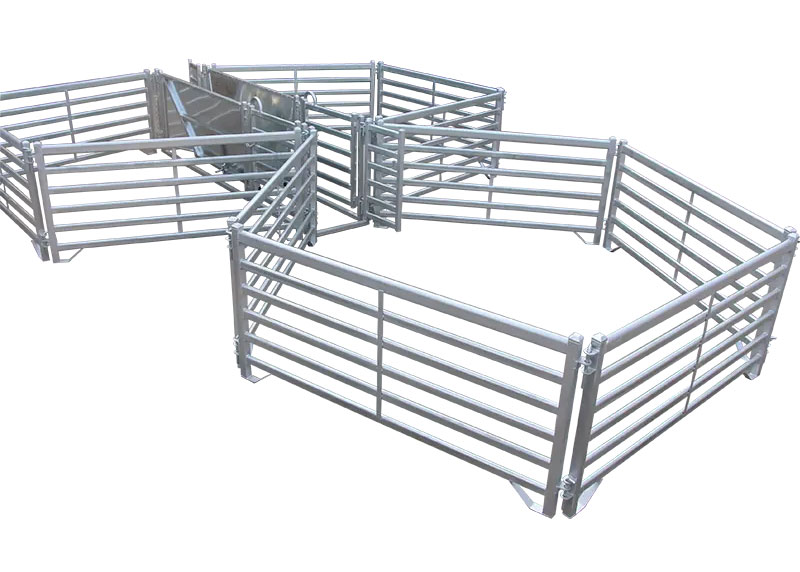
A panel’s connection system dictates setup speed, stability, and how many jobs you can handle with the same inventory. Here’s what wholesale buyers need to verify before ordering.
4-Way Pin Connectors for Multi-Configuration
A single 4-way pin lets you connect panels in straight lines, 90-degree corners, or T-junctions without needing special adapters. For wholesalers, that means stocking one pin type instead of four. DB Fencing pins are cold-rolled steel with a hot-dip galvanized finish matching the panel coating—no galvanic corrosion between pin and tube. You get a 16mm diameter pin that locks into standard tubing without wobble.
- Pin diameter: 16mm solid steel, hot-dip galvanized to match panel coating.
- Tube compatibility: 1.5in (38mm) and 2in (51mm) round tubing.
- Configurations: Inline, 90°, T-junction, 4-way cross.
Panel Stabilizers for Semi-Permanent Setups
When a client needs a corral to stay put for a season, stabilizers beat sandbags or improvised blocking. DB Fencing’s in-house plastic feet—UV-stabilized polypropylene—bolt directly to the panel base. You can fill them with sand or gravel for ballast, or stake them into soil. Because we mold these ourselves in Anping, we also supply local vendors who don’t want to source feet separately. For you, that’s one invoice and one shipping line item. The feet are designed for quick removal if the panels need to revert to portable use.
Compatibility with Standard Fence Posts
Not every job uses portable panels. Some buyers need to tie panels into existing post-and-rail systems. Our panels accept standard post couplers for 2.3in (58mm) and 2in (51mm) round posts. If your customer runs square tube posts, we can weld matching brackets at the factory—no field modification required. This is where round tube panel design shows its advantage: compatibility with off-the-shelf post hardware is plug-and-play. Proprietary square tube systems often demand expensive branded adapters, reducing your margin on the total job.
Customization Options for Distributors
Distributors need factory flexibility without locking capital in untested stock. DB Fencing offers OEM branding, custom colors, and mixed containers with a 100-panel MOQ — built for protecting your margin and reputation.
OEM Branding, Paint, and Packaging — Tailored to Your Line
You cannot afford to put your brand on a panel that rusts through in two years. Our OEM program lets you specify your own branding, RAL powder coat colors, and packaging format — palletized or loose-loaded — while every panel maintains AS 4687-2022 compliance. We also produce UV-stabilized plastic feet in-house, a capability unique in Anping, so you get a matched accessory without sourcing from a second vendor.
When you specify a custom paint color, the base layer determines longevity. Our hot-dip galvanized finish exceeds 42 microns per AS 4687, and any powder coat applied over that base will hold in coastal or feedlot environments. We do not offer electrogalvanized options — the coating is too thin for livestock or construction use. If you need a specific RAL color for site visibility or branding, we match it, but we will not reduce the galvanized undercoat to save cost. That trade-off costs you end-customer trust.
Low MOQ — Test New SKUs Without Overcommitting
Most factories push 500 to 1,000 panel minimums. We hold at 100 panels per variant. That lets you test a new color, a different rail count (5-rail vs 6-rail), or a custom tube wall thickness (1.5mm to 2.5mm) without sitting on slow-moving inventory. For a distributor, this directly improves your inventory turnover rate — less capital tied up in unproven stock.
If the line moves, you scale up. If it doesn’t, you are not stuck with a container of dead product. This applies equally to semi-permanent corral panel specs and portable crowd control barriers. Your downside is capped, and your supplier carries the production flexibility.
Mixed Containers — Fill Every Cubic Foot at the Right Landed Cost
A 40ft HC container holds roughly 500 to 600 panels depending on configuration. If you only need 100 units of a new SKU, you do not want to ship air. Our mixed container program lets you combine your high-volume standards with test variants in a single shipment. Example: 400 units of your standard hot-dip galvanized 6-rail panel plus 100 units of a powder-coated variant for a specific client bid.
We handle the load planning — you tell us the mix. This reduces your landed cost per unit and lets you offer a broader range to your end-customers without committing to full container quantities of each line. Your net margin per panel improves, and your customer complaint rate drops because every panel meets the same galvanizing and welding standard regardless of the color or branding applied.
How to Verify Supplier Claims
A spec sheet without third-party verification is just marketing. You need SGS reports, ISO 9001, and batch traceability to separate real durability from cheap promises.
Ask for the Hard Evidence
If a supplier claims “hot-dip galvanized” or “meets Australian standards,” your next move is to demand the paperwork. Any factory that can’t produce an SGS galvanization report on request is either hiding poor quality or doesn’t understand the export compliance game.
You need three specific documents before you place a trial order. First, an SGS thickness test report confirming the zinc coating is above 42 microns (per ASTM A123 or AS 4687). Second, an ISO 9001 certificate that is current and covers the factory’s quality management system—not an expired photocopy from 2019. Third, a pre-shipment inspection report from a recognized third-party agency (SGS, Bureau Veritas, or Intertek) that verifies batch specifications.
Red Flags That Kill Deals
I’ve seen wholesale buyers burn margin on panels that looked right in a catalog but failed within two seasons. The common thread is always the same: no traceable quality data.
- No test reports: If the supplier cannot produce SGS or equivalent lab results for galvanization thickness, assume the coating is below 30 microns. You’ll be looking at electrogalvanized panels that rust in under 18 months.
- Vague coating descriptions: “Heavy galvanized” or “rust-proof” without a micron number is a red flag. Real hot-dip galvanized panels for outdoor livestock use must state a minimum of 42 microns per AS 4687.
- No batch traceability: A reputable factory stamps batch numbers on panels or maintains production logs. Without this, you cannot track a defect back to its root cause. Once corrosion hits one panel, you have no way to isolate the bad batch.
Veteran Buying Checklist
Here is the checklist I use when vetting corral panel suppliers for bulk import. Cross-reference every claim below against actual data, not promises.
- Galvanization report: Request a current SGS test certificate showing >42 microns on both the tube surface and weld points. Weld zones are where cheap panels fail first.
- ISO 9001 certificate: Verify the scope includes “welded wire mesh products” and the cert is issued by an accredited body, not a shell registrar.
- Pre-shipment inspection: Insist on third-party inspection for your first three containers. The cost is under 2% of your order value, and it eliminates the risk of non-compliant stock arriving at your warehouse.
- Standard compliance: If you target Australia or New Zealand, confirm the panels meet AS 4687-2022/2007. A supplier that cannot show this certification is not ready for ANZ construction or agricultural sites.
- Batch traceability: Ask for photos or records of batch stamps applied during production. This is standard at factories with 10+ welding lines and weekly capacity of 2,000 sets, like DB Fencing.
- Sample verification: Order a sample panel delivered to your warehouse. Weigh it (check against the claimed weight per foot), measure tube wall thickness with a caliper (1.5mm to 2.5mm), and visually inspect the plastic feet for UV stability—a feature we produce in-house, ensuring consistent quality that many local vendors lack.
- Pricing against coated vs. uncoated: Ask for a price break at 42 microns versus 60 microns. A supplier that gives you a straight answer on coating cost-per-micron is transparent. One that dodges the question has variable quality.
Conclusion
You need to decide based on one number: galvanization microns. Hot-dip at 42+ microns gives you 8–12 years in farm conditions. Electrogalvanized panels rust in under two years. That’s not a marketing claim — that’s an ASTM A123 standard your end customer will see after one wet season.
Next step: ask your shortlisted supplier for a third-party SGS report on coating thickness and a sample panel with a 1.5mm wall. Weigh it, measure the tube OD, and confirm the rail count yourself. That one sample tells you more than any spec sheet.
Frequently Asked Questions
What are the specs for cattle panels?
DB Fencing’s cattle panels are manufactured using high-tensile steel wire with a hot-dipped galvanized finish exceeding 42 microns, ensuring corrosion resistance in harsh outdoor environments. Standard panel dimensions typically range from 8 to 16 feet in length and 48 to 60 inches in height, with wire diameters commonly between 4 gauge (5.8 mm) and 6 gauge (4.9 mm) depending on application. All panels comply with Australian Standard AS 4687-2022/2007 and are ISO9001/SGS certified, guaranteeing structural integrity for livestock containment. Custom specifications, including panel length, mesh opening size, and attachment types are available through our OEM service with a low MOQ of 100 panels.
What is the difference between cattle panel and corral panel?
In typical industry usage, a cattle panel is a specific style of welded wire panel designed primarily for containing cattle, often featuring horizontal wires with vertical stays and a rigid frame, while a corral panel is a broader term that can include any panel used to construct temporary or permanent enclosures for various livestock. DB Fencing manufactures both types, but our corral panels are generally heavier-duty, with thicker gauge wire (often 4 gauge) and reinforced edges to withstand the push of large animals in high-density holding areas. Cattle panels may use slightly lighter wire (e.g., 6 gauge) for easier handling and transport, but both are hot-dipped galvanized to the same >42 micron standard. For customers in Australia and New Zealand, we recommend corral panels for permanent feedlots and cattle panels for rotational grazing or transportable systems.
Are cattle panels 4 gauge or 6-gauge?
DB Fencing offers cattle panels in both 4 gauge (5.8 mm) and 6 gauge (4.9 mm) wire diameters, depending on the specific product line and customer requirements. Our standard heavy-duty corral panels are typically 4 gauge for maximum strength and durability in permanent installations, while lighter cattle panels for temporary or less demanding applications are often 6 gauge to reduce weight and cost. All gauges are hot-dipped galvanized with over 42 microns of zinc coating, ensuring long service life even in seaside environments. We recommend 4 gauge for operations involving large breeds or aggressive cattle, and 6 gauge for smaller herds or where portability is a priority. Custom gauge options are available through our OEM service with a low MOQ of 100 panels.
How far apart should posts be for cattle panels?
For optimal stability and to prevent sagging under livestock pressure, posts for DB Fencing cattle panels should typically be spaced 8 to 10 feet apart, depending on panel length and soil conditions. In high-load applications such as corrals with dense herds, we recommend a maximum post spacing of 8 feet to maintain panel rigidity and resist bending. For lighter-use panels on firm ground, 10-foot spacing is acceptable, but we always advise using our hot-dipped galvanized posts and proper anchoring. Our panels are engineered to work with standard post spacing of 8 feet, which aligns with our 8-foot and 16-foot panel lengths for efficient installation. For specific recommendations, our 24-hour quoting team can provide tailored guidance based on your operation’s size and animal type.
What is the best material for corral panels?
The best material for corral panels in cattle operations is hot-dipped galvanized steel, which DB Fencing supplies with a zinc coating exceeding 42 microns to prevent rust in wet, salty, or high-humidity environments. Compared to painted or PVC-coated alternatives, hot-dipped galvanized steel offers superior abrasion resistance against livestock rubbing and weather exposure, ensuring a 15-20 year lifespan under proper use. Our panels meet Australian Standard AS 4687-2022/2007, confirming their structural reliability for containing cattle, sheep, and other livestock. As the only supplier in Anping with its own plastic feet machine, we can also integrate durable plastic footings for temporary corral setups, combining the strength of steel with easy portability. For permanent installations, full galvanized steel with our heavy-duty 4 gauge wire is the industry standard.