Skip to content
Before a single panel goes up, temporary fencing Brisbane projects have to answer two questions. Does the site comply — with the Australian Standard that governs temporary fencing, and with whatever Brisbane City Council requires for the land the fencing occupies? And does the layout work: panel counts, gates, bracing and stable feet. Most contractors here build those layouts from galvanised welded mesh panels in a steel tube frame, stood on flat feet and joined with couplers, because that format ships flat, installs fast and relocates from project to project.
Key Takeaways
- Standard: AS 4687-2022 is the current Australian Standard for temporary fencing and hoardings, superseding AS 4687-2007.
- Permits: Footpath or road reserve occupation in Brisbane may need a council permit — confirm current requirements with Brisbane City Council or your fencing contractor first.
- Workhorse panel: The heavy-duty 2400 × 2100 mm panel (40 mm tube frame) suits construction sites; the 3300 × 2100 mm Maxi Panel cuts joint count on long runs.
- Corrosion protection: Hot-dip galvanised coating on the temporary fence line exceeds 42 microns, specified for outdoor and coastal exposure.
- Ordering scale: The minimum order is 100 panels — at 2400 mm wide, that closes a 240-metre perimeter.
- Timing: Bulk production takes 20–25 days; stock items ship in 7 days.
The specification side is measurable in a way the permit side is not. Panels bound for Australian sites are typically manufactured to AS 4687-2022, with hot-dip galvanised coatings above 42 microns on the temporary fence product line we run from Anping, China. Permit conditions, by contrast, shift with each council and each application. This guide separates the two: the fixed numbers you can order against, and the local requirements you verify with Brisbane City Council or your fencing contractor before panels reach site.
Site Compliance Basics for Brisbane Projects
AS 4687-2022 is the current Australian Standard covering temporary fencing and hoardings, and it replaced the 2007 version that older specifications still cite. When a principal contractor or council officer asks whether your panels are “compliant”, that standard is usually what they mean. Ask your supplier which version their panels are manufactured to, and get the answer in writing before the deposit, not after delivery when a non-compliant run is already standing on the footpath.
Compliance on Australian sites generally extends past the panel itself. Principal contractors may ask for product specifications, coating data and evidence of the manufacturer’s quality systems before panels pass the gate, and they may also require proof of public liability insurance covering the installation. Requirements differ between projects and councils, so confirm the documentation your site demands with the principal contractor, Brisbane City Council or your fencing contractor early in the programme — paperwork delays cost more days than shipping does.
One habit separates smooth projects from difficult ones: order the compliance file with the panels. A manufacturer that is ISO9001 certified and SGS audited can supply coating readings and welding standards as part of the shipment documents, not something you chase after delivery. Our temporary fence line runs hot-dip galvanised coatings above 42 microns, a thickness specified for outdoor and coastal service, and that measurement is part of the record we hand over.
Footpath Permits and Public Access
Any fencing that occupies a footpath, roadway or other council-controlled land in Brisbane may require a permit from Brisbane City Council. What triggers the requirement, how long approval takes and what conditions attach often depend on the location, the duration of the occupation and how much pedestrian or traffic space the fencing consumes. Because these details sit outside the product itself and change over time, confirm current requirements with Brisbane City Council or your fencing contractor before you commit to an installation date. Treat the permit as a programme dependency with its own lead time, not a formality for the morning of the build.
Permit conditions frequently protect pedestrian passage along the kerbside. Layouts that keep a walkable corridor clear of panel feet, coupler bolts and guy braces pass inspection faster than layouts that treat the footpath as storage. Flat-based feet help here: the Australian temporary fence format uses moulded plastic or recycled rubber feet with a low profile, which sit flush on paving and reduce trip points compared with improvised stands. The base choice also changes how the run behaves under wind and impact, so it is worth comparing options before ordering — our breakdown of plastic feet versus recycled rubber bases covers the trade-offs in detail.
On footpath runs, keep three disciplines. Place feet fully inside the fenced zone wherever the layout allows. Fit gates so they swing inward onto the site rather than outward across the pedestrian corridor. Then walk the line after installation the way a council officer would — from the outside, at walking pace, looking for anything protruding.
Panel Layout for Construction Sites
Layout starts with perimeter arithmetic, and the numbers are simple enough to do on the tailgate. One heavy-duty panel covers 2400 mm of run, so 100 panels close a 240-metre perimeter before you subtract gates. The Maxi Panel covers 3300 mm, which means roughly 42 heavy-duty panels per 100 metres of boundary versus about 31 Maxi Panels for the same run — fewer panels to transport, fewer couplers to fit and fewer feet to ballast, at the cost of a heavier unit that needs two people or a machine to shift. For a full run through the dimensions, tube gauges and mesh specs of each format, see our guide to temporary fence panel dimensions, sizes and gauges.
| Panel type | Dimensions | Best fit |
|---|---|---|
| Heavy-duty construction panel | 2400 × 2100 mm, 40 mm tube frame | Construction and civil sites |
| Maxi Panel | 3300 × 2100 mm | Long perimeters needing fewer joints |
| Imperial-format panel | 6ft × 8ft | Fleets already running imperial stock |
| Extended imperial panel | 6ft × 9.5ft | Wider coverage in imperial fleets |
| Econo lightweight panel | 3 mm tube | Short-term, low-exposure applications |
Detail decisions carry more risk than the arithmetic. Couple every panel joint — a run with every second clamp fitted sheds panels in the first decent storm. Plan gate positions against deliveries and pedestrian flow, not against wherever the run happens to finish. Set corners so panels overlap in the direction that keeps the mesh on the inside of the turn. And order spares: couplers and feet are the first casualties of a busy site, and a small buffer of each keeps the perimeter intact between deliveries.
Wind, Ballast and Stability
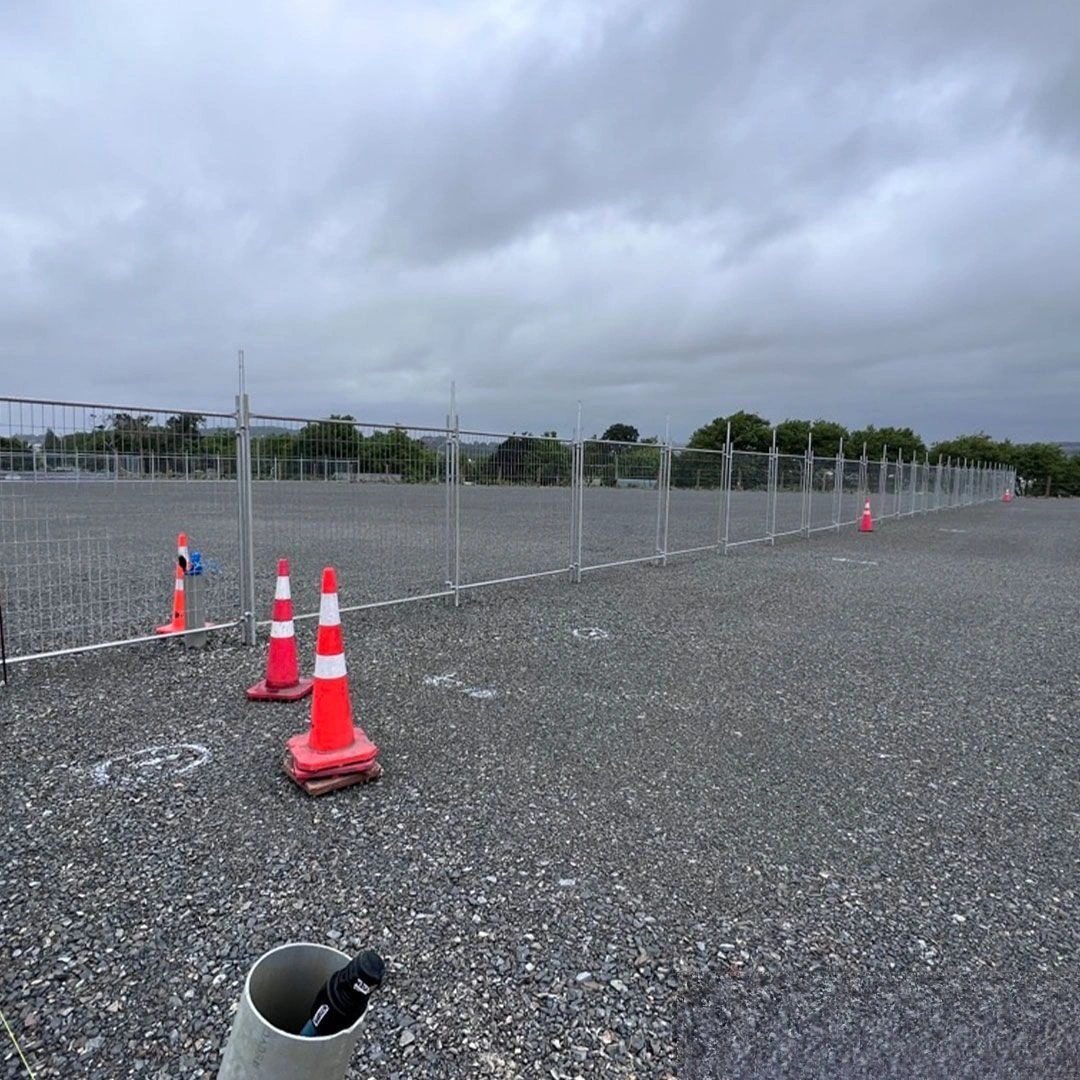
South East Queensland delivers the kind of storms that expose under-specified fencing. A welded mesh panel presents a large sail area to gusting wind, and an unballasted run can lift, walk or collapse onto a footpath — exactly where the council and the public will notice. Stability comes from three elements working together: couplers that make the run act as one structure, bracing on exposed lengths and at changes of direction, and ballast on the feet. Sites in cyclone-affected regions face stricter demands again, and our article on cyclone-rated temporary fencing for wind regions C and D covers what those specifications involve.
Corrosion protection is the other stability factor, because a panel that rusts through its frame loses section strength long before it looks failing. The temporary fence line we manufacture runs hot-dip galvanised coatings above 42 microns, a thickness chosen for outdoor and coastal exposure rather than dry inland service. Brisbane’s humidity and coastal salt make that margin worth specifying on paper. Ask for the coating thickness in the product data — a supplier who cannot quote a micron figure for their own galvanising has told you something.
Sourcing Panels for Brisbane Projects
Brisbane buyers source temporary fencing two ways: hire locally, or buy from a manufacturer and own the assets. Our position is straightforward — a company running three or more projects a year is usually better off owning panels, because the hire clock never stops and the panels you hire are the ones you would have bought anyway. A single short project flips that maths. The decision deserves real numbers, not instinct, and the trade-offs deserve more space than this paragraph.
For buyers going the ownership route, the commercial terms on our temporary fence line are anchored to a few fixed points. The minimum order quantity is 100 panels. Bulk production runs take 20–25 days, and stock items ship within 7 days. Payment terms are flexible and negotiated per order. Shipping follows the standard Incoterms — FOB (you take the goods aboard the vessel), CIF and CFR (freight carried to your port, with or without insurance), or DDU and DDP (delivered to your door, duty and tax either unpaid or paid) — and quotes go out within 24 hours of an enquiry.
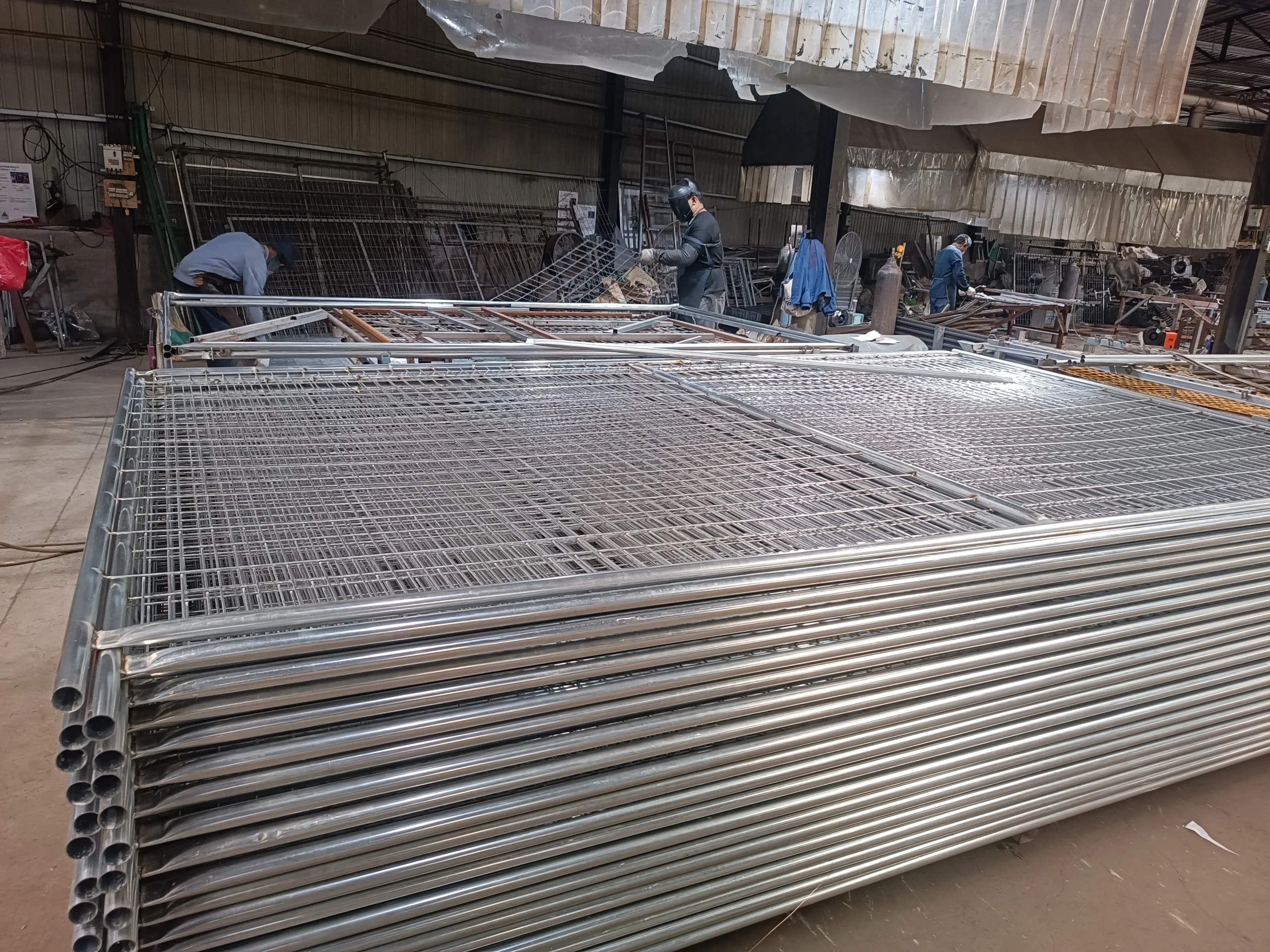
Every exporter on the internet claims certified factories, so ignore the claim and ask for the paper. We are ISO9001 certified and SGS audited, and an audited supplier sends the documentation without blinking; one that hesitates is telling you something. Capacity matters on the same timeline: our Anping plant runs 10 welding lines with output up to 2,000 sets per week, and 75% of our shipments go to Australia and New Zealand, so Australian standard specifications are the default here rather than a special request. The company has exported fencing since 2009.
Frequently Asked Questions
Do I need a permit for temporary fencing on a Brisbane footpath?
You may. Fencing that occupies a footpath, roadway or other council-controlled land in Brisbane often requires a permit from Brisbane City Council, and conditions vary by location and duration. Confirm current requirements with Brisbane City Council or your fencing contractor before installation.
What standard applies to temporary fencing in Australia?
AS 4687-2022 is the current Australian Standard for temporary fencing and hoardings, superseding AS 4687-2007. Specify panels manufactured to the current version and ask for the compliance documentation before you pay a deposit.
What panel sizes suit Brisbane construction sites?
The heavy-duty 2400 × 2100 mm panel with a 40 mm tube frame is the construction workhorse, while the 3300 × 2100 mm Maxi Panel covers more ground with fewer joints. Imperial 6ft × 8ft and 6ft × 9.5ft formats also circulate in Australian fleets.
How long does a bulk panel order take from a manufacturer?
Bulk production runs take 20–25 days, while stock items ship within 7 days. Sea freight time to Brisbane sits on top of that, so build both into your programme.
What is the minimum order for temporary fence panels?
The minimum order is 100 panels on this product line. At 2400 mm per panel, that closes a 240-metre perimeter before subtracting gates.
Conclusion
Getting temporary fencing right in Brisbane comes down to sequencing. The product numbers are fixed and orderable today: AS 4687-2022 manufacture, hot-dip galvanising above 42 microns, 2400 × 2100 mm heavy-duty panels, a 100-panel minimum and 20–25 day bulk production. The council requirements around footpath occupation are the variable piece, and they belong at the front of your programme, confirmed with Brisbane City Council or your fencing contractor before panels ship.
If you are weighing ownership against hire for the year ahead, map your project pipeline against those fixed numbers, then compare the panel dimensions against your typical perimeter work. A quote request costs an email, and ours goes out within 24 hours.