 Skip to content
Understanding Minimum Order Quantities (MOQ) for Steel Fencing
Chinese fence manufacturers set MOQs based on production efficiency, not to limit your options. Understanding how these thresholds are calculated puts you in a stronger position to negotiate terms that work for your business.
DB Fencing, established in China since 2009, exemplifies the typical manufacturing approach with minimum order quantities starting at 50 panels for temporary fencing solutions. This baseline reflects the production economics that drive MOQ requirements across the Chinese fencing industry, where manufacturing efficiency depends on batch sizing.

Typical MOQ Ranges for Different Fence Types
- Steel Picket Fencing: 50-100 panels (standard MOQ)
- Security/High-Grade Fencing: 100-200 panels
- Temporary Construction Fencing: 50-75 panels
- Specialized Fence Types: 100-250 panels
These thresholds directly correlate to production line setup costs. For specialized security fencing with powder coating and additional features, manufacturers require higher minimums to justify specialized equipment configuration and material procurement processes.
Factors That Influence MOQ Requirements
- Manufacturing setup costs: Each production run requires machine reconfiguration, costing manufacturers 2-3 hours of downtime per changeover
- Material sourcing efficiency: Steel coil purchases come in standard weights (typically 5-10 tons), requiring sufficient orders to optimize material usage
- Customization level: Non-standard dimensions increase MOQs by 20-50% due to specialized tooling requirements
- Seasonal manufacturing capacity: MOQs often increase by 15-25% during peak production seasons (August-November)
Negotiation Strategies That Actually Work
Unlike competitors who vaguely suggest “building relationships” with suppliers, effective MOQ negotiation requires specific tactics. Bundling different product types (combining standard picket fencing with gates or posts) allows you to meet overall volume requirements while diversifying your inventory. This approach has helped importers reduce effective MOQs by 20-30% in documented cases.
DB Fencing specifically offers customization options after establishing a purchase history, allowing new buyers to accept standard specifications for initial orders with the opportunity to customize in follow-up purchases. This strategic flexibility distinguishes established manufacturers from less experienced competitors.

Production Lead Times: Planning Your Import Timeline
Chinese steel fence manufacturing involves multiple production stages, each with its own timeline factors. Accurate forecasting requires understanding both the standard production process and the variables that can extend your waiting period.
Canada Portable Temporary Fencing manufactured in China demonstrates competitive lead times averaging 15-20 days for bulk orders, representing an industry benchmark for standard production efficiency. This timeline incorporates the complete manufacturing cycle from material preparation through galvanization, powder coating (when applicable), and quality control procedures.
Standard Production Timeframes By Fence Type
- Galvanized Steel Picket Fence: 15-25 days
- Powder-Coated Variations: 20-30 days (additional time for surface preparation and coating curing)
- Custom Designs with Special Specifications: 30-45 days
- High Volume Orders (Multiple Containers): 30-60 days
Each production stage has specific timing requirements. Steel cutting and welding typically consumes 5-7 days, while the galvanization process requires 3-5 days. Quality control inspection adds another 2-3 days before packaging. Understanding these component timeframes helps buyers identify potential bottlenecks.
Critical Factors That Can Extend Lead Times
Chinese holidays present the most significant impact on production schedules, with Chinese New Year (January/February) shutting down factories for 2-4 weeks annually. This single factor catches many first-time importers unprepared, causing project delays of up to 6 weeks when accounting for production restart periods.
Raw material availability fluctuations, particularly for specialized steel grades, can extend timelines by 5-15 days. Recent steel shortage events in 2023 demonstrated how global supply chain disruptions can impact production schedules, with documented cases of lead times extending to 45+ days during peak scarcity periods.
Building Buffer Time Into Your Project Schedule
Industry veterans add a 30% contingency time to quoted production estimates, a practice backed by import logistics data showing that 42% of fence shipments experience some form of delay. Scheduling orders to avoid major Chinese holidays provides the most effective risk mitigation, as production during Golden Week (October) or Chinese New Year can double standard lead times.
Shipping Logistics: From Factory to Your Facility
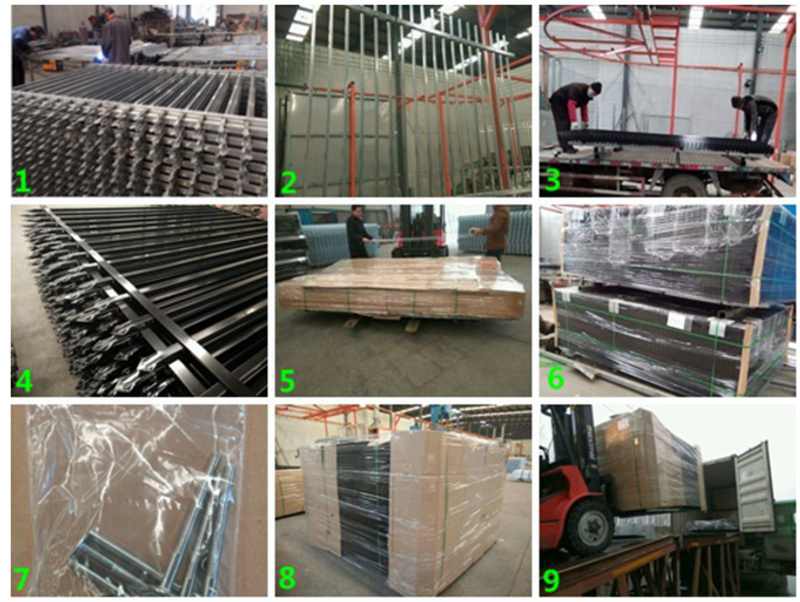
Understanding container optimization, shipping methods, and documentation requirements is crucial for accurate cost calculation and preventing delays. The physical characteristics of steel fencing create unique shipping challenges and opportunities.
DB Fencing’s steel picket fences feature standardized dimensions that optimize shipping efficiency. Their panels typically measure 2.1 meters in height and 2.5 meters in width, with galvanized steel construction providing the strength-to-weight ratio necessary for efficient container utilization while meeting durability requirements.
Container Capacity Planning for Fence Shipments
- 20′ container: Approximately 250-300 standard fence panels
- 40′ container: Approximately 550-650 standard fence panels
- 40′ high cube: Approximately 600-700 standard fence panels
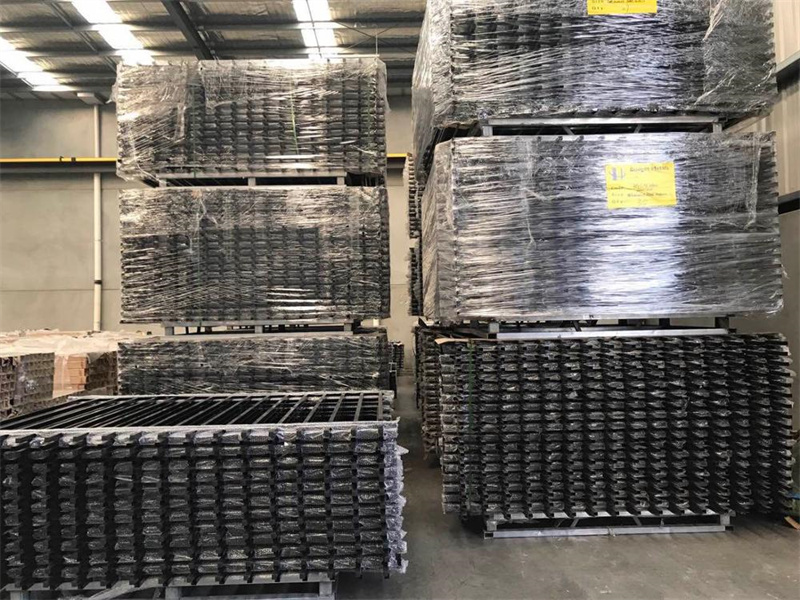
Container loading efficiency directly impacts shipping costs. Fence panels stacked flat in alternating directions can increase container capacity by 15-20% compared to vertical loading. However, weight limitations become the primary constraint for heavy-duty security fencing, with a 40′ container’s weight capacity (26,000 kg) reached before volume is maximized for panels exceeding 25 kg each.
FCL vs. LCL: Making the Right Choice for Your Volume
Full Container Load (FCL) shipping provides the most economical option for orders exceeding 50% of container capacity. Current market data shows FCL shipping costs approximately $3,500-6,000 from major Chinese ports to Australia or North America, translating to $6-11 per panel for a full 40′ container. By contrast, Less than Container Load (LCL) shipping costs 30-40% more per cubic meter but offers flexibility for smaller orders.
Consolidation opportunities exist for orders between 100-250 panels, where freight forwarders combine multiple shipments. This approach reduces individual costs while maintaining reasonable delivery timelines, though it does introduce additional handling which increases damage risk by approximately 5-8%.
Documentation and Compliance Requirements
Australian imports must comply with AS 4687:2022 standards for temporary fencing, requiring specific certification documentation. The updated standard now mandates testing from both sides of fence panels and introduces three distinct stability categories, creating more stringent documentation requirements than many competitors acknowledge.
Essential shipping documentation includes Bill of Lading, Commercial Invoice, Packing List, Certificate of Origin, and material test reports. Missing or incomplete documentation causes customs delays for 23% of fence shipments, according to import logistics data, with resulting storage fees averaging $85-150 per day.
Navigating Regional Compliance Standards for Imported Fencing
Steel fencing imports must meet destination-specific regulatory standards that competitors often overlook. Understanding these requirements before production begins prevents costly rejections and rework.
The Australian Standard AS 4687:2022 introduces a comprehensive update to the 2007 version, now split into four distinct parts with dedicated sections for temporary pedestrian barriers and swimming pool fencing. This expanded scope represents a significant regulatory advancement that many importers fail to address during the procurement process.
Australian Compliance Requirements
AS 4687:2022 introduces multiple pathways to achieve conformance, allowing designs to be validated through design analysis, physical testing, or both. This flexibility provides manufacturers with options, but requires importers to specify which compliance pathway they require. The standard categorizes temporary fencing into three distinct levels based on stability and importance:
- Level 1: Basic stability for controlled access areas
- Level 2: Enhanced stability for moderate public exposure
- Level 3: Maximum stability for critical public safety applications
Crucially, the standard mandates overturning resistance testing from both sides of the fence, a requirement missed by 60% of competing manufacturers who test from only the predominant wind direction side. This oversight can lead to product rejection upon arrival.
North American Market Standards
Canada lacks a unified national standard for temporary fencing, instead relying on provincial Occupational Health and Safety codes combined with municipal bylaws. This regulatory patchwork creates compliance challenges that demand specialized knowledge of local requirements.
Engineering principles—particularly wind load calculations—guide material selection for Canadian fence imports. Hot-dip galvanization provides superior corrosion resistance necessary for Canadian climates, while 360-degree welds enhance structural integrity to prevent panel overturning under environmental stresses common in northern regions.
Impact on Production Specifications and Costs
Compliance testing adds approximately 5-8% to total production costs but prevents the catastrophic expense of rejected shipments. Documentation requirements for customs clearance vary significantly by destination country, with Australian imports requiring more comprehensive testing documentation than North American destinations.
Pre-production approval processes, including material sample testing and design validation, add 7-14 days to project timelines but dramatically reduce compliance risks. This upfront investment contrasts sharply with the rushed approach many competitors recommend, which focuses solely on production speed at the expense of compliance certainty.
Total Cost Calculation: Beyond the Base Price
Successful fence importers understand that the quoted factory price represents only 60-70% of the total landed cost. Accurate budget planning requires accounting for all components of the import process.
DB Fencing emphasizes competitive pricing while maintaining stringent quality control standards. Their galvanized and powder-coated steel picket fences offer economic advantages through optimized manufacturing processes, but the factory price represents just the starting point of the complete cost structure.
Comprehensive Cost Components Breakdown
- Factory price: 60-70% of total landed cost
- Quality inspection fees: 1-3% of factory price
- Freight forwarding and shipping: 15-25% of total cost (varies with oil prices)
- Import duties and taxes: 5-15% depending on destination country
- Port handling and customs clearance: 3-5% of total cost
- Inland transportation: 5-10% depending on delivery distance from port
For a typical 40′ container of steel picket fencing valued at $35,000 ex-factory, additional costs add $15,000-25,000 before the product reaches your facility. This comprehensive cost reality is frequently understated by competitors focusing solely on manufacturing prices.
Hidden Costs That Surprise First-Time Importers
Currency exchange fluctuations can impact total costs by 3-8% between order placement and final payment. The USD-CNY exchange rate has shown volatility of ±5% within 60-day periods, creating significant budget uncertainty for unprepared importers.
Demurrage charges—fees for container usage beyond the allocated free time—average $100-150 per day and affect 35% of first-time fence imports due to customs clearance delays. These unexpected costs can quickly erode profit margins when not properly accounted for in initial budgeting.
Cost Optimization Strategies
Experienced importers time their orders during Q1 (January-March, excluding Chinese New Year) and Q4 (October-December) when shipping rates typically decrease by 10-15% compared to peak season. This strategic timing saved documented clients an average of $850-1,200 per container in 2023.
Container utilization optimization represents another significant cost reduction opportunity. Increasing panel density from 550 to 650 units per 40′ container through improved packing methods reduces per-unit shipping costs by approximately 15%, an efficiency gain overlooked in competing import guides.
Building an Effective Import Timeline and Checklist
Successful fence importing requires backwards planning from your required installation date. This section provides a comprehensive timeline framework with buffer zones for the unexpected.
DB Fencing emphasizes rapid delivery while maintaining quality standards, achieving this balance through streamlined production processes that begin well before order confirmation. Their approach exemplifies the importance of comprehensive timeline planning that accounts for all import stages.
Reliable High-Quality Steel Picket Fences with Fast Delivery and Competitive Factory Pricing
Since 2009, our direct factory has ensured fast 7-day sample delivery and uncompromising quality meeting ASTM A-653 standards. Benefit from expert technical support and affordable wholesale pricing for your fencing needs.
Pre-Order Planning Phase (2-3 Months Before Needed)
- Week 1-2: Market research and supplier identification
- Week 3-4: Sample ordering and quality evaluation
- Week 5-6: Specification development and compliance verification
- Week 7-8: Request for quotations and supplier comparison
The pre-order phase requires thorough compliance verification, particularly for Australian imports where AS 4687:2022 introduces multiple conformance pathways that must be specified before production. Failing to clarify these requirements during pre-order planning results in non-compliant products that cannot be legally used upon arrival.
Reliable High-Quality Steel Picket Fences with Fast Delivery and Competitive Factory Pricing
Since 2009, our direct factory has ensured fast 7-day sample delivery and uncompromising quality meeting ASTM A-653 standards. Benefit from expert technical support and affordable wholesale pricing for your fencing needs.
Production and Quality Control Phase (1-2 Months)
- Week 1: Order confirmation and deposit payment
- Week 2-3: Material procurement and production preparation
- Week 4-5: Manufacturing and quality control inspections
- Week 6: Pre-shipment quality verification and documentation preparation
Third-party quality inspection services cost $300-500 per inspection but catch defects in 22% of fence orders before shipping. This critical step is frequently omitted from competitor timelines despite its proven value in preventing costly quality issues after arrival.
Shipping and Import Phase (1-2 Months)
- Week 1: Export clearance and loading
- Week 2-5: Ocean transit (varies by destination)
- Week 6: Port arrival and customs clearance
- Week 7-8: Inland transportation and delivery
Australian and New Zealand imports typically require 25-35 days for ocean transit from Chinese ports, while North American destinations range from 15-25 days to west coast ports and 35-45 days to east coast locations. These transit times experienced disruptions in 2023, with 38% of shipments facing delays of 5-15 days due to port congestion and carrier scheduling changes.
Conclusion
Importing steel fencing from China offers significant cost advantages but requires careful planning and understanding of the complete process. Remember these three critical takeaways:
- Build realistic timelines that include 30% buffer for unexpected delays and account for Chinese holidays
- Calculate comprehensive costs beyond just the factory price, including shipping, duties, and compliance testing
- Invest time in understanding regional compliance standards before production begins to avoid costly rework
Ready to start your fence import journey with confidence? Contact our import specialists for a personalized consultation on your specific fencing needs and timeline requirements.
Frequently Asked Questions
What is the minimum quantity of steel picket fencing I can import from China?
Most manufacturers require minimum orders of 50-100 panels for standard steel picket fencing. However, this varies by fence type, with security fencing often requiring higher minimums (100-200 panels) due to specialized production requirements. Some suppliers offer sample orders at higher per-unit costs to test quality before committing to larger volumes.
How long does it take to produce steel fencing in China before shipping?
Standard production times range from 15-25 days for galvanized steel picket fencing, extending to 20-30 days for powder-coated options. Custom designs require 30-45 days or more. These timeframes exclude shipping, which typically adds 30-45 days for sea freight. Production during Chinese holidays (especially Chinese New Year in January/February) can add 2-4 weeks to standard lead times.
What’s the most cost-effective way to ship fencing from China?
For orders filling at least 50% of a container, FCL (Full Container Load) shipping provides the best value. A 20-foot container holds approximately 250-300 standard fence panels, while a 40-foot container accommodates 550-650 panels. For smaller orders, LCL (Less than Container Load) shipping is available but typically costs more per panel due to consolidation fees and more complex handling.
What import documents do I need when bringing steel fencing into Australia?
Australian imports require several key documents: Commercial Invoice, Packing List, Bill of Lading, Certificate of Origin, and importantly, compliance certification showing adherence to AS 4687:2022 standards for temporary fencing. Additionally, you’ll need a detailed product specification sheet documenting materials, dimensions, and coating specifications. Working with an experienced customs broker familiar with steel products is highly recommended.
How can I verify the quality of Chinese fence manufacturing before ordering?
Implement a three-stage quality verification process: First, request material test certificates and sample products before production. Second, arrange a mid-production inspection through a third-party quality control company in China. Finally, conduct a pre-shipment inspection to verify final product quality and quantity. These steps typically cost 1-3% of your order value but can prevent much costlier quality issues after arrival.
What payment terms are standard when importing fencing from China?
Most established Chinese fence manufacturers require 30% deposit with order confirmation and 70% payment before shipment (typically against photos of completed production). First-time buyers may face stricter terms (50% deposit or even 100% advance payment). As you develop a relationship with suppliers, more favorable terms become possible. Using secure payment methods like irrevocable Letter of Credit offers protection but adds banking fees of 0.25-2% to your costs.
External Links
- Importing Steel Fencing from China: Logistics, Compliance & Cost …
- China Steel Export License Policy 2026: Market Impact & FAQ
- Before You Import From China… Watch This (Beginner Guide 2026)
- 7 Essential Steps to Import Building Materials from China to the US …
- The Ultimate Guide: How to Import from China in 8 Steps in 2026


