 Skip to content
The Bottom Line on Fence TCO
- Steel fencing, despite higher upfront costs, offers competitive 25-year total ownership costs due to durability and low maintenance.
- Choosing fencing materials with lifecycle and maintenance costs in mind leads to smarter ROI and reduces unexpected capital outlays.

Understanding Fence Lifecycle Cost Analysis
For any facility manager or procurement director overseeing a large commercial property, the perimeter fence is more than just a boundary line—it’s a critical infrastructure asset. I recall a project for a sprawling logistics hub where the initial budget pressure led the committee to select a seemingly low-cost wood picket fence. Within five years, constant repairs from warping and insect damage became a recurring operational headache. By year ten, they were facing a full replacement, completely erasing their initial savings. This common scenario underscores a fundamental principle: the sticker price of a commercial fence is merely the first chapter in a long financial story. To make truly sound capital investment decisions, leaders must embrace a lifecycle cost analysis approach.
This method moves beyond the initial purchase price to provide a comprehensive, long-term financial picture of an asset. For a durable good like a commercial fence, which is expected to perform for decades, this analysis is essential for accurate budgeting and maximizing return on investment. The core idea is to account for every dollar that will be spent on the asset over its entire service life, using financial principles like Net Present Value (NPV) to discount future costs to their current value. This allows for a true apples-to-apples comparison, as a repair cost ten years from now is worth less in today’s dollars, making it possible to accurately weigh initial savings against long-term expenses.
The analysis forces a shift in perspective, moving from the limiting question of “What is the cheapest option today?” to the strategic question of “What is the most valuable and cost-effective solution over the next 25 years?”. This holistic viewpoint transforms fence procurement from a simple purchase into a calculated capital investment. It enables leaders to anticipate future expenditures, mitigate financial risks, and justify higher upfront costs that deliver superior long-term value.
What Is Total Cost of Ownership (TCO)?
Total Cost of Ownership (TCO) is a financial framework used to evaluate the complete cost of an asset, extending far beyond its initial acquisition price. For commercial fencing, a TCO analysis includes a range of predictable and potential expenses: the initial material acquisition and professional installation, recurring annual maintenance, periodic major repairs, potential mid-life replacement costs, and finally, the expenses associated with disposal or recycling at the end of its useful life. It can even quantify indirect costs, such as the operational impact of downtime if a fence failure disrupts business activity.
This comprehensive view is critical for capital-intensive decisions because it exposes the hidden costs that a simple price comparison conceals. A fence with a low upfront price may demand expensive, frequent maintenance or require a full replacement long before a more durable, higher-priced alternative would. When projecting these costs over a 25-year time horizon—a typical planning cycle for major infrastructure—the long-term financial implications become starkly clear. This long-range view allows financial controllers and CFOs to budget more accurately for future operational expenditures and avoid the disruptive shock of unplanned capital outlays, making total cost of ownership a cornerstone of strategic asset management.

Key Cost Components in Fence TCO
A robust TCO calculation for a commercial fence is built from several distinct cost categories. The most obvious are the material and installation costs, which can range from $6 per linear foot for basic wood to over $15 for high-grade coated steel. However, the analysis only begins there. Annual maintenance costs are a critical, ongoing expense. For example, a wood fence may require staining or sealing every few years, costing as much as $0.30 per foot annually, while a galvanized steel or aluminum fence might only need occasional cleaning, averaging just $0.10-$0.15 per foot per year. As an industry report from a leading Fencing Manufacturers Association would confirm, these seemingly small annual figures accumulate into significant sums over a 25-year period.
Beyond routine upkeep, you must also budget for unscheduled repairs, which are heavily influenced by cost drivers like climate, corrosion risk, and potential for vandalism. A fence in a coastal, high-salt environment will degrade faster than one in a dry, inland location. Finally, the model must account for major mid-life replacement and end-of-life disposal or recycling costs. A pressure-treated wood fence may need a full replacement in 12-15 years, effectively doubling its initial installation cost, whereas a high-quality steel fence is likely to last well beyond the 25-year analysis an a deep dive into maintenance cost strategies reveals. Each component interacts, painting a holistic financial picture that is far more telling than any initial quote.
How Replacement Cycles Affect TCO
Replacement cycles are the scheduled or predictable timelines within which a material is expected to fail or degrade to the point of needing a complete overhaul. This is perhaps the most impactful factor on long-term TCO. For example, pressure-treated wood fencing typically has a replacement cycle of 12-15 years due to its susceptibility to rot, warping, and insect damage. This means that a 25-year TCO calculation for a wood fence must include not just the initial installation cost, but also a second full installation cost around year 13. This mid-life financial shock can devastate a facility’s operational budget if not planned for from day one.
In contrast, materials like hot-dip galvanized steel and aluminum often have life expectancies of 30 years or more, meaning they require no full replacement within the 25-year TCO window. Vinyl and some composites may fall in between, with lifespans of 20-25 years, sometimes requiring a retrofit or replacement near the end of the analysis period. The financial impact of a mid-life replacement goes beyond the material and labor; it involves removal and disposal of the old fence and potential operational disruptions. Properly managing fence replacement cycles within an asset lifecycle management framework transforms this potential budget crisis into a predictable, manageable expense.
25-Year Cost Breakdown: Steel Fencing
I once advised a data center client who was initially hesitant about the upfront cost of a powder-coated galvanized steel fence. However, once we modeled the 25-year TCO, the numbers spoke for themselves. The alternative quotes required budgeting for constant inspections in their corrosive industrial environment and a full replacement in 15 years. The steel fence, by contrast, was a single, long-term capital expense with minimal projected upkeep, offering the kind of financial predictability their operations demanded.
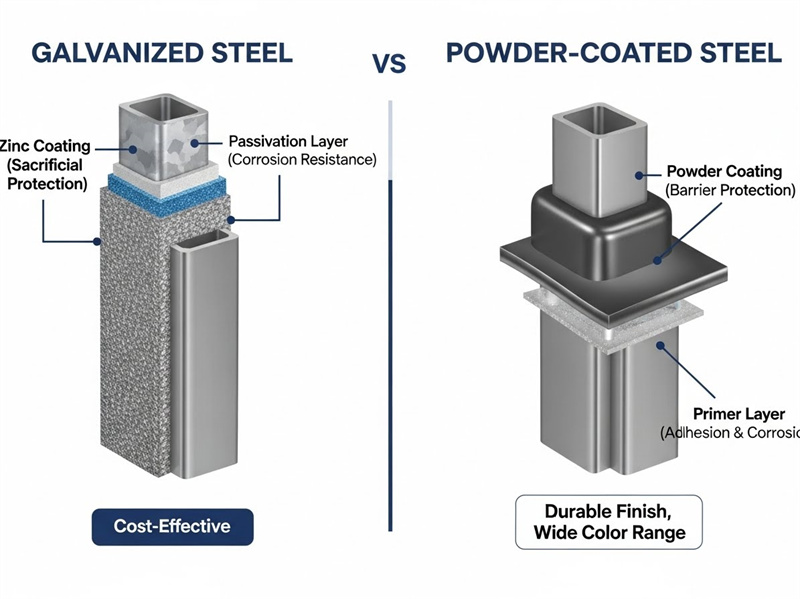
When specifying a perimeter for a high-securityfacility or a long-term commercial development, steel fencing consistently emerges as a top contender, and a deep dive into its 25-year cost profile reveals why. The key to steel’s longevity and favorable TCO lies in its advanced corrosion protection mechanisms. Hot-dip galvanizing, a process where the fabricated steel is submerged in molten zinc, creates a series of zinc-iron alloy layers that are metallurgically bonded to the steel. This multi-layered barrier provides robust protection against abrasion and corrosion. For even greater durability and aesthetic appeal, a powder coating—a thermoset polymer finish—can be applied over the galvanized steel, creating an almost impenetrable shield against moisture and UV radiation. These protective technologies are what transform raw steel into a 30-to-40-year asset.
Material and Installation Costs
On paper, the initial investment for steel fencing is higher than that of some alternatives. A typical hot-dip galvanized steel picket system costs approximately $12 to $15 per linear foot for both material and installation. This cost can fluctuate based on the thickness (gauge) of the steel, the complexity of the terrain, and regional labor rates. Opting for a dual-layer of protection with a powder coat over the galvanization may add slightly to the initial cost, pushing it towards the $13 to $16 per foot range. While this upfront expense may seem substantial, it’s crucial to view it as the down payment on a long-term asset. The benefits of these coatings are profound; hot-dip galvanizing provides sacrificial protection where even if the coating is scratched, the surrounding zinc will corrode first, protecting the steel. Powder coating adds a tough, decorative layer that further seals the metal from the elements.
| Fence Type | Material Cost ($/ft) | Installation Cost ($/ft) | Total Initial Cost ($/ft) |
|---|---|---|---|
| Hot-Dip Galvanized Steel | 8-10 | 4-5 | 12-15 |
| Powder-Coated Steel | 9-11 | 4-5 | 13-16 |
Maintenance and Repair Expenses
This is where the higher initial investment in steel fencing begins to pay significant dividends. The annual maintenance for a properly protected steel fence is minimal, typically limited to occasional cleaning to remove dirt and debris. The projected cost is a mere $0.10 to $0.15 per linear foot per year. The primary long-term task is inspecting for any breaches in the protective coating, such as deep scratches or impact damage, and applying a touch-up of a zinc-rich compound to prevent localized corrosion. This simple preventive step is crucial; it stops a small problem from growing into a larger, more expensive one. Many high-quality steel fence systems also come with extensive warranties on their coatings—often 15 to 20 years—which provides further financial certainty and minimizes out-of-pocket repair costs, a key factor in any maintenance cost comparison.
End-of-Life Disposal and Recycling
When a steel fence eventually reaches the end of its exceptionally long service life (often 30-40 years), it retains value in a way few other materials can. Steel is one of the most recycled materials on the planet. As a result, the net cost of disposal is negligible and can even be a net positive. The cost to remove and transport the old fence is estimated at around $0.05 per foot, but this can often be offset by the residual value of the scrap steel, which is highly sought after by recycling facilities. This high recyclability presents a significant environmental advantage, as manufacturing new steel from recycled scrap requires dramatically less energy and resources than producing it from raw iron ore. According to peer-reviewed lifecycle assessment studies, this circular economy model dramatically lowers the material’s overall environmental footprint compared to landfilling non-recyclable materials.
Summarizing Steel Fence 25-Year TCO
When all the cost components are aggregated over a 25-year horizon, the financial resilience of steel becomes clear. Despite an initial outlay of $12-$16 per foot, the extremely low annual maintenance costs and the absence of a costly mid-life replacement cycle keep the total cost remarkably stable. The total 25-year cost of ownership for a hot-dip galvanized steel picket fence lands in the range of $420 to $460 per linear foot. This figure demonstrates that diligent corrosion management more than justifies the initial price tag. From a facility management perspective, this stability provides predictable operational budgets and a reliable return on investment (ROI). The fence becomes a “set-and-forget” asset that performs its function security and aesthetically without demanding constant financial attention, unlike replacement-heavy materials.
| Cost Component | Cost Range ($/ft) |
|---|---|
| Material + Installation | 12-15 (annualized over 25 yrs) |
| Annual Maintenance | 0.10-0.15 per year |
| Repairs | Minimal |
| Disposal/Recycling | 0.05 |
| Total 25-Year Cost | 420-460 |
Comparing Steel to Alternative Materials
A city parks director I worked with was reviewing bids for a large community sports complex and was leaning towards a wood fence based on the low initial bid. We ran a 25-year TCO projection that factored in the city’s union labor rates for the staining required every three years and a full replacement at year 13. When she saw that the “cheap” wood fence would ultimately cost more than aluminum or steel, the budgetary choice became clear, protecting her department from future operational strains.
While steel presents a compelling case for long-term value, a thorough analysis requires a side-by-side comparison with other common commercial fencing materials. Each alternative carries a unique financial and operational signature shaped by its inherent material properties. The primary factors driving the vast differences in TCO are the maintenance cycles and replacement frequencies. These aren’t arbitrary figures; they are dictated by the fundamental C of how each material responds to environmental stressors over time. Wood is subject to biological degradation from moisture and insects, vinyl is vulnerable to photochemical degradation from UV radiation, and composites offer a balance but are not without their own long-term considerations. Understanding these underlying factors is key to choosing the right material for a specific application and budget.
Wood Fencing Lifecycle Costs
Pressure-treated wood fencing offers the lowest initial barrier to entry, with material and installation costs typically falling between $6 and $9 per linear foot. This initial affordability is its main attraction, but it’s a deceptive one. The TCO of wood is driven by relentless and costly maintenance. To fend off rot and insect damage, a wood fence requires a new coat of stain or sealant every 2-3 years, an ongoing operational expense that averages around $0.30 per foot annually—double or triple that of steel. Even with diligent upkeep, its susceptibility to the elements means a full replacement is often necessary after just 12-15 years. This mid-cycle replacement, costing another $6-$9 per foot, is what catapults wood’s 25-year TCO to an estimated $460-$520 per foot, making it the most expensive option over the long term.
| Cost Component | Estimated Cost ($/ft) |
|---|---|
| Initial Material + Installation | 6-9 |
| Annual Maintenance | 0.30 |
| Replacement (Year 13) | 6-9 |
| Total 25-Year Cost | 460-520 |
Vinyl Fencing Cost Profile
Vinyl (PVC) fencing presents a compelling alternative with an initial cost of $10-$13 per foot, placing it in the mid-range. Its standout feature is its extremely low maintenance profile, requiring little more than an occasional cleaning with soap and water, which translates to an annual cost of only about $0.05 per foot. However, vinyl is not without its vulnerabilities. In climates with extreme temperatures, it can become brittle over time, increasing its susceptibility to cracking from impacts or thermal stress. This degradation can shorten its effective lifespan to 20-25 years. Consequently, a TCO analysis must account for a potential replacement or significant retrofit, costing $8-$11 per foot, toward the end of the 25-year period. This leads to a total 25-year TCO of around $350-$380, making it one of the most cost-effective options if its environmental and durability limitations are acceptable.
| Cost Component | Estimated Cost ($/ft) |
|---|---|
| Initial Material + Installation | 10-13 |
| Annual Maintenance | 0.05 |
| Replacement (Year 20-25) | 8-11 |
| Total 25-Year Cost | 350-380 |
Composite and Engineered Wood Fencing
Occupying the premium end of the market, composite and engineered wood fencing has an initial installed cost of $11-$14 per foot. These materials are designed to offer the aesthetic appeal of wood without its high-maintenance drawbacks. Made from a blend of wood fibers and recycled plastics, they are highly resistant to rot, insects, and warping. Maintenance is limited to periodic cleaning, costing around $0.07 per foot per year. Crucially, high-quality composite fencing is engineered to last the full 25-year analysis horizon without needing major replacement. Emerging technologies like densified wood, such as the commercially developed SuperWood, promise mechanical strength comparable to steel with a lower environmental footprint. While disposal costs are slightly higher than steel at about $0.08/ft due to mixed materials, the overall 25-year TCO of $380-$410 makes it a strong competitor, especially for projects where aesthetics are a high priority.
| Cost Component | Estimated Cost ($/ft) |
|---|---|
| Initial Material + Installation | 11-14 |
| Annual Maintenance | 0.07 |
| Disposal/Recycling | 0.08 |
| Total 25-Year Cost | 380-410 |
Aluminum Fencing Cost and Value
Aluminum is a standout performer in the metal fencing category, offering a lightweight yet durable solution. Its initial cost ranges from $9 to $12 per foot, making it more affordable upfront than steel. Aluminum’s greatest advantage is its natural resistance to corrosion; it forms a protective oxide layer that prevents rust, making it ideal for coastal or high-humidity environments. This property results in minimal annual maintenance, costing only about $0.06 per foot for cleaning. With a typical lifespan of 30-35 years, it easily surpasses the 25-year analysis period without any replacement costs. This combination of a moderate initial price and near-zero long-term upkeep gives aluminum one of the lowest 25-year TCO profiles, estimated at $350-$380 per foot, making it a powerful contender for the most cost-effective long-term fencing solution.
| Cost Component | Estimated Cost ($/ft) |
|---|---|
| Initial Material + Installation | 9-12 |
| Annual Maintenance | 0.06 |
| Total 25-Year Cost | 350-380 |
Cost Comparison Summary Table
When all data is aggregated, the long-term financial landscape of commercial fencing comes into sharp focus. The following table provides a clear, side-by-side comparison of the 25-year total cost of ownership for each major material. For CFOs, procurement directors, and facility managers, this summary acts as a powerful decision-making tool. It immediately highlights the trade-off between initial cost and long-term durability. While wood is the cheapest to install, its frequent maintenance and mid-life replacement make it the most expensive over 25 years. Conversely, vinyl and aluminum emerge as TCO leaders, while steel, despite its higher upfront price, proves to be a highly competitive and resilient investment due to its unparalleled durability and low upkeep.
| Material | Initial Cost ($/ft) | Annual Maintenance ($/ft) | Mid-Life Replacement Cost ($/ft) | Disposal Cost ($/ft) | Estimated 25-Year TCO ($/ft) |
|---|---|---|---|---|---|
| Steel (Galvanized/Powder-Coated) | 12-16 | 0.10-0.15 | Minimal | 0.05 | 420-460 |
| Wood (Pressure Treated) | 6-9 | 0.30 | 6-9 (Year 13) | N/A | 460-520 |
| Vinyl | 10-13 | 0.05 | 8-11 (Year 20-25) | N/A | 350-380 |
| Composite/Engineered Wood | 11-14 | 0.07 | None | 0.08 | 380-410 |
| Aluminum | 9-12 | 0.06 | None | N/A | 350-380 |
ROI and Budgeting for Fence Investments
Once you have the total cost of ownership figures, the next step is to translate that data into actionable financial metrics like Return on Investment (ROI) and integrate it into your capital budget. This is where the analysis moves from a comparative tool to a strategic planning asset. To do this correctly, it’s important to understand advanced ROI calculation methodology, including the use of discount rates to account for the time value of money, the potential costs of operational downtime, and various risk factors that can influence lifecycle budgeting.
Calculating Fence ROI
In the context of a capital investment like commercial fencing, Return on Investment (ROI) measures the project’s profitability relative to its total cost over its lifetime. The calculation goes beyond a simple payback period; a robust methodology includes the initial investment, all projected maintenance costs, and any replacement expenses, all mapped out over a specific time horizon. Crucially, future costs and cash flows must be discounted to their present value, as a dollar spent in ten years is less costly than a dollar spent today. For a CFO, the formula might look something like NPV (Net Present Value) = Σ [Cash Flow / (1 + r)^t] – Initial Investment, where ‘r’ is the discount rate and ‘t’ is the time period, ensuring all future costs are accurately contextualized in a ROI fence investment.

Integrating TCO in Capital Budgeting
Integrating TCO analysis into your capital budgeting process is a proactive strategy to avoid financial surprises and ensure asset sustainability. By accounting for the full lifecycle variance between materials, you can allocate operational funds more accurately and prevent the procurement team from focusing solely on the lowest initial bid, which often leads to higher long-term costs. Strategically, this allows for phased investments where budgets are pre-allocated for future repairs or replacements years in advance. This awareness of lifecycle costs is a powerful tool for financial risk mitigation, turning potential capital emergencies into predictable, planned expenditures.
Tools and Calculators for Fence TCO
To streamline this analysis, several fence TCO calculator tools and Excel models are available, designed for procurement teams and facility managers. These tools typically require key input variables to generate an accurate estimate, including linear footage, material type, local labor rates, expected lifespan, and annual maintenance costs. For maximum accuracy, it’s advisable to customize these tools to reflect your specific site conditions, such as local climate, security requirements, and soil type. A well-built worksheet can serve as a powerful template for comparing bids and presenting the long-term financial case for a specific material choice to stakeholders.
Ready to Calculate Your Project’s TCO?
Download our customizable Excel worksheet to get started and make an informed decision for your commercial property.
Environmental and Sustainability Considerations
Beyond the balance sheet, the environmental impact of a major infrastructure project is an increasingly critical factor in decision-making. A lifecycle assessment (LCA) evaluates a product’s environmental footprint from raw material extraction to end-of-life disposal. By embedding these environmental cost scores alongside the financial TCO, organizations can make truly sustainable choices that align with corporate responsibility goals.
Steel Fence Sustainability Benefits
Steel boasts a strong sustainability profile, primarily due to its high recyclability. Steel is the world’s most recycled material, and using recycled scrap to produce new steel components results in significant embodied carbon savings and reduced demand for raw resource extraction. Furthermore, advanced surface treatments like galvanizing and powder coating extend the fence’s lifecycle, which reduces the overall consumption of resources needed for replacements. Studies comparing the carbon footprint of galvanized steel vs alternatives often highlight these benefits, positioning it as a responsible choice for long-term projects.
Environmental Impacts of Alternatives
Alternative materials each have their own environmental trade-offs. Wood fencing often requires chemical treatments to prevent decay, and its shorter lifespan leads to more frequent replacement and resource consumption. The production of vinyl (PVC) fencing is energy-intensive and presents end-of-life challenges, as it is not easily recycled and can release harmful chemicals. While composites often use recycled content, their mixed-material nature can complicate recycling, and their production still has an associated emissions footprint. Aluminum is highly recyclable, similar to steel, but its primary production is significantly more energy-intensive.
Making Sustainable Choices
Making a truly sustainable choice requires weighing the financial TCO against the environmental lifecycle costs. This means adopting a lifecycle thinking approach that includes a clear end-of-life plan for the chosen material. Facility managers should look towards green procurement policies that prioritize materials with high recycled content and clear recycling pathways. As technology evolves, emerging eco-friendly options like modified or densified wood may also offer a compelling balance of durability and sustainability through effective lifecycle financial analysis.
Conclusion: What Matters Most in Fence TCO
- High initial costs for steel fencing are offset by its durability and low maintenance, making it economically viable over 25 years.
- Alternative materials like vinyl and aluminum may offer lower total costs, but each has specific lifecycle trade-offs and durability considerations.
- Effective ROI calculation and budgeting include all lifecycle costs, enabling smarter commercial fence capital investments.
- Environmental sustainability increasingly influences fence material selection alongside cost, favoring recyclable and low-impact options like steel.
Optimize Your Next Fence Investment
Apply lifecycle cost analysis and sustainability tools to your next commercial fencing procurement for optimized long-term value and ROI.
Frequently Asked Questions
How do I calculate the total cost of ownership for steel fencing?
To calculate the TCO for steel fencing, you must sum up all costs over the entire 25-year lifespan. This includes the initial material and installation cost, the cumulative annual maintenance costs (e.g., cleaning and touch-ups), any anticipated repair costs, and end-of-life disposal or recycling fees. Using a TCO calculator or a simple formula like: TCO = (Initial Cost) + (Annual Maintenance Cost x 25) + (Disposal Cost) is a good starting point.
Why is steel fencing more cost-effective long-term despite higher upfront costs?
Steel’s long-term cost-effectiveness comes from its exceptional durability and low maintenance needs. Its corrosion-resistant coatings (like galvanizing and powder coating) prevent rust and degradation, leading to a lifespan that often exceeds 25 years. This durability eliminates the need for a costly mid-life replacement, which is a major expense for less durable materials like wood.
What are the major maintenance requirements for steel fences?
Maintenance for steel fences is minimal. It primarily involves routine cleaning to remove dirt and environmental buildup, typically costing $0.10-$0.15 per foot per year. The most important task is periodic inspection for any deep scratches or damage to the protective coating. If a breach is found, applying a zinc-rich touch-up paint prevents corrosion and prolongs the fence’s lifespan.
How do environmental factors impact fence material choices?
Environmental factors significantly affect a fence’s durability, maintenance needs, and ultimately, its TCO. For example, high moisture and coastal salt air accelerate corrosion in unprotected metals and rot in wood. Extreme temperature fluctuations can make vinyl brittle and prone to cracking. Choosing a material engineered to withstand your specific climate is key to avoiding premature failure and unplanned replacement costs.
Can steel fencing be recycled at end of life?
Yes, steel fencing is highly recyclable. Steel is one of the most recycled materials globally, and its scrap value can often offset disposal costs. Recycling steel uses significantly less energy than producing it from raw iron ore, making it an environmentally responsible choice. Many local recycling centers and scrap metal dealers accept old steel fencing, and there may be regulations or incentives to encourage it.
What tools can help me compare fencing lifetime costs?
There are several tools available to help compare lifetime costs, including online TCO calculators, downloadable Excel spreadsheet models, and specialized procurement software. To use them effectively, you’ll need key inputs like project linear footage, local labor rates, material costs, and expected maintenance schedules. These tools are invaluable for creating a data-driven comparison between different fencing options for your commercial project.


