 Skip to content
The Custom Steel Fence Essentials
- Successful custom steel fence fabrication hinges on a detailed design consultation combined with expert engineering and precise fabrication methods.
- Choosing the right steel grade, finish, and modular components ensures durability, aesthetic appeal, and seamless site integration tailored to project needs.

Overview of Custom Steel Fence Fabrication
In the world of architectural design and property development, a fence is rarely just a boundary. It is a critical component of a project’s security, aesthetic statement, and overall identity. Custom steel fence fabrication transforms this utilitarian element into a bespoke architectural feature. Unlike off-the-shelf solutions, custom fabrication provides unparalleled adaptability to unique project requirements, delivering superior results in both form and function. Typical applications range from securing high-value commercial properties and defining the perimeter of luxury residential developments to adding distinctive character to public parks and corporate campuses.
The core value of custom fabrication lies in its ability to address project-specific challenges head-on. Standard fencing often forces compromises, whether in accommodating sloped terrain, matching a unique architectural style, or meeting specific security mandates. Custom fabrication, however, begins with the project’s unique DNA. It allows for complete control over materials, dimensions, finishes, and features, ensuring the final product integrates flawlessly with the site and its intended purpose. This approach not only enhances visual harmony but also leads to a more durable, resilient, and effective long-term solution.
Why Choose Custom Steel Fencing
The distinction between standard and custom steel fence fabrication is fundamental. Standard fencing is a product of mass production, offering limited choices in materials, heights, and designs. It is a one-size-fits-many approach that often falls short for projects with specific aesthetic or functional demands. Custom steel fencing, by contrast, is a service-driven process. It allows architects, landscape designers, and developers to specify exact material grades, intricate decorative motifs, non-standard dimensions, and performance-driven features, resulting in a fence that is a true extension of the architectural vision.
For design professionals, the benefits are immense. Customization allows for perfect architectural and landscape integration, where the fence complements building materials, follows complex site lines, and reinforces a specific design language. Functionally, custom solutions can be engineered to meet enhanced security protocols, withstand specific environmental stressors like high winds or coastal salt spray, and incorporate custom gates and access control systems. Industries such as high-end hospitality, corporate headquarters, and exclusive residential communities benefit immensely, where the fence contributes directly to the property’s value and visual branding. While the initial investment may be higher, the long-term cost benefits are significant, driven by superior durability, reduced maintenance, and a timeless aesthetic that avoids premature replacement.

Core Custom Fabrication Process
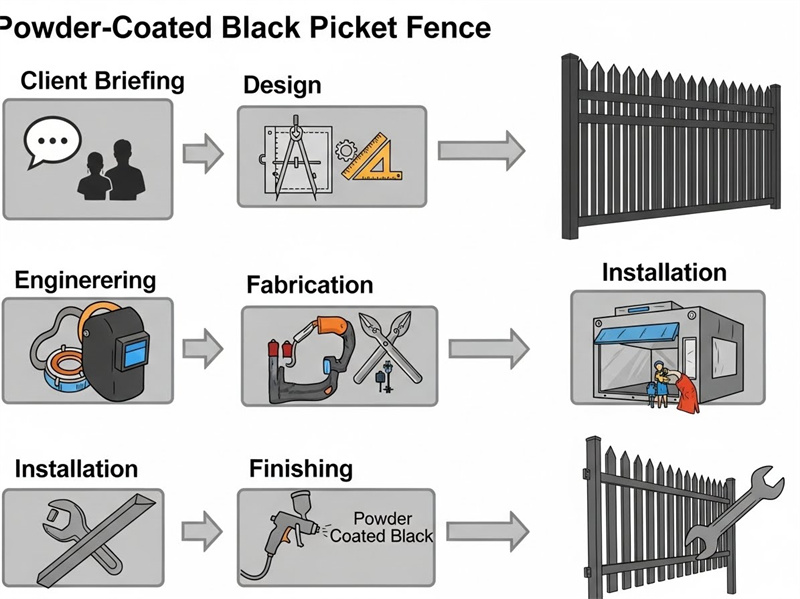
The journey of a custom steel fence from concept to reality is a meticulously managed process involving several key stages. It begins with an in-depth client brief, where the project’s goals are clearly defined. This is followed by design and engineering phases, where concepts are translated into technical specifications. The process then moves to the controlled environment of the fabrication shop for manufacturing and finishing, and concludes with on-site installation and final inspection. Each step is crucial for achieving the desired outcome and requires close collaboration between stakeholders.
The primary stakeholders in this process form a collaborative team: the client, the architect or designer, the structural engineer, the fabricator, and the installation crew. The process is inherently iterative, especially during the initial stages. The designer’s initial concepts are passed to the engineer for structural validation, which may lead to adjustments in material thickness or connection design. These revisions are then reviewed with the client for aesthetic approval, creating a feedback loop that continues until the design is both beautiful and structurally sound. This collaborative refinement is what allows for the integration of unique features like adjustable central supports for perfect leveling on uneven ground or specialty hardware that enhances both security and style.
Design Consultation for Custom Fences
The design consultation is the cornerstone of any successful custom steel fence project. This is where vision meets viability. On a recent project for a contemporary art museum with complex site lines and a need for non-intrusive security, our initial consultation focused on translating the architect’s fluid design language into a buildable fencing system. This early engagement ensures that every requirement is captured, documented, and integrated into the design from day one, preventing costly revisions later in the process. It involves a deep dive into the project’s aesthetic goals, functional imperatives, and physical constraints.
A critical, often underestimated, aspect of this phase is how early-stage site analysis directly shapes design decisions. It’s not simply about measuring a perimeter; it’s about understanding the land’s story. Factors like topography, soil composition, sun exposure, and prevailing wind directions all influence the fence’s structural requirements and material choices. Furthermore, architectural harmony is paramount. The fence must speak the same language as the buildings it surrounds. Our process involves photodocumentation and analysis of adjacent structures to ensure that the fence’s scale, material palette, and decorative elements complement the existing environment, rather than competing with it.
Gathering Project Requirements
A comprehensive requirements-gathering process is methodical and detailed. It begins by documenting the client’s high-level aesthetic goals—is the desired feel modern and minimalist, or traditional and ornate? At the same time, we define functional needs: Is the primary purpose security, privacy, demarcation, or purely decorative? Budgetary constraints are established early to guide material and complexity decisions. Site-specific constraints are then meticulously recorded, including topography challenges, potential drainage issues, local weather patterns (e.g., heavy snow loads or coastal air), and the architectural style of nearby buildings that demand aesthetic cohesion. This detailed approach to site-specific fence integration ensures that the design is grounded in reality from the outset.
Next, we translate client preferences into concrete specifications. This involves decisions on fence height for security or privacy, the spacing between pickets to control visibility, and the selection of decorative elements like finials, scrolls, or custom-cut logo motifs. Color is another key consideration, with clients often needing to match existing architectural trim or branding palettes. Beyond aeasthetics, we address critical practicalities. Security requirements dictate choices in picket spacing, anti-climb features, and gate locking mechanisms. Maintenance expectations influence the choice of finish, and a thorough review of local zoning ordinances and building codes ensures full regulatory compliance from day one.
Design Development and Modelling
Once requirements are established, the creative work of design development begins. Vague ideas are transformed into tangible concepts through the creation of detailed, scaled drawings. For most projects today, this is elevated through the use of 3D modeling. These digital representations are invaluable visualization tools, allowing architects and clients to see a photorealistic render of the fence in its intended environment. This virtual walkthrough helps confirm that the design aligns with their vision before a single piece of steel is cut, providing an opportunity to make adjustments with ease.
The models and drawings specify every detail with precision: the exact dimensions of each panel, the on-center spacing of posts, and the placement of any custom motifs or patterns. This is also the stage where specialty hardware is selected and integrated into the design. Whether it’s a robust, cantilevered gate system for a commercial entrance, aesthetically pleasing hinges and latches, or the inclusion of innovative adjustable central supports for long panels, every component is modeled for fit and function. The design then enters a formal review cycle, where the client and project team provide feedback, leading to iterative adjustments until the final design is unanimously approved and ready for engineerin.

Engineering Custom Steel Fence Solutions
After the design is approved, it moves to the engineering phase, where artistry is fortified by science. This is where we ensure the fence will not only look as intended but also perform flawlessly for decades. The underlying engineering principles are what guarantee longevity and safety. Our team performs detailed load calculations to account for forces like wind pressure, which can exert significant stress on large, solid-style panels. We also analyze potential impact loads and assess ground conditions to design appropriate foundations. This rigorous approach to custom fence engineering ensures the final structure is resilient, safe, and built to last against the specific environmental challenges of its location.
Structural Load and Safety Analysis
A key responsibility of the engineering team is to evaluate the fence’s endurance against a variety of environmental and physical forces. Using advanced software, we model how the fence will behave under heavy wind loads, ensuring that both panels and posts can withstand the pressure without deforming or failing. We also consider potential accidental impacts and soil conditions, which dictate the depth and design of the footings. These calculations determine the optimal post spacing, the necessary steel gauge for panels, and the size and reinforcement requirements for the concrete foundations that anchor the entire system.
Beyond performance, safety is paramount. All design decisions are checked against relevant safety standards and local building codes, which may govern everything from pool fence gate latching mechanisms to the maximum allowable gap between pickets. A critical focus of this analysis is on the welds and joints that hold the structure together. Industry best practices, such as the guidelines published by the American Welding Society, emphasize that the integrity of these connections is as important as the strength of the steel itself. Accordingly, engineers specify the type and size of welds required, and these specifications become part of the formal quality control plan, often involving post-fabrication testing methods to verify joint integrity.
Selecting Steel Grades and Materials
The choice of steel is one of the most critical decisions in custom fence fabrication, directly impacting durability, aesthetics, and cost. Several common steel types are used, each with a distinct profile. Standard carbon steel is a popular choice for its high strength and cost-effectiveness, but it requires a robust protective coating to prevent corrosion. For projects demanding a unique, self-protecting finish, a weather-resistant alloy like Corten steel is an excellent option; it forms a stable, rust-like patina that eliminates the need for paint and offers a striking, earthy appearance. For maximum corrosion resistance, especially in coastal or high-humidity environments, galvanized steel—which is coated in a layer of zinc—is often the preferred choice.
The trade-offs between these grades involve balancing durability, maintenance requirements, and finish compatibility. The thickness, or gauge, of the steel also plays a significant role in performance; thicker steel provides greater strength and impact resistance but also increases weight and cost. Engineers carefully select the appropriate grade and thickness based on the structural analysis, environmental exposure, and the client’s long-term maintenance preferences, ensuring the material is perfectly suited to the demands of the project.
| Steel Grade | Corrosion Resistance | Strength | Typical Uses | Cost Factor |
|---|---|---|---|---|
| Carbon Steel | Low | High | Standard fencing | Low |
| Weather-Resistant Alloy (Corten) | High | High | Outdoor decorative fences | Medium |
| Galvanized Steel | Very High | Medium-High | Coastal and wet environments | Medium |
Designing Custom Connections and Supports
The stability of a fence depends entirely on how it is connected and anchored. Engineers design these connection details with meticulous care. Base plates, which are thick steel plates welded to the bottom of each post, are designed with pre-drilled holes to anchor the fence securely to its concrete footings. The choice of connection method, such as welding or brazing, is specified based on strength requirements and aesthetic considerations. For instance, high-strength welds are used for structural joints, while brazing might be chosen for decorative elements where a cleaner finish is desired.
A hallmark of high-quality custom fence engineering is the inclusion of features that allow for field adjustments. For long fence panels, adjustable central supports are often designed to prevent sagging and allow for precise leveling on site. This is especially valuable on uneven terrain. The use of modular components is another key strategy, enabling easier transport and providing flexibility during installation. Every connection is subject to strict standards, with welding protocols specified and joint inspection procedures, like visual and ultrasonic testing, mandated to ensure that every connection meets or exceeds the required load-bearing capacity.

Fabrication Techniques for Custom Steel Fences
The fabrication stage is where engineered designs are transformed into physical reality. A few years ago, we were tasked with creating an intricate, lace-like steel fence for a historic property restoration. The design’s complexity was such that traditional cutting methods would have been impossible. This is where modern fabrication technology proved its worth. The precision of CNC laser cutting and the quality of our finishing processes are what ultimately determine both the aesthetic perfection and the long-term durability of the final product. Every step, from cutting the raw steel to applying the final coat of paint, is executed within a controlled shop environment to ensure absolute accuracy and repeatable quality.
This precision has a direct and significant impact on the fence’s service life. Inaccurate cuts lead to poor fit-up during assembly, which in turn creates gaps and stresses in the welded joints. These compromised joints are not only weaker but are also prime locations for moisture to collect, initiating corrosion that can prematurely degrade the fence from the inside out. By leveraging advanced cutting and welding technologies, we ensure that every component fits together perfectly, creating strong, seamless joints that are well-protected by the subsequent finishing process. This level of precision is the unseen foundation of a truly long-lasting architectural metalwork installation.
Cutting: CNC, Laser, and Plasma Shearing
The first step in fabrication is cutting the steel components to size, and modern technology offers several high-precision methods. For intricate decorative motifs and complex patterns, nothing surpasses the accuracy of CNC (Computer Numerical Control) laser cutting. A high-powered laser, guided by the digital design file, can cut through steel with incredible detail and a clean edge, making it ideal for the most demanding aesthetic requirements. CNC cutting and plasma shearing are both highly effective, with plasma offering faster cutting speeds for thicker materials, while laser cutting provides the ultimate in precision. As whitepapers on manufacturing processes often highlight, CNC technology enables high repeatability for these custom metal fences, ensuring every panel in a large project is identical.
The choice of cutting process directly impacts the quality of the final assembly. The clean, precise edges produced by laser and plasma cutting minimize the need for secondary grinding and finishing, and more importantly, they ensure a perfect fit between components. This tight tolerance is critical for achieving strong, consistent welds. Furthermore, these advanced cutting methods are highly efficient. Nesting software arranges the digital patterns on a sheet of steel to maximize material usage and minimize waste, contributing to both cost-effectiveness and sustainable manufacturing practices.
Welding and Assembly Processes
Once components are cut, they are assembled and joined together using various welding techniques. The most common methods for steel fences are MIG (Metal Inert Gas) and TIG (Tungsten Inert Gas) welding. MIG welding is known for its speed and efficiency, making it suitable for most structural connections. TIG welding is a more meticulous process that produces exceptionally clean and precise welds, often preferred for highly visible joints where aesthetics are paramount. In some decorative applications, brazing—a process that joins metals at a lower temperature using a filler metal—may be used to create smooth, subtle joints.
Best practices for welding metal fences are rigorous. This includes proper surface preparation to remove contaminants, using the correct filler material, and maintaining consistent parameters to ensure deep penetration and fusion. After welding, every joint undergoes a thorough inspection. This starts with a detailed visual check for any defects like cracks or porosity. For critical structural welds, more advanced non-destructive testing, such as ultrasonic or dye penetrant inspection, may be employed to verify internal integrity. The quality of the weld is not just a structural issue; a clean, smooth weld is also far easier to finish and provides a better foundation for the protective coating.
Surface Treatments and Finishing Options
The final finishing stage is critical for both protecting the steel from corrosion and achieving the desired aesthetic. The most popular high-performance finish for custom steel fences is powder coating. As consistently demonstrated in coatings industry reports, powder coating offers superior durability, corrosion resistance, and color retention compared to traditional liquid paint. The process involves electrostatically applying a dry powder to the grounded steel parts, which are then cured in an oven. This melts the powder into a hard, resilient, and uniform shell that is far more resistant to chipping, scratching, and fading.
One of the great advantages of powder coating for architects and designers is the virtually unlimited range of custom powder coat colors and textural finishes available, from smooth gloss to matte, textured, and metallic effects. For maximum corrosion protection in harsh environments, hot-dip galvanizing is an excellent option. This involves immersing the entire fabricated fence section in a bath of molten zinc, creating a tough, metallurgically-bonded coating. While typically specified in its natural metallic finish, a galvanized surface can also serve as a robust primer for a subsequent powder coat. Quality control for any finish is strict, involving tests to measure coating thickness and check for proper adhesion, ensuring the fence will withstand the elements for years to come.
| Finish Type | Durability | Aesthetic Options | Maintenance | Typical Cost |
|---|---|---|---|---|
| Powder Coating | High | Wide color range, textures | Low | Medium |
| Hot-Dip Galvanizing | Very High | Metallic finish only | Very Low | Medium-High |
| Specialty Paints (e.g., Graphite) | Medium | Custom colors | Medium | Low |

Quality Metal Fences That Last
Choose DB Fencing for reliable metal fence solutions made in China since 2009. Benefit from fast sample delivery, strict quality controls, and competitive factory pricing for your next project.
Production Timelines and Quality Control
Meeting project deadlines without compromising on quality requires disciplined project management and rigorous quality assurance. Understanding the production schedule and the systems in place to guarantee performance is essential for architects and developers. A common bottleneck in fabrication can be the approval process for custom finishes or complex design elements. Experienced fabricators mitigate this by providing physical samples and detailed mock-ups early in the process, allowing for swift client sign-off and keeping the production line moving. Proactive communication and transparent scheduling are key strategies to navigate potential delays and ensure timely delivery.
Production Scheduling and Workflow
A typical custom fence production timeline can vary significantly based on the project’s scope. Generally, the design and engineering phase may take 2-4 weeks. Once approved, fabrication and finishing can range from 4-8 weeks, depending on the complexity of the design, the size of the order, and the specific finishing processes required. Factors like highly intricate laser-cut patterns or multi-stage finishing can extend this timeline. The workflow is structured around key milestones and client approval stages, ensuring the project stays on track and aligned with expectations. A major efficiency gain is achieved through modular prefabrication, where complete fence panels, posts, and gates are assembled in the shop. This approach minimizes on-site assembly time, reduces labor costs, and leads to a faster, more predictable installation.
Quality Control Checks
A robust quality control (QC) program is non-negotiable in high-end fabrication. Inspections are performed at multiple points throughout the production process. Key inspection points include: verifying dimensional tolerances after cutting and assembly to ensure they match the engineering drawings; performing integrity checks on all structural welds; and meticulously inspecting the final surface finish for correct thickness, color consistency, and adhesion. A variety of precision measurement tools, such as digital calipers, and specialized testing techniques are employed to gather this data. Upon completion, clients are provided with a full documentation package, including material certifications, QC inspection reports, and detailed warranty information that is directly linked to the rigorous quality assurance process.
Site Installation and Integration
The final phase of the project—site installation—is where the precisely fabricated components are brought together to form the finished structure. This stage presents its own set of engineering challenges, especially on sites with difficult terrain or complex interfaces with existing buildings. The key to success lies in meticulous planning and the use of smart components designed for field adjustability. Best practices for successful integration involve a pre-installation site walk to confirm footing locations, verify access for equipment, and anticipate any potential obstacles. This foresight ensures a smooth and efficient assembly process, turning engineered plans into a perfectly installed reality.
Foundation and Anchoring Techniques
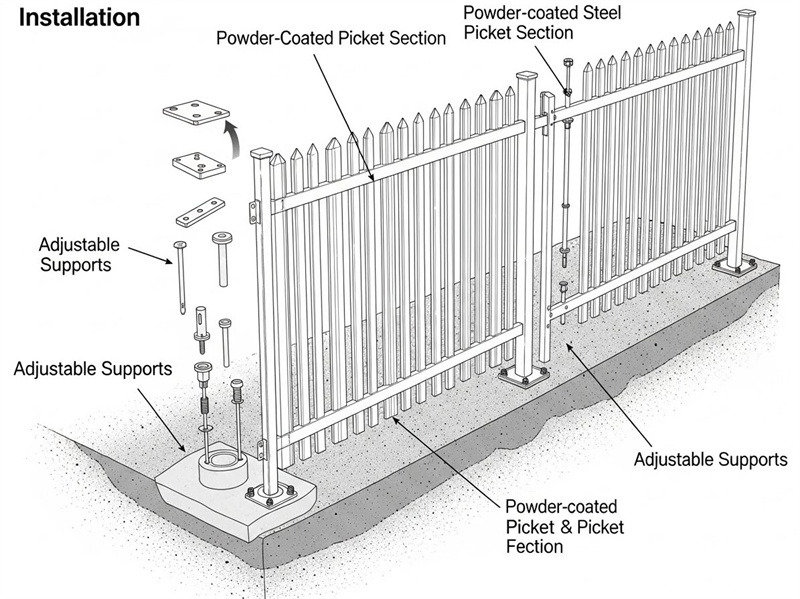
A strong fence needs a strong foundation. The installation process begins with the careful preparation of concrete footings, which are poured to the specific depth and dimensions dictated by the engineering analysis. Once the concrete has cured, the fence posts are positioned and anchored using the pre-engineered base plates and heavy-duty mechanical or chemical anchors. One of ahe most common site challenges is uneven terrain. This is where features like adjustable supports play a critical role. These mechanisms allow installers to precisely level each panel and post, ensuring perfect vertical and horizontal alignment across sloped or undulating ground. Adherence to strict safety measures and installation standards is maintained throughout this process to ensure the crew’s well-being and the structure’s long-term stability.
Final Assembly and Inspection
With the posts securely anchored, the prefabricated panels are lifted into place and attached using the specified connection hardware. Gates, along with their hinges, latches, and any automated operators, are then installed and tested for smooth, reliable operation. A final, comprehensive inspection is conducted across the entire length of the fence. The installation team checks for perfect alignment, confirms the structural integrity of all connections, and inspects the finish for any shipping or installation-related damage that may require touch-ups. Upon successful inspection, a formal handover takes place. The client receives a complete documentation package, including as-built drawings, material specifications, finish warranty details, and a guide for long-term care and maintenance, concluding the process of delivering high-quality, project-specific fence solutions.
Quality Metal Fences That Last
Choose DB Fencing for reliable metal fence solutions made in China since 2009. Benefit from fast sample delivery, strict quality controls, and competitive factory pricing for your next project.
Conclusion: Custom Fence Fabrication Success
The successful execution of a custom steel fence project delivers value far beyond a simple perimeter. It is an investment in security, aesthetics, and brand identity. By embracing a process rooted in collaboration and precision, architects and developers can achieve truly unique outcomes that standard products simply cannot match.
- Custom steel fences deliver unmatched aesthetic and functional benefits tailored to specific project demands.
- Thorough design consultation, expert engineering, precise fabrication, and careful installation ensure outstanding durability and beauty.
- Engage with experienced fabricators early to optimize materials, finishes, and modular components to your project’s unique requirements.
By bringing a clear vision to a capable fabricator, you can transform a functional requirement into a defining architectural statement. The right partnership ensures every detail, from material selection to the final finish, aligns perfectly with your project’s goals. We are ready to help guide you through the process, from initial concept to final production. Contact our expert team today to begin creating a truly bespoke steel fence solution.
Frequently Asked Questions
How do I start ordering a custom steel fence?
The process begins with an initial design consultation with our team. You will provide your project’s aesthetic goals, functional requirements, site plans or photos, and any inspirational images. We will then work with you to gather all necessary details to develop an initial concept and proposal.
What steel grades are best for outdoor fences?
The best steel grade depends on your location and project goals. Carbon steel is a strong and cost-effective option for many environments when properly finished. For projects in coastal areas or with high humidity, galvanized steel offers superior corrosion resistance. Weather-resistant alloys like Corten provide a unique, self-protecting patina for a distinct architectural look.
Can I choose custom powder coat colors?
Absolutely. We offer a vast range of powder coat colors and finishes that can be matched to virtually any color standard, such as RAL color codes. This allows for perfect coordination with your project’s existing architectural elements and branding guidelines. We can also provide samples for approval.
What is the typical timeline for custom fence fabrication?
While timelines can vary significantly based on project complexity and customization, a general estimate for the process can be broken down into key phases. The initial design and engineering stage typically requires 2-4 weeks to finalize all specifications and drawings. Following approval, fabrication and finishing can take an additional 4-8 weeks, with delivery and installation schedules coordinated immediately after. For a precise schedule tailored to your unique requirements, we provide a detailed project-specific timeline after the initial consultation.
How are custom fences installed on uneven terrain?
We specifically engineer fences for uneven terrain. This is managed through a combination of techniques, including creating custom-raked panels that follow the slope of the ground, using stepped panels, and integrating adjustable supports into the design. These features allow our installers to achieve a perfectly aligned and stable fence line, regardless of topography.


