Skip to content
A crush is the one item in a stock yard that decides the geometry of everything around it. Panels can be added and gates moved, but the animal is held inside a box of fixed internal size, fed by a race that matches it, on ground that keeps the frame level. Order a cattle crush ramp, head bail and race as one assumption, and that is where the mismatch shows up on site.
Buyers search this line as a cattle crush, a loading ramp or a cattle crush ramp. Be precise about what the published page covers: it itemises the crush frame, its internal length and its welded accessories, and it does not itemise a ramp, a floor panel or an anchoring detail. The numbers below are what you can hold a quotation to; the gaps are questions to ask before the order.
Key Takeaways
- The published crush is 2.05 m high by 1.06 m long with an internal length of 0.75 m, every tube listed as a 50 × 50 mm rectangular hollow section (RHS — square steel tubing).
- Internal size, not height, is the drafting decision: the page states an internal length of 0.75 m, while the 0.83 m race bow and 0.85 m man gate are passage dimensions for an animal that keeps moving.
- That external 2.05 × 1.06 m is the same footprint as the sliding gate on the same page, which is why they are worth quoting as one working end rather than as separate purchases.
- The accessories are itemised as welded caps, 8 U lugs, flat feet and pins — a frame meant to be located and pinned, not concreted as standard.
The 0.75 m That Sets the Yard
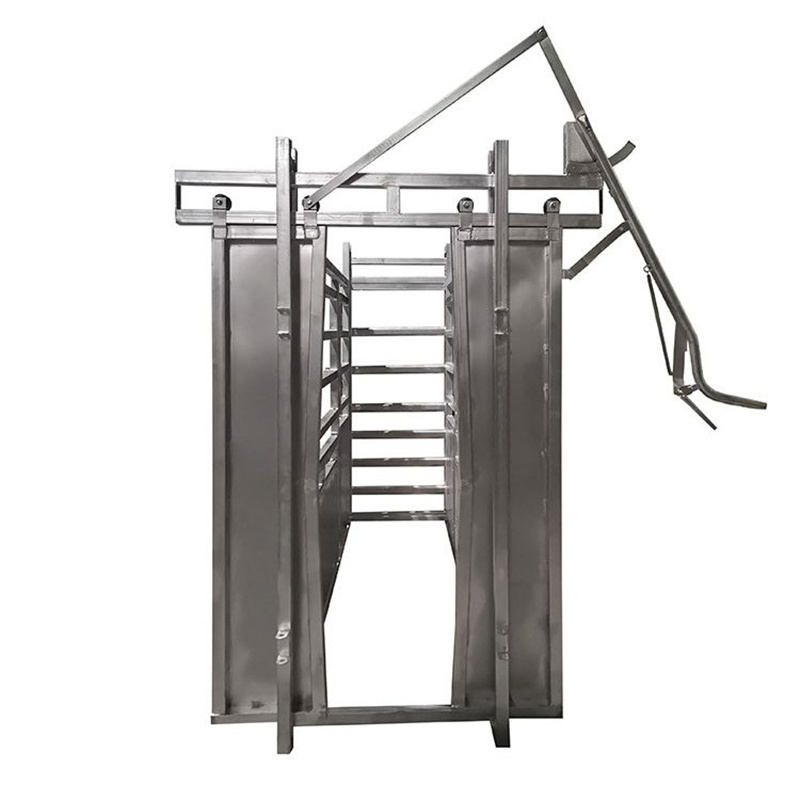
Read the crush specification from the inside out. External height 2.05 m, external length 1.06 m, and an internal length of 0.75 m as the page words it: three numbers that describe a single-animal box, not a holding pen. That internal dimension is where the animal is held during drafting, treatment or loading, and it is why a crush and a yard gate are different products — a yard gate spans an opening, a crush defines one.

The comparison dimensions on the same page make the point. The race bow is listed at 2.3 m × 0.83 m and the man gate at 2.2 m × 0.85 m: both sit near the crush’s 0.75 m internal dimension, and both are passages. An animal moves through a bow and stops inside a crush. Build the race much wider than the crush mouth and the animal can turn and refuse to enter.
Our view, stated plainly: buy the crush first and let its internal dimension dictate the race, rather than buying panels and hoping the working end fits. It is the one item whose tolerance you cannot widen on site with a spare panel.
What the Page Itemises — and What It Does Not
| Item | Stated on the page | Status |
|---|---|---|
| Crush frame size | 2.05 m × 1.06 m; internal length 0.75 m | Itemised |
| Tube section | All tubes RHS 50 × 50 mm | Itemised |
| Side sheeting | Galvanised sheet 1.0 mm thickness | Itemised |
| Accessories | Welded caps, 8 U lugs, flat feet, pins | Itemised |
| Head bail | Listed as used with the crush; no dimensions given | Ask for the pattern |
| Ramp, floor, drainage | Not itemised on the page | Confirm what is supplied |
| Ground fixing method | Flat feet only | Site decision |
Two of those “not itemised” rows matter commercially. A ramp or loading bay is a separate structure with its own geometry, and if your order assumes one, the invoice will not match until you ask. The cattle yard page names the sliding gate, panels and head bail as the crush’s companions; no ramp appears in that sentence.
Integration: Race, Gate, Panel
The working end is one geometry, and the page gives you the matching pairs. The crush is 2.05 × 1.06 m and the sliding gate is listed at the same 2.05 × 1.06 m, so the two present the same face to the yard. The crush carries welded caps, 8 U lugs, flat feet and pins; the sliding gate carries lugs, pins and wheels. Same fixing language, which is the practical argument for ordering them together.
Then count backwards from the crush to the holding area. Yard panels are published at heights of 1.6 m and 1.8 m, with lengths around 2.07 m, 2.09 m and 2.1 m. A race you can walk a mob down is usually two panels long before the bow: at 2.1 m each, two panels give about 4.2 m of single-file run ahead of the crush mouth. Our cattle panel sizing guide works the pen arithmetic; here it is the panel count, not the crush height, that sets how many animals wait out of sight.
Sheep yard panels on the same site are published at 1.0 m high, 2.1 m and 2.8 m long, supplied with 16 mm pins and two sets of double lugs plus two single lugs per panel. If one yard serves cattle and sheep alike, that lug pattern and pin size is the compatibility check: a sheep panel pinned into a cattle crush’s U lugs may behave differently at the joint, so ask how the factory intends it to be made.
Underfoot, Welds and Coating Questions
Flat feet are what the page lists, which puts three site questions on your side of the order. Does the frame sit on level concrete, on compacted gravel, or is it to be anchored? What stops it walking when an animal leans back? How is drainage handled in a yard that washes down? None of that is answered by a tube section, and an installer needs it before the crush arrives.
Then look at where the coatings are, and where they are not. The panel process on this page runs galvanised pipe cutting, welding, polishing the welds, anti-rust paint on the welds, then a silver spray coat — so the weld zone is painted, not zinc, and the coating claim to ask about is the weld, not the tube. The panel section quotes its zinc figure as “more than 15 microns”, while 18-28 microns is the figure carried for the Australian galvanised cattle panel line in our product data. Quote the figure you want per component and get it confirmed, and keep it separate from the hot-dip figure used on outdoor and temporary fence steel.
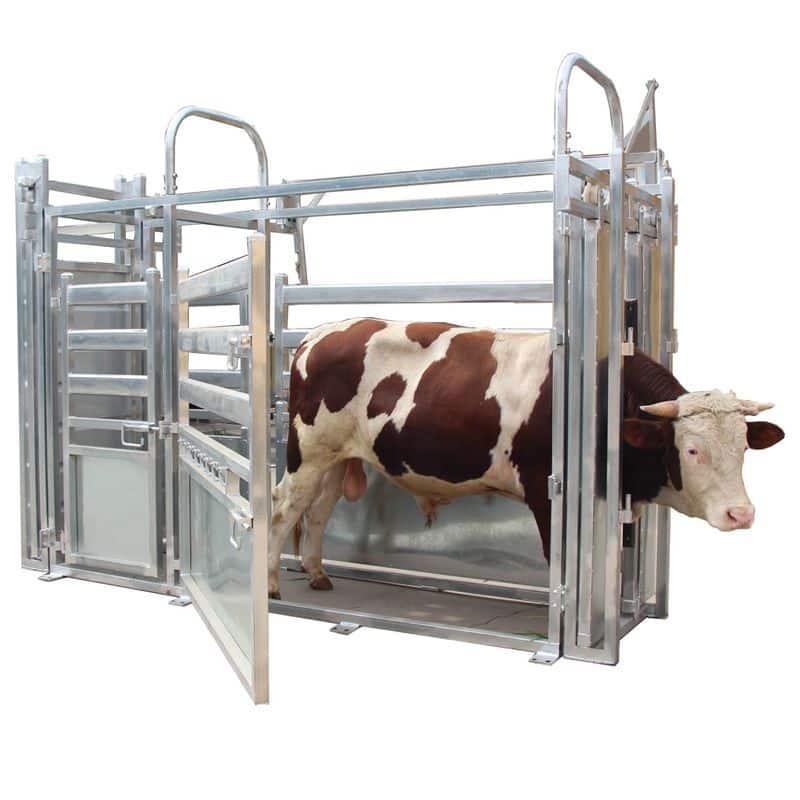
Underfoot is the fourth question the page leaves open: no floor panel is itemised, so ask what sits between the animal’s feet and the ground you build, and whether it comes out for cleaning. Stock items dispatch within 7 days and production runs sit at 20-25 days, with quotations answered inside 24 hours — so these are questions that can be settled before a container is planned.
Frequently Asked Questions
What size cattle crush do I need for a working yard?
Work from the internal length. This page lists 2.05 m × 1.06 m outside with 0.75 m inside, which is a single-animal dimension. Match the race to that internal dimension so an animal cannot turn at the entrance.
Does a cattle crush ramp come with the crush?
The page does not itemise a ramp, a floor or drainage; it names the sliding gate, panels and head bail as what the crush is used with. If your loading or drafting setup needs a ramp, specify it as its own line and confirm what is supplied.
How is a crush fixed to the ground?
The listed accessories are welded caps, 8 U lugs, flat feet and pins — a frame that is located and pinned rather than concreted as standard. Anchoring method is a site decision: confirm the ground condition with your installer before ordering.
What coating should I specify for livestock steel?
Ask for a figure per component, including the weld zones, which this page shows as polished and painted before a silver top coat. Coating minimums depend on the standard applied and the steel thickness, so get the quoted value in writing rather than relying on the word galvanised.
Conclusion
The crush is the fixed point in a stock yard: 0.75 m of internal length that the race, the bow and the gate counts all have to agree with. Order it first, order the sliding gate in the same footprint, and size the panel run backwards from the entrance.
Then close the four gaps the specification leaves: ramp or loading geometry, floor and drainage, anchoring method, and a coating figure quoted per component including the welds. Ask them in the same enquiry that fixes the size — quotations come back within 24 hours, so nothing about the working end has to be guessed.